Introduction
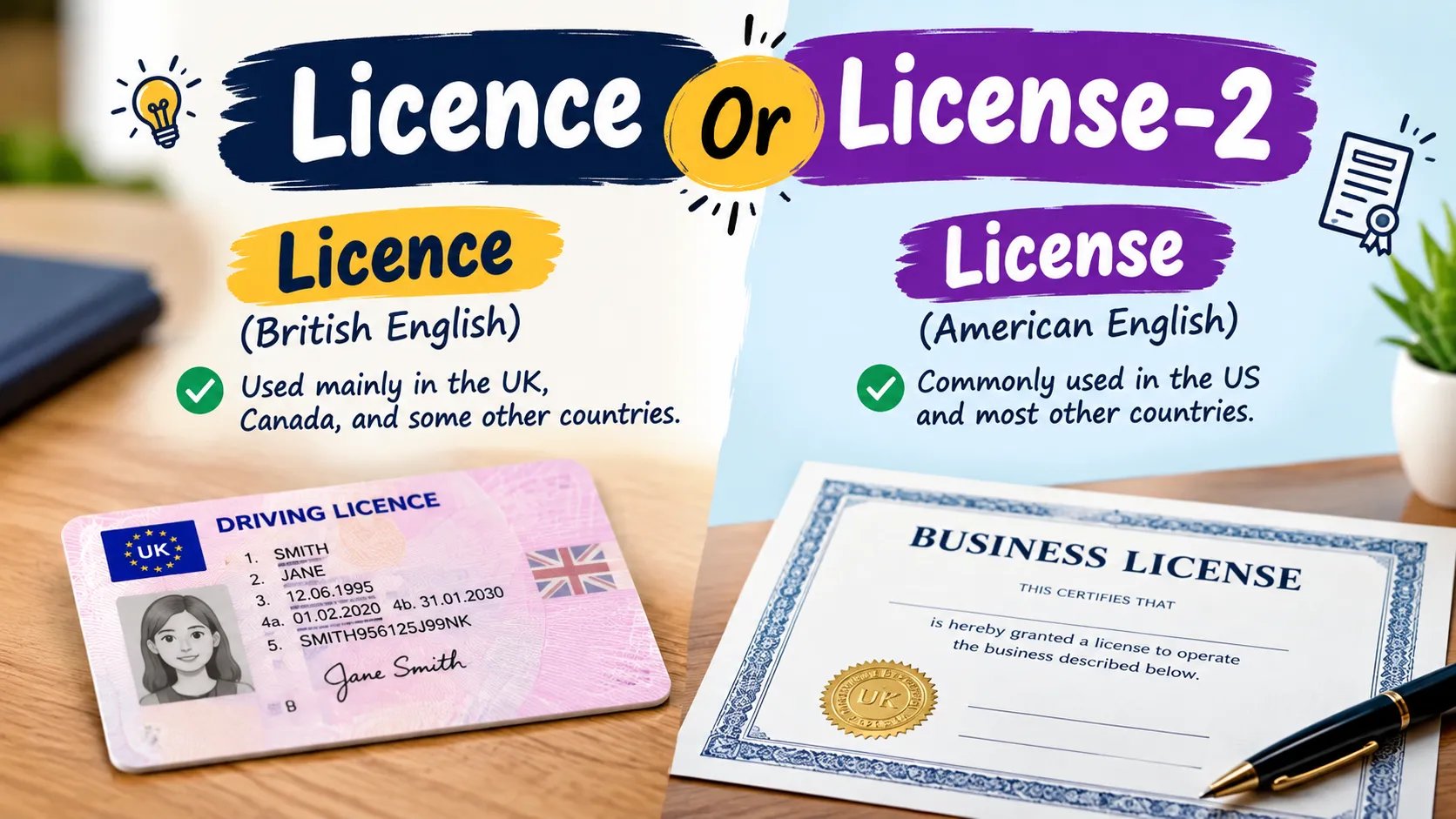
When it comes to the words licence and license, many English learners and writers wonder which spelling is correct. The answer depends mainly on the variety of English you are using. In British English, “licence” is generally used as the noun, while “license” is used as the verb. In American English, “license” is commonly used for both the noun and the verb.
Understanding this difference can help you avoid spelling mistakes in emails, academic writing, websites, and everyday communication. In this guide, we will explain licence vs. license, their meanings, pronunciation, grammatical roles, examples, and the difference between British and American English, so you can confidently choose the right form for your sentence.
Licence or License: Which Spelling Is Correct?
Licence and license are both legitimate English spellings, but their distribution differs by region and grammatical use.
In traditional British English usage:
- licence → noun
- license → verb
In American English:
- license → noun
- license → verb
Oxford lists licence as the British noun and gives license as the North American noun. Its verb entry gives license as the standard form while noting that licence is also found in British English, less frequently.
Quick examples
British English
She has a driving licence.
The council will license the restaurant.
American English
She has a driver’s license.
The city will license the restaurant.
The shortest answer
If you are writing British English, the safest traditional distinction is:
licence = noun
license = verb
If you are writing American English, use:
license = noun and verb
What Is the Difference Between Licence and License?
The core difference is spelling convention, not meaning.
Both words relate to official permission or authorization. A licence/license can refer to a document or permission allowing someone to do, own, use, or operate something.
For example:
You need a driving licence.
The company needs a software licence.
The spelling changes according to the English variety.
Licence as a noun
In British English, licence is a noun meaning official permission or the document that demonstrates that permission.
Examples include:
- driving licence
- fishing licence
- business licence
- television licence
- software licence
- marriage licence
Oxford defines licence as an official document showing that permission has been given to do, own, or use something.
License as a verb
License means to give someone official permission.
The government will license the operator.
The authority licensed the company.
The business is licensed to operate.
Cambridge defines license as giving someone official permission to do or have something.
Licence vs License in British English
British English is where this spelling question becomes particularly interesting.
The traditional distinction is:
| Word | Function | Example |
| licence | Noun | I renewed my driving licence. |
| license | Verb | The authority will license the business. |
| licensed | Verb/adjective | The restaurant is licensed. |
| licensing | Noun/verb form | The licensing process has started. |
This is the pattern most learners are taught because it provides a useful visual distinction between the noun and verb.
However, it is worth knowing that British English is not completely uniform. Cambridge lists licence as a UK noun and also records licence as a UK spelling of the verb license. Oxford likewise notes licence as a less frequent British verb form.
What should learners do?
For clear and consistent British English writing, this convention is easy to follow:
Noun: licence
Verb: license
For example:
I have a valid driving licence.
The government will license the company.
This distinction is especially useful in schoolwork, professional writing, editing, and English-language learning.
License vs Licence in American English
American English normally uses license for both the noun and the verb.
For example:
I need to renew my driver’s license.
Here, license is a noun.
But:
The state will license the business.
Here, license is a verb.
American dictionaries therefore do not normally require the British noun spelling licence. Cambridge’s American English entry defines license as both a noun and a verb, while Oxford identifies license as the North American noun.
Common American examples
- driver’s license
- business license
- fishing license
- professional license
- software license
- marriage license
So if your audience is primarily in the United States, license is normally the spelling to use for both grammatical functions.
Licence or License: Noun vs Verb
The noun-versus-verb distinction is the most important grammar point to remember.
Licence as a noun
A noun names a thing, document, permission, or concept.
Examples:
I have a driving licence.
Her licence expires next month.
He applied for a fishing licence.
The company purchased a software licence.
License as a verb
A verb expresses an action.
Examples:
The authority will license the company.
The government licenses taxi operators.
The agency licensed the business last year.
A useful British English memory trick
Think:
licenCe = CertifiCate
The C can remind you that licence is the noun in the traditional British spelling distinction.
Then:
license = verb
This is a memory aid rather than a universal English grammar rule, but it works well for this particular spelling difference.
Important note
Do not apply the C/S rule to every English word. English contains many spelling patterns that do not follow such a simple rule.
Driving Licence or Driving License?
Both expressions can be correct, depending on the variety of English.
British English
The traditional British expression is:
driving licence
Example:
I need to renew my driving licence.
American English
American English normally uses:
driver’s license
Example:
I need to renew my driver’s license.
Cambridge specifically gives driving licence as the UK form and driver’s license as the US equivalent.
Comparison
| British English | American English |
| driving licence | driver’s license |
| fishing licence | fishing license |
| business licence | business license |
| software licence | software license |
| marriage licence | marriage license |
The important thing is consistency. If the rest of your article follows British English, use the British convention throughout. If it follows American English, use American spelling.
Licensed or Licenced: Which Spelling Is Correct?
This is slightly more complicated than the simple licence/license rule.
Licensed is the standard and very widely used spelling in both British and American English.
Examples:
The restaurant is licensed.
She is a licensed professional.
The company is licensed to use the technology.
Oxford lists the verb forms as licensed and licensing.
However, British English can also show the spelling licenced. Cambridge records licenced as a UK spelling variant of licensed.
What should you use?
For most modern international, educational, and professional writing, licensed is the clearest choice.
So:
The company is licensed to operate.
is an excellent general-purpose form.
Related forms
| Form | Common spelling |
| Noun, British | licence |
| Noun, American | license |
| Verb | license |
| Past form | licensed |
| -ing form | licensing |
| Person receiving permission | licensee |
| Person granting permission | licensor |
Licensing or Licencing: Which Spelling Is Correct?
The form licensing is widely used and is the spelling you will commonly encounter in modern English.
Examples:
software licensing
licensing agreement
licensing requirements
technology licensing
product licensing
Oxford gives licensing as the -ing form of license.
There is, however, another important British-English detail: licencing is also recorded as a UK spelling variant by Cambridge.
Therefore, it would be too strong to say that licencing is always wrong.
For consistency
If you are using the common license → licensing spelling pattern, use:
The company is reviewing its licensing agreement.
If you follow a house style that uses British licence/licencing, maintain that style consistently.
Licensee vs Licensor
Licensee and licensor are related legal and business terms, but they describe different parties.
What is a licensee?
A licensee is a person or organization that receives permission under a licence or license.
Example:
The licensee must comply with the terms of the agreement.
What is a licensor?
A licensor is the person or organization that grants permission.
Example:
The software company is the licensor.
Easy way to remember
| Term | Meaning |
| Licensee | Receives the permission |
| Licensor | Grants the permission |
These words appear frequently in:
- software agreements
- intellectual property
- franchising
- commercial contracts
- technology licensing
- publishing
- brand agreements
Example
Imagine Company A owns a software product and allows Company B to use it.
- Company A = licensor
- Company B = licensee
The permission itself may be described in a licence or license agreement, depending on the spelling convention being used.
Licence and License Examples in Sentences
Examples are one of the easiest ways to understand the distinction.
British English examples
Noun:
She has a valid driving licence.
Noun:
You need a fishing licence.
Noun:
The company purchased a software licence.
Verb:
The government will license the operator.
Verb:
The council licensed the restaurant.
Adjective:
The restaurant is fully licensed.
American English examples
Noun:
She has a valid driver’s license.
Noun:
You need a fishing license.
Noun:
The company purchased a software license.
Verb:
The government will license the operator.
Verb:
The state licensed the business.
Business English
The company obtained a software license.
The technology is licensed for commercial use.
The parties signed a licensing agreement.
Academic English
Researchers must obtain the appropriate license before using the database.
The university has a software licence for its students.
Everyday English
Do you have a driving licence?
Where can I renew my driver’s license?
The correct spelling depends on the English variety being followed.
Licence or License in Canada, Australia, India and Other Countries
English is a global language, so spelling conventions are not limited to only Britain and the United States.
Different countries and organizations may follow different style traditions. Even within a country, official terminology can sometimes be determined by a government department, institution, publication, or style guide.
Canada
Canadian English can show variation. Oxford’s American English dictionary specifically notes licence as a Canadian English form alongside license.
Therefore, Canadian usage should not simply be treated as identical to either American or British English in every context.
Australia and other varieties
Many Commonwealth varieties of English have historically followed British spelling conventions, but individual national usage can vary.
India
Formal English in India frequently uses British-influenced spelling conventions, but the most appropriate choice depends on the institution, publication, examination, or style guide.
The safest rule
When writing for a particular country:
- Check the local style guide if one exists.
- Follow the spelling used by the relevant official authority.
- Keep your spelling consistent throughout the document.
- Do not assume that every English-speaking country follows exactly the same rules.
This is particularly important in legal, governmental, academic, and professional writing.
How to Remember Licence vs License
The easiest memory trick applies to traditional British English usage.
Memory trick: C = noun
Think:
licenCe = CertifiCate
A licence can be a document or official permission.
I have a driving licence.
S = verb
Think:
license = give permission
The authority will license the business.
Another useful comparison
English has other spelling distinctions involving noun and verb forms, such as:
- advice → advise
- practice → practise in traditional British usage
- licence → license in the traditional British distinction
However, these patterns are not identical in every English variety.
One-line memory rule
British English: licence = noun, license = verb.
American English: license = noun and verb.
That is the rule most learners need to remember.
Common Mistakes With Licence and License
Mistake 1: Mixing British and American spelling
A document may become inconsistent if it uses:
driving licence
in one section and:
driver’s license
in another section without a reason.
Choose the English variety that suits your audience and remain consistent.
Mistake 2: Assuming “license” is always American
It is not.
License is also used in British English as a verb.
The authority will license the company.
Mistake 3: Assuming “licence” is always wrong
It is not.
Licence is the traditional British noun spelling and is also recorded as a British verb variant by major dictionaries.
Mistake 4: Treating “licenced” as universally incorrect
British English can use licenced as a variant, although licensed is the widely recognizable standard form. Cambridge records licenced as an alternative UK spelling.
Mistake 5: Treating “licencing” as impossible
Cambridge also records licencing as a UK spelling variant of licensing.
Mistake 6: Choosing spelling without considering the audience
Before writing, ask:
Am I using British English or American English?
That single question will solve most licence/license problems.
Related To Another Article: https://grammixo.com/fulfil-or-fulfill/
Licence vs License: Quick Comparison Table
Here is a quick reference you can save for future writing.
| Feature | British English | American English |
| Noun | licence | license |
| Verb | license is traditional/common; licence is also recorded as a UK variant | license |
| Past form | licensed | licensed |
| -ing form | licensing; licencing also recorded in UK usage | licensing |
| Driver-related term | driving licence | driver’s license |
| Software term | software licence | software license |
| Fishing term | fishing licence | fishing license |
| Business term | business licence | business license |
| Person receiving permission | licensee | licensee |
| Person granting permission | licensor | licensor |
The most important distinction is the noun spelling: licence in traditional British English versus license in American English. Oxford and Cambridge both support this regional distinction while also documenting British variation in some verb forms.
Quick revision box
UK traditional pattern
licence = noun
license = verb
US pattern
license = noun
license = verb
Related forms
licensed
licensing
licensee
licensor
People Also Ask
Both are correct. In traditional British English, licence is the noun and license is the verb. American English uses license for both. British dictionaries also record some variation in verb spelling.
Licence is traditionally the British spelling of the noun. American English normally uses license.
License is used in both British and American English. In British English, it is commonly used as the verb; in American English, it can be both a noun and a verb.
Use driving licence in British English. American English normally uses driver’s license.
It can be both, depending on the English variety. In American English, license is both a noun and a verb. In British English, license is commonly used as a verb, while licence is the traditional noun spelling.
Final Answer: Licence or License?
The simplest rule is:
British English
licence = noun
license = verb
I have a driving licence.
The authority will license the company.
American English
license = noun
license = verb
I have a driver’s license.
The authority will license the company.
There is some variation in British English, and major dictionaries record forms such as licence as a verb and licenced/licencing as British variants.
So the best approach is not to memorize that one spelling is universally right and the other is universally wrong. Instead, identify which English variety you are using, understand the grammatical function of the word, and remain consistent.
In one sentence:
Use “licence” for the noun in traditional British English, “license” for the verb, and “license” for both noun and verb in American English.
