Introduction
Knowing whether to use saw or seen can be confusing, Especially because both words come from the same verb: see. The key is understanding their grammatical roles.
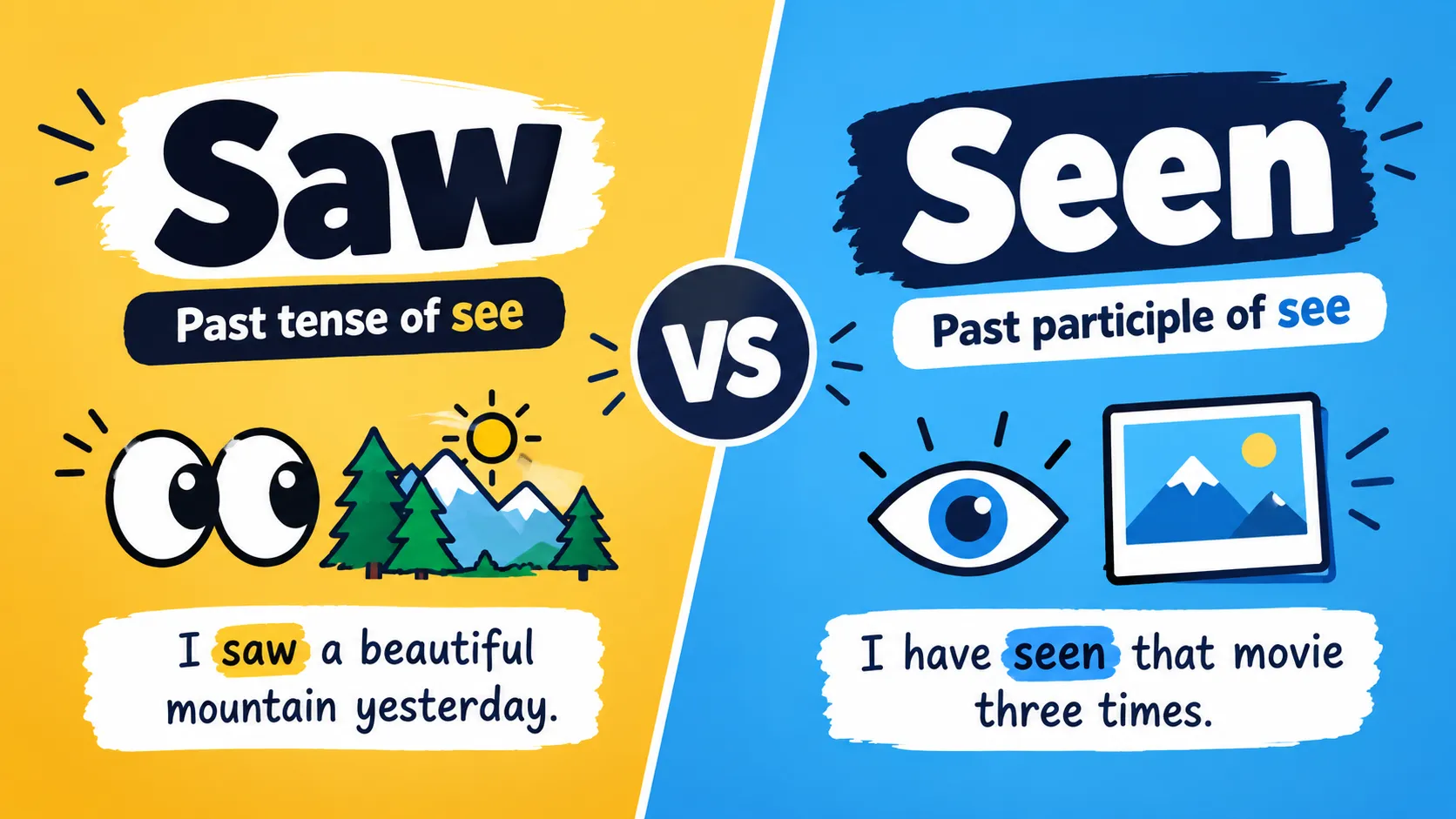
Saw is the simple past form of see, while seen is the past participle. For example, we say “I saw him yesterday” but “I have seen him before.”
This guide explains the difference between saw and seen, shows you when to use each form, covers common mistakes such as “I seen” and “I have saw,” and provides practical exercises to help you use them correctly.
Saw or Seen: Which One Is Correct?
Both saw and seen are correct words, but they are used in different grammatical structures.
The basic verb forms are:
| Verb Form | Word | Example |
| Base form | see | I see my friend every day. |
| Simple past | saw | I saw my friend yesterday. |
| Past participle | seen | I have seen my friend before. |
| -ing form | seeing | I am seeing my friend tomorrow. |
The easiest rule to remember is:
Use “saw” for the simple past. Use “seen” as a past participle, usually with a helping verb such as have, has, had, or be.
Examples:
- I saw him yesterday.
- I have seen him before.
- I seen him yesterday.
- I have saw him before.
See, Saw, and Seen: The Three Forms of See
See is an irregular verb, so its past forms do not follow the regular -ed pattern.
The three principal forms are:
See → Saw → Seen
–See
See is the base form.
I see my teacher every morning.
We can see the mountains from here.
Saw
Saw is the simple past form.
I saw my teacher yesterday.
We saw a beautiful sunset last night.
Seen
Seen is the past participle.
I have seen that movie before.
She had seen the place earlier.
Understanding this three-form pattern makes the rest of the rules much easier.
What Is the Difference Between Saw and Seen?
The main difference between saw and seen is their grammatical function.
Saw is used as the simple past tense:
I saw James at school yesterday.
Seen is a past participle and normally appears as part of a larger verb structure:
I have seen James before.
She had seen the movie already.
He was seen near the station.
Compare these sentences:
| Sentence | Correct? | Reason |
| I saw him yesterday. | ✅ | Simple past |
| I have seen him before. | ✅ | Present perfect |
| I had seen him before. | ✅ | Past perfect |
| He was seen outside. | ✅ | Passive construction |
| I saw him yesterday. | ❌ | Wrong form for simple past |
| I have saw him. | ❌ | Wrong form after have |
So, saw and seen are not interchangeable.
When to Use Saw
Use saw when you are describing an action that Happened in the past using the simple past tense.
Saw for Completed Past Actions
The basic structure is:
Subject + saw + object
Examples:
- I saw John yesterday.
- She saw a bird in the garden.
- We saw the new movie last night.
- They saw an accident on the road.
- He saw his teacher at school.
- I saw your message.
- Maria saw her friend at the mall.
In each example, saw describes a past event.
Saw With Specific Past Time
Saw is commonly used with completed or specific past-time expressions such as:
- yesterday
- last night
- last week
- last month
- two days ago
- an hour ago
- in 2024
- when I was young
Examples:
I saw him yesterday.
We saw that movie last week.
She saw the accident two hours ago.
I saw her in 2024.
A useful clue is that expressions referring to a finished past time often work naturally with the simple past.
Examples of Saw in Everyday English
Here are some natural examples:
- I saw your brother yesterday.
- She saw a strange light outside.
- We saw the match last night.
- They saw an accident on the highway.
- I saw your email this morning.
- He saw his old friend at the station.
- We saw a beautiful sunset.
- She saw the doctor last Monday.
- I saw what happened.
- They saw the problem immediately.
When to Use Seen
Seen is the past participle of see.
Unlike saw, it does not normally function as the simple past form by itself in standard English.
Have or Has + Seen
Use have/has + seen to form the present perfect.
Examples:
- I have seen this movie before.
- You have seen the results.
- We have seen that place many times.
- They have seen the problem.
- She has seen him before.
- He has seen this happen before.
The basic structure is:
Subject + have/has + seen + object
For example:
I have seen that movie.
She has seen the new building.
The present perfect often connects an experience or event with the present.
Had + Seen
Use had + seen to form the past perfect.
Examples:
I had seen the movie before you recommended it.
She had seen him earlier that day.
They had never seen snow before.
The past perfect is useful when one past event happened before another past event.
For example:
I had seen the movie before we discussed it.
First, I saw the movie. Later, we discussed it.
Examples of Seen in Everyday English
- I have seen this before.
- Have you seen my phone?
- She has seen that movie.
- We have seen many changes.
- They had seen the warning.
- He had never seen snow before.
- I have seen him several times.
- She has seen your message.
- We had seen the building before.
- Have you seen what happened?
Saw vs. Seen: Quick Comparison Table
| Feature | Saw | Seen |
| Verb form | Simple past | Past participle |
| Basic pattern | Subject + saw | have/has/had + seen |
| Example | I saw him. | I have seen him. |
| Typical use | Completed past action | Perfect or passive construction |
| Specific past time | Common | Generally not used with finished specific time in the present perfect |
| Can it stand as the simple past verb? | Yes | No, in standard English |
| Example with yesterday | I saw him yesterday. | I have seen him before. |
Remember:
Simple past → saw
Perfect construction → seen
Passive construction → seen
I Saw or I Seen: Which Is Correct?
The correct form in standard English is:
I saw him. ✅
Not:
I seen him. ❌
Why?
Because the sentence is using the simple past tense. The simple past form of see is saw.
Compare:
I saw him yesterday. ✅
I have seen him before. ✅
The first sentence uses the simple past. The second uses the present perfect.
Why “I Seen” Causes Confusion
Learners sometimes hear sentences such as “I seen him” in informal speech or regional varieties of English. However, in standard English used in formal writing, education, exams, and professional communication, use saw for the simple past:
I saw him yesterday.
I Have Saw or I Have Seen: Which Is Correct?
The correct form is:
I have seen him. ✅
Not:
I have saw him. ❌
After have or has in a present perfect construction, use the past participle seen.
Examples:
- I have seen it.
- You have seen it.
- We have seen it.
- They have seen it.
- She has seen it.
- He has seen it.
Incorrect and Correct Examples
| Incorrect | Correct |
| I have saw it. | I have seen it. |
| She has saw him. | She has seen him. |
| We have saw this before. | We have seen this before. |
| They have saw the movie. | They have seen the movie. |
| He has saw the results. | He has seen the results. |

Did You See or Did You Saw: Which Is Correct?
The correct sentence is:
Did you see him? ✅
Not:
Did you saw him? ❌
This is one of the most common mistakes with see.
When did is used to form a simple past question, the main verb returns to its base form.
The pattern is:
Did + subject + base verb
Therefore:
Did + you + see?
Not:
Did + you + saw?
Examples:
- Did you see John?
- Did she see the accident?
- Did they see the movie?
- Did he see my message?
- When did you see her?
- Why did they see him?
Compare:
I saw him yesterday. ✅
Did you see him yesterday? ✅
The word did already carries the past-tense marking, so the main verb remains see.
Saw vs. Seen in Questions
Questions become easier when you identify the helping verb.
Questions With Did
Use:
Did + subject + see
Examples:
Did you see Sarah?
Did she see the accident?
When did they see him?
Not:
Did you saw Sarah? ❌
Questions With Have or Has
Use:
Have/Has + subject + seen
Examples:
Have you seen John?
Has she seen the movie?
Have they seen this place before?
Questions With Had
Use:
Had + subject + seen
Example:
Had you seen him before the meeting?
Other examples:
Had she seen the message before you called?
Had they seen the building before?
Can You Use Seen Without Have?
Yes.
A common shortcut is to say “seen always needs have,” but that is not completely Accurate.
Seen is a past participle. It can appear in passive constructions with forms of be.
Examples:
He was seen near the station.
She was seen leaving the building.
They were seen entering the store.
The car was seen on the highway.
Here, seen is used as part of a passive construction.
So the more accurate rule is:
Seen is a past participle. It commonly appears after forms of have in perfect constructions and forms of be in passive constructions.
Was Seen or Was Saw: Which Is Correct?
The correct sentence is:
He was seen at the station. ✅
Not:
He was saw at the station. ❌
Why?
Because passive constructions use a form of be + past participle.
The past participle of see is seen.
Therefore:
was + seen
Examples:
- She was seen leaving the house.
- He was seen near the park.
- They were seen entering the building.
- The man was seen on camera.
- The children were seen playing outside.
Saw or Seen After Modal Verbs
After modal verbs such as can, could, will, would, should, may, might, and must, use the base form of the verb.
Examples:
- I can see you.
- She could see the mountain.
- We will see them tomorrow.
- You should see this movie.
- They might see him later.
- He may see her tomorrow.
Incorrect:
I can saw him. ❌
Correct:
I can see him. ✅
The general pattern is:
Modal + base verb
Therefore:
can + see
not:
can + saw
and not:
can + seen
Saw vs. Seen With Specific Time Expressions
Specific past-time expressions can help you decide which form to use.
Saw
Use saw when talking about a completed event at a finished past time.
Examples:
I saw him yesterday.
She saw the movie last Friday.
We saw them two hours ago.
Seen
The present perfect have/has seen is generally used without a finished specific past-time expression such as yesterday.
For example:
I have seen that movie before. ✅
But:
I have seen that movie yesterday. ❌
Instead, use:
I saw that movie yesterday. ✅
This distinction is especially important for grammar tests and formal writing.
Saw vs. Seen in Present Perfect and Past Perfect
Present Perfect: Have/Has + Seen
Use the present perfect when the experience or event has a connection to the present.
Examples:
I have seen this movie before.
She has seen the results.
We have seen this problem before.
Past Perfect: Had + Seen
Use the past perfect when one past event occurred before another past event.
Examples:
I had seen the movie before you recommended it.
She had seen the warning before the accident happened.
They had seen the building before they bought the property.
Simple Past: Saw
Use the simple past for a completed past event.
I saw the movie yesterday.
The three structures can be compared like this:
| Tense | Structure | Example |
| Simple past | saw | I saw him yesterday. |
| Present perfect | have/has + seen | I have seen him before. |
| Past perfect | had + seen | I had seen him before the meeting. |
Common Mistakes With Saw and Seen
Understanding common errors is one of the fastest ways to improve.
I Seen Him Yesterday
❌ I seen him yesterday.
✅ I saw him yesterday.
The sentence uses the simple past, so saw is required.
I Have Saw Him
❌ I have saw him.
✅ I have seen him.
After have, use the past participle seen.
Did You See Him?
❌ Did you saw him?
✅ Did you see him?
After did, use the base form see.
He Was Saw There
❌ He was saw there.
✅ He was seen there.
The passive structure requires be + past participle.
They Had Saw It
❌ They had saw it.
✅ They had seen it.
After had, use the past participle seen.
Saw or Seen in Everyday, Academic, and Business English
The distinction between saw and seen applies across different types of English.
Everyday English
I saw your message.
Have you seen my keys?
Did you see that?
Academic English
The researchers saw a significant change in the results.
Previous studies have seen similar patterns.
The exact tense depends on the intended meaning and sentence structure.
Business English
I saw your email this morning.
I have seen the latest report.
Have you seen the revised document?
Using the correct verb form makes professional communication clearer and more precise.
See, Saw, Seen: Complete Grammar Table
| Structure | Correct Form | Example |
| Present | see | I see him every day. |
| Simple past | saw | I saw him yesterday. |
| Present perfect | have/has + seen | I have seen him before. |
| Past perfect | had + seen | I had seen him before. |
| Future perfect | will have + seen | I will have seen it by then. |
| Passive | be + seen | He was seen outside. |
| Infinitive | to see | I want to see him. |
| Modal | modal + see | I can see him. |
| -ing form | seeing | I remember seeing him. |
How to Choose Between See, Saw, and Seen
When you are unsure which form to use, follow these steps.
Step 1: Is the sentence in the simple past?
Use saw.
I saw him yesterday.
Step 2: Is there have, has, or had?
Use seen.
I have seen him.
She has seen him.
They had seen him.
Step 3: Is there a passive structure?
Use seen.
He was seen outside.
Step 4: Is there did?
Use see.
Did you see him?
Step 5: Is there a modal verb?
Use see.
I can see him.
Quick Memory Rule
See = base form
Saw = simple past
Seen = past participle
Did + see
Have/Has/Had + seen
Be + seen
Saw or Seen: Practice Exercises
Test yourself before checking the answers.
Fill in the Blanks
Choose see, saw, or seen.
- I ___ him yesterday.
- Have you ___ this movie?
- Did you ___ Sarah?
- She has ___ that place before.
- We ___ a rainbow last night.
- He had ___ the warning before the accident.
- They were ___ entering the building.
- I can ___ the mountains.
- Did you ___ my message?
- I have never ___ snow.
- She ___ her teacher last Monday.
- Have they ___ this problem before?
- We had ___ the building earlier.
- I will ___ you tomorrow.
- He was ___ near the station.
Multiple-Choice Questions
1. Which sentence is correct?
A. I seen him yesterday.
B. I saw him yesterday.
C. I have saw him yesterday.
D. I seeing him yesterday.
Answer: B
2. Which sentence uses the past participle correctly?
A. I have saw the movie.
B. I have see the movie.
C. I have seen the movie.
D. I have seeing the movie.
Answer: C
3. Which question is correct?
A. Did you saw him?
B. Did you seen him?
C. Did you see him?
D. Did you seeing him?
Answer: C
4. Which sentence is correct?
A. He was saw leaving.
B. She was seen leaving.
C. He was see leaving.
D. She was seeing leaving.
Answer: B
5. Which sentence uses the past perfect correctly?
A. She had saw him.
B. She had see him.
C. She had seen him.
D. She had seeing him.
Answer: C
Sentence Correction
Correct the following sentences.
- I saw him yesterday.
- She has seen the movie.
- Did you see my brother?
- He was seen near the station.
- They had seen the accident.
- I saw it yesterday.
- We can see the mountains.
- Have you seen my keys?
Correct Answers
- I saw him yesterday.
- She has seen the movie.
- Did you see my brother?
- He was seen near the station.
- They had seen the accident.
- I saw it yesterday.
- We can see the mountains.
- Have you seen my keys?
Error Detection
Identify the incorrect word in each sentence.
- I have seen that movie before.
- Did she see the accident?
- He was seen leaving the building.
- We saw them yesterday.
- She had seen the message earlier.
- I saw him last night.
Answers:
- saw → seen
- saw → see
- Correct
- Correct
- Correct
- seen → saw

Related To Another Article: https://grammixo.com/licence-or-license-2/
Practice Answers and Explanations
1. I saw him yesterday.
Saw is correct because the sentence describes a completed action at a specific past time.
2. Have you seen this movie?
Seen follows have in the present perfect.
3. Did you see Sarah?
See follows did because the auxiliary already marks the past tense.
4. She has seen that place before.
Seen is the past participle used with has.
5. He was seen near the station.
Seen is used after was in the passive construction.
These patterns are more useful to memorize than isolated sentences.
Saw or Seen: Quick Revision Rules
Remember these five rules:
- Simple past → saw
- I saw him yesterday.
- Have/has + seen
- I have seen him before.
- Had + seen
- I had seen him before.
- Did + see
- Did you see him?
- Be + seen
- He was seen outside.
One-Line Memory Trick
See → Saw → Seen; Did → See; Have/Has/Had → Seen.
People Also Ask
Yes. Saw is the simple past form of see.
I saw him yesterday.
No. Seen is the past participle of see.
I have seen him before.
In standard English, no.
Use:
I saw him.
Or, depending on the meaning:
I have seen him.
No.
The correct form is:
I have seen.
Use I saw for the simple past.
I saw him yesterday.
Use I have seen when using the present perfect.
I have seen him before.
Saw or Seen: Final Answer
The difference between saw and seen becomes simple once you understand their Grammatical roles.
Saw is the simple past form:
I saw him yesterday.
Seen is the past participle:
I have seen him before.
It can also appear in passive structures:
He was seen near the station.
The most useful patterns are:
| Pattern | Example |
| see | I see him. |
| saw | I saw him yesterday. |
| have/has + seen | I have seen him before. |
| had + seen | I had seen him before. |
| did + see | Did you see him? |
| be + seen | He was seen outside. |
| modal + see | I can see him. |
If you remember See → Saw → Seen, along with Did + See and Have/Has/Had + Seen, most common mistakes become easy to avoid.

1 thought on “Saw or Seen: Difference, Rules & Examples”