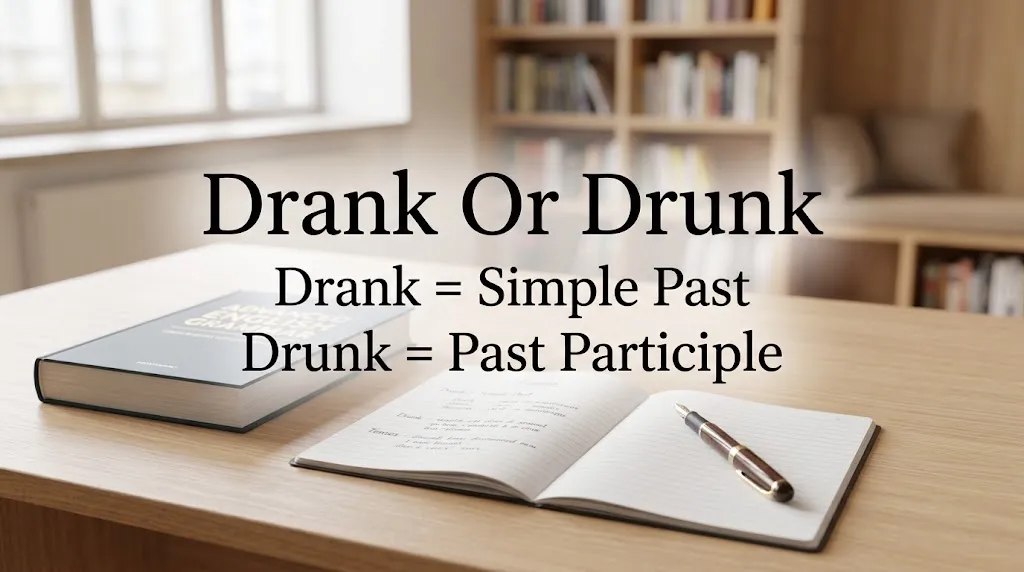
Drank or Drunk: Quick Answer
Drank and drunk are two different forms of the irregular verb drink.
- Drink = base form
- Drank = simple past tense
- Drunk = past participle
Use drank when talking about a Completed action in the simple past:
I drank coffee yesterday.
Use drunk with helping verbs such as have, has, or had:
I have drunk enough water.
However, drunk can also work as an adjective:
He is drunk.
The easiest pattern to remember is:
drink → drank → drunk
What Is the Difference Between Drank and Drunk?
The main difference is grammatical.
Drank is the simple past form of drink. It normally describes an action that happened in the past.
She drank tea this morning.
Drunk is the past participle of drink. It is normally used with an auxiliary verb in perfect constructions.
She has drunk three cups of tea.
So, in standard modern English:
| Word | Grammatical role | Example |
| drink | Base form | I drink water every day. |
| drank | Simple past | I drank water yesterday. |
| drunk | Past participle | I have drunk enough water. |
A common mistake is to use drunk as the simple past:
❌ I drunk coffee yesterday.
The standard form is:
✅ I drank coffee yesterday.
Likewise, after have, has, or had, use drunk:
❌ I have drank coffee.
✅ I have drunk coffee.
Drink, Drank, and Drunk: Complete Verb Forms
Understanding all the forms of drink makes the difference much easier to remember.
| Verb form | Word | Example |
| Base form | drink | I drink water every morning. |
| Third-person singular | drinks | She drinks tea every evening. |
| Present participle | drinking | They are drinking juice. |
| Simple past | drank | We drank water after the game. |
| Past participle | drunk | We have drunk plenty of water. |
Unlike regular verbs such as walk → walked, drink is an irregular verb. Its past forms do not follow the regular -ed pattern.
That is why we say:
drink → drank → drunk
not:
drink → drinked → drinked
Examples of the three main forms
Drink
I drink milk every morning.
Drank
I drank milk before school.
Drunk
I have drunk all the milk.
Once you understand this three-form pattern, most questions about drank or drunk become much easier.
When Should You Use Drank?
Use drank when drink is used in the simple past tense.
The simple past generally describes an action that happened or was completed in the past.
Examples
- I drank coffee before work.
- She drank a glass of water.
- We drank tea after dinner.
- They drank lemonade at the party.
- He drank the entire bottle.
- Sarah drank juice with breakfast.
- My brother drank milk before bed.
- The children drank water after playing outside.
- I drank two cups of tea yesterday.
- We drank hot chocolate last night.
Drank with past-time expressions
Drank commonly appears with expressions that clearly place the action in the past.
I drank tea yesterday.
She drank coffee last night.
We drank water two hours ago.
He drank juice after lunch.
They drank milk before they went to school.
The important point is not simply the presence of a time expression. The sentence must use the simple past structure.
A simple pattern
Subject + drank + object
I drank water.
She drank coffee.
They drank juice.
This is the basic structure to remember when you are describing a completed drinking action in the simple past.
When Should You Use Drunk?
Drunk is the past participle of drink.
It is commonly used with auxiliary verbs such as have, has, and had.
Present perfect
Use:
have/has + drunk
Examples:
I have drunk enough water.
She has drunk her coffee.
They have drunk all the juice.
Past perfect
Use:
had + drunk
Examples:
I had drunk the water before the meeting started.
She had already drunk her coffee.
They had drunk everything before we arrived.
Future perfect
You can also use drunk in the future perfect:
will have + drunk
By noon, I will have drunk several glasses of water.
By the end of the trip, we will have drunk plenty of local tea.
The key idea is that drunk is a past participle, so it does not normally replace drank in a simple-past sentence.
Compare:
✅ I drank the juice yesterday.
❌ I drunk the juice yesterday.
But:
✅ I have drunk the juice.
Is “I Have Drank” or “I Have Drunk” Correct?
In standard Modern English, “I have drunk” is the correct form.
❌ I have drank three glasses of water.
✅ I have drunk three glasses of water.
The reason is simple: have + past participle is the structure used in the present perfect.
The past participle of drink is drunk.
More examples
I have drunk enough water today.
She has drunk her coffee.
We have drunk all the juice.
They have drunk from the same bottle.
The same rule applies to has:
❌ He has drank the milk.
✅ He has drunk the milk.
And to had:
❌ She had drank the coffee before breakfast.
✅ She had drunk the coffee before breakfast.
Quick rule
have + drunk
has + drunk
had + drunk
Not:
have + drank
has + drank
had + drank
Drank vs. Drunk in Questions
Questions are another place where learners often choose the wrong form.
The correct form depends on the helping verb.
Did + drink
After did, use the base form drink, not drank.
✅ Did you drink the water?
❌ Did you drank the water?
Why?
Because did already carries the past tense.
The structure is:
Did + subject + base verb?
Examples:
Did you drink coffee?
And did she drink the milk?
Did they drink anything?
And did he drink the juice?
Have/Has + drunk
With the present perfect, use drunk:
Have you drunk enough water?
Has she drunk her coffee?
Have they drunk all the juice?
Had + drunk
With the past perfect:
Had you drunk anything before dinner?
And had she drunk the medicine?
Had they drunk the water before leaving?
Will + drink
After will, use the base form:
Will you drink some water?
And will she drink coffee?
Will they drink tea?
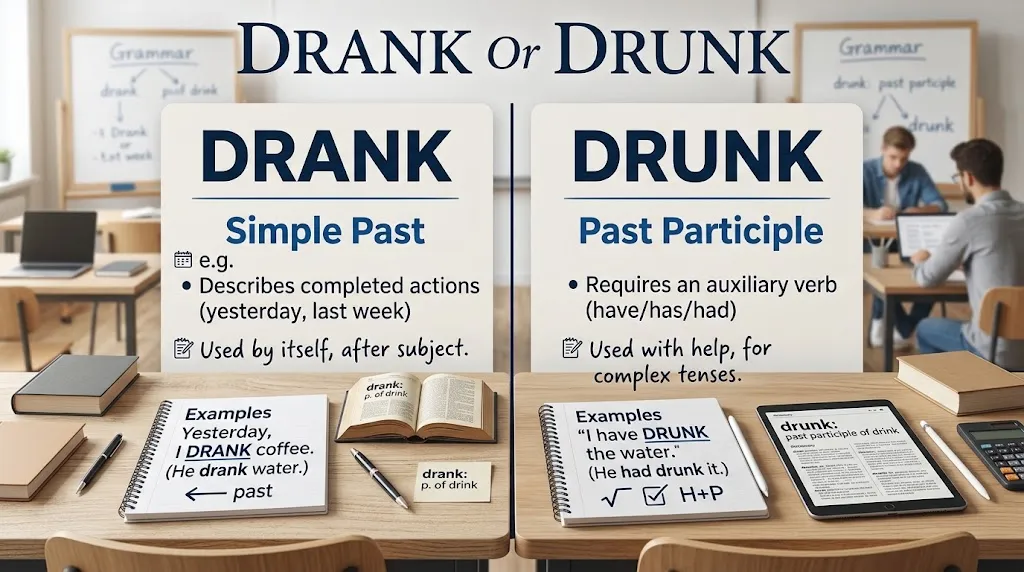
So remember:
did → drink
have/has/had → drunk
will → drink
Drank vs. Drunk in Negative Sentences
Negative sentences follow the same grammatical patterns.
Did not + drink
When using did not or didn’t, use drink.
I did not drink coffee.
She didn’t drink the milk.
They didn’t drink any water.
He did not drink the juice.
Not:
❌ I didn’t drink coffee.
Have not/has not + drunk
With the present perfect:
I have not drunk coffee today.
She has not drunk her tea.
They have not drunk enough water.
Had not + drunk
With the past perfect:
I had not drunk anything before lunch.
She had not drunk the juice before it spilled.
The helping verb determines which form follows it.
Can Drunk Be an Adjective?
Yes. Drunk can also be an adjective.
As an adjective, drunk describes a person who is Intoxicated because of alcohol.
He is drunk.
The man looked drunk.
She appeared drunk after the party.
This use is different from the past participle in a sentence such as:
She has drunk the water.
Compare the two:
She has drunk the water.
Here, drunk is the past participle of drink.
She is drunk.
Here, drunk is an adjective describing her condition.
This distinction is important because drunk does not always need to follow have, has, or had.
Another example
He has drunk two glasses of wine.
Here, drunk tells us about an action.
He is drunk.
Here, drunk describes his condition.
The spelling is the same, but the grammatical role is different.
Drunk vs. Drunken: What Is the Difference?
This can both function as adjectives, but they are not used in the same way.
Drunk commonly describes someone’s current condition:
He was drunk.
The driver appeared drunk.
Drunken is generally used before a noun to describe something associated with intoxication:
A drunken man entered the room.
The police stopped the drunken driver.
They were disturbed by a drunken argument.
A useful comparison is:
| Word | Common use | Example |
| drunk | Condition/adjective | He is drunk. |
| drunken | Descriptive adjective before a noun | A drunken driver was stopped. |
| drunk | Past participle | She has drunk the juice. |
There is some overlap in adjective usage, but drunken is particularly common in expressions where it directly modifies a noun.
Also remember that drunken is not the past participle of drink.
The verb forms remain:
drink → drank → drunk
Is “Drinked” a Correct Word?
For standard modern English, drinked is not the normal past tense or past participle of drink.
The correct forms are:
drink → drank → drunk
So:
❌ I drinked water yesterday.
✅ I drank water yesterday.
And:
❌ I have drinked the milk.
✅ I have drunk the milk.
This happens because drink is an irregular verb. Irregular verbs do not necessarily form their past tense by simply adding -ed.
Compare:
Regular verb:
walk → walked
Irregular verb:
drink → drank → drunk
Other examples of irregular verbs include:
go → went → gone
see → saw → seen
write → wrote → written
Learning drink as a three-part pattern is therefore more useful than trying to apply the regular -ed rule.
Common Drank and Drunk Mistakes
Here are some of the most common errors learners make.
| Incorrect | Correct |
| I drunk coffee yesterday. | I drank coffee yesterday. |
| I have drank the water. | I have drunk the water. |
| She drunk tea last night. | She drank tea last night. |
| Did you drink the juice? | Did you drink the juice? |
| He has drank enough water. | He has drunk enough water. |
| They had drank everything. | They had drunk everything. |
| I drinked milk yesterday. | I drank milk yesterday. |
| Did she drink coffee? | Did she drink coffee? |
| We have drank all the juice. | We have drunk all the juice. |
| He drinked too much water. | He drank too much water. |
Mistake 1: Using drunk as simple past
❌ I drunk tea yesterday.
Use:
✅ I drank tea yesterday.
Mistake 2: Using drank after have
❌ I have drank tea.
Use:
✅ I have drunk tea.
Mistake 3: Using drank after did
❌ Did you drank coffee?
Use:
✅ Did you drink coffee?
Mistake 4: Creating “drinked”
❌ She drinked water.
Use:
✅ She drank water.
These four patterns account for many common mistakes involving drink.
Drank or Drunk: Everyday Examples
Seeing the words in realistic sentences can make the distinction easier to remember.
At home
I drank a glass of water after waking up.
My sister has drunk all the milk.
We drank tea after dinner.
At school
I drank some water during the break.
The students had drunk their juice before class started.
At work
I drank coffee before the meeting.
She has drunk two cups of coffee this morning.
In conversation
“Did you drink anything?”
“Yes, I drank some juice.”
“Have you drunk enough water?”
“Yes, I have.”
With past events
We drank tea at the café yesterday.
They drank coffee after the meeting.
With perfect tenses
I have drunk enough water.
She had drunk her coffee before leaving.
The important thing is to look at the verb structure, rather than memorizing individual sentences.
How to Remember Drank vs. Drunk
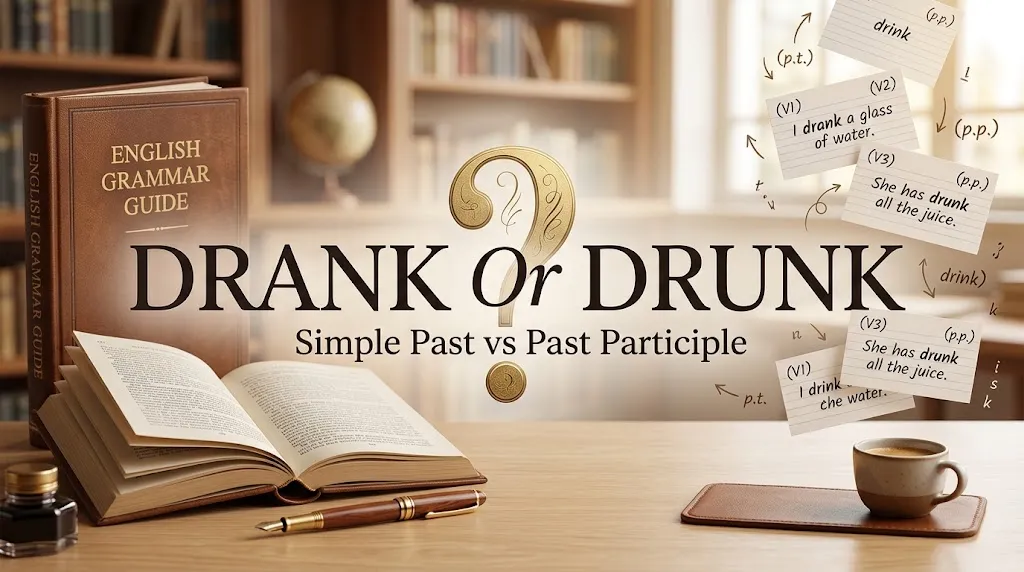
The simplest memory trick is:
Drink → Drank → Drunk
Think of these as three different stages of the same irregular verb.
Remember “drank” for the simple past
Yesterday, I drank water.
Remember “drunk” after have, has, or had
I have drunk water.
She has drunk water.
They had drunk water.
Remember “drink” after did
Did you drink water?
Four quick patterns
Simple past:
I drank.
Present perfect:
I have drunk.
Past perfect:
I had drunk.
Question with did:
Did you drink?
If you remember these four patterns, you can solve most drank or drunk questions correctly.
Related To Another Article: https://grammixo.com/behavior-or-behaviour/
Drank or Drunk Practice Quiz
Choose the correct word in each sentence.
1. I ___ coffee yesterday.
A. drink
B. drank
C. drunk
2. She has ___ all the milk.
A. drank
B. drink
C. drunk
3. Did you ___ enough water?
A. drank
B. drink
C. drunk
4. We ___ tea last night.
A. drunk
B. drink
C. drank
5. They had ___ the juice before we arrived.
A. drunk
B. drank
C. drink
6. He ___ coffee every morning.
A. drinks
B. drank
C. drunk
7. I have ___ three glasses of water.
A. drank
B. drunk
C. drink
8. She didn’t ___ anything at lunch.
A. drank
B. drunk
C. drink
9. By noon, he will have ___ enough water.
A. drank
B. drunk
C. drink
10. I ___ tea two hours ago.
A. drunk
B. drink
C. drank
Answers
- B — drank
Simple past: I drank coffee yesterday. - C — drunk
Present perfect: has + drunk. - B — drink
After did, use the base form. - C — drank
Last night places the action in the simple past. - A — drunk
Past perfect: had + drunk. - A — drinks
This is simple present with he. - B — drunk
Present perfect: have + drunk. - C — drink
After didn’t, use the base form. - B — drunk
Future perfect: will have + drunk. - C — drank
Two hours ago refers to a completed past action.
People Also Ask
A: Yes. Drank is the simple past form of drink.
I drank water yesterday.
A: Drunk is the past participle, not the standard simple past form.
I drank water yesterday.
I have drunk water today.
A: The past participle of drink is drunk.
The three principal forms are:
drink → drank → drunk
A: In standard modern English, use “I have drunk.”
✅ I have drunk enough water.
A: For the simple past, use drank.
✅ I drank coffee yesterday.
Drunk is normally used as a past participle or adjective.
Final Takeaway: Drank or Drunk?
The difference between drank and drunk becomes simple once you focus on their Grammatical roles.
Drank is the simple past:
I drank coffee yesterday.
Drunk is the past participle:
I have drunk coffee.
After did, use drink:
Did you drink coffee?
And drunk can also be an adjective:
He is drunk.
The easiest pattern to memorize is:
Drink → Drank → Drunk
- drink = base form
- drank = simple past
- drunk = past participle
- drunk = adjective in certain sentences
Once you understand this pattern, sentences such as “I drank,” “I have drunk,” “Did you drink?” and “He is drunk” become much easier to distinguish.

1 thought on “Drank or Drunk: Meaning, Difference & Examples”