
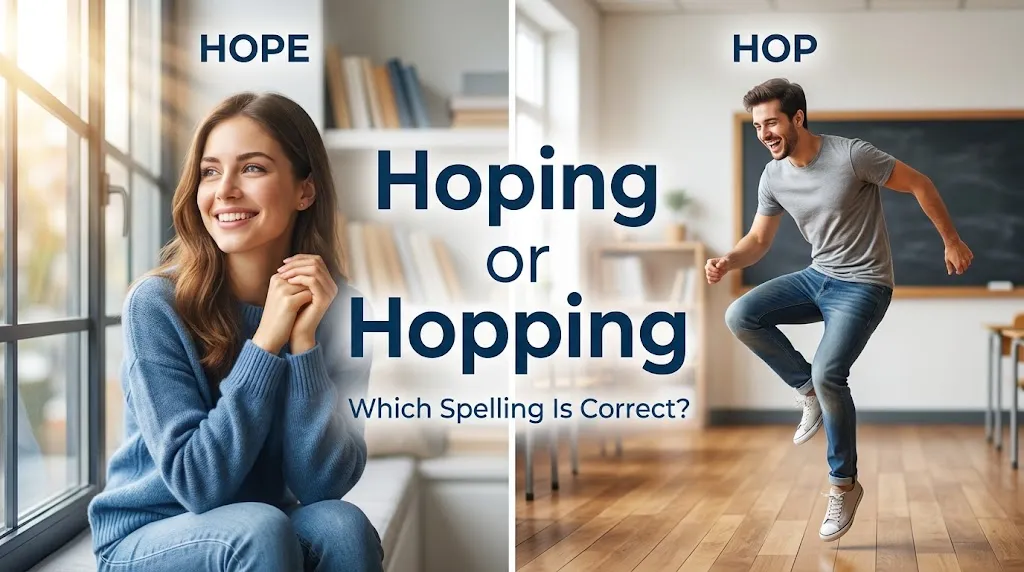
Hoping or Hopping: Which Is Correct?
They are both correct English words, but they have completely different meanings. Hoping comes from the verb hope and describes wishing for or expecting something. Hopping comes from hop and describes jumping or moving with small jumps.
The Spelling Difference is important because hope becomes hoping, while hop becomes hopping. Understanding the base verb makes it much easier to choose the right word.
Hoping or Hopping: Which One Is Correct?
Both hoping and hopping are correct, but you use them in different situations.
- Hoping = wishing, expecting, or wanting something to happen
- Hopping = jumping or moving with small jumps
Examples:
- I am hoping for good news.
- The rabbit is hopping across the garden.
So, if you are talking about a wish or expectation, use hoping. If you are talking about jumping or moving in small jumps, use hopping.
Hoping vs. Hopping at a Glance
| Word | Base Verb | Meaning | Example |
| Hoping | Hope | Wishing or expecting something | I am hoping for good news. |
| Hopping | Hop | Jumping or moving with small jumps | The rabbit is hopping outside. |
The easiest way to remember the difference is to look at the original verb: hope → hoping and hop → hopping.
What Does “Hoping” Mean?
Hoping is the present participle of hope. It means wanting something to happen or believing that it may happen.
For example:
- She is hoping to pass her exam.
- We are hoping for better weather.
- I am hoping that everything goes well.
- They are hoping to visit us soon.
The word commonly appears with for, to, or that constructions. Cambridge Dictionary gives examples of these patterns, including “hope for,” “hope to,” and “hope that.”
What Does “Hopping” Mean?
Hopping is the present participle of hop. Its most common meaning is jumping on one foot or moving with small jumps.
For example:
- The rabbit is hopping across the field.
- The child was hopping on one foot.
- The bird was hopping along the branch.
Hopping can also describe moving from one place or activity to another, often spending only a short time at each. This is why expressions such as bar-hopping, job-hopping, and gallery-hopping are possible.
Why Is It “Hoping” but “Hopping”?
The Difference comes from the two base verbs.
Hope → Hoping
The verb hope ends in a silent e. When -ing is added, the final e is removed:
hope + ing → hoping
Hop → Hopping
The verb hop has a short vowel followed by a single consonant. When -ing is added, the final consonant is doubled:
hop + ing → hopping
This is why the two words look different even though they both end in -ing.
The -ing Spelling Rule Explained.
The spelling of hoping and hopping follows common English verb-form patterns.
For verbs ending in silent e, the e is usually removed before -ing:
- hope → hoping
- make → making
- write → writing
- smile → smiling
For short verbs that follow a consonant-doubling pattern, the final consonant is doubled:
- hop → hopping
- run → running
- sit → sitting
- stop → stopping
This is why writing hopeing or hopping with only one p would be incorrect in standard English.
Hope vs. Hop: Understanding the Base Verbs
The easiest way to understand these words is to learn their base verbs first.
Hope means to want something to happen or to be true.
- I hope you feel better.
- We hope to see you soon.
Hop means to jump on one foot or move by small jumps.
- The bird can hop across the ground.
- He had to hop on one foot.
Their main verb forms are:
| Base Verb | Past Form | -ing Form |
| hope | hoped | hoping |
| hop | hopped | hopping |
Once you know the base verb, choosing the correct -ing form becomes much easier.
How to Use “Hoping” in a Sentence
There are several common ways to use hoping.
Hoping for + noun
Use hoping for when you are expressing a desire for something.
- I am hoping for good news.
- She is hoping for a promotion.
- They are hoping for better results.
Hoping to + verb
Use hoping to before a base verb.
- I am hoping to visit London.
- He is hoping to win the competition.
- We are hoping to finish early.
Hoping that + clause
Use hoping that when introducing a complete idea.
- I am hoping that you can help me.
- She is hoping that everything goes well.
- We are hoping that he arrives on time.
The pattern hope + to-infinitive is standard English grammar.
How to Use “Hopping” in a Sentence
Hopping is normally used when someone, an animal, or something else is moving by jumping.
Physical movement
- The rabbit is hopping through the garden.
- The child was hopping around the room.
On one foot
- She was hopping on one foot.
- He started hopping after hurting his other foot.
Moving between places
- We spent the afternoon gallery-hopping.
- They went bar-hopping after dinner.
Very busy or active
In informal English, hopping can also describe a place that is very busy or full of activity.
- The restaurant was hopping on Saturday night.
- The city center is hopping in the evening.
Cambridge Dictionary records both the jumping sense and the informal sense of being busy or active.
Hoping vs. Hopping Pronunciation
Hoping and hopping are not simply two spellings of the same sound.
- Hoping: /ˈhoʊ.pɪŋ/ in American English
- Hopping: /ˈhɑː.pɪŋ/ in American English
The first word comes from hope, while the second comes from hop. The vowel sound also differs between the two words. Cambridge lists separate pronunciations for hoping and hopping.
Common Mistakes With Hoping and Hopping
Because the words look similar, learners sometimes use one in place of the other.
Mistake 1
❌ I am hopping you are well.
✅ I am hoping you are well.
The sentence expresses a wish, so hoping is correct.
Mistake 2
❌ The rabbit is hoping across the garden.
✅ The rabbit is hopping across the garden.
The rabbit is physically jumping, so hopping is correct.
Mistake 3
❌ I am hopeing for good news.
✅ I am hoping for good news.
The final silent e in hope is removed before -ing.
Mistake 4
❌ The child is hoping on one foot.
✅ The child is hopping on one foot.
The action involves jumping, so the correct word is hopping.
Hoping or Hopping in British and American English
There is no standard British-versus-American spelling difference between these two words.
Both varieties use:
- hoping
- hopping
The difference is based on the meanings and spelling patterns of hope and hop, not on regional spelling.
Pronunciation can vary between British and American English, but the spellings remain the same.
Hoping or Hopping: Examples in Everyday English
Here are some examples that show the difference in natural situations.
Hoping
- I am hoping for a quick reply.
- She is hoping to get the job.
- We are hoping that you can come.
- He was hoping to see his friends.
- They are hoping for good weather.
Hopping
- The rabbit was hopping across the grass.
- The child was hopping on one foot.
- The bird kept hopping around the yard.
- They went bar-hopping after work.
- The restaurant was hopping last night.
One especially useful expression is was/were hoping. It is commonly used when making a polite statement or request, such as “I was hoping you could help me.” Cambridge specifically identifies this use of the past continuous form of hope.

Related To Another Article: https://grammixo.com/drank-or-drunk/
Easy Memory Trick for Hoping vs. Hopping
Use the base word to remember the difference:
Hope → Hoping = wish
Hop → Hopping = jump
You can also remember the spelling this way:
Hope loses its final e before -ing:
hope → hoping
Hop doubles its final p:
hop → hopping
So if you are talking about a wish, think hoping. If you are talking about jumping, think hopping.
Hoping vs. Hopping Practice Quiz
Choose hoping or hopping in each sentence.
- I am ______ to hear from you soon.
- The rabbit was ______ around the garden.
- She is ______ to get the position.
- The boy was ______ on one foot.
- We are ______ for good weather.
- They spent the evening bar-______.
Answers:
- hoping
- hopping
- hoping
- hopping
- hoping
- hopping
The first, third, and fifth sentences describe wishes or expectations. The other sentences describe jumping or movement between places.
People Also Ask
A: Both are correct. Hoping comes from hope and relates to wishing or expecting something. Hopping comes from hop and relates to jumping or moving with small jumps.
A: Hoping means wishing or expecting something to happen. Hopping means jumping, usually with small movements or on one foot.
A: Hop becomes hopping because the final consonant is doubled before -ing under the relevant English spelling pattern.
A: Hoping comes from hope. The final silent e is removed before -ing, giving hoping.
A: Yes. Hopping is the present participle of hop and can describe jumping, moving between places, or being very active in informal contexts.
Hoping vs. Hopping: Final Difference
The Difference is simple once you identify the base verb:
Hoping = hope + ing → wishing or expecting
Hopping = hop + ing → jumping or moving with small jumps
Remember hope → hoping and hop → hopping. The first loses the silent e, while the second doubles the final p. Once you connect each word to its base verb, you can easily choose the correct spelling and meaning.

1 thought on “Hoping or Hopping: Difference, Meaning & Examples”