Introduction
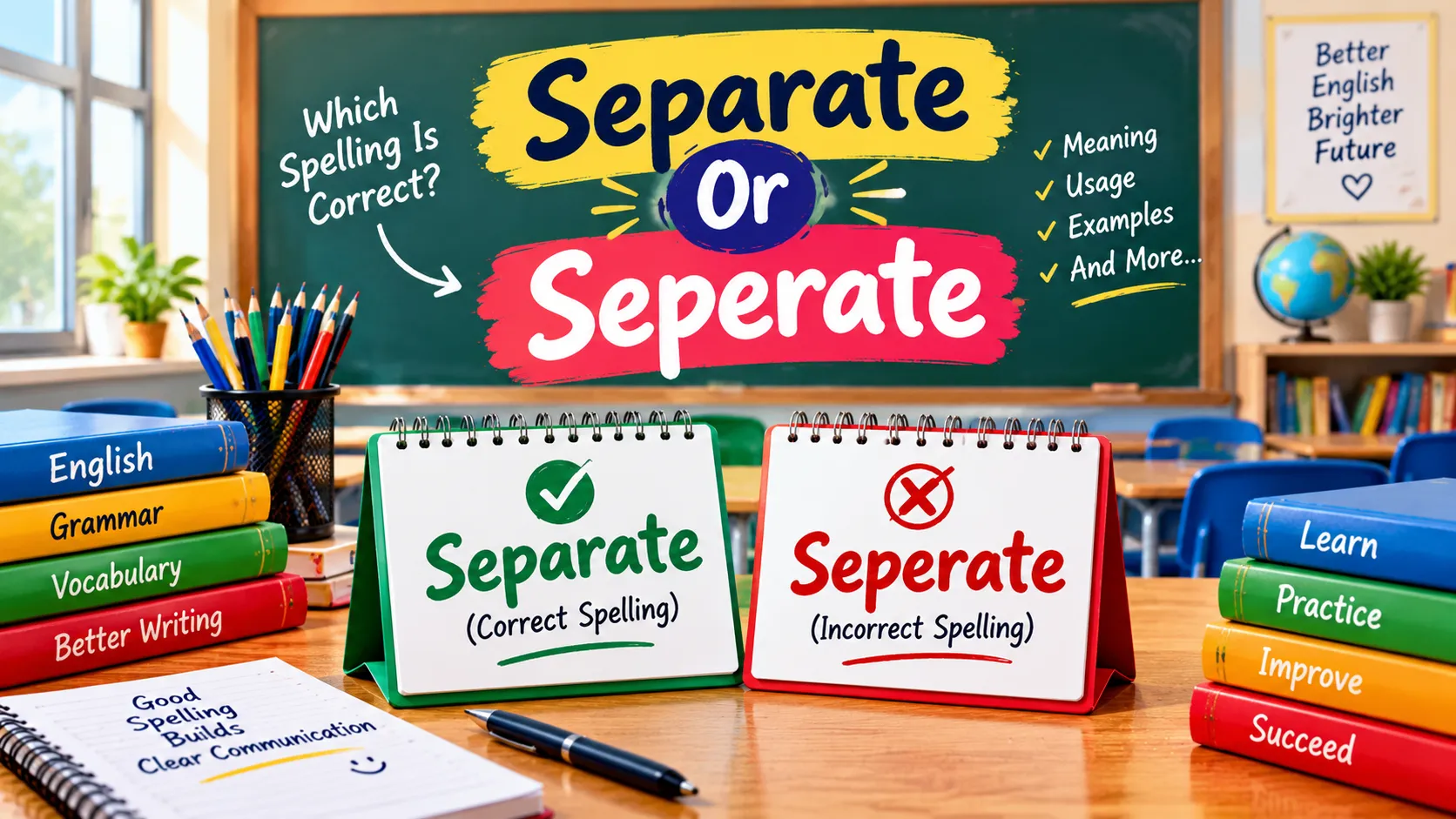
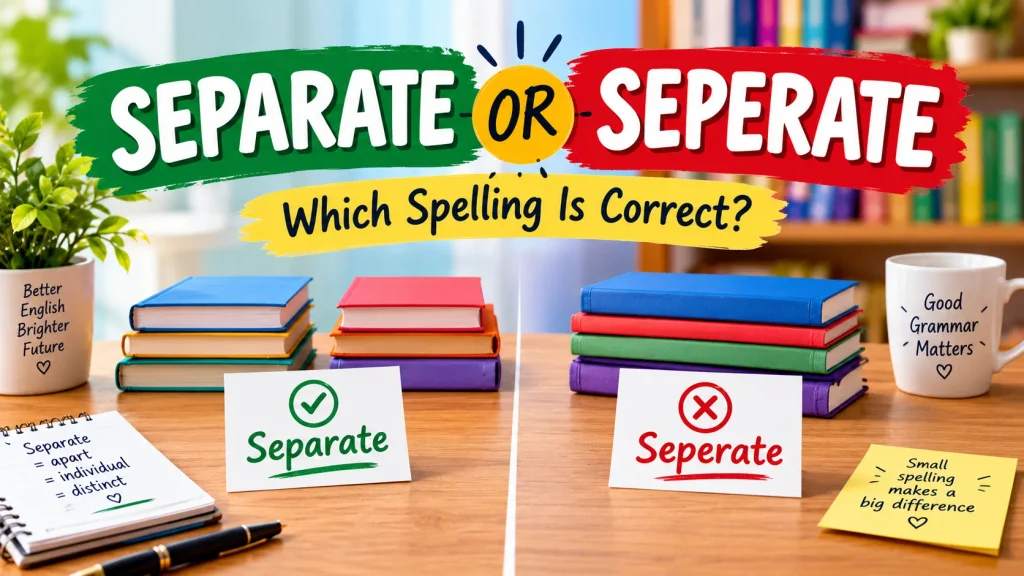
Separate is the Correct Spelling in standard English. Seperate is a common spelling mistake and is not accepted as the standard spelling in either American or British English.
The word separate can mean to divide things, keep people or objects apart, or describe things that are independent or different from one another. It can function as both a verb and an adjective.
For example:
- Correct: Please keep these documents separate.
- Incorrect: Please keep these documents seperate.
The easiest way to remember the spelling is to focus on the middle letter. Separate is spelled s-e-p-a-r-a-t-e, with an a in the middle syllable, not an e.
What Is the Difference Between Separate and Seperate?
The difference between separate and seperate is spelling. Only separate is the standard English word.
| Word | Status | Example |
| Separate | Correct spelling | We work in separate offices. |
| Seperate | Common misspelling | We work in seperate offices. |
Use separate in school assignments, professional emails, academic writing, and everyday communication. If you see seperate in a sentence, correct it to separate unless you are discussing the misspelling itself.
Why Is Separate the Correct Spelling?
The standard spelling is separate, with the letter a in the middle. This spelling is used in dictionaries and in both major varieties of English.
Examples:
- I need a separate notebook for science.
- The teacher separated the students into groups.
- Please send the files separately.
Notice that the same spelling pattern continues in related words such as separated, separating, and separately.
Why Is Seperate Incorrect?
Seperate replaces the middle a in separate with an e. This is a spelling error rather than an alternative British or American spelling.
The mistake often happens because the middle vowel is not strongly pronounced in ordinary speech. Writers may hear the word and guess how it should be spelled.
However, pronunciation alone is not always a reliable guide to English spelling. Remembering the written form helps prevent this mistake.
What Does Separate Mean?
The word separate has several related meanings. It can describe things that are not joined, actions that divide things, or differences between people, ideas, and objects.
Separate as an Adjective
As an adjective, separate describes things that are different, independent, or not joined together.
Examples:
- My brother and I have separate bedrooms.
- The company maintains separate accounts for each department.
- Please use a separate sheet of paper for your answer.
- The two events took place on separate days.
In these sentences, separate describes the relationship between people, objects, accounts, or events.
Separate as a Verb
As a verb, separate means to divide something into parts or move people and objects apart.
Examples:
- Please separate the white clothes from the dark ones.
- The teacher separated the class into four groups.
- We need to separate facts from opinions.
- The two teams separated after the match.
The verb can be used with an object, as in “Separate the papers,” or without a direct object, as in “The two groups separated.”
Separate as a Noun
Separate is not commonly used as a standalone noun in everyday English. The noun form most readers need is separation.
For example:
- The separation of the two departments improved organization.
- The wall provides separation between the rooms.
In fashion and clothing, separates can refer to individual garments that can be combined with other pieces rather than worn as a matching set.
For general grammar and spelling purposes, remember that separate is primarily used as an adjective and a verb.
Separate Meaning in Everyday English
In daily communication, separate can describe different situations.
Keeping things apart: Keep raw food separate from cooked food.
Distinguishing ideas: It is important to separate facts from assumptions.
Organizing items: Separate the receipts by month.
Describing independent things: They have separate responsibilities at work.
Although the context changes, the central idea remains the same: things are divided, distinct, or independent.
Why Is Separate Commonly Misspelled as Seperate?
Many English spelling mistakes occur when the pronunciation of a word does not clearly reveal its written form. Separate is a good example because the middle vowel may sound weak when spoken naturally.
How Pronunciation Causes Spelling Confusion
The unstressed middle syllable can make the vowel difficult to identify. A writer may hear a sound similar to a short, unclear vowel and choose e instead of a.
This does not mean that seperate is correct in some accents. The standard written form remains separate.
For example:
- Incorrect: We need a seperate room.
- Correct: We need a separate room.
Reading the sentence aloud can help with fluency, but checking the spelling pattern is more reliable.
The Difference Between the Letters A and E
The key spelling difference is the middle vowel.
- Separate: s-e-p-a-r-a-t-e
- Seperate: s-e-p-e-r-a-t-e
The second form uses e where the standard spelling requires a.
A useful habit is to pause when writing the word and check the middle syllable. If you write seperate, replace the middle e with a.
Why English Spelling Cannot Always Be Predicted by Sound
English spelling reflects historical developments, word origins, and established writing conventions. As a result, words that sound similar may contain different letters.
For this reason, spelling rules and memory techniques are useful, but they do not explain every English word perfectly.
With separate, learning the standard written form is more useful than trying to derive the spelling from pronunciation alone.
How to Pronounce Separate Correctly
The pronunciation of separate changes depending on whether it is used as an adjective or a verb. Cambridge Dictionary records different pronunciations for these two uses.
Separate as an Adjective
When separate is an adjective, it is commonly pronounced approximately SEP-uh-ruht.
For example:
- They have separate rooms.
- We submitted separate reports.
The final part sounds like “uht,” rather than the full “ayt” sound used in the verb.
Separate as a Verb
When separate is a verb, it is commonly pronounced approximately SEP-uh-rayt.
For example:
- Please separate the papers.
- We should separate the two sections.
The final syllable sounds like “rayt.”
British and American Pronunciation Differences
British and American English have small differences in the pronunciation of separate, particularly in the middle sounds. However, both varieties distinguish the adjective pronunciation from the verb pronunciation.
The spelling remains the same in both varieties.
For detailed British and American pronunciations, consult the cambridge dictionary pronunciation guide.
What Is the Correct Spelling of Separate in British and American English?
The correct spelling is separate in both British and American English. Unlike words such as colour and color, this word does not have two standard regional spellings.
Separate in American English
American English uses separate for both the adjective and the verb.
Examples:
- The school has a separate library.
- Please separate the recyclable materials.
- We submitted the forms separately.
The spelling does not change when the word is used in a different grammatical role.
Separate in British English
British English also uses separate.
Examples:
- Each department has a separate entrance.
- Please separate the papers before filing them.
- The items were stored separately.
British writers should not replace the middle a with e. The spelling is identical in standard British and American usage.
Is Seperate Ever an Accepted Alternative Spelling?
No. Seperate is not an accepted standard alternative spelling in British or American English.
You might encounter it in informal messages, online posts, or unedited documents. Its appearance in published or online writing does not make it correct.
Use separate in formal and informal writing.
Easy Ways to Remember How to Spell Separate
A simple memory technique can make this Frequently Misspelled word easier to remember.
The “There Is a Rat in Separate” Memory Trick
One popular mnemonic is:
There is a RAT in sepARATe.
The letters R-A-T appear together in the middle portion of separate. Remembering this pattern can help you recall that the word contains an a rather than an e in the middle syllable.
For example, when you are unsure whether to write separate or seperate, recall the word rat and check the spelling.
Remember the A-R-A Letter Pattern
Look at the central letters of separate:
sep-A-R-A-te
The two a letters surrounding r can act as a visual reminder of the correct spelling.
You do not need to memorize a complicated rule. Simply remember that the standard word contains a in the middle syllable.
A Simple Spelling Check Before You Write
Before submitting an assignment or sending a professional email, check the word carefully.
Ask yourself:
- Have I written separate with an a in the middle?
- Have I accidentally typed seperate?
- Do related forms, such as separately and separation, also have the correct spelling?
This quick review is particularly useful when proofreading longer documents.
Correct and Incorrect Examples of Separate and Seperate
Examples make it easier to recognize the correct spelling in real sentences.
Correct Examples Using Separate
- Please keep your personal and professional accounts separate.
- The teacher gave each student a separate assignment.
- We decided to separate the documents into different folders.
- The two buildings have separate entrances.
- You should separate your opinions from the available evidence.
- The ingredients should be stored separately.
- The manager created separate schedules for both teams.
- Each applicant must complete a separate form.
- The road separates the two neighborhoods.
- The files were separated according to their dates.
All these examples use separate or one of its correctly spelled forms.
Common Incorrect Examples Using Seperate
The following sentences contain the common spelling error.
Incorrect: I need a seperate notebook.
Correct: I need a separate notebook.
Incorrect: Please seperate the documents.
Correct: Please separate the documents.
Incorrect: We work in seperate departments.
Correct: We work in separate departments.
Incorrect: The files were seperated by date.
Correct: The files were separated by date.
The important point is that changing the middle a to e makes the spelling incorrect.
How to Correct Separate Spelling Mistakes
If you find seperate in your writing, replace it with separate. Then check related words for the same error.
For example:
- Seperated → Separated
- Seperately → Separately
- Seperation → Separation
A spellchecker can identify many of these mistakes, but it is still useful to understand the correct spelling yourself.
How to Use Separate in Everyday Sentences
The word appears in education, business, formal writing, emails, and everyday conversation. The examples below show how to use it naturally in different contexts.
Separate in School and Education
Students frequently use separate when discussing assignments, subjects, groups, and documents.
Examples:
- Write your answers on a separate sheet.
- The teacher separated the students into small groups.
- Each subject has a separate section in my notebook.
- Please keep your homework separate from your class notes.
Separate in Business and Professional Writing
In professional settings, separate can describe departments, responsibilities, accounts, and projects.
Examples:
- The company operates two separate offices.
- We Maintain Separate records for each project.
- Please separate the urgent tasks from the routine tasks.
- Each department has separate responsibilities.
Separate in Emails and Messages
The word is also useful in everyday digital communication.
Examples:
- I have attached the files as separate documents.
- Could you send the invoices separately?
- Please keep the two requests separate.
- I will send you a separate message with the details.
Separate in Formal and Academic Writing
Academic and formal writing often uses separate to distinguish concepts, categories, and findings.
Examples:
- The study examined the two groups separately.
- Researchers should separate observed results from interpretations.
- Each variable was analyzed as a separate factor.
- The report discusses the issues in separate sections.
Separate in Daily Conversation
In conversation, separate can describe practical tasks and personal decisions.
Examples:
- Let’s keep these bags separate.
- We need to separate the clean clothes from the dirty ones.
- The children sat at separate tables.
- It is difficult to separate the two ideas.
These examples demonstrate that the same standard spelling works across different situations.
Separate, Separated, Separating, Separately, and Separation
Learning related word forms helps you use separate accurately and avoid repeating spelling errors.
| Word | Part of speech | Meaning or use |
| Separate | Verb or adjective | Divide, or keep things distinct |
| Separates | Verb | Present-tense form used with he, she, or it |
| Separated | Past tense or past participle; also an adjective | Divided or kept apart |
| Separating | Present participle or gerund | Dividing or moving apart |
| Separately | Adverb | In a distinct or independent way |
| Separation | Noun | The act or state of being divided |
Separate vs. Separated
Separate is the base form of the verb, while separated is its past-tense and past-participle form.
Examples:
- Present: I separate the files every morning.
- Past: I separated the files yesterday.
- Present perfect: I have separated the files by category.
The adjective separated can also describe people or things that are no longer together.
Example: The two sections are separated by a wall.
Separate vs. Separating
Separating describes an ongoing action or can function as a gerund.
Examples:
- She is separating the books by subject.
- Separating fact from opinion takes practice.
The spelling changes by adding -ing to the base form: separate → separating. The final e is dropped before the suffix is added.
Separate vs. Separately
Separate is an adjective or verb, while separately is an adverb.
Examples:
- Adjective: We have separate accounts.
- Verb: Please separate the accounts.
- Adverb: The accounts are managed separately.
Use separately when describing how an action is performed.
Separate vs. Separation
Separate describes something distinct or the act of dividing, whereas separation is a noun referring to the act or state of being divided.
Examples:
- The rooms are separate.
- We decided to separate the rooms with a partition.
- The separation of the rooms improved privacy.
Remember that the correct noun is separation, not seperation.
Common Misspellings of Related Words
Some writers repeat the same vowel mistake in words related to separate.
| Incorrect spelling | Correct spelling |
| Seperate | Separate |
| Seperated | Separated |
| Seperating | Separating |
| Seperately | Separately |
| Seperation | Separation |
Checking the base word can help you recognize the correct spelling of the entire word family.
- Related To Another Article: https://grammixo.com/556-2-patient-or-pacient/
Common Mistakes to Avoid When Using Separate
Correct spelling is important, but writers should also use the right word form and grammatical structure.
Writing Seperated Instead of Separated
The past-tense form is separated, with an a in the base word.
Incorrect: The teacher seperated the class.
Correct: The teacher separated the class.
Writing Seperately Instead of Separately
The adverb is spelled separately, not seperately.
Incorrect: The two applications were processed seperately.
Correct: The two applications were processed separately.
Writing Seperation Instead of Separation
The correct noun is separation.
Incorrect: The separation between the departments was unclear because the report used the misspelled form seperation.
Correct: The separation between the departments was unclear.
Confusing Spelling With Pronunciation
The adjective separate and the verb separate have different common pronunciations, but their spelling is identical.
Do not change the written form based on how the word sounds in a particular sentence.
Separate or Seperate: Practice Quiz
Test your Understanding with these five short questions. Choose the correct answer before checking the explanations.
Choose the Correct Spelling
Question 1: Which spelling is correct?
A. Seperate
B. Separate
Question 2: Complete the sentence: “Please keep the documents _____.”
A. seperate
B. separate
Question 3: Which is the correct past-tense form?
A. Seperated
B. Separated
Question 4: Choose the correct adverb.
A. Separately
B. Seperately
Question 5: Which is the correct noun form?
A. Seperation
B. Separation
Answers and Explanations
- B — Separate. The standard spelling contains a in the middle syllable.
- B — Separate. The word describes documents that should be kept apart.
- B — Separated. This is the correct past-tense and past-participle form.
- A — Separately. The adverb retains the a spelling.
- B — Separation. This is the correct noun form.
If you answered all five correctly, you understand the main spelling pattern and its common related forms.
People also Ask
Separate is correct. Seperate is a common misspelling and should be corrected in standard English writing.
Spell it s-e-p-a-r-a-t-e. Remember the a in the middle syllable.
Seperate is a spelling error rather than a standard English word. You may encounter it in informal writing, but it should not be used as the correct spelling.
The middle vowel can be difficult to identify because it is often unstressed in speech. Remembering the written pattern sep-a-rate helps prevent the common error.
Yes. Both British and American English use separate. There is no standard regional spelling difference for this word.
Conclusion
The correct spelling is Separate, whether you are writing in British or American English. Seperate is a common spelling mistake caused partly by the weak middle vowel in pronunciation.
Remember that separate can function as a verb or adjective, while separately is an adverb and separation is a noun. Learning these related forms will help you write more accurately in schoolwork, emails, professional documents, and everyday communication.
Whenever you are unsure, check the middle vowel: separate has an a, not an e.

1 thought on “Separate or Seperate: Which Spelling Is Correct?”