Introduction
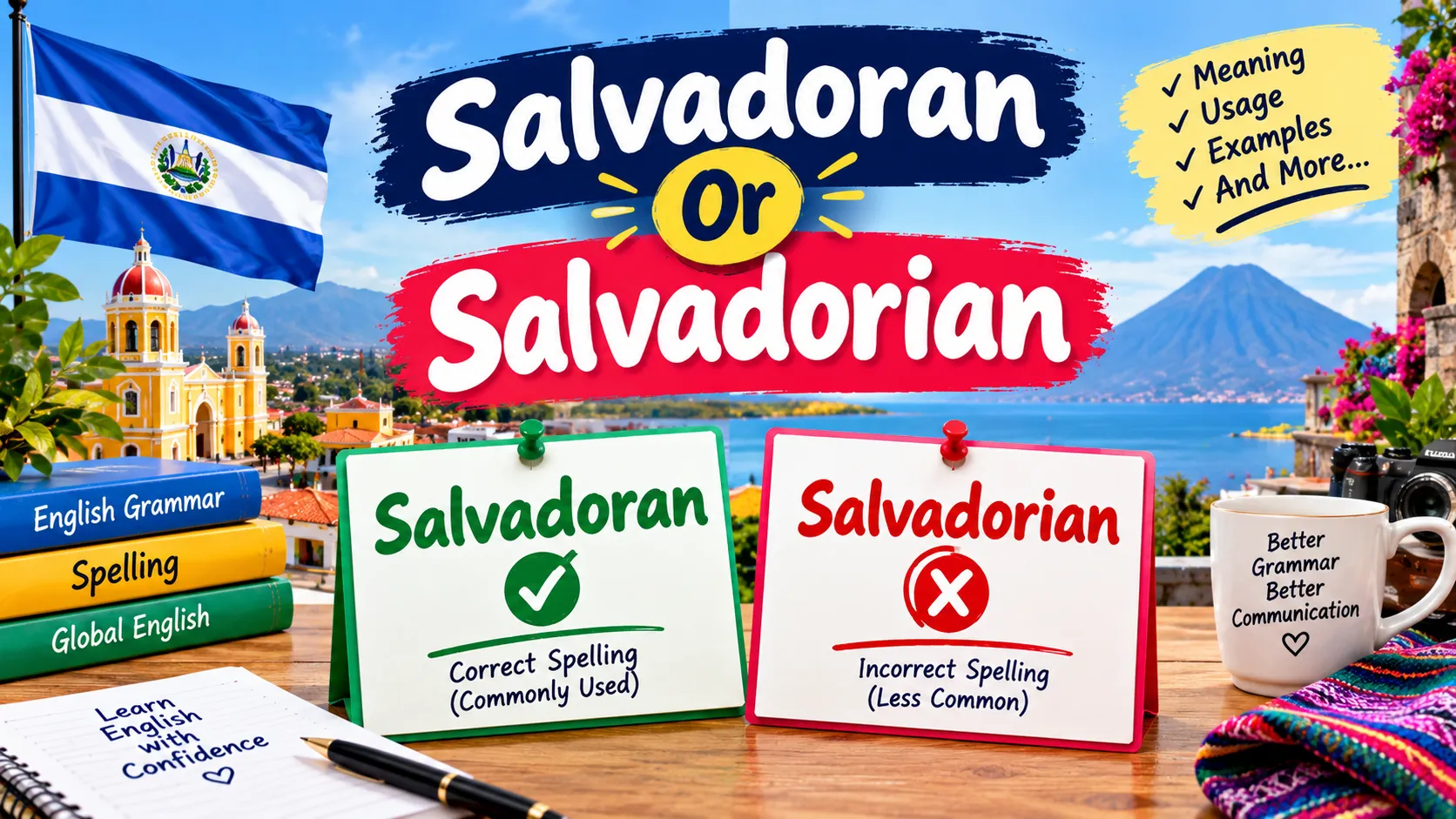
When writing about El Salvador, you may wonder whether to use Salvadoran Or Salvadorian. Both spellings appear in English, and understanding their usage can help you choose the right word for your writing.
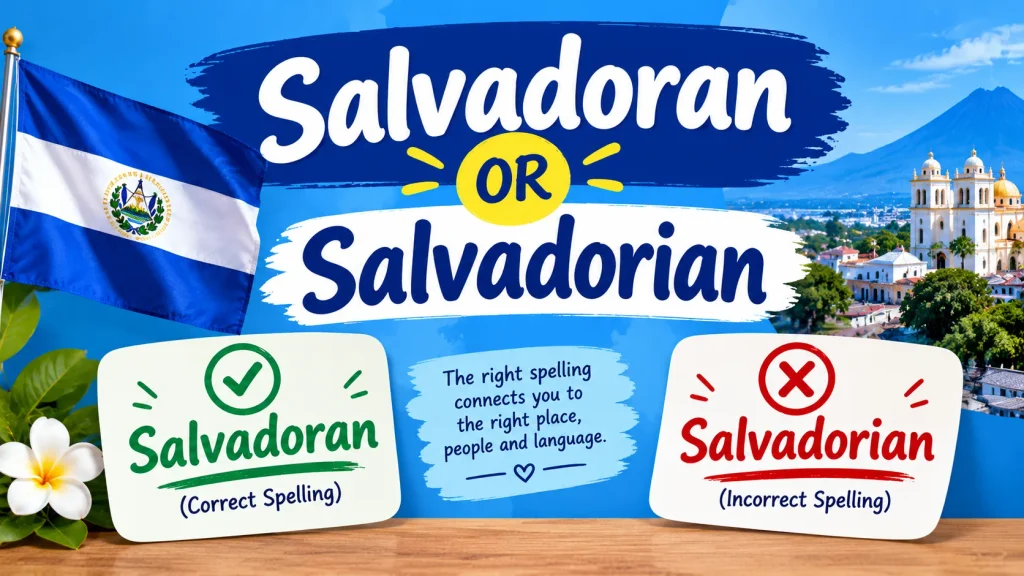
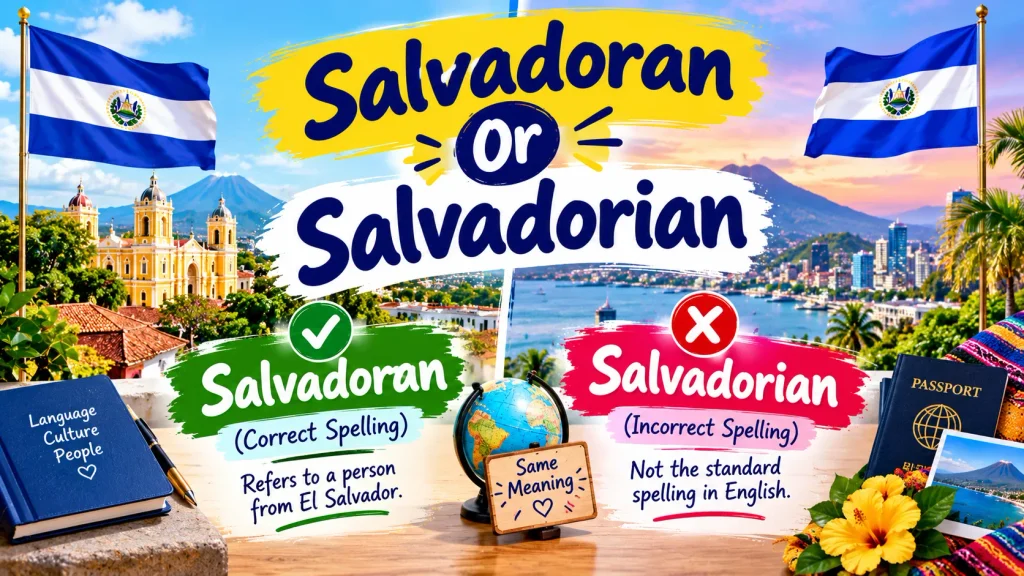
Salvadoran is the preferred and widely established spelling, while Salvadorian is also used as an alternative. Both words can describe a person from El Salvador or something connected with the country. The choice is generally a matter of spelling preference and usage rather than a difference in meaning.
For most general, educational, and professional writing, Salvadoran is a practical choice. However, recognizing Salvadorian is useful when reading articles, books, and other English-language publications.
In this guide, you will learn the meanings of both words, their pronunciation, grammatical roles, common mistakes, and how to use them naturally in sentences.
Salvadoran or Salvadorian: Quick Answer
You know that Salvadoran and Salvadorian are alternative English terms for people and things associated with El Salvador, a country in Central America.
Salvadoran is the more established choice in many English-language references and is commonly used in news reporting, education, and general writing. Salvadorian is another form that readers may encounter.
Consider these examples:
- Salvadoran: My neighbor is Salvadoran.
- Salvadorian: She enjoys sharing Salvadorian cultural traditions.
- Salvadoran: We learned about Salvadoran history in class.
The spelling you choose should remain consistent throughout your article or document. If you are following a particular dictionary, publication, or style guide, use its preferred form.
What Does Salvadoran Mean?
Salvadoran refers to a person from El Salvador or something related to that country, its people, or its culture.
El Salvador is a Central American country known for its Pacific coastline, volcanic landscapes, rich cultural traditions, and distinctive cuisine. The word Salvadoran helps identify people and things connected with this nation.
The word can function as both a noun and an adjective, depending on the sentence.
Salvadoran as a Noun
As a noun, Salvadoran refers to a person from El Salvador or someone of Salvadoran nationality or background.
Examples:
- A Salvadoran joined our international student group.
- The author is a Salvadoran who writes about Central American culture.
- Several Salvadorans attended the cultural festival.
- My friend introduced me to a Salvadoran artist.
The plural form is Salvadorans. Add an s to refer to more than one person.
Salvadoran as an Adjective
As an adjective, Salvadoran describes something connected with El Salvador.
It commonly appears before nouns referring to food, culture, people, history, and traditions.
Examples:
- We prepared a Salvadoran meal for our guests.
- Salvadoran culture includes diverse artistic and musical traditions.
- The students studied Salvadoran history.
- She bought a book about Salvadoran literature.
In these sentences, Salvadoran describes the noun that follows it.
Examples of Salvadoran in Sentences
Here are additional examples showing how to use Salvadoran in everyday English.
- The Salvadoran community organized a cultural celebration.
- My teacher recommended a book about Salvadoran history.
- We tried traditional Salvadoran pupusas at the restaurant.
- A Salvadoran journalist reported on the event.
- The museum displayed Salvadoran artwork.
- He is learning more about his Salvadoran heritage.
Each sentence uses Salvadoran to identify a person or describe a connection with El Salvador.
What Does Salvadorian Mean?
Salvadorian is an alternative English spelling used to describe a person from El Salvador or something associated with the country.
Although Salvadoran is the preferred form in many references and publications, Salvadorian also appears in English usage. Therefore, it is misleading to assume that every occurrence of Salvadorian is automatically a grammatical error.
The two forms generally communicate the same idea.
Definition and Common Usage
Salvadorian can be used as a noun or an adjective, just like Salvadoran.
Examples:
- She is Salvadorian.
- We met a Salvadorian musician at the event.
- They attended a Salvadorian cultural celebration.
- The documentary explored Salvadorian traditions.
These examples illustrate how the alternative spelling works in sentences.
Is Salvadorian an Accepted Alternative?
Yes. Salvadorian is an established alternative spelling found in English-language usage and reference sources.
However, the two spellings may not be equally common in every publication or context. Salvadoran is a sensible default when you want a widely established form.
For formal writing, check the relevant dictionary or editorial style guide if consistency is important.
Remember that the fact that a spelling is less common does not automatically make it incorrect. Language usage can include more than one accepted form of a word.
Examples of Salvadorian in Sentences
The following sentences demonstrate natural ways to use Salvadorian.
- My colleague is Salvadorian and enjoys discussing Central American history.
- We attended a Salvadorian cultural event last weekend.
- The writer explored Salvadorian identity in her essay.
- They prepared Salvadorian dishes for the celebration.
- He interviewed a Salvadorian artist for his project.
These examples show the same general meaning that Salvadoran conveys.
Salvadoran vs. Salvadorian: Key Differences
The main difference between Salvadoran and Salvadorian is their spelling. In ordinary English usage, they generally have the same meaning.
Neither word refers to a different nationality, and the spelling does not change the country being discussed.
Meaning and Definition
Both words can refer to:
- A person from El Salvador.
- Someone with Salvadoran or Salvadorian nationality or background.
- Food associated with El Salvador.
- The country’s culture, history, or traditions.
For example, Salvadoran history and Salvadorian history both refer to the history of El Salvador.
Spelling and Word Formation
The two forms differ in their endings:
- Salvadoran ends in -an.
- Salvadorian includes -ian.
English uses several endings to form words associated with places and nationalities. There is no single ending that applies to every country, which is why nationality terms sometimes have alternative forms.
The spelling of a nationality word is often established through convention and usage rather than a universal rule.
Which Form Is More Common?
Salvadoran is widely established and is often the preferred spelling in dictionaries, journalism, and general English writing.
Salvadorian also occurs, but its frequency can vary by source, region, and publication.
If you are writing an educational article, a school assignment, or a general-interest blog post, Salvadoran is a practical default. If a publication consistently uses Salvadorian, follow its style.
Popularity alone does not determine whether a word is grammatically acceptable.
Side-by-Side Comparison Table
| Feature | Salvadoran | Salvadorian |
| Meaning | Related to El Salvador | Related to El Salvador |
| Refers to a person | Yes | Yes |
| Used as an adjective | Yes | Yes |
| Used as a noun | Yes | Yes |
| Preferred in many references | Yes | Alternative form |
| Plural for people | Salvadorans | Salvadorians |
| Capitalization | Capitalized | Capitalized |
The central point is that both spellings can communicate the same meaning. Salvadoran is a useful default when you do not have a specific style preference to follow.
Why Is Salvadoran the Preferred Spelling?
Salvadoran is a widely established form in modern English and is a practical choice for readers who want a clear, familiar spelling.
It is used to describe the country’s people, nationality, cuisine, culture, and history. It also appears frequently in news and educational contexts.
How English Forms Nationality Words
English forms nationality terms in several ways. Some end in -an, others in -ian, and still others use endings such as -ese or -ish.
For example:
- Mexico → Mexican
- Italy → Italian
- Canada → Canadian
- Japan → Japanese
- England → English
These examples demonstrate that nationality words do not follow one universal spelling pattern.
The correct form usually depends on established English usage. It is better to learn the accepted word than to create a nationality term by applying a suffix mechanically.
The Connection Between El Salvador and Salvadoran
The country is called El Salvador. The adjective and nationality term Salvadoran is used to identify people and things associated with it.
Examples include:
- A Salvadoran citizen
- Salvadoran literature
- Salvadoran traditions
- Salvadoran cuisine
Notice that the country name and the nationality term are not identical. In English, the country is El Salvador, while the nationality adjective is Salvadoran.
Why Salvadorian Is Also Used
Salvadorian follows a familiar English word-forming pattern in which -ian appears in words associated with places or people.
English contains many nationality terms ending in -ian, such as Canadian and Italian. This pattern may help explain why Salvadorian appears in writing.
Nevertheless, a familiar word-forming pattern does not always determine the most established spelling. Salvadoran remains a widely preferred form, while Salvadorian is a recognized alternative.
Salvadoran vs. Salvadorian in American and British English
A common question is whether Salvadoran is American English and Salvadorian is British English.
The distinction is not as straightforward as common American-versus-British spelling differences such as color and colour.
Usage in American English
Salvadoran is commonly used in American English, including news articles, educational materials, and discussions of Central American communities.
Examples:
- The school organized a Salvadoran heritage event.
- The newspaper published an article about Salvadoran culture.
- Students researched Salvadoran immigration history.
Salvadorian may also appear in American English, although usage depends on the writer and publication.
Usage in British English
Salvadoran is also used in British English. The alternative Salvadorian may be encountered in English-language sources from different regions.
It is therefore unwise to assume that the spelling ending in -ian is exclusively British.
Examples:
- The class studied Salvadoran history.
- The museum displayed Salvadoran paintings.
- The report discussed Salvadoran communities.
These sentences are natural examples of the established form.
Is This a US vs. UK Spelling Difference?
No, not in the usual sense of a systematic American-versus-British spelling distinction.
The choice between Salvadoran and Salvadorian is better understood as a difference between alternative forms, with Salvadoran being a widely preferred option.
If you are writing for a British or American audience, follow your chosen dictionary or editorial style guide rather than assuming that the audience requires one spelling.
How to Pronounce Salvadoran and Salvadorian
Knowing the pronunciation can make it easier to recognize and use both terms in conversation.
Pronunciation may vary slightly among English speakers, but the following guides provide a useful starting point.
Salvadoran Pronunciation
Salvadoran is commonly pronounced approximately as:
sal-vuh-DOR-uhn
The main stress falls on the syllable represented by DOR.
Try saying the word slowly:
sal-vuh-DOR-uhn
Then repeat it at a natural speaking pace.
Example: “My friend is Salvadoran.”
Salvadorian Pronunciation
Salvadorian is commonly pronounced approximately as:
sal-vuh-DOR-ee-uhn
The additional syllable helps distinguish its pronunciation from Salvadoran.
Try breaking it into parts:
sal-vuh-DOR-ee-uhn
Example: “She is Salvadorian.”
Easy Pronunciation Tips for English Learners
Use these tips to practise both forms:
- Say each word slowly before increasing your speaking speed.
- Pay attention to the main stress around DOR.
- Notice the extra vowel sound in the middle of Salvadorian.
- Listen to a reliable dictionary’s audio pronunciation if you need a precise model.
- Practise each word in a complete sentence rather than memorizing it in isolation.
The pronunciation guides above are approximate, so dictionary audio is helpful if you want to learn the precise sounds.
What Is the Difference Between Salvadoran, Salvadorian, and Salvadorean?
Readers may also encounter a third spelling: Salvadorean.
This form appears in some English-language usage, but it is less familiar to many readers than Salvadoran. Like Salvadorian, it can be used to describe a person or something connected with El Salvador.
Meaning of Salvadorean
Salvadorean is another Spelling Variant associated with El Salvador.
For example:
- The article discussed Salvadorean history.
- We met a Salvadorean artist.
- The book explored Salvadorean cultural traditions.
These examples illustrate the intended meaning. However, Salvadoran is a practical choice if you want to use a widely established spelling.
Comparison of All Three Spellings
| Word | General meaning | Usage guidance |
| Salvadoran | A person or thing connected with El Salvador | Widely established; recommended default |
| Salvadorian | A person or thing connected with El Salvador | Alternative spelling |
| Salvadorean | A person or thing connected with El Salvador | Another variant found in English usage |
All three forms are associated with the same country. Their spelling and relative familiarity differ, but they do not refer to three different nationalities.
Which Form Should You Choose?
For most general English writing, choose Salvadoran.
It is a clear and widely established option for describing people, food, culture, and history associated with El Salvador.
You may retain Salvadorian or Salvadorean when quoting a source, reproducing an organization’s official wording, or following a publication’s established style.
The important thing is to use the form appropriate to your context and remain consistent.
Capitalization, Singular, and Plural Rules
Correct spelling is only part of using nationality words accurately. Capitalization and grammatical number also matter.
Should Salvadoran Be Capitalized?
Yes. Nationality terms are capitalized in English.
Correct examples:
- She is Salvadoran.
- We studied Salvadoran culture.
- A Salvadoran student joined the class.
- The exhibition featured Salvadoran artists.
Incorrect in standard English:
- She is salvadoran.
- We studied salvadoran culture.
The same rule applies to Salvadorian and Salvadorean when they are used as nationality terms.
Salvadoran or Salvadorans?
Use Salvadoran when referring to one person or when the word functions as an adjective. Use Salvadorans when referring to multiple people.
Examples:
- Singular noun: A Salvadoran spoke at the meeting.
- Plural noun: Several Salvadorans attended the meeting.
- Adjective: We learned about Salvadoran traditions.
Do not add a plural ending to an adjective simply because the noun it describes is plural.
For example, Salvadoran traditions is correct, not Salvadorans traditions.
Correct Use Before Nouns
When Salvadoran describes another noun, it usually appears directly before that noun.
Examples:
- Salvadoran food
- Salvadoran culture
- Salvadoran history
- Salvadoran music
- Salvadoran literature
- Salvadoran communities
The word remains Salvadoran regardless of whether the following noun is singular or plural.
Compare:
- The student explored Salvadoran culture.
- The students explored Salvadoran cultures.
In both sentences, Salvadoran remains unchanged because it functions as an adjective.
Common Mistakes to Avoid
Even when two spellings have similar meanings, writers can make mistakes when choosing or using them.
Treating Every Alternative Spelling as Wrong
One common mistake is assuming that Salvadorian is always incorrect.
Salvadoran is a widely preferred form, but Salvadorian also appears as an alternative in English usage.
For general writing, use Salvadoran unless your chosen reference or style guide recommends otherwise. When discussing spelling differences, explain the distinction accurately instead of automatically labelling the alternative as a misspelling.
Confusing the Country Name With the Nationality
The country’s name is El Salvador. Salvadoran is the widely established nationality term and adjective.
Examples:
- Correct: She lives in El Salvador.
- Correct: She is Salvadoran.
- Correct: He enjoys Salvadoran food.
These words have related meanings but perform different grammatical roles.
Mixing Different Spellings in One Article
Switching between Salvadoran and Salvadorian without a reason can confuse readers.
For example, using Salvadoran culture in one paragraph and Salvadorian culture in the next may make readers wonder whether the words have different meanings.
Choose one spelling for your main writing and use it consistently. If you are comparing the variants, make their relationship clear.
Incorrect Capitalization and Word Choice
Nationality terms should be capitalized even when they appear in the middle of a sentence.
Correct:
- The author is Salvadoran.
- They studied Salvadoran history.
- We met several Salvadorans.
Incorrect:
- The author is salvadoran.
- They studied salvadoran history.
- We met several salvadorans.
Capitalization is a basic but important part of standard English writing.
- Related To Another Article: https://grammixo.com/separate-or-seperate/
Salvadoran or Salvadorian: Examples in Everyday English
The following examples show how the two spellings can be used in different contexts.
Examples About People and Nationality
- My new classmate is Salvadoran.
- Several Salvadorans participated in the international exchange program.
- A Salvadorian student presented her research.
- The speaker discussed his family’s connections to El Salvador.
- The community welcomed visitors from El Salvador.
These sentences use the terms to identify people and their connections with the country.
Examples About Food and Cuisine
- We tried Salvadoran pupusas at a local restaurant.
- She prepared a Salvadorian meal for her friends.
- The cooking class explored Salvadoran cuisine.
- He bought a cookbook featuring recipes from El Salvador.
- They enjoyed learning about Salvadoran food traditions.
Both Salvadoran and Salvadorian can describe food associated with El Salvador.
Examples About Culture and Traditions
- The museum hosted an exhibition of Salvadoran art.
- We watched a documentary about Salvadoran traditions.
- The festival celebrated the music and culture of El Salvador.
- She wrote an essay about Salvadorian heritage.
- The class explored Salvadoran literature.
These examples demonstrate the adjective use of both forms.
Examples in Emails and Professional Writing
Nationality terms can also appear naturally in formal correspondence and professional documents.
Example 1: Educational email
“Dear Professor, I am researching Salvadoran history for my upcoming presentation. Could you recommend a reliable academic source?”
Example 2: Event invitation
“We invite you to attend our cultural event celebrating Salvadoran art, music, and traditions.”
Example 3: Professional report
“The report examines the experiences of Salvadoran communities and their contributions to local cultural life.”
In formal writing, Salvadoran is a practical default because it is widely established and readily recognizable.
Examples in News and Academic Writing
The word can also be used in journalism, research, and educational writing.
- The report examined Salvadoran migration patterns.
- Researchers studied Salvadoran literature and its historical context.
- The news article discussed a Salvadoran community initiative.
- The university hosted a lecture on Salvadorian cultural identity.
- The historical study explored El Salvador’s political and social development.
When writing about specific people, communities, or historical events, make sure the facts are accurate and that the terminology suits the context.
How to Remember the Correct Spelling
If you regularly confuse Salvadoran and Salvadorian, a simple memory strategy can help.
An Easy Memory Tip
Remember this phrase:
“Salvadoran is my standard choice.”
The word Salvadoran has the shorter ending, -an. Use it as your default when you are unsure which form to choose.
This is a spelling preference to remember, not a rule proving that the alternative is always wrong.
Common Word Combinations to Remember
Practising familiar combinations can make the spelling easier to recall.
- Salvadoran people
- Salvadoran nationality
- Salvadoran culture
- Salvadoran food
- Salvadoran history
- Salvadoran traditions
- Salvadoran communities
- Salvadoran literature
Learn these phrases as complete units. They are useful in essays, blog posts, school assignments, and everyday conversation.
Salvadoran or Salvadorian: Practice Quiz
Test your Understanding with the following questions. Choose the option that best completes each sentence.
Question 1: Which spelling is the widely preferred choice in general English writing?
A. Salvadoran
B. Salvadorian
C. Both are country names
Question 2: Which sentence uses capitalization correctly?
A. She studies salvadoran history.
B. And she studies Salvadoran history.
C. She studies salvadorans history.
Question 3: Which word is appropriate when referring to several people from El Salvador?
A. Salvadoran
B. Salvadorans
C. Salvadoran’s
Question 4: Is Salvadorian used as an alternative spelling in English?
A. Yes
B. No, it is never used
C. It refers to a different country
Question 5: Which sentence uses the adjective correctly?
A. They enjoy Salvadorans food.
B. They enjoy salvadoran food.
C. They enjoy Salvadoran food.
Answers and Explanations
- A — Salvadoran. It is a widely established and preferred spelling.
- B — She studies Salvadoran history. Nationality terms are capitalized.
- B — Salvadorans. The plural noun refers to more than one person.
- A — Yes. Salvadorian is an alternative form found in English usage.
- C — They enjoy Salvadoran food. The nationality adjective is capitalized and does not take a plural ending.
If you answered all five questions correctly, you understand the main spelling and grammar rules.
People Also Ask
A: Salvadoran is the widely preferred spelling, while Salvadorian is an alternative form used in English. Both can refer to people or things associated with El Salvador.
A: Salvadorian is an established alternative spelling found in English usage. However, Salvadoran is the preferred choice in many references and is a practical default for general writing.
A: A person from El Salvador is commonly called a Salvadoran. Salvadorian is also used as an alternative term.
A: Yes. Salvadoran is used in British English as well as American English. The difference between Salvadoran and Salvadorian should not be treated as a simple US-versus-UK spelling rule.
A: Both expressions are used, but Salvadoran food is a widely established choice. Use Salvadoran when you want a familiar, consistent spelling in general writing.
Conclusion
When choosing between Salvadoran and Salvadorian, Salvadoran is the widely established spelling and a reliable default for most English writing. Salvadorian is also used as an alternative and generally communicates the same meaning.
Both forms can describe a person from El Salvador or something connected with the country’s culture, food, history, or traditions. The additional spelling Salvadorean may also appear in English-language sources.
To write clearly, capitalize nationality terms, use Salvadorans when referring to multiple people, and keep your spelling consistent throughout your work. If you are writing for a specific publication or academic institution, follow its preferred dictionary or style guide.
With these simple rules, you can confidently use Salvadoran or recognize Salvadorian when you encounter it in everyday English.

1 thought on “Salvadoran or Salvadorian: Which Spelling Is Correct?”