Introduction
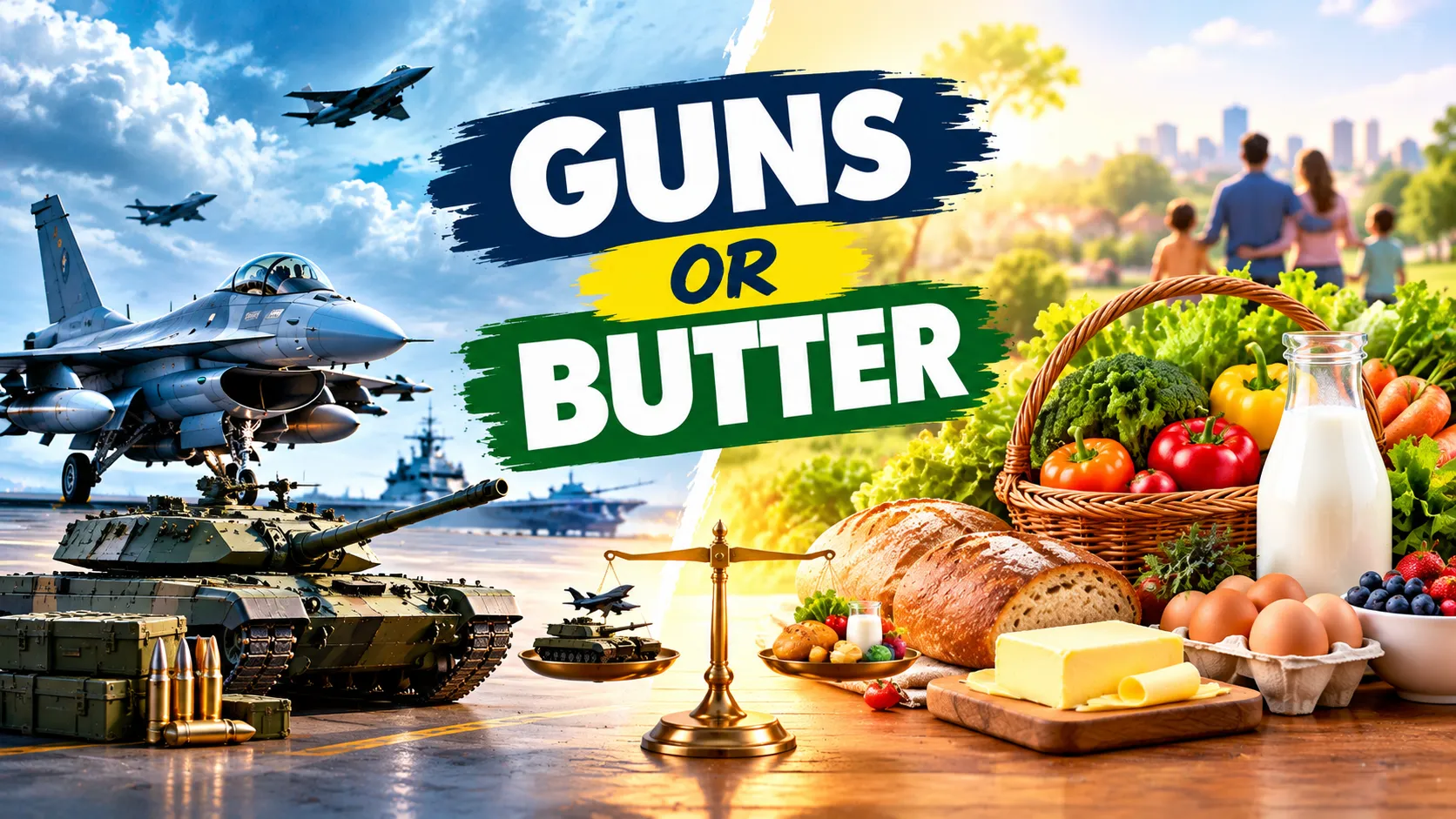
The phrase “Guns Or Butter” describes one of the most important ideas in economics: every society must make choices about how to use its limited resources. Governments have to decide how much to allocate to national defense and how much to spend on public needs such as education, healthcare, housing, and infrastructure.
These decisions involve trade-offs because a country’s money, labor, materials, and productive capacity are limited. Increasing resources devoted to one priority may reduce the resources available for another, especially in the short term.
Understanding guns or butter helps students learn about scarcity, opportunity cost, economic efficiency, and government budget decisions. It also explains how economists use the Production Possibilities Frontier (PPF) to illustrate the choices an economy faces.
Guns or Butter – Quick Answer
Guns or butter is an economic concept that illustrates the trade-off between spending resources on national defense and using those resources to produce civilian goods and services.
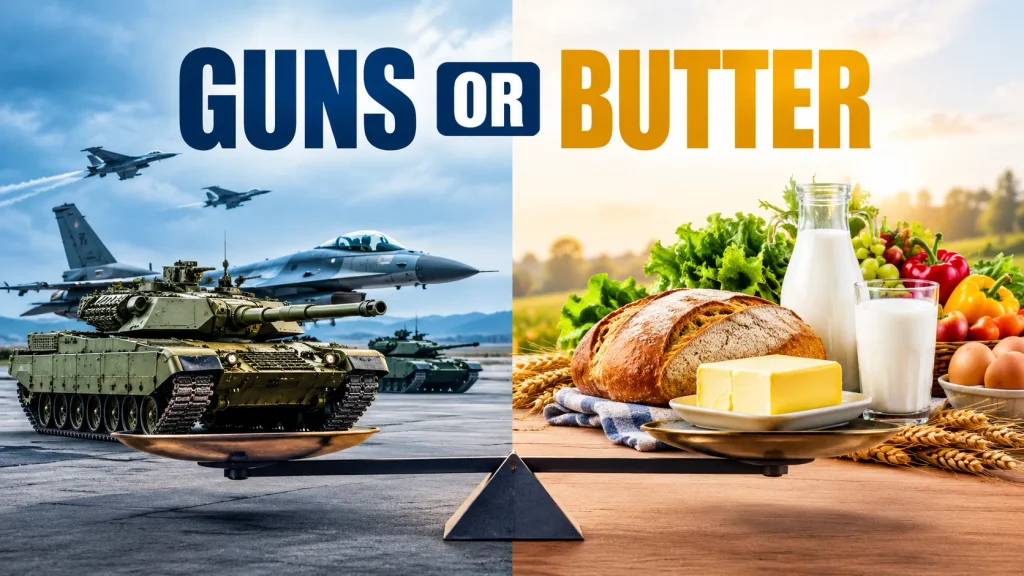
In this expression, “guns” represent military and defense spending, while “butter” represents civilian consumption and public welfare. The concept demonstrates that limited resources require governments and societies to make choices about competing priorities.
For example, if a government directs more of its available resources toward defense, it may have fewer resources available for schools, hospitals, and other public services unless it increases its productive capacity or obtains additional funding.
What Does Guns or Butter Mean in Economics?
In economics, guns or butter is a model of resource allocation. It shows how an economy must decide between different uses of its available resources.
The model uses two broad categories to simplify a complicated decision:
- Guns: Resources used for national defense and military purposes.
- Butter: Resources used to meet civilian needs and support everyday living standards.
The term does not mean that a country must choose only one category. Rather, it highlights the tension that can arise when decision-makers try to increase one type of spending without increasing the resources available to support it.
For instance, a government may want to improve national security while also expanding healthcare and education. Both goals can be valuable, but policymakers must consider the cost of each decision and the resources that will remain available for other priorities.
The central economic question is: What must a society give up to obtain more of something it wants?
This question connects guns or butter directly to scarcity and opportunity cost.
What Do Guns and Butter Represent?
The two terms represent different categories of economic output rather than two literal products.
What Does “Guns” Represent?
In the guns or butter model, guns represent resources allocated to national defense and security.
This category may include:
- Defense personnel and training.
- Military equipment and related supplies.
- Defense research and technology.
- Security infrastructure.
- Other government expenditures intended to support national defense.
From an economic perspective, these activities use resources that could potentially be employed elsewhere. The model helps explain why defense decisions can have consequences for the wider economy.
However, defense spending can also support employment, research, manufacturing, and technological development. Its overall economic effects depend on how resources are used and how the spending is financed.
What Does “Butter” Represent?
Butter represents civilian goods and services that contribute to people’s everyday lives and general welfare.
Examples include:
- Schools and educational services.
- Hospitals and healthcare.
- Public transportation and infrastructure.
- Housing and community services.
- Food production and other consumer goods.
- Social support and public welfare programs.
The term is symbolic. It does not refer only to food or agricultural production.
In the model, butter represents the civilian side of economic activity. It helps illustrate the resources a society can devote to improving living standards, meeting everyday needs, and supporting public services.
The Origin and History of the Guns or Butter Concept
The guns or butter concept became particularly prominent in discussions of wartime economic planning and government resource allocation during the twentieth century.
During major conflicts, governments have often redirected labor, industrial capacity, raw materials, and public funds toward defense production. These changes can affect the availability of civilian products and services.
The United States during World War II provides a useful historical example. As the country expanded its war effort, a growing share of production was directed toward military needs. The St. Louis Federal Reserve’s educational resource, The Arsenal of Democracy, uses historical data and a production possibilities frontier to help students understand how the allocation between defense and civilian production changed during this period.
Historical examples show that an economy’s priorities can shift significantly during emergencies. They also demonstrate that the trade-off is influenced by the country’s ability to increase production, mobilize workers, and use resources more efficiently.
Today, economists and policymakers can use the same basic idea to discuss competing demands on public budgets, including security, education, healthcare, infrastructure, and other government responsibilities.
How Does the Guns or Butter Model Work?
The guns or butter model works by showing how limited productive resources must be allocated among competing uses.
Suppose a country has a certain amount of labor, capital, land, technology, and raw materials. In the short term, these resources cannot always be increased quickly.
If the country decides to produce more defense-related goods, it may need to redirect workers, factories, materials, or public funding away from civilian production. Consequently, fewer resources may be available for other goods and services.
The same principle works in reverse. If more resources are devoted to civilian production, the economy may have less capacity for defense output under the same resource and technology constraints.
This does not mean every increase in defense spending automatically reduces healthcare or education spending by the same amount. The outcome depends on taxation, borrowing, available capacity, economic growth, and the specific choices made by policymakers.
The Role of Scarcity in Economic Decisions
Scarcity occurs when resources are limited in relation to people’s wants and society’s needs.
Even wealthy countries face scarcity because they cannot use the same resources for every possible purpose at the same time. Governments must therefore decide which priorities deserve available funds and productive capacity.
For example, a government may want to build new schools, upgrade hospitals, improve roads, and strengthen national security. If its budget and available resources are limited, it must consider the costs and benefits of each proposal.
Scarcity does not necessarily mean a country has no money. It means that resources have alternative uses and that choosing one option may limit the ability to pursue another.
Why Every Choice Has an Opportunity Cost
Opportunity cost is the value of the next-best alternative given up when a choice is made.
In the guns or butter model, the opportunity cost of allocating more resources to defense is the civilian output or other valuable activity sacrificed as a result.
Consider a hypothetical economy that can use a particular set of resources to produce either 100 units of defense output or 200 units of civilian output when all resources are devoted to one category.
If the economy changes its allocation and produces more defense output, it may have to give up some civilian production. The amount sacrificed represents the opportunity cost of that decision.
Opportunity cost is not always measured in money. It can also be measured in lost production, services, time, or other benefits.
The concept helps policymakers compare alternatives rather than judging a decision only by its direct financial cost.
Guns or Butter and the Production Possibilities Frontier (PPF)
The Production Possibilities Frontier (PPF) is an economic model that illustrates the maximum combinations of two goods or categories of output an economy can produce with its available resources and technology.
The guns or butter model is often explained using a PPF because it provides a visual way to understand trade-offs.
Imagine a graph with defense output on the vertical axis and civilian output on the horizontal axis. Each point on the frontier represents a possible combination of the two categories when resources are being used productively.
Moving along the frontier toward greater defense output generally means giving up some civilian output, assuming resources and technology remain unchanged.
The PPF is useful because it connects the abstract ideas of scarcity and opportunity cost to a visual representation of economic choices.
What Does the PPF Curve Show?
The PPF shows the maximum combinations of two categories of output that can be achieved under given conditions.
A simplified guns or butter graph might include:
- The vertical axis representing defense output.
- The horizontal axis representing civilian output.
- A downward-sloping frontier showing the available production trade-offs.
- Points inside the frontier representing production below the economy’s potential.
- Points outside the frontier representing combinations that are currently unattainable.
The curve may be bowed outward because resources are not equally suited to producing every type of output. As resources are shifted toward one category, increasingly larger amounts of the other category may have to be sacrificed.
A straight frontier can also be used in a simplified model when the opportunity cost is assumed to remain constant.
Points on, Inside, and Outside the PPF
Understanding the position of a point is important when interpreting a production possibilities frontier.
Points on the PPF
A point on the frontier represents productive efficiency. Given current resources and technology, the economy cannot increase one category of output without reducing the other.
Points inside the PPF
A point inside the frontier represents an inefficient use of available productive resources. For example, some workers or factories may be unemployed or resources may not be used effectively.
Improving efficiency could allow the economy to increase output without immediately sacrificing production in the other category.
Points outside the PPF
A point outside the frontier represents a combination that the economy cannot currently produce with its existing resources and technology.
Such a combination may become attainable in the future if the economy grows, productivity improves, or additional resources become available.
How to Interpret a Guns or Butter Graph
To interpret the graph, first identify what each axis represents. Next, examine how the quantities change as the economy moves from one point to another.
Suppose the economy moves from a point with relatively high civilian output and lower defense output to a point with higher defense output and lower civilian output.
The change illustrates a trade-off. The reduction in civilian output is the opportunity cost of the additional defense output in this simplified example.
A PPF does not tell policymakers which point they should choose. Instead, it shows the available combinations and helps explain the economic consequences of different decisions.
For further study, OpenStax explains the PPF, efficiency, and social choices in its educational chapter on the production possibilities frontier.
Guns or Butter Examples in Real Life
The guns or butter model can help explain government choices in many situations. The following examples illustrate the underlying economic principles without suggesting that one priority is always more important than another.
Defense Spending vs. Education
Suppose a government has limited funds available for new public investment. It is considering increasing defense-related spending while also trying to build schools and improve educational facilities.
If the government redirects part of its existing investment budget toward defense, it may have to postpone some school construction or other education projects.
The opportunity cost would include the benefits those delayed educational projects could have provided.
However, this outcome is not inevitable. A Growing Economy, improved tax revenue, or more efficient spending could allow the government to support both priorities more effectively.
National Security vs. Healthcare
Healthcare and national security are both important public concerns, but they may compete for limited resources.
For example, a government might have to choose between accelerating a defense modernization program and expanding hospital facilities within a fixed investment budget.
If it allocates more funding to one project, fewer funds may remain for the other unless additional resources become available.
The economic task is to assess the benefits, costs, urgency, and long-term effects of each option.
The guns or butter model helps identify the trade-off, while detailed policy analysis is needed to determine which allocation best meets society’s needs.
Public Infrastructure vs. Other Government Priorities
Roads, bridges, public transportation, water systems, and electricity infrastructure require workers, materials, and funding.
When governments allocate more resources to infrastructure, fewer resources may initially be available for some other projects. On the other hand, improved infrastructure can raise productivity and reduce costs throughout the economy.
This means that spending decisions can have both immediate opportunity costs and longer-term economic benefits.
The guns or butter framework encourages decision-makers to consider both.
A Simple Hypothetical National Budget Example
Imagine that a government has an additional budget of $100 million and is considering how to allocate it between defense and civilian public services.
It has two simplified options:
| Allocation | Defense | Civilian services |
| Option A | $30 million | $70 million |
| Option B | $50 million | $50 million |
Under Option A, more of the additional budget is allocated to civilian services. Under Option B, more is allocated to defense.
Moving from Option A to Option B shifts $20 million away from civilian services and toward defense.
The opportunity cost of this decision is the civilian spending that is no longer funded by that portion of the budget.
This is a hypothetical budget illustration, not a claim about the actual cost or effectiveness of either category. Real government budgets also include revenue, borrowing, existing commitments, and many other spending priorities.
Guns or Butter vs. Opportunity Cost
You know that guns or butter and opportunity cost are closely related, but they are not exactly the same concept.
Guns or butter is a model used to illustrate a particular type of resource-allocation decision. Opportunity cost is the broader economic principle that explains what must be given up when a choice is made.
For example, if a country increases defense production and gives up some civilian output, guns or butter describes the trade-off, while opportunity cost identifies the value of the civilian output sacrificed.
Opportunity cost also applies to everyday decisions, business investment, education choices, and the allocation of resources in many other settings.
In short, guns or butter is an example of opportunity cost in action.
Guns or Butter vs. Scarcity and Trade-Offs
Scarcity, trade-offs, and opportunity cost are connected, but each term has a distinct meaning.
| Economic term | Meaning | Example |
| Scarcity | Resources are limited relative to wants and needs. | A government has limited funds for new projects. |
| Trade-off | Choosing more of one option may require less of another. | More funding for one project leaves less for another under a fixed budget. |
| Opportunity cost | The value of the next-best alternative sacrificed. | The benefits of a delayed school project. |
| Guns or butter | A model illustrating choices between defense and civilian output. | Comparing defense investment with public services. |
| PPF | A graph showing possible output combinations. | A frontier showing defense and civilian production. |
These concepts work together to explain why economic decisions require prioritization and why the consequences of a choice matter.
Advantages and Importance of the Guns or Butter Model
The guns or butter model is valuable because it simplifies a complicated economic problem into a form that students and readers can understand.
It Explains Scarcity Clearly
The model shows that productive resources are limited and have competing uses. This makes scarcity easier to understand in a real-world setting.
It Illustrates Opportunity Cost
The model demonstrates that choosing to increase one category of output can mean sacrificing another. It encourages people to consider what is given up rather than focusing only on what is gained.
It Supports Government Budget Analysis
Policymakers can use the underlying principle to think about competing spending priorities and the implications of allocating limited funds.
It Helps Students Understand the PPF
The model provides a familiar example for studying production possibilities, productive efficiency, and the effects of changing resource allocation.
It Encourages Balanced Decision-Making
The concept does not require society to reject defense or civilian welfare. Instead, it encourages careful consideration of competing objectives, available resources, and long-term consequences.
Limitations of the Guns or Butter Model
Although the guns or butter model is useful, it simplifies many features of a real economy.
It Reduces a Complex Economy to Two Categories
Actual government budgets contain numerous priorities, including education, healthcare, transportation, Environmental protection, debt payments, and public administration.
Reducing these decisions to two categories helps explain the basic concept but cannot capture every relevant consideration.
It May Oversimplify Budget Decisions
Government spending does not always involve a direct transfer of the same amount from one category to another.
A government may raise revenue, borrow funds, reduce other expenditures, or benefit from economic growth. The consequences depend on the circumstances and how the spending is financed.
It Does Not Measure Every Social Benefit
The model illustrates production trade-offs, but it does not automatically measure the full social value of a school, hospital, security program, or infrastructure project.
Those benefits require additional evidence and evaluation.
It Usually Assumes Given Resources and Technology
A basic PPF analysis considers what can be produced with current resources and technology. In reality, innovation, investment, education, and productivity improvements can change an economy’s productive capacity.
It Does Not Determine the Best Political Choice
Economics can explain costs, benefits, constraints, and possible outcomes. It cannot determine society’s preferred priorities without considering public values, policy goals, and the distribution of benefits and costs.
The model is therefore a useful starting point for analysis, not a complete formula for government policy.
- Related To Another Article: https://grammixo.com/hispanic-or-latino/
Can a Country Have Both Guns and Butter?
Yes. A country can support both national defense and civilian welfare.
The guns or butter model does not claim that a country must produce only defense goods or only civilian goods. It shows that, under a given set of resource constraints, producing more of one category may involve an opportunity cost in the other.
A country may increase both categories if it improves productivity, reduces waste, develops new technology, or expands its productive resources.
It may also finance different priorities through changes in revenue or spending. However, financing choices can create their own costs and constraints.
The important question is not whether both categories can exist. It is how resources can be allocated to support both priorities while considering affordability, efficiency, and long-term needs.
How Economic Growth Changes the Guns or Butter Trade-Off
Economic growth can expand the production possibilities available to a country.
When productivity improves, workers become more effective, technology advances, or the economy gains additional productive resources, the PPF can shift outward.
An outward shift means the economy can potentially produce more defense output, civilian output, or both than it could previously.
For example, better technology may allow factories to produce more goods using the same amount of labor and materials. Improved education and training can also help workers become more productive.
Economic growth does not eliminate every trade-off. Resources remain limited, and governments still have to decide how to distribute the benefits of greater productive capacity.
However, a larger and more productive economy may have more options than an economy whose resources and technology remain unchanged.
How to Calculate Opportunity Cost in a Guns or Butter Example
A simple numerical example can help students understand how opportunity cost works.
Suppose an imaginary economy can produce the following combinations:
| Production option | Defense output | Civilian output |
| A | 0 | 100 |
| B | 10 | 90 |
| C | 20 | 70 |
| D | 30 | 40 |
These figures are hypothetical units used only to explain the concept.
Moving from Option A to Option B increases defense output by 10 units and reduces civilian output by 10 units.
The opportunity cost of those additional 10 defense units is therefore 10 civilian units.
Moving from Option B to Option C increases defense output by another 10 units but reduces civilian output by 20 units. In this case, the opportunity cost of the additional 10 defense units is 20 civilian units.
This example also shows how opportunity cost can change as production changes. The additional resources required for further increases in one category may involve progressively larger sacrifices in the other.
The exact relationship depends on the economy’s resources, technology, and production conditions.
Common Misconceptions About Guns or Butter
Misconception 1: Guns or Butter Is a Spelling Difference
Correction: Guns or butter is an established economic expression, not a comparison between alternative spellings.
Misconception 2: Butter Only Means Food
Correction: In this model, butter represents civilian goods and services broadly, including healthcare, education, infrastructure, and consumer products.
Misconception 3: A Country Must Choose Only One Category
Correction: A country can allocate resources to both defense and civilian needs. The model illustrates trade-offs between possible allocations.
Misconception 4: Defense Spending Always Reduces Public Services
Correction: A reduction in other output or spending is not automatic. The effect depends on available resources, funding, economic conditions, and government decisions.
Misconception 5: The PPF Tells Governments What They Should Choose
Correction: The PPF illustrates production possibilities and opportunity costs. It does not determine society’s preferred allocation.
Misconception 6: Economic Growth Removes All Scarcity
Correction: Economic growth can expand production possibilities, but resources remain limited relative to the many possible uses for them.
Guns or Butter in Economics Exams and Assignments
Students may encounter guns or butter in introductory economics, social studies, or questions about government spending and resource allocation.
A strong answer should explain the central concept and connect it to scarcity, opportunity cost, and the PPF where relevant.
Key Terms Students Should Know
Scarcity: The condition in which resources are limited relative to wants and needs.
Opportunity cost: The value of the next-best alternative given up when a decision is made.
Trade-off: A situation in which obtaining more of one thing may require sacrificing another.
Production Possibilities Frontier: A graph showing the maximum combinations of two categories of output that can be produced with available resources and technology.
Productive efficiency: A situation in which more of one good cannot be produced without reducing production of another, given current resources and technology.
Economic growth: An increase in an economy’s productive capacity over time.
Common Exam Mistakes and How to Avoid Them
- Do not define guns or butter only as a government budget. Explain the underlying economic trade-off.
- Do not confuse opportunity cost with the total amount of money spent.
- Explain what the PPF axes represent before interpreting a graph.
- Remember that points inside the PPF indicate productive inefficiency in the standard model, while points outside it are currently unattainable.
- Do not claim that every increase in defense spending must reduce civilian spending by an identical amount.
- Use a simple example to demonstrate the relationship between resource allocation and opportunity cost.
Practice Questions With Answers
Question 1: What does the guns or butter model illustrate?
Answer: It illustrates the trade-off between allocating resources to national defense and allocating resources to civilian goods and services.
Question 2: What is opportunity cost?
Answer: Opportunity cost is the value of the next-best alternative sacrificed when a decision is made.
Question 3: What does a point inside the PPF represent?
Answer: It represents a combination of output that can be produced with available resources but reflects productive inefficiency in the standard model.
Question 4: Can economic growth allow a country to produce more of both categories?
Answer: Yes. If productive capacity expands, the economy may be able to produce more defense output and more civilian output.
Question 5: Does guns or butter mean that governments must eliminate one spending category?
Answer: No. It illustrates resource-allocation trade-offs rather than requiring an all-or-nothing decision.
People Also Ask
The main idea is that limited resources require choices between competing uses. The model illustrates the trade-off between defense production and civilian goods and services.
Guns or butter is commonly used as a macroeconomic concept because it examines national production, government priorities, and the allocation of resources across an economy. It also illustrates general economic principles that apply to individual and business decisions.
The PPF shows the possible combinations of defense and civilian output that an economy can produce with its available resources and technology. It provides a visual explanation of the trade-offs described by guns or butter.
If an economy allocates more resources to defense and produces less civilian output as a result, the civilian output sacrificed represents the opportunity cost of that decision.
Governments face limited budgets, productive resources, and competing public needs. They must consider which priorities to fund, what alternatives they may have to delay, and how each decision affects society.
Conclusion
The Guns or butter concept provides a simple way to understand how societies allocate limited resources between competing priorities. Defense and civilian welfare represent two broad categories that governments must consider when making economic decisions.
The concept becomes clearer when connected to scarcity, opportunity cost, and the Production Possibilities Frontier. Together, these ideas explain why resources have alternative uses, why choices involve trade-offs, and how economic growth can expand the available options.
For students, the key lesson is that guns or butter does not mean a country must choose only one priority. Instead, it offers a framework for examining the costs, benefits, and production possibilities associated with different economic decisions.
Understanding this framework makes it easier to analyze government spending and other resource-allocation questions in economics.

1 thought on “Guns or Butter: Meaning, Examples & Economic Theory”