Introduction
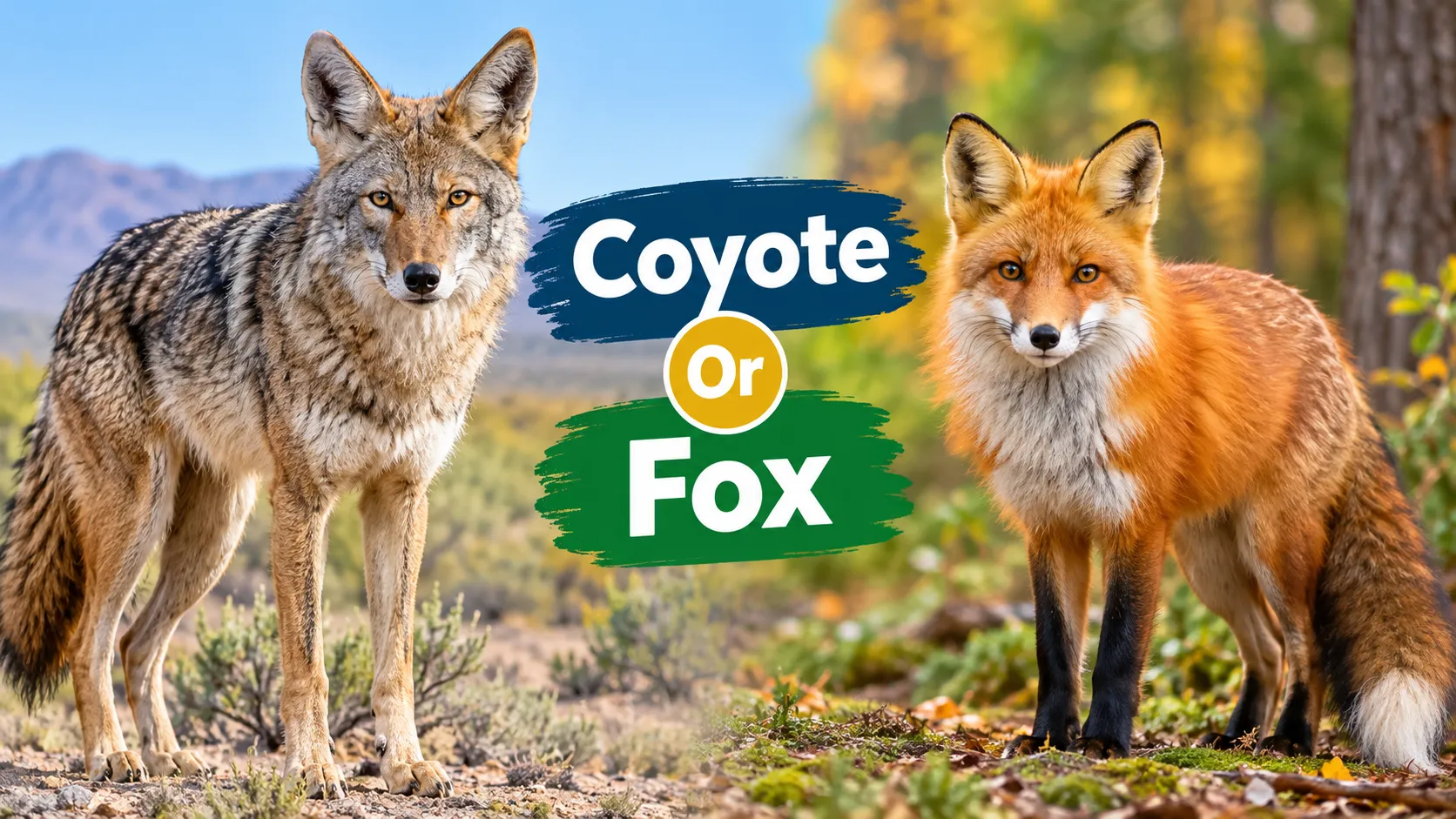
When you see a wild animal with pointed ears, a narrow muzzle, and a bushy tail, you might wonder whether it is a coyote or a fox. These two animals belong to the dog family, Canidae, and share several physical characteristics. However, their size, body shape, behavior, habitat preferences, and vocalizations can help you tell them apart.
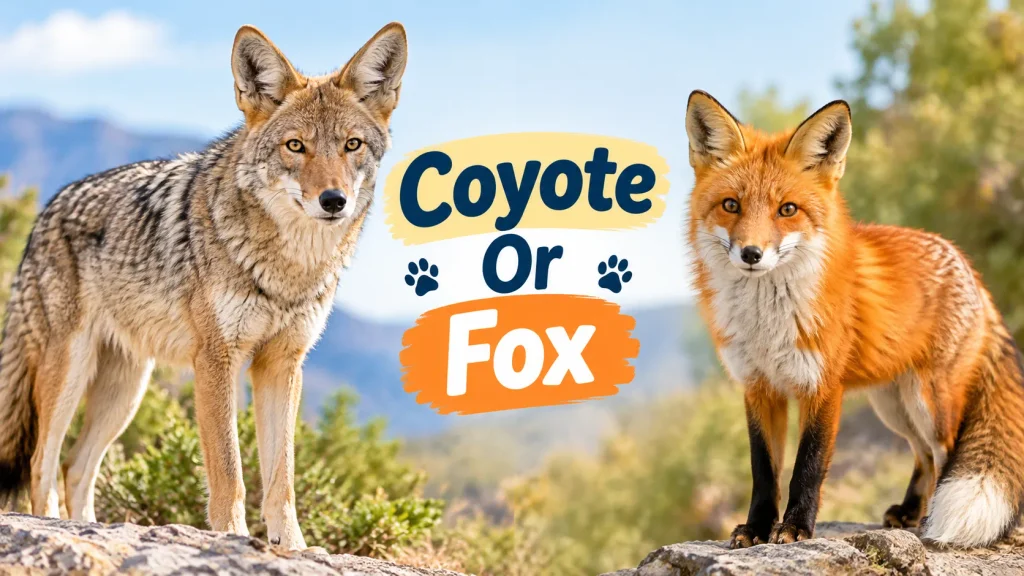
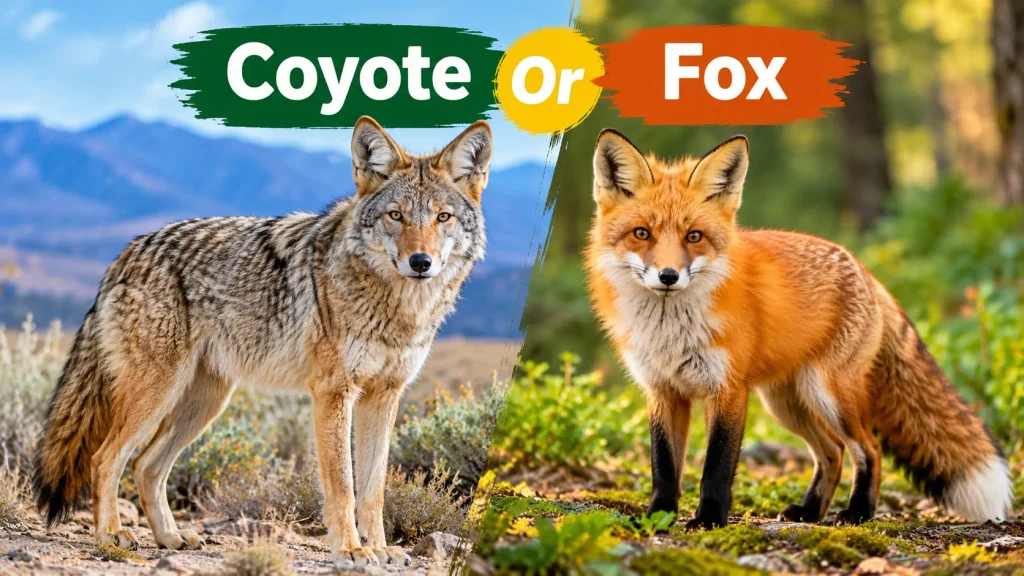
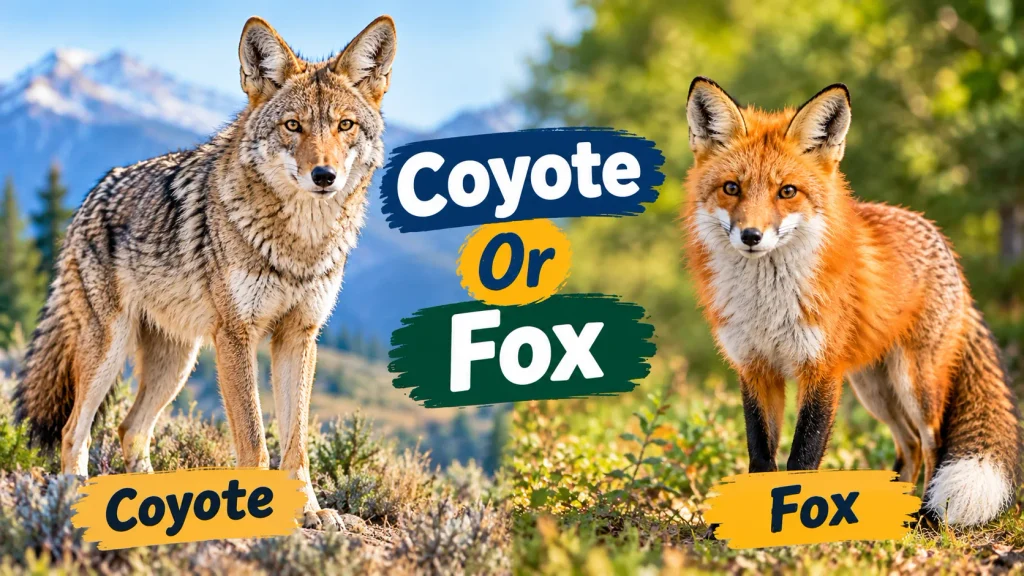
The most noticeable difference is size. Coyotes are generally larger, taller, and more heavily built than foxes. Foxes usually have a more delicate appearance, a narrower face, and a relatively longer, bushier tail. However, identifying an animal correctly requires considering several features rather than relying on fur color alone.
In this guide, you will learn the differences between coyotes and foxes, including their appearance, diet, habitats, footprints, sounds, behavior, and interactions with people.
Coyote or Fox: Quick Answer
A coyote is a medium-sized wild canid native to North and Central America, while a fox is a smaller-to-medium-sized canid found in many parts of the world, depending on the species.
Coyotes typically have long legs, a narrow muzzle, and grayish, tan, or brown fur. Foxes generally have a more compact body, pointed ears, and a prominent bushy tail. Red foxes often have reddish fur and a white-tipped tail, while gray foxes usually have gray fur and a black-tipped tail.
The easiest way to distinguish a coyote from a fox is to compare its overall size, body proportions, tail, and movement.
Coyote vs. Fox: Comparison Table
The following table summarizes the main differences between a coyote and two commonly discussed fox species: the red fox and the gray fox.
| Feature | Coyote | Red Fox | Gray Fox |
| Scientific name | Canis latrans | Vulpes vulpes | Urocyon cinereoargenteus |
| General size | Medium-sized | Small to medium-sized | Small to medium-sized |
| Body shape | Taller and longer-legged | Slender and relatively low to the ground | Compact and somewhat stocky |
| Typical coat | Gray, tan, brown, or mixed | Red, orange, brown, or other color variations | Gray, black, white, and reddish tones |
| Tail | Bushy, often held low | Very bushy, often white-tipped | Bushy, usually black-tipped |
| Face | Narrow, elongated muzzle | Pointed muzzle | Pointed muzzle |
| Diet | Small mammals, fruit, insects, and other available food | Rodents, rabbits, insects, fruit, and other food | Small mammals, birds, insects, fruit, and other food |
| Social behavior | Often solitary or in pairs; family groups also occur | Often solitary while foraging | Usually solitary while foraging |
| Common habitats | Grasslands, deserts, forests, suburbs, and cities | Forest edges, fields, farmland, and urban areas | Forests, brushy areas, and rocky habitats |
| Distinctive clue | Larger frame and longer legs | Reddish coat and often white-tipped tail | Gray coat and ability to climb trees |
These are general characteristics, not absolute identification rules. Fox species differ, and coat colors can vary significantly within a species.
What Is a Coyote?
A coyote is a wild mammal belonging to the family Canidae, which also includes domestic dogs, wolves, and foxes. Its scientific name is Canis latrans, and it is native to North and Central America.
Coyotes are known for their adaptability. They can survive in open grasslands, deserts, woodlands, agricultural landscapes, and urban environments. Their ability to use different food sources and habitats has helped them persist in areas where many other large predators are less common.
Coyote Appearance and Physical Characteristics
Coyotes have a lean body, long legs, erect ears, and a relatively narrow muzzle. Their appearance can sometimes resemble that of a medium-sized domestic dog, although their proportions and behavior are often different.
Their fur commonly combines gray, tan, brown, and black hairs. Some individuals appear more reddish, especially around the ears, legs, or tail.
A coyote’s tail is bushy but generally less prominent in proportion to its body than a fox’s tail. It often hangs downward while the animal walks.
Adult coyotes vary in size depending on their location, sex, and local conditions. The California Department of Fish and Wildlife gives a typical weight range of approximately 10 to 35 pounds, although individuals outside that range can occur.
Coyote Habitat and Distribution
Coyotes originally occupied many open habitats, but their range has expanded across much of North America.
They may be found in:
- Grasslands and prairies
- Deserts and dry scrublands
- Forest edges and open woodlands
- Farmland and agricultural areas
- Suburban neighborhoods and some cities
Coyotes are highly adaptable, but the habitats they use depend on local vegetation, shelter, prey availability, and human activity.
In urban environments, coyotes may travel through parks, greenbelts, and other areas that provide cover and food. Their presence does not necessarily mean that an area is unsafe, but people should give them space and avoid encouraging them to approach humans.
Coyote Diet and Hunting Habits
Coyotes are opportunistic omnivores. Although they eat many kinds of animal prey, their diet can also include plant material.
Common food sources include:
- Mice, voles, and other small mammals
- Rabbits and hares
- Birds and eggs
- Insects and other invertebrates
- Fruits and berries
- Carrion and other available food sources
Coyotes often hunt alone or in pairs when pursuing small prey. Family groups may cooperate in some situations, particularly when raising young or obtaining larger food sources.
Their diet changes with the season and local environment. A coyote living near farmland may eat different foods from one living in a desert or an urban neighborhood.
What Is a Fox?
A fox is a small-to-medium-sized member of the dog family. Unlike coyotes, which belong to the genus Canis, many familiar foxes belong to other genera, including Vulpes and Urocyon.
The word “fox” refers to several species rather than a single animal. Red foxes and gray foxes are two well-known examples in North America, and they differ in appearance, habitat use, and behavior.
Foxes are generally recognized by their pointed faces, upright ears, relatively compact bodies, and bushy tails.
Fox Appearance and Physical Characteristics
Most foxes have a slender body, pointed muzzle, alert ears, and a long tail that helps with balance and communication. Their fur may be red, orange, gray, brown, black, white, or a mixture of colors, depending on the species and individual.
Red foxes often have dark lower legs, a reddish coat, and a white-tipped tail. Gray foxes usually display a mixture of gray and black fur, with reddish markings around parts of the neck and body.
Compared with a coyote, a typical fox has a smaller frame and shorter-looking legs. Its tail may appear especially large relative to its body.
However, not every fox is red, and not every animal with gray fur is a coyote. Looking at several physical characteristics together provides a more reliable identification.
Red Fox vs. Gray Fox
Red foxes and gray foxes are different species. Understanding their differences is important because the term “fox” does not describe one uniform appearance.
Red fox
The red fox (Vulpes vulpes) is widely distributed across the Northern Hemisphere and has also been introduced to other regions. It commonly has reddish-orange fur, dark lower legs, and a bushy tail with a white tip. Its coat can also appear silver, black, or mixed in color.
Red foxes use a variety of habitats, including meadows, forest edges, farmland, and some urban areas.
Gray fox
The gray fox (Urocyon cinereoargenteus) typically has gray and black fur, reddish markings, and a black stripe along the upper surface of its tail. It often uses wooded and brushy habitats.
One particularly distinctive feature of the gray fox is its ability to climb trees. This behavior helps it escape threats, find shelter, and sometimes reach food.
Although both species are smaller than coyotes, their body shapes and habitat preferences are not identical.
Fox Habitat and Distribution
Foxes inhabit a wide range of environments, but the distribution depends on the species.
Red foxes occur across large parts of Europe, Asia, and North America, as well as introduced populations elsewhere. They can live in forests, grasslands, agricultural landscapes, and urban areas.
Gray foxes are native to parts of North and Central America and often favor wooded or brushy environments.
Foxes may use rock crevices, hollow logs, burrows, dense vegetation, or other sheltered locations for resting and raising young.
Their ability to live near people varies by species and location. Some foxes regularly use suburban spaces, while others remain more secretive.
Fox Diet and Hunting Habits
Foxes are opportunistic feeders. Their diet commonly includes small animals and may also include plant foods.
Depending on the species and habitat, foxes may eat:
- Mice, voles, and other rodents
- Rabbits and other small mammals
- Birds and eggs
- Insects and other invertebrates
- Berries, fruits, and other plant material
- Carrion when available
Foxes often hunt alone. A red fox may use its excellent hearing to locate small animals hidden in grass or beneath snow. It can then pounce to capture its prey.
Gray foxes also hunt small mammals and birds and may climb trees when doing so. Their precise hunting strategies depend on the environment and available food.
Some foxes cache surplus food by hiding it for later. This behavior helps them make use of food when it is available rather than depending entirely on immediate feeding opportunities.
Coyote vs. Fox: 10 Major Differences
Although coyotes and foxes share some characteristics, several useful differences can help you distinguish them.
1. Size and Weight
Size is usually one of the easiest clues.
Coyotes Are Generally larger and taller than red foxes and gray foxes. Their long legs and relatively large frame are noticeable when they walk across open ground.
Foxes typically have a smaller body and a more delicate overall appearance. A red fox may look surprisingly long because of its tail, but its body is usually much lighter than that of a coyote.
Age matters, too. A young coyote may be smaller than an adult fox, making identification more difficult.
2. Body Shape and Leg Length
Coyotes usually have a lanky build, long legs, and a body that appears designed for covering distance efficiently.
Foxes often look more compact. Their legs may appear shorter relative to their bodies, and their thick tails can make their silhouettes seem rounder.
When comparing animals in photographs, look at the shoulder height, leg length, torso, and tail together rather than relying on a single measurement.
3. Face, Snout, and Ears
Coyotes generally have an elongated muzzle, a relatively broad head, and erect, pointed ears. Their face often appears longer and more substantial than a fox’s face.
Foxes commonly have a narrow, pointed muzzle and prominent ears. A red fox’s face may look especially delicate, while a gray fox can appear somewhat stockier.
These differences can be subtle in distant photographs. Lighting, viewing angle, and the animal’s age may affect how its features appear.
4. Tail Shape and Color
Both animals have bushy tails, but their proportions and markings can help distinguish them.
A red fox typically has a long, thick tail with a white tip. Its tail may look nearly as long as its body.
A gray fox usually has a black-tipped tail with a dark stripe along the upper surface. A coyote also often has a dark or black tip, but its tail is generally less exaggerated in proportion to its larger body.
Therefore, tail color alone is not enough. Consider tail length, body size, and other identifying features.
5. Fur Color and Markings
Coyotes commonly have mixed gray, tan, brown, and black fur. Their coloring often creates a mottled appearance that blends with grasslands, woodland edges, or dry landscapes.
Red foxes are often reddish-orange, with darker legs and a white-tipped tail. However, their coats can vary considerably.
Gray foxes usually have a grizzled gray coat with black and reddish markings.
Because color variations occur in all these animals, fur color should be treated as supporting evidence rather than a definitive identification method.
6. Habitat and Range
Coyotes have a broad range across North and Central America. They inhabit grasslands, deserts, forests, farmland, and many developed areas.
Red foxes have an even broader global distribution, including parts of North America, Europe, and Asia, along with introduced populations in some other regions.
Gray foxes are found in parts of North and Central America and often favor wooded or brushy habitats.
Coyotes and foxes can occupy the same general landscape. However, their exact habitat use may differ depending on food, shelter, competing predators, and human activity.
7. Diet and Food Preferences
Coyotes eat rodents, rabbits, birds, insects, fruit, carrion, and other foods available in their environment. They can also consume larger prey when circumstances allow.
Foxes commonly feed on rodents, rabbits, birds, insects, fruit, and other small food sources.
Both animals are opportunistic feeders, so their diets overlap substantially. The available food often matters more than a strict species-specific menu.
One important difference is that coyotes may be better equipped to take larger prey because of their greater size. Foxes generally focus on smaller prey, although their diets vary by species and location.
8. Social Behavior
Coyotes may live alone, in pairs, or in family groups. Their social organization can change according to breeding, territory, and food availability.
Foxes are often solitary while searching for food, although many form breeding pairs and raise young in family groups.
It is inaccurate to assume that every coyote travels in a pack or that every fox always lives alone.
If you see several animals together, consider their age, season, and behavior before drawing conclusions about their species.
9. Sounds and Vocalizations
Coyotes are well known for their howls, yips, and barks. Several coyotes calling together can create a chorus of overlapping sounds.
Foxes also make a range of vocalizations. Depending on the species and situation, they may bark, whine, growl, or produce sharp, high-pitched calls.
Sound can be useful when identifying wildlife, but it is not always conclusive. Vocalizations vary with context, and unfamiliar calls can be difficult to distinguish.
If you hear a wild animal at night, do not assume it is a coyote simply because it produces a loud or unusual sound.
10. Tracks and Footprints
Coyotes and foxes both leave paw prints with four prominent toes and claw marks that may be visible in suitable ground conditions.
Coyote tracks are often larger and more elongated than fox tracks, reflecting the animals’ greater size. Their prints may form relatively straight travel patterns when the animal walks efficiently.
Fox tracks are usually smaller, although the precise dimensions depend on the species, animal, and substrate.
Track appearance also changes with mud, snow, sand, and the animal’s movement. Overlapping prints can make even experienced observers uncertain.
For reliable identification, compare several prints and consider stride, trail pattern, nearby habitat, and any visible animal.
Related To Another Article: https://grammixo.com/monkeys-or-monkies/
How to Tell a Coyote from a Fox in the Wild
If you see a possible coyote or fox, focus on a few observable features rather than attempting to identify it from one characteristic.
Look at the Overall Silhouette
A coyote usually appears taller, longer-legged, and larger-bodied. A fox typically looks smaller, with a more compact frame and a relatively prominent tail.
If the animal is far away, compare its proportions with nearby objects only when doing so is safe and does not require approaching it.
Examine the Tail
A red fox’s white-tipped tail is a useful clue. A gray fox often has a black-tipped tail with a dark stripe along the top.
Coyotes also commonly have a dark tail tip, so a black tip does not automatically indicate a fox.
Observe the Face and Movement
Coyotes tend to have a longer-looking muzzle and a lankier gait. Foxes generally have a more pointed face and a lighter-looking frame.
These are tendencies rather than fixed rules. Do not rely on movement alone if the animal is young, partially hidden, or seen only briefly.
Consider the Location
The local range of a species can help narrow down the possibilities. For example, the species found in a particular North American region may differ from those found elsewhere.
However, habitat alone does not prove an animal’s identity. Coyotes and foxes can share many landscapes, especially where food and cover are abundant.
Why Coat Color Alone Can Be Misleading
A dark fox, a pale fox, or a reddish coyote may not match the appearance people expect.
Coat color can vary with genetics, season, age, and regional populations. A photograph may also distort color because of lighting or image processing.
The safest approach is to combine several clues: body size, proportions, face shape, tail markings, and local species distribution.
What Do Coyote and Fox Footprints Look Like?
Footprints can offer useful clues when an animal is not visible, but identifying a species from tracks alone can be challenging.
Coyote Tracks
Coyote tracks are often relatively large, narrow, and oval compared with many fox tracks. Four toes and claw marks may be visible, particularly in soft soil or snow.
Their walking trail may appear relatively direct, though turns, running, and uneven terrain can change the pattern.
Fox Tracks
Fox tracks are generally smaller and may also appear oval. Four toes and claw marks can be visible, but the clarity of these details depends on the surface.
Small tracks are not automatically fox tracks. A young coyote, domestic dog, or another small canid may leave prints that appear similar.
Can Tracks Confirm the Species?
Not always. Track size overlaps among animals, and the ground can distort the shape of each print.
To improve identification, look at multiple prints, estimate their dimensions without disturbing the trail, and consider the location and surrounding signs.
Photographs taken from a safe distance can help a wildlife professional assess uncertain tracks.
Are Coyotes and Foxes Related?
Yes. Coyotes and foxes are related because both belong to the family Canidae, a group that includes dogs, wolves, jackals, and other canids.
However, they are not the same species.
Coyotes belong to the genus Canis. The red fox belongs to Vulpes, while the gray fox belongs to Urocyon.
Their shared ancestry helps explain why they have similar features, such as pointed ears, elongated muzzles, fur-covered bodies, and bushy tails. Their differences reflect the separate evolutionary histories and adaptations of their respective lineages.
Are Foxes a Type of Coyote?
No. A fox is not a type of coyote, and a coyote is not a type of fox.
They are distinct animals within the same broader family. The word “fox” also covers multiple species, which is why it is important to identify the particular fox species when comparing physical characteristics or behavior.
Do Coyotes and Foxes Live in the Same Area?
Yes. Coyotes And Foxes can inhabit the same region, although their exact distribution and habitat preferences vary.
In some places, red foxes use forest edges, fields, and suburban spaces, while coyotes use a wider range of open and developed habitats. Gray foxes may favor denser woodland or brushy cover.
These patterns are not universal. Both species may adjust their activity and habitat use according to local conditions.
How Do Coyotes and Foxes Interact?
Coyotes and foxes can compete for food and space when their needs overlap. Coyotes may also pose a threat to foxes because of their larger size.
Research and wildlife observations in some regions suggest that foxes can reduce direct encounters by using different habitats or being active at different times.
However, the relationship depends on local ecology. It is too broad to say that coyotes always chase foxes away or that the two species always avoid each other.
Do Coyotes Hunt Foxes?
Coyotes can kill foxes, and foxes may avoid areas where the risk of encountering larger predators is high.
Nevertheless, coyotes do not necessarily hunt foxes as their primary food source. Their diets usually include more common prey such as rodents and rabbits, depending on local availability.
Interactions between the two species are influenced by territory, food supply, shelter, and the presence of other predators.
Are Coyotes or Foxes More Dangerous to Humans?
Neither animal should be approached or treated as a pet. Both are wild animals, and their behavior can be unpredictable, particularly when they feel threatened, are protecting young, or have become accustomed to people providing food.
Coyotes are larger and may present a greater risk to pets in some situations. Foxes are smaller, but they can still bite if cornered or handled.
The actual risk depends on the animal’s behavior, the situation, and local conditions.
How to Behave During a Wildlife Encounter
If you see a coyote or fox:
- Keep a respectful distance and never attempt to touch or feed it.
- Give the animal a clear route to leave.
- Keep children close to a responsible adult.
- If the animal approaches, remain calm, give it space, and follow local wildlife-agency guidance.
- If an animal appears unusually aggressive, disoriented, or sick, contact the appropriate local wildlife or animal-control authority.
Do not approach an animal to obtain a closer photograph.
Keeping Pets Safe Around Coyotes and Foxes
Keep dogs on a leash in areas where wildlife may be present, and supervise pets outdoors.
Avoid leaving pet food, food waste, or other attractants outside. Secure rubbish and follow local recommendations for reducing wildlife encounters.
Cats and small dogs may be vulnerable to coyotes and other predators. Keeping pets supervised and close to home can reduce the chance of an encounter.
If a wild animal bites or scratches a person or pet, seek prompt medical or veterinary advice and follow local public-health guidance.
Common Myths About Coyotes and Foxes
Several misconceptions can make wildlife identification more difficult.
Myth 1: Every Fox Has Red Fur
Fact: Red foxes can have several coat-color variations, and other fox species have different typical markings. Gray foxes commonly have gray, black, and reddish fur.
Myth 2: Coyotes Always Travel in Packs
Fact: Coyotes may be solitary, live in pairs, or travel in family groups. Their social behavior depends on local conditions and the time of year.
Myth 3: A Black-Tipped Tail Always Belongs to a Coyote
Fact: Gray foxes also have black-tipped tails. A red fox often has a white-tipped tail, but tail markings should be considered alongside body proportions and other features.
Myth 4: Foxes and Coyotes Eat Completely Different Foods
Fact: Their diets overlap. Both may eat rodents, rabbits, birds, insects, fruit, and other available food sources.
Myth 5: A Wild Canid Seen During the Day Must Be Sick
Fact: Coyotes and foxes may be active during daylight hours. The time of a sighting alone does not establish whether an animal is healthy or unwell.
An animal showing concerning behavior should be assessed by an appropriate local authority rather than approached.
Coyote or Fox: Test Your Knowledge
Use these short questions to check your understanding of the main differences.
Question 1: Which animal is generally larger?
A. Coyote
B. Red fox
C. Both are always the same size
Question 2: Which fox commonly has a white-tipped tail?
A. Gray fox
B. Red fox
C. Neither species
Question 3: Which animal is especially known for its ability to climb trees?
A. Coyote
B. Gray fox
C. Red fox only
Question 4: Do coyotes and foxes have completely different diets?
A. Yes
B. No, their diets overlap
C. Neither eats plant material
Question 5: Which feature is most useful for identifying a coyote or fox?
A. Fur color alone
B. One footprint alone
C. A combination of size, body shape, tail, and other clues
Quiz Answers and Explanations
- A. Coyote. Coyotes are generally larger than foxes.
- B. Red fox. A white-tipped tail is a common red fox characteristic.
- B. Gray fox. Gray foxes are particularly notable for their tree-climbing ability.
- B. No, their diets overlap. Both are opportunistic feeders.
- C. A combination of clues. Several characteristics together are more reliable than one feature alone.
People Also Ask
A: Yes, coyotes are generally larger and taller than red foxes and gray foxes. They usually have longer legs and a more substantial body. However, age and individual variation can make identification more difficult.
A: Compare overall size, body proportions, face shape, tail markings, and movement. Coyotes usually look larger and longer-legged, while foxes tend to have a smaller frame and a relatively bushy tail. Local species distribution can also help.
A: No. Both belong to the Canidae family, but they are distinct animals. Coyotes belong to the genus Canis, whereas red foxes belong to Vulpes and gray foxes to Urocyon.
A: Their diets overlap considerably. Both may eat rodents, rabbits, birds, insects, fruit, and carrion. Coyotes can also take larger prey, depending on the circumstances.
A: Both can be active at night, but their activity patterns vary. Coyotes and foxes may also be seen during the day, depending on season, food availability, disturbance, and local conditions.
Conclusion
The main difference between a coyote and a fox is their overall size and body structure. Coyotes are generally larger, taller, and longer-legged, while foxes tend to have smaller frames, pointed faces, and relatively bushier tails.
Other characteristics can help narrow down the identification. Red foxes often have reddish fur and white-tipped tails, while gray foxes commonly have gray-and-black coats and black-tipped tails. Coyotes usually display a mixture of gray, tan, brown, and black.
Both animals are adaptable members of the dog family, and their diets and habitats overlap in many places. For accurate identification, consider several clues together and remember that appearance varies among species and individuals.
Whether you spot a coyote crossing an open field or a fox moving along a forest edge, observing it from a safe distance is the best way to appreciate its behavior without disturbing wildlife.

1 thought on “Coyote or Fox: 10 Key Differences Explained”