Introduction
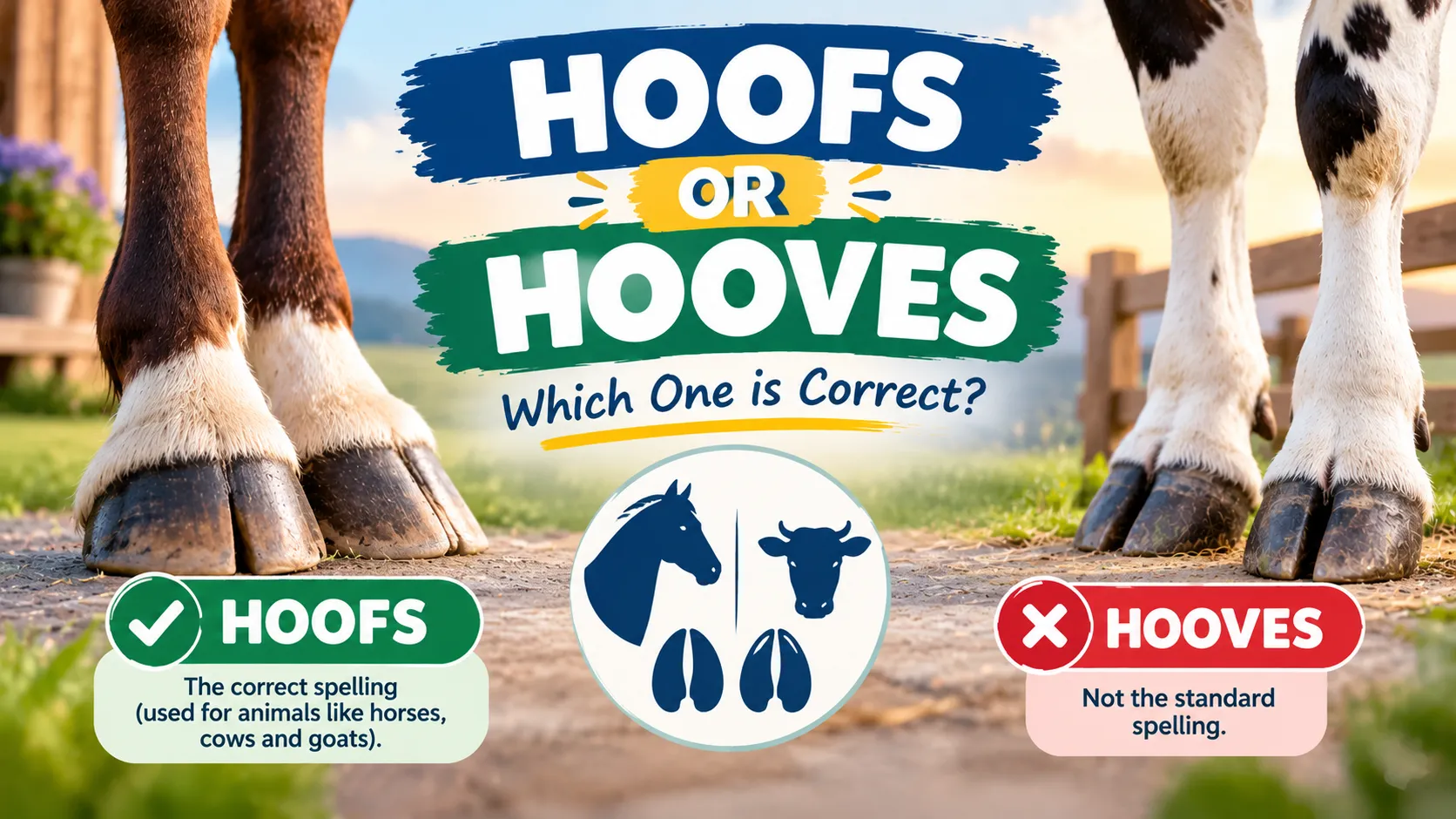
Have you Ever Wondered whether the correct plural of hoof is hoofs or hooves? Both spellings are correct in English, but understanding how they work can help you choose the right form for your writing.
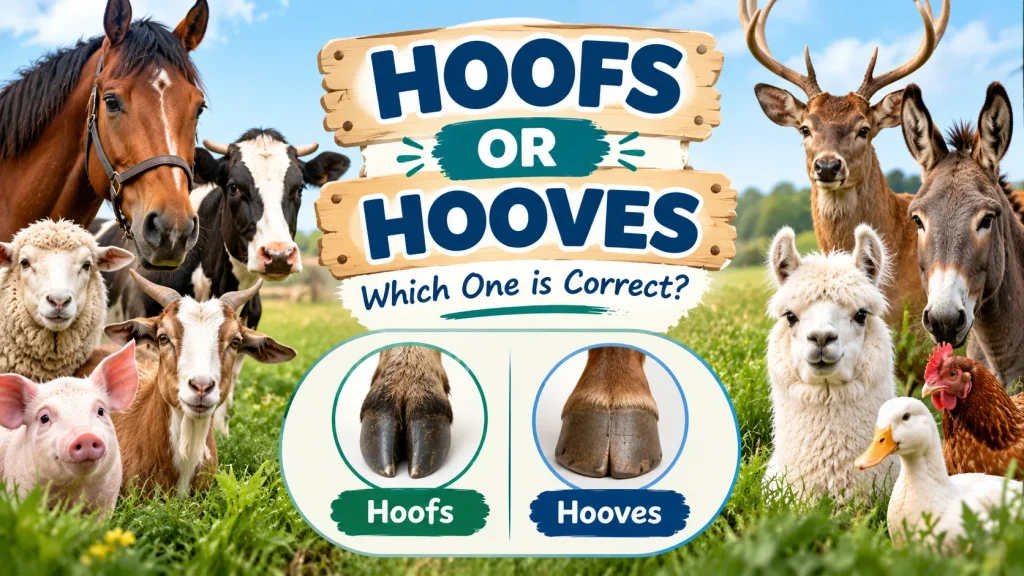
A hoof is the hard, protective covering on the foot of an animal such as a horse, cow, goat, or deer. When referring to more than one hoof, you can use either hoofs or hooves. Both forms are accepted, although hooves is a common choice in everyday writing.
In this guide, you will learn the difference between hoofs and hooves, understand their plural forms, explore practical examples, and discover common mistakes to avoid.
Hoofs or Hooves: The Quick Answer
Both hoofs and hooves are correct plural forms of the noun hoof. They refer to the same thing and do not have different meanings when used as plural nouns.
The main difference is spelling. Hoofs follows the regular plural pattern of adding -s, while hooves uses the spelling pattern in which the ending changes from -f to -ves.
For most general writing, hooves is a useful default because it is widely familiar to readers. However, hoofs is also acceptable, so you do not need to treat it as a spelling mistake.
Examples:
- The horse lifted its hooves as it walked.
- The farmer checked the cattle’s hoofs for signs of injury.
- The goat’s hooves left marks in the soft ground.
- The horses’ hoofs made a steady sound on the road.
All four sentences use a recognized form of the word.
Is Hoofs Correct?
Yes, hoofs is a correct plural of hoof. It follows the regular English rule of forming many plural nouns by adding -s to the singular form.
For example:
- One hoof, two hoofs
- One roof, two roofs
- One belief, several beliefs
The spelling hoofs can be used when referring to the feet of animals with hooves. It is not inherently incorrect, informal, or outdated.
Is Hooves Correct?
Yes, hooves is also a correct plural of hoof. It follows a different plural pattern in which the final -f changes to -ves.
Examples include:
- One hoof, two hooves
- One wolf, two wolves
- One calf, two calves
These examples demonstrate a spelling pattern found in English, although not every noun ending in -f follows it.
Which Form Should You Use?
Choose hooves as a practical default for general writing if you are unsure which form to use. It is familiar and widely used in everyday English.
However, hoofs is also grammatically acceptable. If you are following a particular dictionary, publication, or style guide, use the form recommended by that reference and remain consistent throughout your text.
What Does Hoof Mean?
The word hoof refers to the hard outer covering of the foot of certain mammals. It protects the end of the foot and helps the animal stand, walk, run, or move across different surfaces.
Hooves are especially associated with animals such as horses, cattle, sheep, goats, and deer.
The word is commonly used in animal care, farming, wildlife writing, veterinary discussions, and everyday conversation.
Examples:
- The horse injured one hoof while running.
- The veterinarian examined the animal’s hoof.
- A goat can climb over rocky ground using its strong hooves.
- The deer left a hoofprint in the mud.
Notice that hoof refers to one hoof, while hoofs and hooves can refer to more than one.
What Animals Have Hooves?
Many mammals have hooves, including horses, cows, goats, sheep, deer, and pigs. Different species have different hoof structures and movement patterns.
For example, horses have a single hoof on each foot, while cattle, goats, sheep, and deer have cloven hooves, meaning their hooves are divided into two main parts.
Examples:
- The horse’s hoof was carefully cleaned.
- The sheep’s hooves were covered in mud.
- The deer left several hoofprints near the stream.
- The farmer inspected the cows’ hooves before moving the herd.
These examples show how the word appears in everyday descriptions of animals.
Hoof as a Singular Noun
Hoof is a singular countable noun. Use it when referring to one hoof.
Examples:
- The horse has a small stone stuck in its hoof.
- A healthy hoof helps support the animal’s movement.
- The farrier examined each hoof carefully.
- The goat hurt one hoof while climbing.
When referring to multiple hooves, use either hoofs or hooves.
What Is the Difference Between Hoofs and Hooves?
The difference between hoofs and hooves is their spelling and plural formation, not their basic meaning.
Both words refer to more than one hoof when used as nouns. Neither spelling describes a different animal, a different body part, or a different condition.
| Feature | Hoofs | Hooves |
| Singular form | Hoof | Hoof |
| Grammatical role | Plural noun or verb form | Plural noun |
| Meaning as a noun | More than one hoof | More than one hoof |
| Plural pattern | Add -s | Change -f to -ves |
| Correct spelling | Yes | Yes |
| General writing | Acceptable | A useful default |
Examples:
- The horses’ hoofs were covered in dust.
- The horses’ hooves were covered in dust.
Both sentences communicate the same meaning.
Are Hoofs and Hooves Interchangeable?
Yes, when they are used as plural nouns, hoofs and hooves are interchangeable in meaning.
However, the word hoofs can also function as a verb form. This creates a grammatical difference between the two spellings in certain sentences.
Compare:
- The cow’s hooves were muddy. (Plural noun)
- The farmer cleaned the cow’s hoofs. (Plural noun)
- The horse hoofs the ground impatiently. (Verb)
In the third sentence, hoofs means that the horse strikes or scrapes the ground with its hoof. Here, it is not a plural noun.
Understanding the role of the word in a sentence helps you choose the correct form.
Why Does Hoof Have Two Plural Forms?
English has several ways to form plural nouns. Although adding -s is common, some nouns also have an alternative plural spelling that changes the final letters of the word.
The word hoof is one example of a noun that has two accepted plural forms.
The Regular Plural Rule: Hoof to Hoofs
One common way to form a plural noun is to add -s to the singular word.
This gives us:
- Hoof → Hoofs
- Book → Books
- Tree → Trees
- Roof → Roofs
The word hoofs follows this regular pattern. It is a valid plural form and should not automatically be corrected to hooves.
The F-to-V Plural Pattern: Hoof to Hooves
Some English nouns ending in -f form their plurals by changing -f to -ves.
Examples include:
- Wolf → Wolves
- Calf → Calves
- Leaf → Leaves
- Hoof → Hooves
However, English plural spelling is not completely predictable. Some words ending in -f take only -s, some take -ves, and others allow more than one form.
For example, roof normally becomes roofs, while hoof can become either hoofs or hooves.
The best approach is to learn the accepted forms of individual words rather than assuming every noun ending in -f follows the same rule.
Why English Allows Both Forms
English vocabulary has developed through different historical influences and spelling patterns. As a result, some nouns retain alternative plural forms.
For hoof, both the regular plural hoofs and the alternative hooves are recognized in modern English.
You do not need to memorize a separate meaning for each form. Instead, remember that both refer to multiple hooves and that the choice is mainly a matter of spelling preference and context.
When Should You Use Hooves?
Use hooves when you want a familiar, widely recognized plural form in general writing.
It works naturally in sentences about animals, farming, wildlife, riding, and animal care.
Examples:
- The horse’s hooves clicked against the stone floor.
- The veterinarian examined the cow’s hooves.
- The deer crossed the field, leaving its hooves in the wet grass.
- The young goats had small but strong hooves.
Hooves in Everyday English
In everyday conversation, hooves is a natural choice when discussing animal movement, appearance, or care.
Examples:
- The horse’s hooves need cleaning.
- Mud was stuck between the goat’s hooves.
- The sheep’s hooves left prints along the path.
- We heard the sound of the horses’ hooves approaching.
These sentences demonstrate how the word can be used without making the writing sound overly technical.
Hooves in Academic and Professional Writing
Hooves is suitable for educational material, animal-care articles, wildlife descriptions, and other formal or professional writing.
Examples:
- Healthy hooves are important for the mobility of many farm animals.
- Regular examination can help identify problems affecting a horse’s hooves.
- The study examined the relationship between ground conditions and hoof health.
- The animals’ hooves showed signs of wear after moving across rough terrain.
For technical or academic work, make sure any health-related claims are supported by reliable veterinary sources. The spelling choice itself does not change the scientific meaning.
When Should You Use Hoofs?
Use hoofs when it fits your writing style, your preferred dictionary, or a publication’s spelling conventions.
It is a correct plural noun, so there is no need to avoid it simply because hooves is more familiar to some readers.
Examples:
- The horses’ hoofs struck the ground.
- The farmer checked the cattle’s hoofs after bringing them into the barn.
- Dust covered the animals’ hoofs.
- The sound of the horses’ hoofs echoed through the stable.
Hoofs as an Accepted Plural Noun
The important point is that hoofs is not a misspelling. It is an accepted alternative plural form of hoof.
Some writers may prefer hooves, while others may use hoofs. Both choices can be correct when the word functions as a plural noun.
If you are editing an article, essay, or report, avoid changing every instance of hoofs merely because you personally prefer hooves. Check the intended style and maintain consistency.
When to Follow a Dictionary or Style Guide
When writing for a school, publisher, website, or professional organization, check whether it specifies a preferred dictionary or style guide.
If it does, follow its guidance consistently. If it does not, either accepted plural form can work.
For example, if your article uses hooves throughout, there is usually no reason to switch to hoofs halfway through without a clear purpose.
Consistency makes your writing easier to read and edit.
Hoofs or Hooves in British and American English
Both hoofs and hooves are Recognized English plural forms. Neither spelling should automatically be labeled exclusively British or exclusively American.
Although British and American English differ in many spelling conventions, this particular choice is not best explained by a simple regional rule.
Usage in British English
Both forms are understood in British English. Writers can use hooves as a familiar plural form or hoofs as an accepted alternative.
Examples:
- The horse’s hooves were cleaned after the ride.
- The farmer inspected the cattle’s hoofs.
Usage in American English
Both forms are also acceptable in American English.
Examples:
- The horses’ hooves left tracks in the snow.
- The rancher checked the animals’ hoofs.
If you are writing for an American audience, you can use hooves as a practical default. However, it would be inaccurate to claim that hoofs is always wrong in American English.
Is Either Form Regionally Incorrect?
No. The distinction between hoofs and hooves should not be reduced to a rule that one is British and the other is American.
Both are accepted plurals. Your choice should depend on your preferred wording, the reference you follow, and consistency within your article.
Hoofs, Hooves, and Hoof’s: Understanding the Difference
Plural nouns and possessive forms can look similar, but they perform different grammatical jobs.
Understanding the apostrophe is especially useful when writing about one animal, several animals, or something belonging to an animal.
Hoof
Hoof is the singular form. It refers to one hoof.
Example: The horse injured its hoof while running.
Hoofs and Hooves
Hoofs and hooves are plural forms. They refer to more than one hoof.
Examples:
- The horse lifted its hooves.
- The farmer examined the cattle’s hoofs.
Neither plural form requires an apostrophe when used as an ordinary noun.
Hoof’s
Hoof’s is the possessive form of the singular noun hoof. It indicates that something belongs to or is associated with one hoof.
Example: The hoof’s outer surface was covered in mud.
Here, the apostrophe indicates possession or association, not plurality.
Hooves’
Hooves’ is the possessive form of the plural noun hooves. It refers to something belonging to or associated with multiple hooves.
Example: The hooves’ tracks were visible in the wet soil.
Compare these forms:
- The horse’s hoof was dirty. (One hoof belonging to the horse)
- The horse’s hooves were dirty. (Multiple hooves belonging to the horse)
- The horses’ hooves were dirty. (Hooves belonging to multiple horses)
- The hooves’ tracks crossed the field. (Tracks made by the hooves)
These small differences can make a significant difference in the meaning of a sentence.
Common Mistakes with Hoofs and Hooves
Even though both plural forms are correct, writers sometimes confuse them with singular forms, possessives, or other spelling patterns.
Using Hoove as a Singular Noun
The standard singular noun is hoof, not hoove.
Incorrect: The cow hurt its hoove.
Correct: The cow hurt Its Hoof.
Use hoof for one and either hoofs or hooves for more than one.
Assuming Hoofs Is Incorrect
Some writers believe that only hooves is acceptable.
Incorrect claim: Hoofs is always a spelling mistake.
Correct explanation: Both hoofs and hooves are accepted plural forms.
If your dictionary or style guide recommends one form, follow that preference. Do not present the alternative as universally incorrect.
Adding an Unnecessary Ending to Hooves
Once you have written hooves, you do not need to add another plural ending.
Incorrect: The horses’ hoov eses were muddy.
Correct: The horses’ hooves were muddy.
The standard plural spelling is hooves.
Confusing Plurals with Possessives
A plural noun does not automatically require an apostrophe.
Incorrect: The horse’s hoove’s were dirty.
Correct: The horse’s hooves were dirty.
In the correct sentence, horse’s shows possession, while hooves is the plural noun.
Assuming Every F-Ending Noun Changes to VES
Not all nouns ending in -f form plurals with -ves.
For example:
- Roof → Roofs
- Chief → Chiefs
- Wolf → Wolves
- Hoof → Hoofs or hooves
Learning the accepted plural forms of individual words will help you avoid this mistake.
Switching Between Forms Without a Reason
Both spellings are correct, but changing between them unnecessarily can make a piece of writing less consistent.
For example, using hooves in one paragraph and hoofs in the next without a reason may distract readers.
Choose your preferred form and use it consistently unless a quotation, source, or specific editorial requirement calls for a different spelling.
Is Hoofs Ever a Verb?
Yes. Hoofs can function as a verb as well as a plural noun.
As a verb, hoofs is the third-person singular present-tense form of hoof. The verb can describe striking or scraping something with a hoof. It also appears in the informal expression hoof it, which means to walk, especially when traveling on foot.
The grammatical role depends on the sentence.
Hoofs as the Third-Person Singular Verb
Examples:
- The horse hoofs the ground when it becomes impatient.
- The animal hoofs the dirt before moving forward.
- The pony hoofs at the loose straw in its stall.
In these examples, hoofs describes an action performed by the animal.
Compare:
- The horse’s hooves are muddy. (Plural noun)
- The horse hoofs the ground. (Verb)
The spelling is the same in some cases, but the grammatical function is different.
The Meaning of Hoof It
The informal expression hoof it means to go somewhere on foot, usually by walking.
Examples:
- We missed the bus, so we had to hoof it home.
- The hikers decided to hoof it to the nearest village.
- If the car breaks down nearby, we can hoof it to the station.
In this expression, hoof is a verb. Its forms include hoof, hoofs or hooves in some verb usages, and hoofed for the past tense. The most important point for this article is that the plural noun hooves should not be confused with a verb simply because the spellings look similar.
Related To Another Article: https://grammixo.com/spay-or-neuter/
Related Word Forms of Hoof
Learning related forms of hoof can help you use the word more accurately.
Hoof as a Noun
As a noun, hoof refers to the hard covering of an animal’s foot.
Example: The farrier examined the horse’s hoof.
Hoof as a Verb
As a verb, hoof can refer to striking or scraping with a hoof. In informal English, hoof it means to travel on foot.
Example: The horse began to hoof the ground.
Hoofed
Hoofed is a form used to describe an animal that has hooves. It can also be the past-tense or past-participle form of the verb hoof.
Examples:
- Deer are hoofed mammals.
- The horse hoofed the ground before settling down.
Hoofing
Hoofing is the -ing form of the verb hoof.
Example: The horse was hoofing at the dirt while waiting.
The appropriate form depends on whether you are describing a body part, an animal, or an action.
Hoofs or Hooves: Practice Questions
Test your understanding of the two plural forms and related grammar rules.
Choose the correct answer for each sentence.
- The horse lifted its (hoof / hooves) over the fallen branch.
- The farmer examined the cattle’s (hoofs / hoove) carefully.
- The singular form of hooves is (hoof / hoove).
- The horse’s (hoof’s / hooves) were covered in mud.
- Both (hoofs / hooves) and hoofs are accepted plural forms of hoof.
- The horse (hoofs / hooves) the ground impatiently.
- The (hoof’s / hooves’) tracks were visible in the soil.
- The veterinarian checked the animal’s injured (hoof / hooves).
Answers and Explanations
- Hooves — The sentence refers to the plural form in a natural everyday context.
- Hoofs — This is an accepted plural form of hoof.
- Hoof — The standard singular noun is hoof.
- Hooves — The sentence refers to multiple hooves belonging to one horse.
- Hooves — Both hoofs and hooves are correct plural forms.
- Hoofs — Here, the word is a verb describing an action, not a plural noun.
- Hooves’ — The apostrophe comes after the plural noun to indicate possession or association.
- Hoof — The sentence refers to one injured hoof.
If you can identify whether the sentence needs a singular noun, plural noun, possessive, or verb, you can choose the correct form with confidence.
People Also Ask
A: Both are correct. Hoofs and hooves are accepted plural forms of hoof. For general writing, hooves is a useful default, but hoofs is not incorrect.
A: Yes. Hoofs is a recognized plural form of hoof. It can also be the third-person singular present-tense form of the verb hoof, depending on the context.
A: The singular form of hooves is hoof. For example, one horse has a hoof on each foot, while multiple feet have hooves.
A: Hooves is commonly pronounced /huːvz/, with a long “oo” sound, similar to the vowel sound in move. The final sound is /vz/.
A: English has different plural spelling patterns. Hooves follows a pattern in which the final -f changes to -ves. However, hoof also has the regular plural form hoofs.
Conclusion
The choice between Hoofs And Hooves is straightforward once you understand that both are correct plural forms of hoof. They share the same basic meaning, so the difference is mainly one of spelling and usage preference.
Use hooves as a practical default in general writing, or use hoofs when it fits your preferred style or reference guide. Remember that hoof is the singular noun, hoofs and hooves are accepted plurals, and hoof’s is a possessive form.
By learning these distinctions and applying them consistently, you can use the word confidently in essays, articles, educational content, and everyday communication.

1 thought on “Hoofs or Hooves: Which Plural Is Correct?”