Introduction
The words Withdraw And Withdrawal are closely related, but they serve different grammatical purposes. Both can refer to taking money out of a bank account, leaving a course, or removing something from a situation. However, choosing the correct word depends on how you construct your sentence.
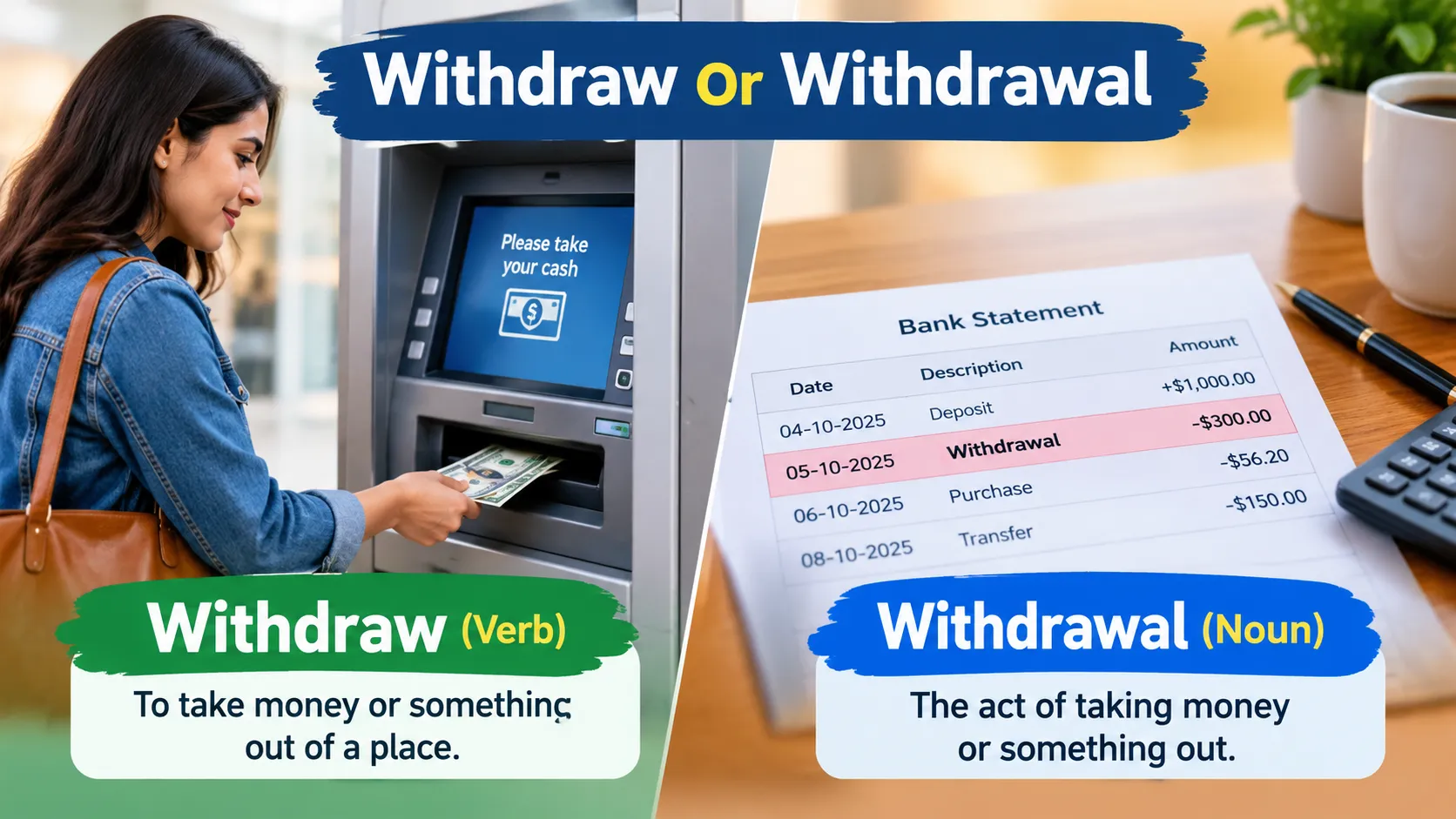
Withdraw is a verb that describes an action, while withdrawal is a noun that names the action or process. For example, you can withdraw money from your bank account, but you can also make a withdrawal. Understanding this difference will help you write more accurately in everyday conversations, academic assignments, banking transactions, and formal documents.
Withdraw vs. Withdrawal: The Quick Answer
Use withdraw when you need a verb to describe an action. Use withdrawal when you need a noun to refer to that action or process.
- Withdraw (verb): I need to withdraw some money.
- Withdrawal (noun): I made a withdrawal yesterday.
Both sentences are correct because each word has a different grammatical function. You would not normally say, “I need to withdrawal some money,” because withdrawal cannot replace the verb withdraw in that sentence.
Withdraw vs. Withdrawal at a Glance
| Feature | Withdraw | Withdrawal |
| Part of speech | Verb | Noun |
| Main function | Describes an action | Names an action or process |
| Example | She will withdraw her application. | Her withdrawal was approved. |
| Past form | Withdrew | No verb tense |
| Past participle | Withdrawn | Not applicable |
| -ing form | Withdrawing | Not applicable |
| Plural form | Not applicable | Withdrawals |
| Common context | Taking, removing, or leaving | The act or process of taking, removing, or leaving |
The easiest way to remember the distinction is to ask yourself whether your sentence needs an action word or the name of an action.
What Does Withdraw Mean?
Withdraw is a verb meaning to remove, take back, pull away, or leave a particular situation. Its exact meaning depends on the context.
The word appears in everyday English, banking, education, business, and official communication.
Withdraw as a Verb
A verb tells readers what someone or something does. Withdraw describes an action performed by a person, organization, or other subject.
Consider these examples:
- I plan to withdraw cash before the trip.
- The student decided to withdraw from the course.
- The company may withdraw its offer.
- The team had to withdraw from the competition.
In each example, withdraw or one of its verb forms describes an action.
Different Meanings of Withdraw
1. To take money out
In banking, withdraw means to remove money from a bank account.
Example: Maria went to the ATM to withdraw cash.
2. To remove or take back something
You can withdraw a request, application, offer, statement, or complaint.
Example: The applicant decided to withdraw her application.
3. To leave an activity or organization
The word can describe leaving a course, competition, agreement, or other organized activity.
Example: Daniel chose to withdraw from the training program.
4. To move away from a situation
Withdraw can also mean to move back or remove yourself from an activity or interaction.
Example: The organization decided to withdraw its staff from the project.
5. To stop providing support or participation
An organization or individual may withdraw support, permission, or participation.
Example: The sponsor threatened to withdraw its financial support.
These meanings share a common idea: something is being taken away, removed, or brought to an end.
Example Sentences With Withdraw
Here are additional examples showing how to use the verb correctly.
- I need to withdraw money for my household expenses.
- She will withdraw her name from the list.
- The manager asked him to withdraw the proposal.
- We decided to withdraw from the event.
- The candidate withdrew before the final round.
- The company has withdrawn its earlier offer.
- He is withdrawing from the discussion.
- The school allowed the student to withdraw from the class.
- They may withdraw their support if the conditions change.
Notice that the form of the verb changes according to the tense and sentence structure, but withdrawal remains a noun.
What Does Withdrawal Mean?
Withdrawal is a noun that refers to the act, process, or result of withdrawing. It can describe taking money out of an account, leaving a course, removing an application, or stepping away from a situation.
The noun can appear after articles such as a and the, after possessive words, or in other noun phrases.
Withdrawal as a Noun
A noun names a person, place, thing, concept, event, or process. Withdrawal names the action or process associated with the verb withdraw.
Consider these examples:
- The withdrawal took only a few minutes.
- Her withdrawal from the competition surprised everyone.
- The bank confirmed the cash withdrawal.
- His withdrawal from the discussion was voluntary.
In these sentences, withdrawal identifies an event, process, or act rather than directly describing what someone does.
Different Meanings of Withdrawal
1. Taking money from an account
A withdrawal is an amount of money taken from a bank account or the transaction in which money is removed.
Example: The bank recorded a cash withdrawal of $100.
2. Leaving a course or program
Withdrawal can refer to a student’s decision or formal process of leaving a class, school, or educational program.
Example: Her withdrawal from the course was approved.
3. Removing an application or request
The noun can describe the act of taking back an application, offer, or request.
Example: The withdrawal of his application was confirmed by email.
4. Ending participation or support
Withdrawal can refer to an individual or organization stopping its involvement or support.
Example: The withdrawal of financial support affected the project.
5. A medical or psychological context
In medical contexts, withdrawal can refer to symptoms or effects associated with stopping or reducing a substance or medication. The precise meaning depends on the situation and may require professional medical guidance.
Example: The patient discussed possible withdrawal symptoms with a healthcare professional.
Example Sentences With Withdrawal
The following sentences demonstrate the noun in different contexts.
- The bank charged a fee for the withdrawal.
- The company announced the withdrawal of its offer.
- We received confirmation of the withdrawal.
- The withdrawal of the complaint ended the formal process.
- A cash withdrawal is available at the ATM.
- The school processed his withdrawal from the program.
- The withdrawal of support changed the project’s plans.
- She submitted a withdrawal request online.
- The report explains the reasons for the withdrawal.
Withdraw vs. Withdrawal: Key Grammar Differences
The main difference between these words is their grammatical role. Knowing where each word belongs in a sentence is more useful than memorizing definitions alone.
Action vs. Event or Process
Use Withdraw when describing what someone does. Use withdrawal when referring to the action as an event, transaction, or process.
Compare the following sentences:
- Verb: The customer will withdraw the money.
- Noun: The customer’s withdrawal was recorded.
The first sentence describes an action the customer will perform. The second identifies the transaction itself.
Here is another comparison:
- Verb: She withdrew from the course.
- Noun: Her withdrawal from the course was accepted.
Both sentences communicate a similar idea, but their grammatical structures are different.
When to Use Withdraw After a Helping Verb
After the modal helping verbs will, can, could, may, might, must, and should, use the base form withdraw.
Correct examples:
- I will withdraw the application.
- You can withdraw your money tomorrow.
- She might withdraw from the program.
- They must withdraw the incorrect statement.
- He should withdraw his complaint.
Incorrect: She will withdrawal her application.
Correct: She will withdraw her application.
The same base form is used after to when to introduces an infinitive.
Correct examples:
- I want to withdraw some cash.
- They decided to withdraw their offer.
- He needs to withdraw from the competition.
When to Use Withdrawal After an Article or Noun Phrase
Use withdrawal when your sentence requires a noun.
Articles such as a and the often help identify noun phrases, although not every noun requires an article.
Examples:
- A withdrawal was made this morning.
- Her withdrawal surprised the committee.
- The bank approved the withdrawal request.
Compare:
- Correct: He made a withdrawal.
- Incorrect: He made a withdraw.
In this structure, made a requires a noun, so withdrawal is the appropriate choice.
Withdraw From vs. Withdrawal From
Both expressions can be correct, but they use different grammatical structures.
Withdraw from uses a verb followed by from and a noun phrase.
Examples:
- She decided to withdraw from the course.
- The company will withdraw from the agreement.
- He withdrew from the competition.
Withdrawal from uses a noun followed by from and a noun phrase.
Examples:
- The company’s withdrawal from the agreement was announced.
- His withdrawal from the competition surprised the audience.
The choice depends on the sentence. Use withdraw from to describe an action and withdrawal from to name that action or process.
The Correct Verb Forms of Withdraw
So, Withdraw is an irregular verb, so its past tense and past participle do not follow the regular pattern of simply adding -ed.
| Verb form | Correct word | Example |
| Base form | Withdraw | I withdraw cash when necessary. |
| Third-person singular | Withdraws | She withdraws money every month. |
| Simple past | Withdrew | He withdrew his application yesterday. |
| Past participle | Withdrawn | The offer has been withdrawn. |
| -ing form | Withdrawing | They are withdrawing their support. |
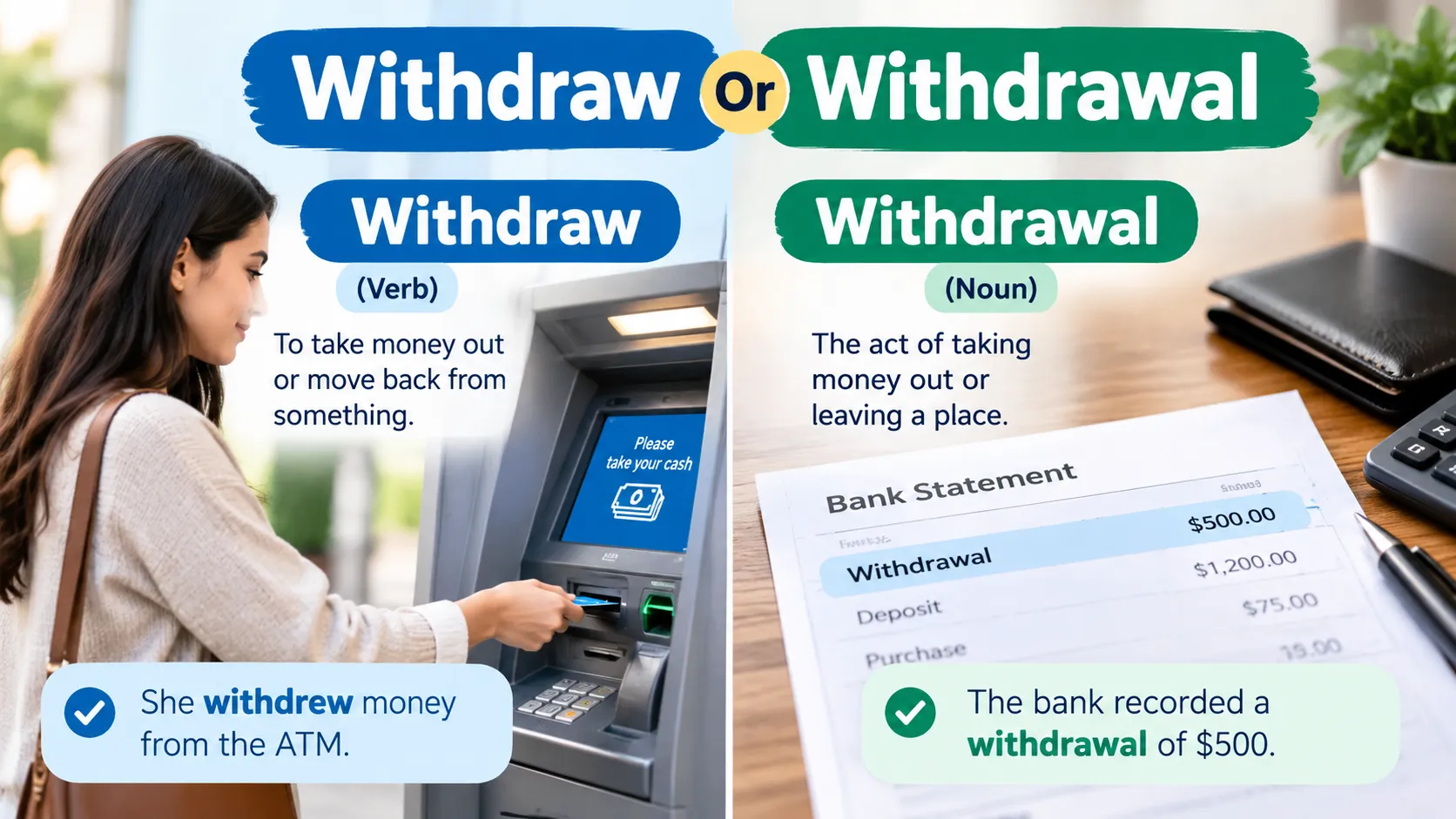
Withdraw, Withdraws, Withdrew, Withdrawn, and Withdrawing
So, Withdraw is the base form used with subjects such as I, you, we, and they in the simple present, and after modal verbs.
Example: They withdraw money from the account regularly.
Withdraws is used with third-person singular subjects such as he, she, and it in the simple present.
Example: She withdraws a small amount each week.
Withdrew is the simple past form.
Example: The candidate withdrew from the election last week.
Withdrawn is the past participle. It is commonly used with helping verbs such as has, have, and had, and in passive constructions.
Examples:
- She has withdrawn her application.
- The offer had been withdrawn before the meeting.
- The statement was withdrawn by its author.
Withdrawing is the -ing form used in continuous tenses and other grammatical constructions.
Examples:
- He is withdrawing his request.
- They were withdrawing from the agreement.
Withdraw vs. Withdrew vs. Withdrawn
These three forms are related, but they are not interchangeable.
Use withdraw for the base form or present-tense structures.
Example: I will withdraw the money tomorrow.
Use withdrew for a completed action in the simple past.
Example: I withdrew the money yesterday.
Use withdrawn with an appropriate helping verb or in a participial construction.
Example: I have withdrawn the money.
A common mistake is writing, “I have withdrew the money.” The correct sentence is “I have withdrawn the money” because have requires the past participle in this construction.
Is Withdrawal Countable or Uncountable?
Withdrawal can be countable or uncountable depending on its meaning and use in a sentence.
Withdrawal as a Countable Noun
When it refers to an individual transaction, event, or instance, it is commonly countable.
Examples:
- I made a withdrawal yesterday.
- The bank recorded three withdrawals.
- Two withdrawals appeared on the statement.
- Each withdrawal was reviewed separately.
The plural form is withdrawals.
Withdrawal as an Uncountable Noun
When it refers more generally to a process, condition, or concept, it can be used without an article and without a plural ending.
Examples:
- Withdrawal from the program requires approval.
- The report discusses withdrawal from public life.
- The patient received information about withdrawal.
The intended meaning and sentence structure determine whether the noun is countable or uncountable.
Withdrawal vs. Withdrawals
Use withdrawal for a singular countable transaction or when using the noun in an uncountable sense.
Example: The withdrawal was successful.
Use withdrawals when referring to multiple countable transactions or events.
Example: The bank statement lists four withdrawals.
Do not add an s to the verb withdraw simply because the action happens more than once. The subject and tense determine the verb form.
Correct: They withdraw money every Friday.
Correct: She withdraws money every Friday.
Withdraw or Withdrawal in Everyday Situations
Understanding The Grammatical difference becomes easier when you see both words in familiar situations.
Withdraw or Withdrawal in Banking
Banking is one of the most common contexts in which these words appear.
Use withdraw to describe taking money out of an account.
Examples:
- I need to withdraw cash before the shop closes.
- She withdrew money from her savings account.
- Customers can withdraw funds through an ATM.
Use withdrawal to refer to the transaction or amount taken out.
Examples:
- The withdrawal appeared on my bank statement.
- The bank confirmed the cash withdrawal.
- A withdrawal fee may apply to this transaction.
Compare these two sentences:
- I will withdraw $50 from my account.
- I made a withdrawal of $50 from my account.
Both are grammatically correct, but the first focuses on the action while the second focuses on the transaction.
Withdraw or Withdrawal in School and University
Students may encounter these terms when leaving a course or program.
Examples with withdraw:
- She decided to withdraw from the class.
- He wants to withdraw his university application.
- The student withdrew from the program before the deadline.
Examples with withdrawal:
- Her withdrawal from the class was approved.
- The university processed his withdrawal request.
- The withdrawal deadline is listed on the academic calendar.
Always check the institution’s policies because a course withdrawal may have academic or financial consequences.
Withdraw or Withdrawal in Applications and Official Writing
Both terms are common in professional communication.
Examples with withdraw:
- I would like to withdraw my application.
- The organization decided to withdraw its proposal.
- The candidate withdrew his request.
Examples with withdrawal:
- Please confirm the withdrawal of my application.
- The withdrawal request has been received.
- The organization announced the withdrawal of its proposal.
In formal writing, choose the word that fits the grammatical structure rather than the one that sounds more official.
Withdraw or Withdrawal in General Conversation
The verb and noun also appear in ordinary discussions about leaving activities or changing decisions.
Examples:
- I may withdraw from the discussion.
- His withdrawal from the conversation was unexpected.
- They decided to withdraw their invitation.
- The withdrawal of the invitation caused confusion.
- She withdrew her support for the proposal.
- Her withdrawal of support changed the outcome.
These examples show that the distinction applies well beyond banking.
Related To Another Article: https://grammixo.com/hoofs-or-hooves/
Common Mistakes With Withdraw and Withdrawal
Even experienced English learners can confuse these words because they share the same root and similar meanings.
Withdraw vs. Withdrawal in the Wrong Sentence Position
The most common mistake is using the noun where a verb is needed or the verb where a noun is required.
Incorrect: I want to withdrawal some money.
Correct: I want to withdraw some money.
Incorrect: He made a withdraw.
Correct: He made a withdrawal.
Incorrect: The withdrawal the application was necessary.
Correct: The withdrawal of the application was necessary.
The first two errors involve choosing the wrong part of speech. The third needs the preposition of to connect the noun withdrawal to the thing being withdrawn.
Withdrawal vs. Withdrawl: Which Spelling Is Correct?
The correct spelling is withdrawal. The spelling withdrawl is a common misspelling and should generally be avoided in standard English writing.
Correct examples:
- The withdrawal was approved.
- She submitted a withdrawal request.
- The bank recorded several withdrawals.
Incorrect examples:
- The withdrawl was approved.
- She submitted a withdrawl request.
A useful spelling reminder is to retain the -al ending in withdrawal. Do not assume that removing the final letters from withdraw and adding an l produces the noun.
Withdrew vs. Withdrawn: Avoiding Verb-Form Errors
Another frequent mistake is confusing the simple past form with the past participle.
Incorrect: She has withdrew her application.
Correct: She has withdrawn her application.
Incorrect: He withdrawn from the competition yesterday.
Correct: He withdrew from the competition yesterday.
Remember:
- Simple past: withdrew
- Past participle: withdrawn
Use withdrew for a simple past action. Use withdrawn in constructions that require a past participle, such as has withdrawn or was withdrawn.
Using Withdrawal Without the Correct Preposition
When explaining what was withdrawn, the noun often takes the preposition of. When describing leaving a course, group, or activity, the expression commonly uses from.
Examples:
- The withdrawal of the offer was announced.
- Her withdrawal from the course was approved.
- The withdrawal of financial support affected the project.
The appropriate preposition depends on the relationship between the noun and the information that follows it.
Withdraw vs. Withdrawal: Pronunciation Guide
Both words begin with the same root, but their endings differ.
- Withdraw: commonly pronounced /wɪðˈdrɔː/ in many British pronunciations and /wɪðˈdrɔː/ or a similar regional form in American English.
- Withdrawal: commonly pronounced /wɪðˈdrɔːəl/ in British English and /wɪðˈdrɔːəl/ or a similar regional form in American English.
Pronunciation varies by accent. In both words, the main stress falls on the second syllable: with-DRAW and with-DRAW-al.
Practice the words in short sentences:
- I will withdraw the money.
- The withdrawal was completed.
- They withdrew from the competition.
- The withdrawal request was accepted.
Reading the words aloud in context can help you remember both their pronunciation and their grammatical function.
Easy Tips to Remember the Difference
If you regularly confuse withdraw and withdrawal, use these simple reminders.
1. Remember the part of speech.
Withdraw is a verb; withdrawal is a noun.
2. Check what comes before the word.
After will, can, should, or to in an infinitive, the base verb withdraw is usually required.
Example: She wants to withdraw.
3. Look for noun patterns.
Expressions such as a withdrawal, the withdrawal, and several withdrawals use the noun.
Example: The bank processed a withdrawal.
4. Remember the irregular past forms.
The simple past is withdrew, and the past participle is withdrawn.
5. Replace the word to test the sentence.
If you can replace the word with an action such as leave or remove, you may need a verb. If you can replace it with the act of leaving or the transaction, you may need a noun. Always check that the replacement fits the sentence.
Withdraw or Withdrawal? Practice Quiz
Choose the correct word or verb form to complete each sentence. Try answering before checking the solutions.
- I need to ______ some cash before the journey. (withdraw / withdrawal)
- The bank confirmed the ______ yesterday. (withdraw / withdrawal)
- She has ______ her application. (withdrew / withdrawn)
- He decided to ______ from the course. (withdraw / withdrawal)
- The student’s ______ was approved. (withdraw / withdrawal)
- They will ______ their proposal tomorrow. (withdraw / withdrawal)
- The statement was ______ by its author. (withdrew / withdrawn)
- The bank recorded three ______ this month. (withdrawal / withdrawals)
- She ______ from the competition last year. (withdrew / withdrawn)
- I want to ______ my request. (withdraw / withdrawal)
Answers and Explanations
- Withdraw — To introduces the base verb in this sentence.
- Withdrawal — The sentence needs a noun referring to the transaction.
- Withdrawn — The helping verb has requires the past participle.
- Withdraw — The infinitive construction to withdraw is correct.
- Withdrawal — The possessive phrase the student’s is followed by a noun.
- Withdraw — The modal verb will is followed by the base verb.
- Withdrawn — The passive construction uses the past participle.
- Withdrawals — The number three requires the plural countable noun.
- Withdrew — The sentence describes a completed action in the past.
- Withdraw — The phrase want to takes the base verb.
People Also Ask
A: Withdraw is a verb. It describes an action, such as taking money out of an account, removing an application, or leaving a course.
Example: I will withdraw my application.
A: Withdrawal is a noun. It names the act, transaction, event, or process of withdrawing.
Example: The withdrawal of the application was confirmed.
A: Write “I want to withdraw.” The word to introduces an infinitive verb in this construction, so the base form withdraw is correct. Withdrawal is a noun and cannot replace it.
A: No. In standard English, the correct spelling is withdrawal. The form withdrawl is a misspelling.
A: The simple past tense is withdrew, and the past participle is withdrawn.
Examples:
Past: She withdrew her application.
Past participle: She has withdrawn her application.
Conclusion
The difference between Withdraw And Withdrawal becomes straightforward once you understand their grammatical roles. Withdraw is a verb that describes an action, while withdrawal is a noun that names the action, event, or process.
Use withdraw in sentences such as “I need to withdraw money” and “She decided to withdraw from the course.” Use withdrawal in sentences such as “I made a withdrawal” and “Her withdrawal from the course was approved.”
Also remember the irregular verb forms: withdraw, withdraws, withdrew, withdrawn, and withdrawing. Learning these forms alongside the noun withdrawal will help you avoid common mistakes in everyday English, banking, academic writing, and professional communication.
When in doubt, identify whether your sentence needs an action or the name of an action. That simple check will help you choose the correct word confidently.

1 thought on “Withdraw or Withdrawal: Meaning, Difference & Examples”