
Introduction
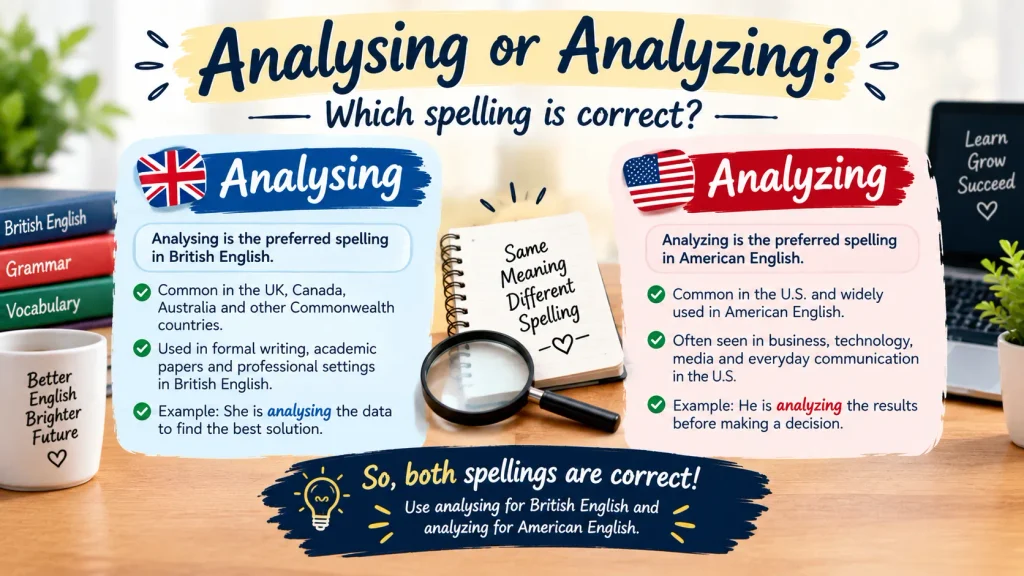
If you have ever wondered whether to write analysing or analyzing, the answer is simple: both spellings are correct. The difference depends on the variety of English you use. Analysing is the standard British English spelling, while analyzing is the standard American English spelling.
Both words have the same meaning: to examine something carefully to understand its details, structure, or significance. Whether you are writing an academic essay, a business report, or a blog post, choosing the appropriate spelling will help keep your writing clear and consistent.
In this guide, you will learn the difference between analysing and analyzing, explore their grammatical forms, and discover practical examples to help you choose the right spelling.
Quick Answer: Analysing or Analyzing?
Both analysing and analyzing are correct spellings of the present participle of the verb.
- Analysing: Preferred in British English.
- Analyzing: Preferred in American English.
- Meaning: To examine something in detail.
- Pronunciation: Generally the same in both varieties.
- Usage: Both can be used in continuous verb forms and as gerunds.
British English: The students are analysing the results.
American English: The students are analyzing the results.
Both sentences are grammatically correct and communicate exactly the same idea. The only difference is the spelling convention.
What Does Analysing or Analyzing Mean?
Analysing and analyzing mean examining something systematically and carefully to understand how it works, identify important details, or reach a conclusion.
The word is commonly used when discussing information, data, literature, scientific results, business performance, or a problem that requires careful thought.
For example:
- A student analyses a poem to understand its meaning.
- A scientist analyses samples to identify their contents.
- A business owner analyzes sales figures to understand customer behaviour.
- A researcher analyses survey responses to identify patterns.
The choice between analysing and analyzing does not change the meaning. It simply reflects the spelling variety being used.
Analysing or Analyzing in Everyday English
These words appear in many everyday situations.
Education: Students analyse information before writing an assignment.
Business: Managers analyze reports before making decisions.
Science: Researchers analyse experimental results.
Technology: Developers analyze data to identify trends.
Literature: Readers analyse characters, themes, and symbolism in a novel.
In each example, the verb describes the process of examining something carefully rather than simply looking at it.
Analysing vs. Analyzing: Key Differences
The main difference between analysing and analyzing is regional spelling. Both forms serve the same grammatical purpose and have the same meaning.
| Feature | Analysing | Analyzing |
| Preferred English variety | British English | American English |
| Base verb | Analyse | Analyze |
| Past tense | Analysed | Analyzed |
| Present participle | Analysing | Analyzing |
| Meaning | Examining carefully | Examining carefully |
| Pronunciation | Generally the same | Generally the same |
| Correctness | Correct | Correct |
Remember that the spelling of the base verb determines which form you should use. If you write analyse, use analysing. If you write analyze, use analyzing.
This approach helps maintain consistency throughout your writing.
When to Use Analysing
Use analysing when writing in British English or following a style guide that prefers British spelling.
This spelling is common in British educational materials, academic writing, professional documents, and publications that follow British English conventions.
Examples of Analysing in Sentences
- The researcher is analysing the survey results.
- We are analysing the causes of the problem.
- She enjoys analysing classic novels.
- The students were analysing the poem in class.
- The company is analysing customer feedback.
- Scientists are analysing samples collected from the river.
- He spent the afternoon analysing the financial report.
- The teacher is analysing the students’ progress.
Each sentence uses analysing correctly according to British spelling conventions.
Analysing in Academic Writing
Students may use analysing when examining evidence, evaluating arguments, or interpreting information in an essay.
For example:
The essay focuses on analysing the author’s use of symbolism.
If your school, college, or university requires British English, this spelling is generally appropriate. However, always check the institution’s instructions before submitting academic work.
When to Use Analyzing
Use analyzing when writing in American English or following a style guide that requires American spelling.
It is the usual spelling in American educational resources, business documents, research papers, and publications.
Examples of Analyzing in Sentences
- The researcher is analyzing the survey results.
- We are analyzing the causes of the problem.
- She enjoys analyzing classic novels.
- The students were analyzing the poem in class.
- The company is analyzing customer feedback.
- Scientists are analyzing samples collected from the river.
- He spent the afternoon analyzing the financial report.
- The teacher is analyzing the students’ progress.
These sentences demonstrate the American spelling of the same verb.
Analyzing in Business and Research
The word is frequently used when describing the examination of statistics, customer behaviour, financial records, and experimental results.
For example:
The research team is analyzing the data before publishing its findings.
When writing for an American audience, analyzing is generally the natural choice.
Analysing or Analyzing in British and American English
British and American English contain several spelling differences. Some words use different vowels, while others differ in their endings.
For example:
| British English | American English |
| Analyse | Analyze |
| Analysing | Analyzing |
| Analysed | Analyzed |
| Colour | Color |
| Centre | Center |
| Labour | Labor |
| Theatre | Theater |
The analyse/analyze distinction is a spelling convention rather than a difference in meaning.
What About Australian and New Zealand English?
Australian and New Zealand English generally follow British spelling conventions, so analyse, analysing, and analysed are common forms.
However, English spelling preferences can vary between publications and institutions. If you are writing for a particular organization, follow its preferred style.
Which Spelling Should Pakistani and Indian Writers Use?
Writers in Pakistan and India often encounter British English spelling in educational settings, but individual schools, universities, employers, and publications may follow different conventions.
The best choice depends on your intended audience and the requirements of your assignment or publication.
- For a British English assignment, use analysing.
- For an American English assignment, use analyzing.
- For professional writing, follow your organization’s style guide.
- For a website, choose a consistent spelling style suited to your main audience.
Neither spelling is inherently better. Correctness depends on using the appropriate form consistently.
Analysing vs. Analyzing: Spelling Rules Explained
Understanding the base verb makes the difference between these spellings easy to remember.
The British form is analyse, while the American form is analyze. When the -ing ending is added, the final e is dropped and the ending is added to the remaining word.
This produces:
- Analyse → Analysing
- Analyze → Analyzing
The same distinction appears in the past-tense forms:
- Analyse → Analysed
- Analyze → Analyzed
Analysing and Analyzing
Both forms describe the ongoing process of examining something carefully.
British: They are analysing the evidence.
American: They are analyzing the evidence.
Analysed and Analyzed
Both forms are correct past-tense and past-participle forms of the verb.
British: The team analysed the results yesterday.
American: The team analyzed the results yesterday.
Analyse and Analyze
These are the base forms of the verb.
British: We analyse every application carefully.
American: We analyze every application carefully.
Analysis and Analyses
These words require particular attention because they have different grammatical uses.
- Analysis: A singular noun referring to a detailed examination.
- Analyses: The plural form of the noun analysis, or the third-person singular present-tense form of the verb.
Examples:
The analysis revealed an important pattern.
The researchers published three separate analyses.
She analyses the results before writing her report.
Notice that analyses can be a noun or a verb. Its function depends on how it is used in the sentence.
Is Analysing a Verb, a Gerund, or a Present Participle?
Analysing is a form of the verb analyse. Depending on the sentence, it can function as a present participle or a gerund.
The American spelling, analyzing, works in the same way.
Analysing as a Present Participle
A present participle is commonly used with a form of be to create continuous verb tenses.
Examples:
- She is analysing the report.
- They were analysing the results.
- We are analysing the problem.
In these sentences, analysing forms part of the verb phrase and describes an ongoing action.
Analysing as a Gerund
A gerund is an -ing form of a verb that functions as a noun.
Examples:
- Analysing data requires patience.
- She enjoys analysing historical documents.
- Analysing the evidence helped us understand the situation.
In the first sentence, analysing data functions as the subject. In the second, analysing historical documents is the activity she enjoys.
The same grammatical rules apply to analyzing in American English.
Analysing or Analyzing: Example Sentences
The following examples demonstrate how both spellings work in different contexts.
Academic Writing
British English: The student is analysing the arguments presented in the article.
American English: The student is analyzing the arguments presented in the article.
British English: Analysing historical sources can reveal new perspectives.
American English: Analyzing historical sources can reveal new perspectives.
Business and Data Analysis
British English: Our team is analysing customer purchasing patterns.
American English: Our team is analyzing customer purchasing patterns.
British English: The manager analysed last month’s sales figures.
American English: The manager analyzed last month’s sales figures.
Science and Research
British English: Scientists are analysing water samples from the lake.
American English: Scientists are analyzing water samples from the lake.
British English: The researchers analysed the experimental results.
American English: The researchers analyzed the experimental results.
Everyday Situations
British English: I am analysing the situation before making a decision.
American English: I am analyzing the situation before making a decision.
British English: He enjoys analysing complicated problems.
American English: He enjoys analyzing complicated problems.
Literature and Text Analysis
British English: The class is analysing the main character’s decisions.
American English: The class is analyzing the main character’s decisions.
British English: She wrote an essay analysing the poem’s central theme.
American English: She wrote an essay analyzing the poem’s central theme.
These examples show that the meaning and grammatical function remain unchanged across the two spelling varieties.
Common Mistakes to Avoid
Although analysing and analyzing are both correct, writers can still make mistakes when choosing between them or using related words.
1. Mixing British and American Spellings
Using analysing in one paragraph and analyzing in another may make a document inconsistent.
Better approach: Choose one spelling convention and use it throughout the document unless you are quoting a source that uses a different form.
2. Confusing Analysis with Analysing
These words have related meanings but different grammatical functions.
Incorrect: The analysing was useful.
Correct: The analysis was useful.
Use analysis when you need a noun describing an examination or its results. Use analysing when referring to the activity itself.

3. Confusing Analysis with Analyses
Analysis is singular, while analyses is its plural form.
Correct: The analysis was detailed.
Correct: The two analyses produced different conclusions.
However, analyses can also be a verb.
Correct: She analyses the information carefully.
4. Using the Wrong Past-Tense Form
The spelling of the past tense should match your chosen English variety.
British English: The team analysed the report.
American English: The team analyzed the report.
5. Ignoring the Required Style Guide
A school, university, employer, or publisher may specify which English variety to use.
Better approach: Check the relevant instructions before finalizing your work.
6. Assuming One Spelling Is Always Incorrect
Neither analysing nor analyzing is universally incorrect.
The appropriate form depends on the spelling convention you are following. Both are accepted forms of the same verb.
Related To Another Article: https://grammixo.com/moustache-or-mustache/
Analysing or Analyzing: Comparison Table
Use this table as a quick reference when writing.
| Word Form | British English | American English |
| Base verb | Analyse | Analyze |
| Third-person singular | Analyses | Analyzes |
| Present participle | Analysing | Analyzing |
| Past tense | Analysed | Analyzed |
| Past participle | Analysed | Analyzed |
| Singular noun | Analysis | Analysis |
| Plural noun | Analyses | Analyses |
The noun forms analysis and analyses are spelled the same way in both British and American English.
The main regional difference appears in the verb forms.
Which Spelling Should You Use?
Choosing between analysing and analyzing is straightforward once you know your audience.
For a British Audience
Use analysing when writing according to standard British English conventions.
For example:
The researcher is analysing the results of the study.
For an American Audience
Use analyzing when writing according to American English conventions.
For example:
The researcher is analyzing the results of the study.
For Academic Assignments
Check your institution’s spelling and style requirements. If no specific variety is required, choose a consistent convention and apply it throughout your assignment.
For Websites and Blogs
Consider the main audience of your website. If your content primarily targets readers in the United States, analyzing may be the more suitable choice. For a British English audience, analysing is generally appropriate.
You do not need to repeat the keyword excessively to make the spelling choice clear. A natural explanation with relevant examples is more useful to readers.
For International Readers
Either form can communicate the intended meaning. The important thing is to maintain consistency and respect any specific editorial requirements.
People Also Ask
A: Both are correct. Analysing is the preferred British English spelling, while analyzing is the standard American English spelling. Both mean examining something carefully.
A: Analysing is the standard British English form. It is derived from the verb analyse.
A: Yes. Analyzing is the standard American English spelling of the present participle of analyze.
A: Yes. Both words mean examining information, evidence, or a situation carefully to understand it better. The difference is regional spelling, not meaning.
A: They are generally pronounced the same way, although individual accents may vary. The spelling difference does not ordinarily change the pronunciation.
Conclusion
The choice between analysing and analyzing depends on the variety of English you are using. Both spellings are correct and have the same meaning.
Use analysing for British English and analyzing for American English. Remember that the same distinction applies to analyse/analyze and analysed/analyzed, while the nouns analysis and analyses retain the same spellings in both varieties.
Whether you are writing an essay, preparing a report, or publishing content on Grammixo.com, choose the form that suits your audience and use it consistently.

1 thought on “Analysing Or Analyzing”