Introduction
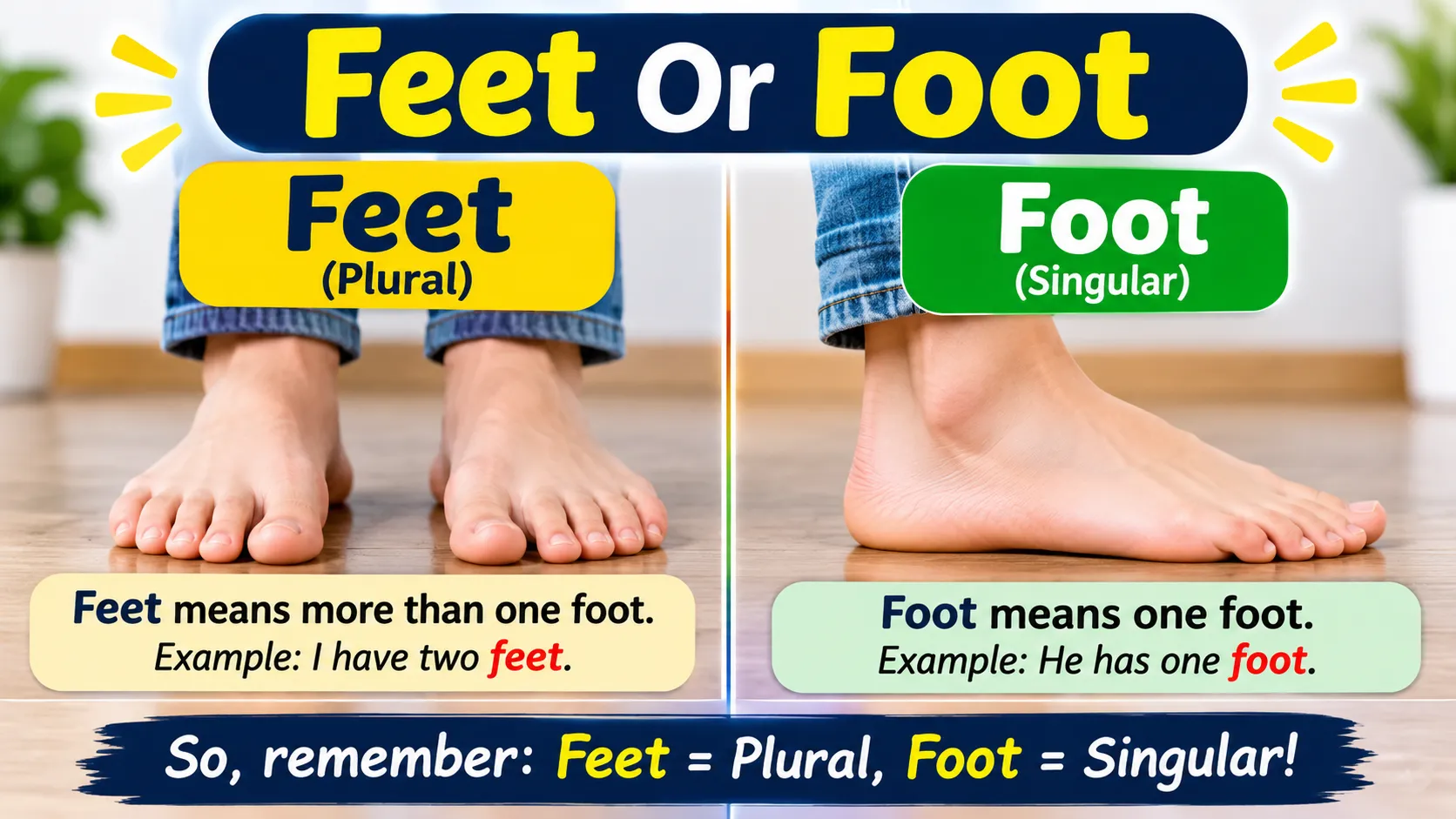
Feet And Foot are both correct English words, but they are not interchangeable in every sentence. The basic rule is simple: foot is the singular form, while feet is the usual plural form.
However, measurements create a few important exceptions.
For example:
- One foot
- Two feet
- Six feet tall
- A six-foot wall
Why do we say “six feet tall” but “a six-foot wall”? The answer depends on how the measurement functions in a sentence.
This guide explains feet vs. foot, including body parts, measurements, height, compound adjectives, common mistakes, examples, and practice exercises.
2. Quick Answer: Foot vs. Feet
The easiest way to understand the difference is:
| Word | Use | Example |
| Foot | Singular body part | My foot hurts. |
| Feet | Plural body part | My feet hurt. |
| Foot | One measurement unit | The table is one foot long. |
| Feet | Multiple measurement units | The table is six feet long. |
| Foot | Compound adjective | A six-foot wall. |
Remember:
- One = foot
- More than one = feet
- Before a noun as a compound modifier = foot
For example:
- The wall is 10 feet high.
- It is a 10-foot wall.
Both sentences are correct because the measurements have different grammatical functions.
3. What Does Foot Mean?
Foot is a singular noun with several meanings.
Foot as a Body Part
A foot is the part of the leg below the ankle that a person or animal stands and walks on.
Examples:
- My foot hurts.
- I injured my left foot.
- He kicked the ball with his right foot.
- She has a small cut on her foot.
The plural is feet, not foots.
Foot as a Unit of Measurement
A foot is a unit of length equal to 12 inches or 0.3048 meters.
Examples:
- The rope is one foot long.
- The table is one foot wide.
- The room is one foot taller than expected.
Foot as the Bottom of Something
Foot can also refer to the bottom or lower end of an object or place.
Examples:
- They built a house at the foot of the mountain.
- There was a chair at the foot of the bed.
- The note appears at the foot of the page.
4. What Does Feet Mean?
Feet is the usual irregular plural of foot.
It can refer to two or more body parts or multiple units of measurement.
Feet as Body Parts
Examples:
- My feet are cold.
- Both feet were injured.
- She washed her feet.
- His feet were covered in mud.
Feet as Measurements
Examples:
- The pool is six feet deep.
- The building is 100 feet tall.
- The road is 20 feet wide.
- The airplane was flying at 30,000 feet.
5. Foot vs. Feet: The Main Difference
Here is a simple comparison:
| Situation | Correct Form | Example |
| One body part | Foot | I hurt my foot. |
| More than one body part | Feet | Both my feet hurt. |
| One measurement | Foot | The board is one foot long. |
| Multiple measurements | Feet | The board is six feet long. |
| Measurement before a noun | Foot | A six-foot board |
| Height measurement | Feet | He is six feet tall. |
| Height used as a modifier | Foot | A six-foot-tall man |
The important point is that number alone does not always determine whether you use foot or feet. The grammatical position of the measurement also matters.
6. Why Is the Plural of Foot Feet?
Foot → feet is an example of an irregular plural noun.
Many English nouns form plurals by adding -s:
- Book → books
- Car → cars
- Table → tables
However, some nouns change their spelling:
- Tooth → teeth
- Goose → geese
- Man → men
- Woman → women
- Foot → feet
Therefore:
- Incorrect: Two foots
- Correct: Two feet
For ordinary modern English, feet is the standard plural when referring to multiple feet or measurement units.
7. Foot or Feet When Talking About Body Parts
The body-part rule is straightforward.
Use Foot for One
- My foot hurts.
- I hurt my right foot.
- She injured one foot.
- His left foot is swollen.
Use Feet for More Than One
- My feet hurt.
- Both feet are cold.
- She washed her feet.
- His feet were dirty.
Compare:
“I hurt my foot.”
This means one body part.
“I hurt both feet.”
This means two body parts.
8. Foot or Feet as a Unit of Measurement
A foot is a measurement of length.
The basic conversion is:
1 foot = 12 inches = 0.3048 meters
For example:
- The table is 1 foot long.
- The table is 3 feet long.
- The room is 10 feet wide.
- The tree is 20 feet tall.
- The pool is 6 feet deep.
- The ladder is 12 feet high.
In ordinary measurement statements, feet is generally used for quantities greater than one.
9. Is It One Foot or One Feet?
The correct expression is one foot, not one feet.
Examples:
- The ruler is one foot long.
- The box is one foot wide.
- The rope is one foot shorter.
The same rule applies when using the number 1:
- Correct: 1 foot
- Incorrect: 1 feet
10. Is It Two Feet or Two Foot?
In an ordinary measurement statement, use two feet.
Examples:
- The table is two feet long.
- The hole is two feet deep.
- The wall is two feet high.
However, two-foot can be correct when it functions as a compound adjective.
Examples:
- A two-foot table
- A two-foot wall
- A two-foot ruler
Both forms can be correct, depending on the grammatical structure.
11. Why Do We Say Six Feet Tall but a Six-Foot Wall?
This is one of the most important distinctions in the feet or foot question.
Consider these two sentences:
- The wall is 6 feet tall.
- It is a 6-foot wall.
Both are correct.
Six Feet Tall
Here, six feet is the measurement being stated.
Six-Foot Wall
Here, six-foot works as a compound adjective describing the noun wall.
The general pattern is:
Measurement after the verb:
The wall is 10 feet high.
Measurement before a noun:
It is a 10-foot wall.
This explains why the measurement unit becomes singular when it is part of a compound modifier.
12. Foot in Compound Adjectives
A compound adjective consists of two or more words that work together to describe a noun.
Measurements frequently form compound adjectives.
Examples:
- A 10-foot wall
- A 20-foot ladder
- A 6-foot table
- A 12-foot boat
- A 50-foot tree
- A 100-foot building
Notice that foot remains singular.
Incorrect: A 10-feet wall.
Correct: A 10-foot wall.
This is because 10-foot functions as one descriptive unit.
13. Feet vs. Foot When Talking About Height
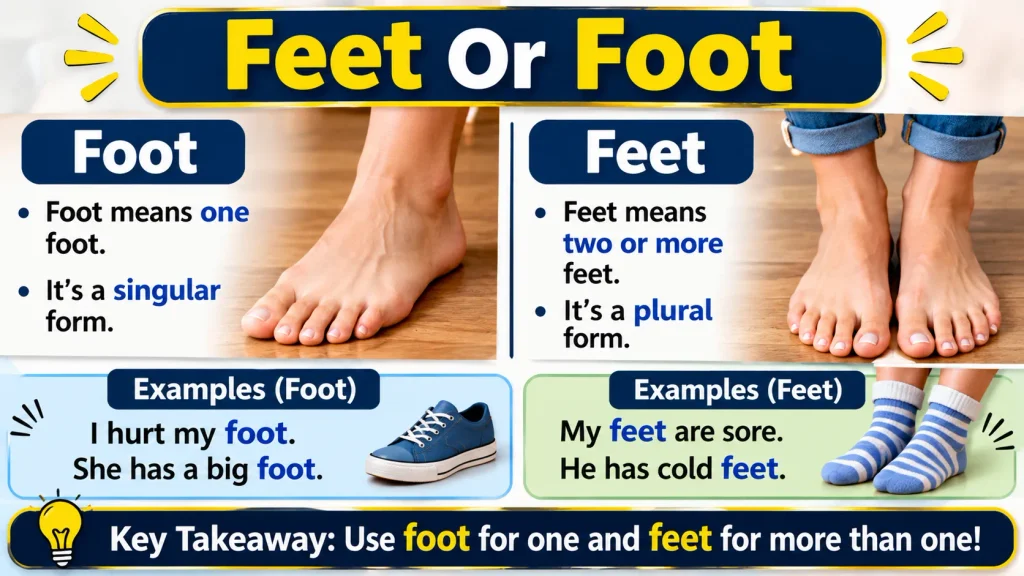
Height is one of the most common situations where people search for “6 foot or 6 feet.”
For a normal height measurement, feet is the standard form.
Examples:
- He is six feet tall.
- She is five feet four inches tall.
- The player is 6 feet 6 inches tall.
When the height comes before a noun, use foot:
- A six-foot-tall man
- A five-foot-four child
- A 6-foot-6 basketball player
The grammatical structure changes, so the form changes too.
14. Is Six Foot Tall Correct?
You may sometimes hear:
“He is six foot tall.”
This form occurs in informal speech and Some Varieties of English.
However, for standard formal writing, six feet tall is the safest and clearest choice.
For example:
- Standard: He is six feet tall.
- Compound adjective: He is a six-foot-tall man.
This distinction is particularly useful for students, professional writers, and English learners.
15. 5 Feet 8 Inches vs. 5-Foot-8
A person’s height can be written in several ways.
Full Measurement
He is 5 feet 8 inches tall.
Compact Form
He is 5-foot-8.
Compound Description
He is a 5-foot-8 basketball player.
For clear formal writing, the full measurement is often easiest to understand.
16. Foot or Feet With Numbers
The basic number rule is:
| Number | Normal Measurement |
| 1 | 1 foot |
| 2 | 2 feet |
| 3 | 3 feet |
| 5 | 5 feet |
| 6 | 6 feet |
| 10 | 10 feet |
| 20 | 20 feet |
Examples:
- The room is 1 foot wide.
- The room is 5 feet wide.
- The wall is 10 feet high.
- The tree is 20 feet tall.
Remember that compound adjectives use singular foot:
- A 1-foot ruler
- A 5-foot table
- A 10-foot wall
- A 20-foot ladder
17. Foot or Feet With Decimals
Decimals can make learners unsure about singular and plural forms.
In normal measurement expressions, quantities other than exactly one generally use feet.
Examples:
- 0.5 feet
- 1.5 feet
- 2.5 feet
- 10.5 feet
Example sentences:
- The board is 1.5 feet long.
- The hole is 2.5 feet deep.
- The object is 0.5 feet away.
The grammatical choice depends on the quantity being expressed.
18. Foot or Feet With Ranges
For measurement ranges, feet is commonly used.
Examples:
- 5–10 feet
- 10–20 feet
- 20–30 feet
- 50–100 feet
Example sentences:
- The tree is approximately 20–30 feet tall.
- Keep a distance of 5–10 feet.
You may also see the abbreviation:
5–10 ft
19. What Is the Abbreviation for Foot and Feet?
The common written abbreviation for both foot and feet is ft.
Examples:
- 5 ft
- 10 ft
- 20 ft
- 100 ft
The symbol ′ is also commonly used for feet.
For inches, the symbol ″ is used.
For example:
5′ 8″ = 5 feet 8 inches.
20. Common Mistakes With Foot and Feet
Here are some Common Mistakes English learners should avoid.
Mistake 1: Using One Feet
Incorrect: I am one feet away.
Correct: I am one foot away.
Mistake 2: Using Two Foot in a Normal Measurement
Incorrect: The table is two foot long.
Correct: The table is two feet long.
However, this is correct:
It is a two-foot table.
Mistake 3: Using Foots as the Plural
Incorrect: My foots hurt.
Correct: My feet hurt.
Mistake 4: Writing a 10-Feet Wall
Incorrect: They built a 10-feet wall.
Correct: They built a 10-foot wall.
Mistake 5: Using Six Foot Tall in Formal Writing
For standard formal writing:
Preferred: He is six feet tall.
As a compound modifier:
He is a six-foot-tall man.
Mistake 6: Thinking Foot Always Means One
This rule is too simplistic.
Usually, one foot is singular and two feet is plural.
However, compound modifiers use singular foot even after plural numbers.
Example:
A 20-foot boat.
21. Foot vs. Feet: Example Sentences
| Sentence | Correct Answer | Reason |
| My ___ hurts. | Foot | One body part |
| Both my ___ hurt. | Feet | More than one |
| The board is one ___ long. | Foot | One unit |
| The board is six ___ long. | Feet | Multiple units |
| It is a six-___ board. | Foot | Compound adjective |
| The wall is 20 ___ high. | Feet | Measurement |
| It is a 20-___ wall. | Foot | Compound adjective |
| He is six ___ tall. | Feet | Height measurement |
| He is a six-___-tall man. | Foot | Compound modifier |
| I washed my ___. | Feet | More than one body part |
22. Foot and Feet in Everyday Expressions
Some English expressions use foot or feet as fixed phrases. Their forms should be learned as complete expressions.
Expressions With Foot
- Put your foot down
- Put your best foot forward
- Get your foot in the door
- Set foot somewhere
- On foot
- Get off on the right foot
- Have one foot in the grave
Expressions With Feet
- Get cold feet
- Get your feet wet
- Stand on your own feet
- Be back on your feet
- Have both feet on the ground
- Sweep someone off their feet
- Six feet under
These expressions have established meanings, so you should not change their forms based only on singular and plural rules.
23. Foot as the Bottom of Something
The word foot has meanings beyond body parts and measurements.
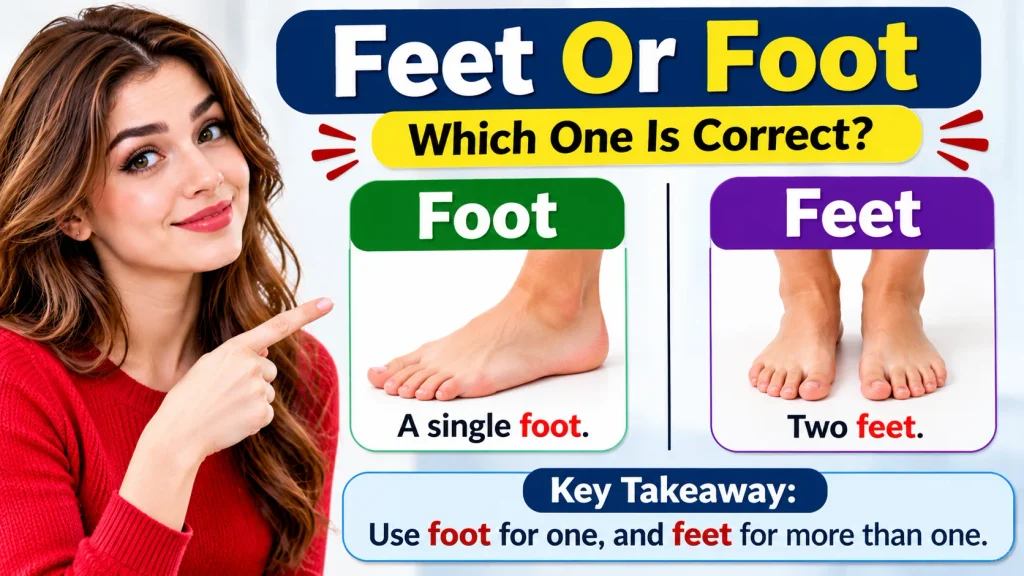
It can refer to the bottom or lower end of an object, place, or space.
Examples:
- They live at the foot of the mountain.
- There was a chair at the foot of the bed.
- The information appears at the foot of the page.
In these examples, foot refers to the lower part or end of something.
24. Foot and Feet in British and American English
The fundamental distinction between foot and feet is shared by British and American English.
For example:
“The room is 10 feet long.”
This sentence is natural in both varieties.
However, informal expressions can vary. Forms such as “six foot tall” occur in informal or regional usage, while “six feet tall” is the straightforward standard form for formal writing.
For learners, especially in academic or examination settings, it is useful to prefer:
- Six feet tall
- A six-foot-tall man
Related To Another Article: https://grammixo.com/excell-or-excel/
25. Foot vs. Feet in Academic and Professional Writing
Clear measurement language is important in academic, technical, and professional writing.
Examples:
Professional:
The structure is 40 feet wide.
Technical:
The cable is approximately 15 feet long.
Academic:
The sample was collected from a depth of 10 feet.
Compound modifier:
Researchers examined a 10-foot section of the structure.
The main goal is to use the correct grammatical structure consistently.
26. Practice Exercises
Test your understanding of foot and feet with These Exercises.
Exercise 1: Fill in the Blanks
Choose foot or feet.
- My left ___ hurts.
- Both my ___ are cold.
- The table is one ___ long.
- The wall is ten ___ high.
- They built a ten-___ wall.
- He is six ___ tall.
- She is a six-___-tall athlete.
- The hole is three ___ deep.
- We bought a two-___ ladder.
- The box is two ___ wide.
Answers:
- Foot
- Feet
- Foot
- Feet
- Foot
- Feet
- Foot
- Feet
- Foot
- Feet
Exercise 2: Correct the Mistakes
- I hurt both my foots.
Correct: I hurt both my feet. - The wall is ten foot high.
Formal standard: The wall is ten feet high. - They built a ten-feet wall.
Correct: They built a ten-foot wall. - The table is one feet long.
Correct: The table is one foot long. - He is six foot tall.
Formal standard: He is six feet tall. - She is a six-feet-tall woman.
Correct: She is a six-foot-tall woman.
Exercise 3: Multiple-Choice Questions
1. Which sentence is correct?
A. The box is two foot long.
B. The box is two feet long.
C. The box is two foots long.
D. The box is two feets long.
Answer: B — The box is two feet long.
2. Which is correct?
A. A ten-feet wall
B. A ten-foot wall
C. A ten-foots wall
D. A ten-feet’s wall
Answer: B — A ten-foot wall.
3. Which is the normal formal expression?
A. He is six foot tall.
B. He is six feet tall.
C. He is six foots tall.
D. He is six feets tall.
Answer: B — He is six feet tall.
4. What is the plural of foot?
A. Foots
B. Feets
C. Feet
D. Footes
Answer: C — Feet.
5. Which sentence uses a compound adjective?
A. The wall is 20 feet high.
B. The wall is 20 foot high.
C. It is a 20-foot wall.
D. The wall has 20 foot.
Answer: C — It is a 20-foot wall.
People Also Ask
Foot is normally singular.
Example: One foot.
Its standard plural form is feet.
Example: Two feet.
Yes. Feet is the standard plural of foot when referring to body parts or ordinary plural measurement units.
One foot is correct.
Example: The table is one foot long.
For an ordinary measurement statement, two feet is correct.
Example: The table is two feet long.
However, two-foot is correct before a noun as a compound modifier.
Example: A two-foot table.
Yes. Six feet tall is the standard straightforward way to express someone’s height.
Example: He is 6 feet tall.
Conclusion
The difference between feet and foot becomes easy once you Understand The Grammatical context.
Use foot for one body part or one ordinary measurement:
One foot.
Use feet for multiple body parts or ordinary plural measurements:
Two feet.
Six feet tall.
However, when a measurement comes directly before a noun as a compound adjective, use singular foot:
A six-foot wall.
A 10-foot ladder.
A 20-foot boat.
The key is to remember the structure:
“The wall is 10 feet high.”
“It is a 10-foot wall.”
Once you understand why these two sentences use different forms, most questions about feet or foot, foot vs. feet, and 6 foot vs. 6 feet become much easier.
