
Introduction
Love Or Hate is a common English expression used to describe two opposite reactions: strong positive feelings and strong negative feelings. You can use it when talking about people, food, movies, activities, opinions, products, or experiences.
You may also come across related expressions such as love it or hate it, either love or hate, love and hate, love-hate, and love-hate relationship.
Although these expressions look similar, they are not always interchangeable.
This guide explains what “love or hate” means, how to use it correctly, the difference between “love or hate” and “love and hate,” common grammar patterns, punctuation, examples, and common mistakes.
2. Quick Answer: What Does Love or Hate Mean?
“Love or hate” means to have either a very strong positive feeling or a very strong negative feeling toward someone or something.
For example:
People love or hate this movie.
This means that the movie receives very different reactions.
You can also say:
People either love or hate this movie.
Or:
You will either love it or hate it.
Simple meaning:
Love or hate = strongly like or strongly dislike.
However, the phrase does not always mean that there are literally only two possible opinions. It is often used to emphasize a strong contrast.
3. Love or Hate: Grammar at a Glance
| Expression | Meaning | Example |
| Love or hate | Opposite possible reactions | People love or hate the movie. |
| Either love or hate | Two alternatives emphasized | People either love or hate it. |
| Love it or hate it | A strong contrast in reaction | Love it or hate it, the movie is popular. |
| Love and hate | Both feelings considered together | She feels both love and hate. |
| Love-hate | Conflicting positive and negative feelings | They have a love-hate relationship. |
| Love-hate relationship | A relationship containing affection and conflict | I have a love-hate relationship with my job. |
4. What Does Love or Hate Mean?
The expression love or hate connects two opposite feelings.
Love expresses a strong positive feeling, while hate expresses a strong negative feeling.
When they are connected with or, the phrase presents alternatives.
Examples
- Some people love or hate spicy food.
- Readers may love or hate the author’s style.
- People love or hate social media.
- You may love or hate the new design.
In these examples, the speaker is emphasizing the contrast between positive and negative reactions.
Does Love or Hate Always Mean Only Two Opinions?
No. Someone might actually feel neutral, mildly positive, or mildly negative.
In everyday English, love or hate can simply be an expressive way to describe something that produces strong or divided reactions.
For example:
People seem to love or hate this restaurant.
The speaker does not necessarily claim that every single person has one of exactly two opinions.
5. Love or Hate vs. Love It or Hate It
These expressions have similar meanings, but their grammatical structures are different.
Love or Hate
Here, love and hate can function as verbs with the same object.
People love or hate this movie.
The object is “this movie.”
Structure:
Subject + love/hate + object
Love It or Hate It
Here, it is the object of both verbs.
Love it or hate it, the movie is memorable.
You can also say:
You will either love it or hate it.
The expression love it or hate it is particularly common when describing something that produces strong or divided reactions.
Comparison
| Sentence | What It Emphasizes |
| People love or hate this movie. | Different reactions |
| People either love or hate this movie. | Two alternatives |
| You will either love it or hate it. | A prediction involving two alternatives |
| Love it or hate it, the movie is memorable. | The statement applies regardless of reaction |
6. Either Love or Hate vs. Love or Hate
Both forms can be correct.
The word either makes the alternatives more explicit.
Without Either
People love or hate the product.
With Either
People either love or hate the product.
Both sentences communicate the idea of contrasting reactions.
You can also use the more explicit either…or structure:
People either love the product or hate it.
This creates a clear parallel structure.
More Examples
- Some students love or hate grammar exercises.
- Some students either love or hate grammar exercises.
- They either love the city or hate it.
- You will either love it or hate it.
Quick rule: Use either when you want to emphasize that there are two alternatives. It is not always necessary.
7. Love or Hate vs. Love and Hate
The difference between or and and is important.
Love or Hate
Or presents alternatives.
People love or hate the new design.
The sentence focuses on different possible reactions.
Love and Hate
And connects the two feelings.
She feels both love and hate toward the character.
This can suggest that both emotions are present or relevant.
Compare
People love or hate the movie.
This emphasizes different reactions.
He experienced both love and hate while thinking about his past.
This emphasizes the two emotions together.
Another example:
I love or hate this song depending on my mood.
This describes changing reactions.
I have feelings of love and hate toward the song.
This describes conflicting feelings.
8. What Does Love-Hate Mean?
Love-hate describes a combination or conflict of positive and negative feelings.
It is usually used as a compound expression.
For example:
I have a love-hate relationship with social media.
This suggests that the speaker enjoys some aspects of social media but dislikes or becomes frustrated with other aspects.
Another example:
She has a love-hate relationship with her job.
She may enjoy the work but dislike the long hours, pressure, or other parts of the job.
Love or Hate vs. Love-Hate
These expressions should not be confused.
Love or hate:
People either love or hate the restaurant.
This emphasizes different possible reactions.
Love-hate:
I have a love-hate relationship with the restaurant.
This describes conflicting feelings associated with the same person, thing, or situation.
9. What Is a Love-Hate Relationship?
A love-hate relationship is a relationship involving both positive and negative feelings.
The expression can describe relationships between:
- People
- Jobs
- Hobbies
- Places
- Technology
- Activities
- Brands
- Subjects
- Experiences
Examples
I have a love-hate relationship with my job.
They have a love-hate relationship.
She has a love-hate relationship with social media.
Many students have a love-hate relationship with mathematics.
A love-hate relationship does not necessarily mean that someone literally loves and hates another person at exactly the same moment. It can describe a complicated relationship involving affection, frustration, enjoyment, disagreement, or changing feelings.
10. How to Use Love and Hate in a Sentence
The verbs love and hate can be followed by nouns, Pronouns, and verb forms.
Love or Hate + Noun
Use a noun when you are talking about a person, thing, activity, or idea.
Examples:
- I love chocolate.
- She hates traffic.
- They love football.
- He hates cold weather.
- We love English.
- I hate exams.
Structure:
Subject + love/hate + noun
For example:
She + loves + music.
Love or Hate + Pronoun
You can also use an object pronoun after love or hate.
Examples:
- I love it.
- She hates him.
- They love them.
- We hate it.
- He loves her.
The pronoun acts as the object of the verb.
Love or Hate + Verb-ing
A very common pattern is:
Love/hate + verb-ing
This structure is frequently used when talking about activities and general preferences.
Examples:
- I love reading.
- She hates waiting.
- They love traveling.
- He hates driving.
- We love watching movies.
- I hate getting up early.
More examples:
- I love playing football.
- She hates cleaning the house.
- We love traveling together.
- He hates studying late at night.
- They love watching movies.
Important grammar point:
Remember the third-person singular -s in the present simple.
- I love reading.
- They love reading.
- She loves reading.
- He hates waiting.
Love or Hate + To-Infinitive
Both love and hate can also be followed by a to-infinitive.
Structure:
Love/hate + to + base verb
Examples:
- I love to travel.
- She loves to read.
- He hates to wait.
- They hate to lose.
You may therefore see both:
I love reading.
I love to read.
Both can be grammatical. The preferred form can depend on context and the meaning the speaker wants to express.
For general activities and preferences, love + -ing is extremely common.
11. Love vs. Hate + -ing
The following pattern is useful for English learners:
Love/hate + gerund (-ing form)
| Subject | Love | Hate |
| I | I love reading. | I hate waiting. |
| You | You love swimming. | You hate driving. |
| He | He loves cooking. | He hates cleaning. |
| She | She loves singing. | She hates running. |
| We | We love traveling. | We hate studying late. |
| They | They love playing football. | They hate getting up early. |
Why Is the -ing Form Used?
The -ing form can function as a noun-like expression referring to an activity.
Reading is enjoyable.
After verbs such as love and hate, this makes it natural to talk about activities.
I love reading.
She hates waiting.
Love or Hate: Meaning, Grammar & Examples· Post
Save draft Publish
Change block type or style
Move Image block from position 157 up to position 156
Move Image block from position 157 down to position 158
Change alignment Replace
blob:https://grammixo.com/6eda21fa-2e6f-45da-94cd-371f8d54cefeMeta Boxes
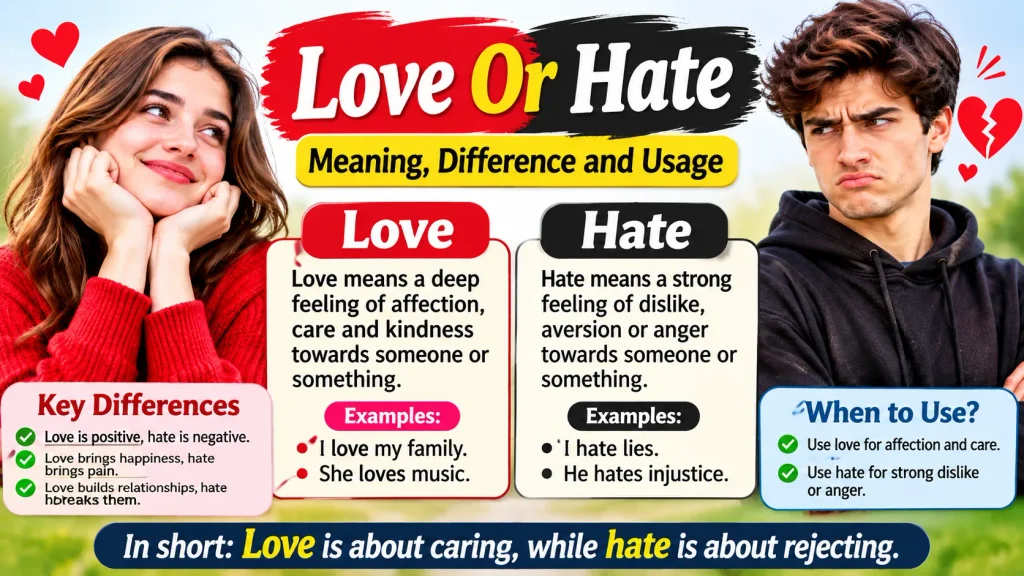
12. Love vs. Hate: What Is the Difference?
The basic difference is the emotional direction.
Love
Love expresses strong positive feelings.
I love music.
This tells us that the speaker has a strong positive feeling toward music.
Hate
Hate expresses strong negative feelings.
I hate noise.
This tells us that the speaker has a strong negative feeling toward noise.
Comparison
| Word or Phrase | Basic Meaning | Example |
| Love | Strong positive feeling | I love music. |
| Hate | Strong negative feeling | I hate noise. |
| Love or hate | Alternative positive/negative reactions | People love or hate the movie. |
| Love and hate | Both feelings considered together | He feels love and hate. |
| Love-hate | Conflicting positive and negative feelings | A love-hate relationship. |
13. Is Love or Hate Hyphenated?
Usually, no.
When love and hate are functioning as ordinary verbs connected by or, they are written as separate words.
Correct:
People either love or hate it.
Incorrect:
People either love-or-hate it.
However, related expressions can require or commonly use hyphens when they function as compound modifiers.
Love-Hate
They have a love-hate relationship.
Love-It-or-Hate-It
It is a love-it-or-hate-it product.
The hyphens help connect the words when the entire expression functions together as a modifier.
Compare
Ordinary verb phrase:
People either love or hate it.
Compound modifier:
It is a love-it-or-hate-it product.
Compound expression:
They have a love-hate relationship.
14. Common Mistakes With Love or Hate
1. Confusing Or With And
Incorrect:
People love and Hate The Movie.
If you mean people have opposite reactions, use:
Correct:
People love or hate the movie.
However, love and hate can be correct when both feelings are being discussed together.
The character experiences both love and hate.
2. Leaving the Object Unclear
The sentence:
I love or hate.
is usually incomplete because the reader does not know what you love or hate.
Better:
I love or hate this movie.
Or:
I either love it or hate it.
3. Using Loves After Does
Incorrect:
She doesn’t loves cooking.
Correct:
She doesn’t love cooking.
After does or doesn’t, use the base form of the verb.
More examples:
Does she love cooking?
She doesn’t love cooking.
4. Using the Wrong Form After Love
Incorrect:
I love read books.
Correct:
I love reading books.
You can also say:
I love to read books.
5. Confusing Love-Hate With Love or Hate
Incorrect:
I have a love or hate relationship with my job.
Correct:
I have a love-hate relationship with my job.
But:
People love or hate this job.
The first describes conflicting feelings; the second emphasizes different possible reactions.
6. Forgetting Third-Person Singular Agreement
Incorrect:
She love reading.
Correct:
She loves reading.
Incorrect:
He hate waiting.
Correct:
He hates waiting.
15. Love or Hate Examples
Here are examples ranging from simple everyday English to more advanced usage.
Very Easy Examples
- I love chocolate.
- I hate noise.
- She loves music.
- He hates traffic.
- They love football.
- People love or hate spicy food.
Easy Examples
- Some people love or hate rainy weather.
- You may love or hate this movie.
- I love reading books.
- She hates waiting in long lines.
- They either love or hate the new design.
Intermediate Examples
- People seem to love or hate the new restaurant.
- You will probably either love it or hate it.
- I have a love-hate relationship with social media.
- Some students love studying English, while others dislike it.
- The movie has received very different reactions from viewers.
Advanced Examples
- The director’s unconventional style is something audiences tend to love or hate.
- The new policy has generated strongly divided reactions among employees.
- Despite its unusual design, the product has become a classic love-it-or-hate-it example.
- She describes her relationship with the city as a love-hate relationship, appreciating its opportunities while becoming frustrated with its pace of life.
Related To Another Article: https://grammixo.com/feet-or-foot/
16. Love or Hate in Real-Life English
The expression is common in everyday conversation.
Talking About Food
Do you love or hate spicy food?
I love it, but my brother hates it.
Talking About Movies
You’ll either love it or hate it.
People seem to love or hate the ending.
Talking About Technology
Users either love or hate the new interface.
Talking About Hobbies
People tend to love or hate running.
Talking About Places
Visitors often love or hate the city’s busy atmosphere.
17. Love or Hate in Questions
You can naturally use love or hate in questions.
Examples:
- Do you love or hate coffee?
- Do you love it or hate it?
- Do you love or hate rainy weather?
- What do you love or hate about your job?
- Do you love or hate studying English?
You can also ask:
What is something you either love or hate?
This asks the listener to name something that produces a strong positive or negative reaction.
18. Love or Hate in Conversation
Here is a short natural dialogue:
Ali: Do you love or hate spicy food?
John: I love it. What about you?
Ali: I hate extremely spicy food, but I like mildly spicy dishes.
This example shows that love or hate can introduce two possible reactions without claiming that everyone must have one of those reactions.

19. Love or Hate in Formal and Informal English
Love or hate is grammatically Acceptable in both everyday and written English, but the best wording depends on the context.
Informal
People love or hate this movie.
More Formal
The movie has generated strongly divided opinions.
Informal
Love it or hate it, everyone is talking about it.
More Formal
Regardless of individual opinions, the subject has attracted considerable attention.
For academic or professional writing, a more precise phrase can sometimes communicate the intended meaning better.
20. Love or Hate in Academic English
In academic writing, writers may prefer more precise language when discussing attitudes or reactions.
Instead of:
Students love or hate the course.
You could write:
Students report substantially different reactions to the course.
Instead of:
People love or hate the technology.
You could write:
Public responses to the technology vary considerably.
The informal expression is still understandable, but formal writing often benefits from specifying the type or degree of reaction.
People Also Ask
Love or hate means to have either a strong positive or strong negative reaction to someone or something.
Yes. For example:
People love or hate the movie.
It is a normal grammatical construction.
Both are correct, but their structures differ. Love or hate can take a noun or pronoun as its object, while love it or hate it uses it as the object of both verbs.
Yes.
People either love or hate the product.
Either emphasizes the two alternatives.
Love or hate presents alternative reactions. Love-hate describes conflicting positive and negative feelings, as in a love-hate relationship.
Conclusion
“Love or hate” is a Simple Expression, but its related forms can create confusion for English learners.
Use love or hate when talking about opposite possible reactions:
People love or hate the movie.
Use either…or when you want to emphasize alternatives:
People either love or hate the movie.
Use love it or hate it for a common expression describing strongly different reactions:
Love it or hate it, the movie is memorable.
Use love and hate when the two emotions are connected:
The character experiences both love and hate.
And use love-hate when positive and negative feelings exist together, especially in:
A love-hate relationship.
For grammar, remember that love and hate can be followed by nouns, pronouns, -ing forms, and, in appropriate contexts, to-infinitives:
I love music.
And I hate noise.
I love reading.
And I hate waiting.
I love to travel.
Understanding these small differences will help you write more accurately and sound more natural in everyday conversation, academic writing, and professional English.
