Introduction
Affective and effective are two commonly confused English Words. They look and sound similar, but they have different meanings and are used in different situations.
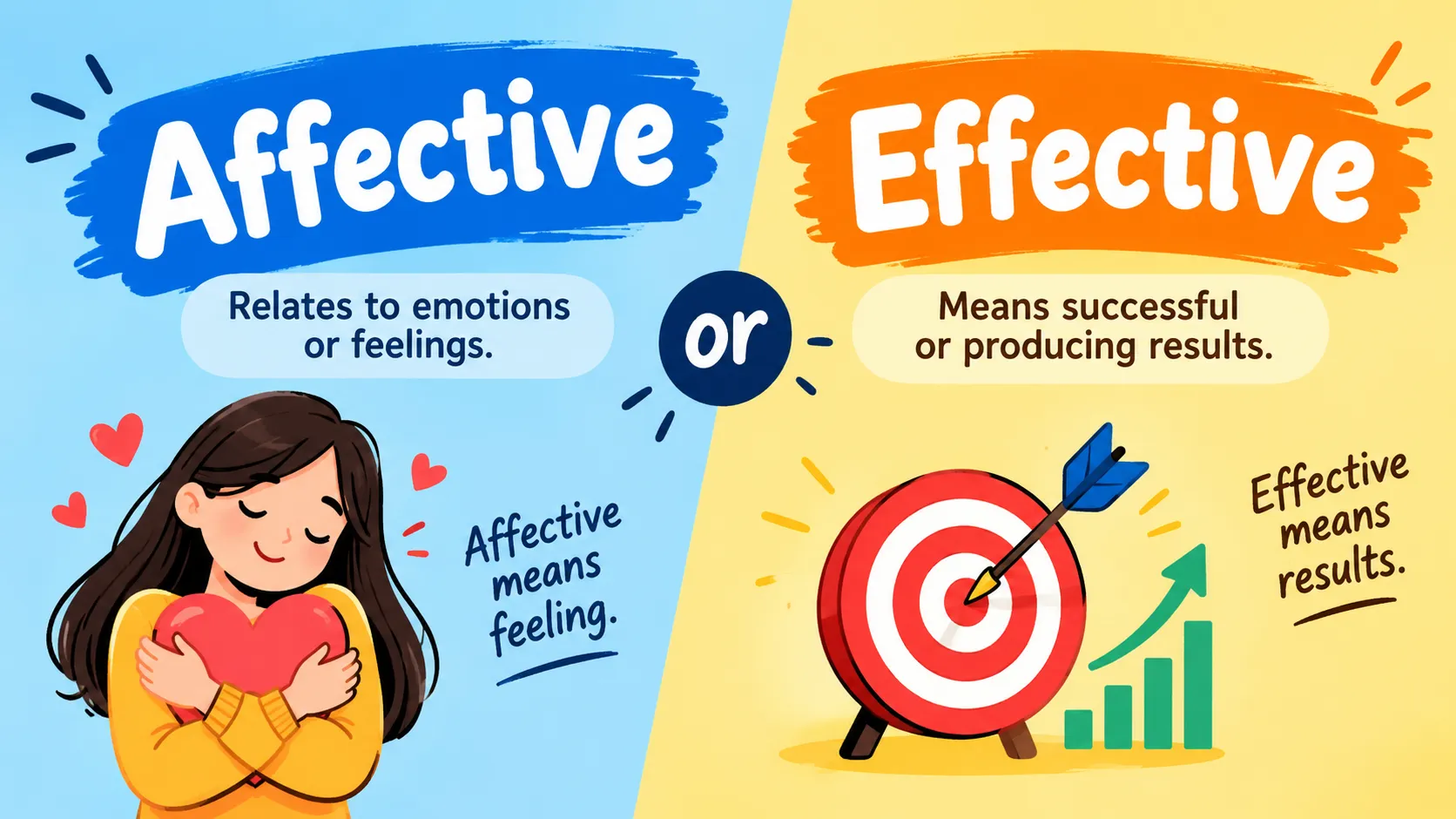
In simple terms, affective relates to feelings, emotions, or emotional responses, while effective usually means successful, useful, or capable of producing the intended result.
For example:
- The treatment was effective.
- The patient showed a strong affective response.
The first sentence is about whether the treatment worked. The second is about an emotional response.
Understanding this difference can help you choose the correct word in academic writing, professional communication, everyday English, and psychology-related contexts.
Affective vs Effective at a Glance
| Word | Part of Speech | Main Meaning | Common Context |
| Affective | Adjective | Related to feelings or emotions | Psychology, behavior, emotional responses |
| Effective | Adjective | Producing the intended result or working successfully | Everyday, academic, business, professional English |
A useful shortcut is:
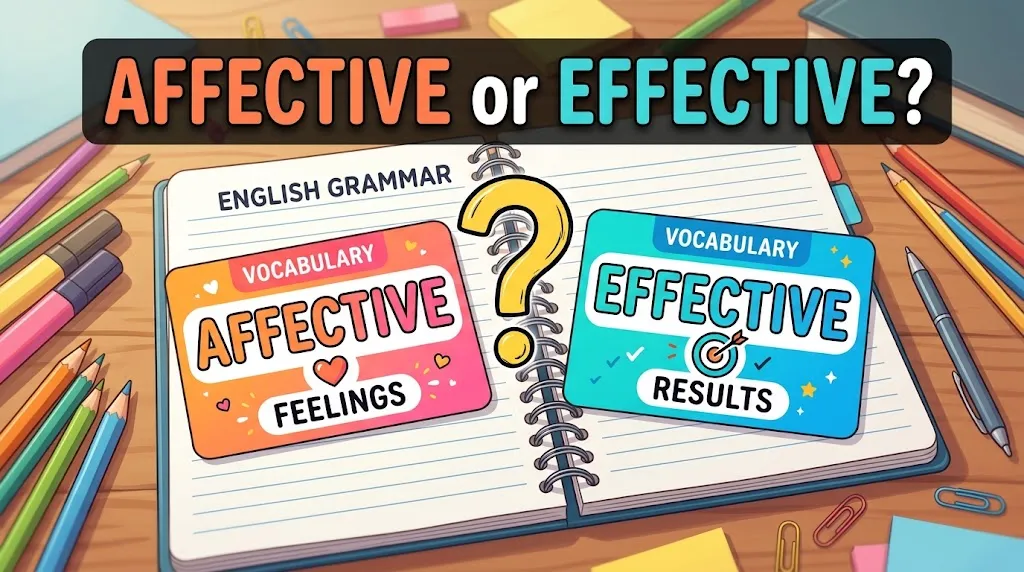
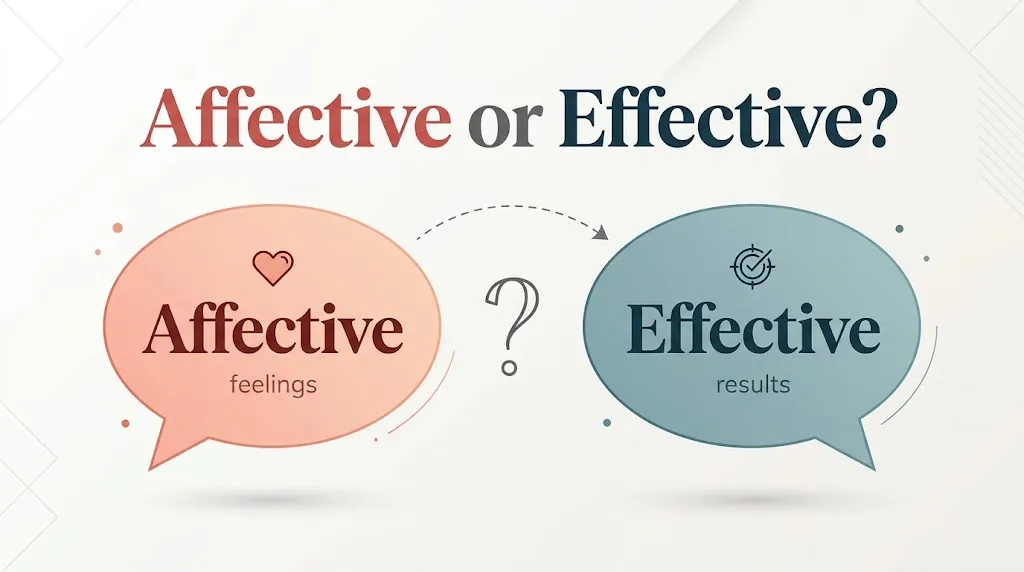
Affective = emotions and feelings
Effective = results and success
However, this shortcut does not cover every meaning of effective. The word can also mean that something is officially in operation or in force, as in “The new rule is effective Monday.”
What Does Affective Mean?
Affective is an adjective related to emotions, feelings, moods, or the way emotions are expressed.
It is especially common in psychology, psychiatry, education, and other academic contexts. For example, you may encounter expressions such as affective response, affective state, affective behavior, and affective disorder.
Consider these examples:
- The researchers measured the students’ affective responses.
- The patient displayed changes in affective behavior.
- The course focuses on students’ cognitive and affective development.
- The study examined the affective effects of social interaction.
In ordinary conversation, emotional is often more natural than affective. For example, “She had an emotional reaction” is usually more conversational than “She had an affective reaction.”
This is important because affective should not simply be used as a sophisticated replacement for “emotional” in every sentence.
What Does Effective Mean?
Effective is an adjective that usually describes something that produces the desired or expected result.
For example:
- This is an effective study method.
- The medicine was effective.
- We need an effective solution.
- She developed an effective marketing strategy.
Here, the focus is on whether something works or achieves its purpose.
Effective can also mean in operation or in force.
For example:
- The new policy becomes effective next month.
- The discount is effective immediately.
- The changes will be effective from January 1.
The word can also describe something that creates a strong or striking impression in certain contexts. Because of these different senses, “effective” has a wider range of everyday uses than “affective.”
Affective and Effective Pronunciation
The words are Pronounced similarly, which is one reason learners sometimes confuse them.
Affective
Affective is commonly pronounced approximately as:
uh-FEK-tiv
The stress falls on the second syllable.
Effective
Effective is commonly pronounced approximately as:
ih-FEK-tiv
Again, the second syllable receives the main stress.
Because the words sound so similar, focusing only on pronunciation is not enough to choose between them. The meaning and context of the sentence are more important.
Affective vs Effective: Key Differences
The easiest way to understand the difference is to identify what the sentence is talking about.
If the sentence concerns feelings, emotions, moods, or emotional responses, affective may be appropriate.
If the sentence concerns success, results, usefulness, performance, or something being in operation, effective is usually the correct choice.
Compare these sentences:
The new teaching method was effective.
This means the teaching method worked or produced the desired result.
The students showed a positive affective response.
This means the sentence is referring to the students’ emotional response.
Here are some more comparisons:
| Affective | Effective |
| affective response | effective response |
| affective behavior | effective strategy |
| affective state | effective treatment |
| affective development | effective communication |
| affective symptoms | effective solution |
The key difference is emotion versus result.
Affective vs Effective in Different Contexts
The correct word becomes easier to identify when you look at the context.
Education
Effective is common when discussing teaching methods or strategies:
Group activities can be an effective teaching method.
Affective can appear when discussing students’ emotions, attitudes, or emotional development:
The course included both cognitive and affective learning objectives.
Psychology
Affective is particularly common in psychology:
The researchers examined the participants’ affective responses.
Effective can describe whether a treatment or intervention works:
The treatment was effective for many participants.
Healthcare
Use effective when discussing whether a medicine or treatment works:
The medication proved effective.
Use affective when discussing emotions or emotional states:
The patient experienced affective changes.
Business
Effective is the natural choice for strategies, communication, management, and solutions:
Clear communication is essential for an effective workplace.
Using affective in this type of sentence would normally change the meaning or sound unnatural.
Technology
Effective can describe a tool, method, system, or solution that achieves its purpose:
The software provides an effective way to organize large amounts of data.
Academic Writing
Both words can appear in academic writing, but they serve different purposes.
The researchers developed an effective method.
Here, the method successfully achieved its purpose.
The researchers examined participants’ affective responses.
Here, the researchers studied emotional responses.
Affective or Effective in a Sentence
Seeing the words in complete sentences makes the distinction easier to remember.
Examples of Affective
- The researchers studied the students’ affective responses to the new curriculum.
- The patient showed changes in affective behavior.
- The study examined affective development during childhood.
- The psychologist observed an unusual affective state.
- The researchers measured participants’ affective reactions.
- The program considered both cognitive and affective development.
- The experiment focused on affective responses to stressful situations.
- The course included several affective learning objectives.
- The researchers investigated the relationship between mood and affective behavior.
- The study explored how music influences affective states.
In these examples, the word is connected with emotions, feelings, moods, or emotional responses.
Examples of Effective
- This study method is highly effective.
- The new treatment was effective.
- We need an effective solution to the problem.
- She used an effective communication strategy.
- Exercise can be an effective way to improve fitness.
- The company introduced an effective marketing campaign.
- The new system is more effective than the previous one.
- The teacher found an effective way to explain the topic.
- The new rules become effective next month.
- The changes are effective immediately.
In these examples, effective refers to success, usefulness, results, or something becoming operational.
Common Phrases With Affective
Because affective is a more specialized adjective, it frequently appears in Established academic and psychological phrases.
Affective response
An affective response is an emotional reaction to something.
The participants showed a strong affective response to the images.
Affective state
An affective state refers to a person’s emotional condition or state.
The study examined how sleep influences affective states.
Affective behavior
Affective behavior relates to the expression or display of emotions.
The researchers observed changes in affective behavior.
Affective development
Affective development concerns the development of emotions and emotional responses.
Parents can influence a child’s affective development.
Affective disorder
Affective disorder is a term used in psychological and psychiatric contexts for disorders involving mood or emotional states.
The research examined different types of affective disorders.
Affective learning
In education, affective learning relates to attitudes, values, emotions, and feelings rather than only knowledge or cognitive skills.
These collocations are useful because they show where affective naturally belongs.
Common Phrases With Effective
Effective appears in a much wider range of everyday and professional expressions.
Effective method
The teacher introduced an effective method for learning vocabulary.
Effective strategy
The company needs an effective strategy for reaching new customers.
Effective solution
We are looking for an effective solution to the problem.
Effective treatment
Doctors are researching more effective treatments.
Effective communication
It can prevent misunderstandings.
Effective way
Walking is an effective way to stay active.
Effective immediately
This means something starts operating or applying immediately.
The new rule is effective immediately.
Effective from
This indicates when something begins to apply.
The new prices are effective from July 1.
Effective in reducing
The program was effective in reducing unnecessary expenses.
Effective at
The new system is effective at detecting errors.
These patterns are useful for students because they show how effective works naturally in real sentences.
Affective vs Effective vs Affect vs Effect
Affective and effective are easier to understand when you also know the difference between affect and effect.
| Word | Common Role | Basic Meaning |
| Affect | Verb | To influence or change something |
| Effect | Noun | A result or consequence |
| Affective | Adjective | Related to emotions or feelings |
| Effective | Adjective | Producing a desired result or working successfully |
Affect
As a verb, affect usually means to influence or change something.
Lack of sleep can affect your concentration.
Effect
As a noun, effect usually means a result or consequence.
Lack of sleep can have a negative effect on concentration.
Affective
Affective relates to emotions or emotional responses.
The study examined the participants’ affective responses.
Effective
Effective usually means successful or capable of producing a desired result.
The new study method was effective.
There are additional grammatical uses of affect and effect, so the simple “affect = verb, effect = noun” rule is a useful starting point rather than a complete description of the two words.
Related To Another Article: https://grammixo.com/wix-or-squarespace/
Common Mistakes With Affective and Effective
Because the words look almost identical, several mistakes are common.
Mistake 1: Using affective when you mean successful
Incorrect:
The medicine was affective.
If you mean the medicine worked, use effective.
Correct:
The medicine was effective.
Mistake 2: Using effective when you mean emotional
Incorrect:
The researchers studied the participants’ effective responses.
If the researchers are studying emotional responses, affective is the appropriate adjective.
Correct:
The researchers studied the participants’ affective responses.
Mistake 3: Treating affective as a general synonym for emotional
Although affective relates to emotion, it is often a specialized term. In ordinary conversation, emotional may sound more natural.
For example:
She had an emotional reaction.
is generally more natural in everyday English than:
She had an affective reaction.
Mistake 4: Confusing effective with efficient
Effective and efficient are related but not identical.
Effective means achieving the desired result.
Efficient focuses on achieving a result with minimal wasted time, effort, resources, or energy.
For example:
The new system is effective because it solves the problem.
The new system is efficient because it solves the problem using fewer resources.
Mistake 5: Assuming every word beginning with “affect” refers to emotion
The related words affect, effect, affective, and effective have different meanings and grammatical uses. Always consider the meaning of the whole sentence instead of relying only on spelling.
How to Remember Affective vs Effective
A simple memory trick can help.
Effective = Effect = Result
Think:
Effective → effect → result
If something works or produces the result you want, use effective.
The new study plan is effective.
It produces the desired result.
Affective = Affect = Emotion
Think:
Affective → affect → emotion
When affective is used in its psychological sense, it relates to feelings, moods, or emotional responses.
The study measured affective responses.
The focus is on emotions.
There is one important caution: affect has more than one meaning and grammatical use, so this memory trick should be treated as a helpful shortcut, not a complete grammar rule.
Affective or Effective Practice Quiz
Choose affective or effective in each sentence.
- The new exercise program was highly ______.
- The researchers measured the children’s ______ responses.
- The new policy becomes ______ next Monday.
- The patient experienced changes in ______ behavior.
- We need an ______ strategy to solve the problem.
- The study examined the students’ ______ development.
- The treatment proved ______.
- The psychologist studied the participant’s ______ state.
- The new communication system is very ______.
- The researchers recorded an unusually strong ______ reaction.
Answers
- effective
- affective
- effective
- affective
- effective
- affective
- effective
- affective
- effective
- affective
Why?
Use effective when the sentence focuses on something working, producing a result, or coming into operation.
Use affective when the sentence focuses on feelings, emotions, moods, or emotional responses.
For example:
The treatment was effective.
The focus is on whether the treatment worked.
The patient had an affective reaction.
The focus is on the patient’s emotional response.
People Also Ask
Yes. Affective is a standard English adjective. It relates to emotions, feelings, moods, or emotional responses and is especially common in psychology and other specialized contexts.
Affective relates to emotions or feelings, while effective generally means successful, useful, or capable of producing the intended result.
No. They are not opposites. They have different meanings.
Affective concerns emotions and feelings, while effective concerns results, success, or operation.
No. In standard usage, affective and effective have distinct meanings. You should not use one as a substitute for the other.
In psychology, affective generally refers to emotions, feelings, moods, and emotional responses. It appears in terms such as affective state, affective response, and affective disorder.
Final Answer: Affective or Effective?
The choice between affective and effective depends on what you want to say.
Use affective when you are talking about feelings, emotions, moods, or emotional responses, especially in psychological or Academic contexts.
Use effective when you mean successful, useful, capable of producing a desired result, or in operation.
The easiest shortcut is:
Affective = emotion
Effective = result
For example:
The treatment was effective.
The patient showed an affective response.
Once you focus on the meaning rather than the similar spelling, the difference between these two words becomes much easier to understand.

1 thought on “Affective or Effective: Difference, Meaning & Examples”