Introduction
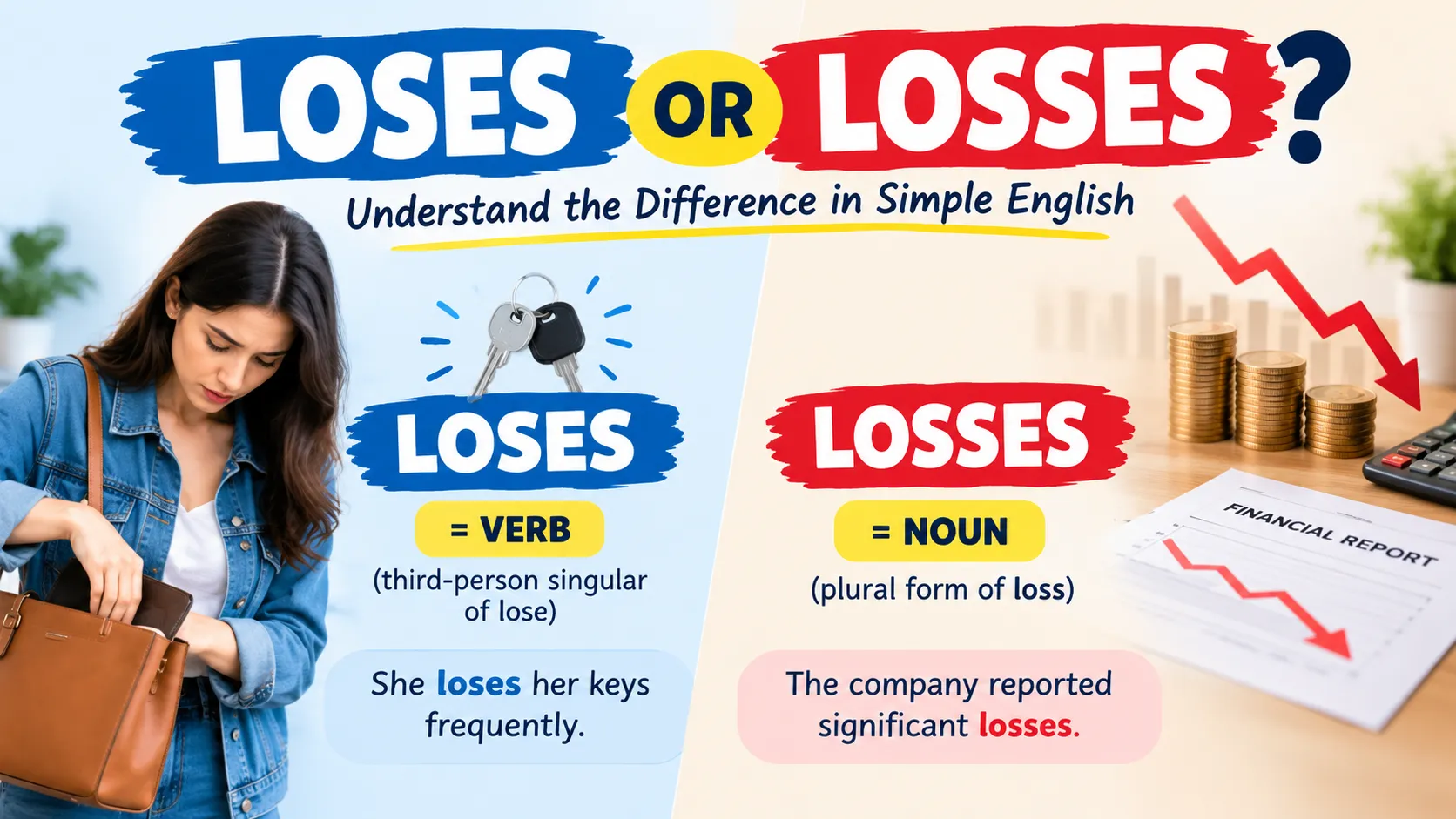
Loses and losses are both correct English words, but they do not have the same Grammatical function. Loses is a verb, while losses is the plural form of the noun loss.
The difference becomes easy once you ask one simple question: Am I describing an action, or am I naming a loss or losses?
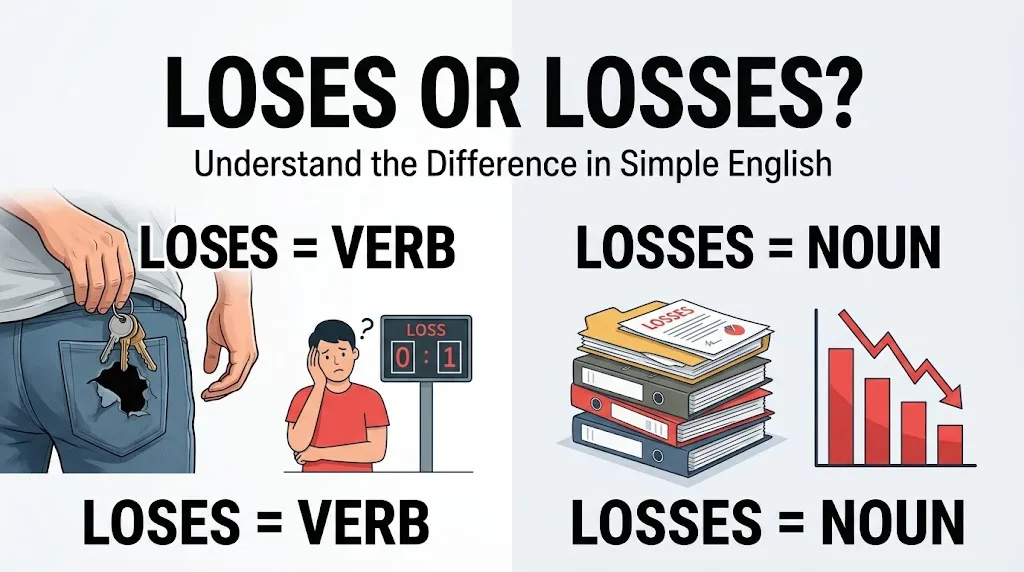
- Loses = verb/action
- Losses = plural noun/result
For example:
- She loses her keys frequently.
- The company reported significant losses.
Both words are related to lose, but they cannot normally replace each other. The grammatical role of the word determines which form you need.
Loses or Losses: Quick Answer
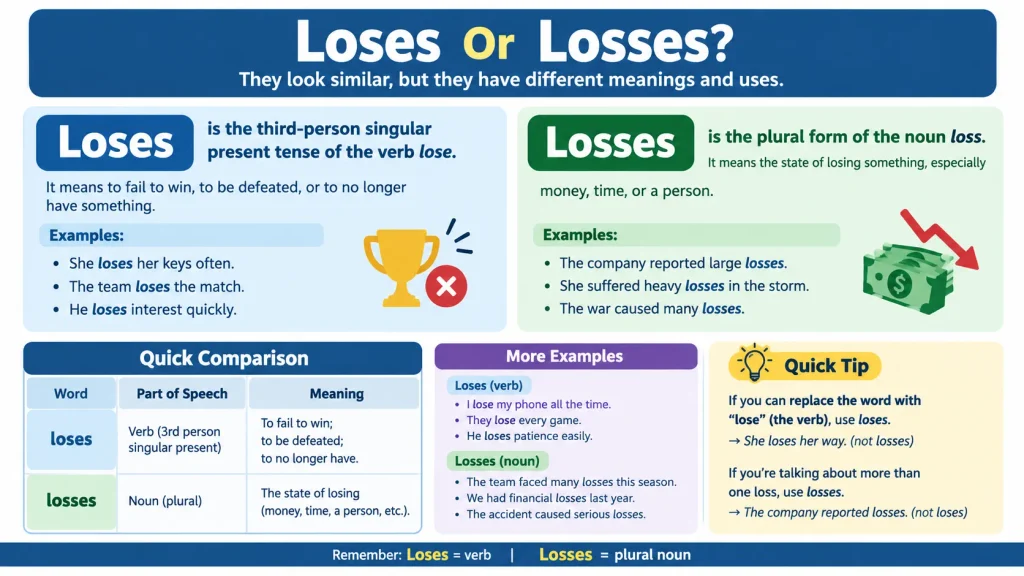
Use loses when you need the third-person singular present form of the verb lose.
She loses her phone frequently.
Use losses when you need the plural noun loss.
The company reported heavy financial losses.
What Does “Loses” Mean?
Loses is the third-person singular present-tense form of the verb lose.
You use it with:
- he
- she
- it
- a person’s name
- a singular noun
The verb lose can mean to fail to keep something, fail to win, no longer have something, or fail to maintain something.
Examples of “Loses”
- She loses her keys almost every week.
- He loses focus when he gets tired.
- The team loses another match.
- The company loses customers when service becomes slow.
- My phone loses battery quickly.
- Sarah loses interest after a few minutes.
In each example, loses describes an action or state involving a singular subject.
Why Is It “Loses” and Not “Losses”?
The base verb is lose.
When the subject is third-person singular in the present tense, the form changes to:
lose → loses
Compare these forms:
| Subject | Correct Form | Example |
| I | lose | I lose my keys. |
| You | lose | You lose your keys. |
| We | lose | We lose our keys. |
| They | lose | They lose their keys. |
| He | loses | He loses his keys. |
| She | loses | She loses her keys. |
| It | loses | It loses its connection. |
So, loses is not the plural of loss. It is a verb form of lose.
What Does “Losses” Mean?
Losses is the plural form of the noun loss.
A loss can refer to something that has been lost, a defeat, a reduction, deprivation, or an amount that has decreased. Losses refers to more than one such event, result, or amount.
Examples of “Losses”
- The company reported large financial losses.
- The team suffered three losses this season.
- The storm caused significant property losses.
- Investors were concerned about market losses.
- The business is recovering from its recent losses.
- The organization experienced several unexpected losses.
Here, losses is a noun. It names something rather than describing an action.
Lose, Loses, Loss, or Losses?
Understanding all four related forms makes the difference much easier.
| Word | Part of Speech | Function | Example |
| lose | Verb | Base form | I may lose my wallet. |
| loses | Verb | Third-person singular present | She loses her wallet. |
| loss | Noun | One loss or instance of losing | The loss was unexpected. |
| losses | Noun | More than one loss | The losses were significant. |
Compare the Four Forms
Lose:
I don’t want to lose this opportunity.
Loses:
He often loses opportunities because he waits too long.
Loss:
The company experienced a major loss.
Losses:
The company experienced several major losses.
Quick Memory Pattern
Remember:
lose → loses → lost → losing
and
loss → losses
The first group contains forms of the verb lose. The second contains the noun loss and its plural.
When Should You Use “Loses”?
Use loses when the word functions as a verb and the subject is third-person singular.
Use “Loses” With Singular Subjects
- He
- She
- It
- John
- The company
- The team
- My computer
- The player
Examples
- He loses his temper easily.
- She loses track of time while reading.
- The company loses money during slow months.
- The player loses concentration under pressure.
- The computer loses its connection frequently.
A Useful Test
Try replacing loses with another verb.
She loses her keys.
The word clearly tells us what she does, so it is functioning as a verb.
When Should You Use “Losses”?
Use losses when you are talking about multiple losses and the word functions as a noun.
Common contexts include:
Business
The company reported substantial losses.
Sports
The team had four losses this season.
Finance
Investors were concerned about market losses.
Property
The flood caused serious property losses.
Employment
The industry experienced significant job losses.
In each example, losses names multiple results, events, or amounts.
Loses vs. Losses in Business Writing
These words frequently appear in business, finance, and professional communication.
Compare:
The company loses money when costs increase.
Here, loses is the verb.
Now compare:
The company reported significant financial losses.
Here, losses is the noun.
Another useful comparison is:
The business loses customers every month.
The business is trying to reduce customer losses.
The subject matter is similar, but the grammatical role changes.
Business Writing Rule
If you are describing what a company does, you may need loses.
If you are naming the financial or business results, you may need losses.
Loses vs. Losses in Sports
Sports examples make this distinction especially clear.
Use loses when describing what a team or player does:
The team loses when it makes too many mistakes.
Use losses when discussing multiple defeats:
The team has five losses this season.
Compare:
- He loses the match.
- The team records another loss.
- The team has several losses.
- They do not want to lose another match.
The meaning is related, but the grammatical form changes according to the sentence.
Loses vs. Losses in Everyday English
You may encounter these words in many everyday situations.
Personal Situations
She loses her phone frequently.
Work
He loses concentration during long meetings.
Technology
My laptop loses power quickly.
Business
The company reported significant losses.
Sports
The team suffered two consecutive losses.
Travel
He loses his passport.
The key is not the topic. The key is the Grammatical Function.
Common Mistakes With Loses and Losses
Mistake 1: Using “Losses” as a Verb
❌ She losses her keys every morning.
✅ She loses her keys every morning.
Why?
The sentence needs a verb. Loses is the third-person singular form of lose. Losses is a plural noun.
Mistake 2: Using “Loses” as a Plural Noun
❌ The company reported major loses.
✅ The company reported major losses.
Why?
The sentence needs a plural noun. The plural of loss is losses.
Mistake 3: Confusing “Lose” With “Loss”
❌ The company suffered a major lose.
✅ The company suffered a major loss.
Why?
After a major, the sentence needs a singular noun. Therefore, loss is correct.
Mistake 4: Confusing “Lose” With “Loose”
Lose and loose are different words.
- Lose = fail to keep, find, or win something
- Loose = not firmly fixed, tight, or contained
Examples:
Don’t lose your keys.
The screw is loose.
Do not use loose when you mean lose.
Is “He Losses” Correct?
No, not when you mean that he fails to keep, find, or win something.
Correct:
He loses his keys.
Incorrect:
He losses his keys.
The subject he requires the third-person singular form of lose, which is loses.
However, losses can appear with he when it functions as a noun:
He suffered several losses during the season.
Here, losses is the noun, not the verb.
Is “Losses” a Verb?
No. In standard English, losses is the plural noun form of loss.
Compare:
She loses the game.
She suffers several losses.
The first sentence uses loses as a verb. The second uses losses as a noun.
Is “Loses” a Noun?
No. Loses is the third-person singular present form of the verb lose.
The noun forms are:
- loss — singular
- losses — plural
Examples:
The loss was unexpected.
The losses were unexpected.
Are “Loses” and “Losses” Pronounced the Same?
No. They have different pronunciations.
Loses is commonly pronounced approximately LOO-ziz.
Losses is commonly pronounced approximately LOSS-iz.
Accent and dialect can affect the exact sound, so pronunciation should not be your only way of deciding which word to use. Sentence structure is more reliable.
Why Are Loses and Losses So Easy to Confuse?
There are several reasons.
1. They Look Very Similar
The words are visually close:
- loses
- losses
The extra s can easily be overlooked while typing.
2. They Are Related Words
Both forms are connected to the idea of losing:
- lose → loses
- loss → losses
3. They Appear in Similar Contexts
Sports, business, finance, and everyday situations can use both words.
The team loses matches.
The team has several losses.
4. Both Are Correctly Spelled Words
This is an important point for proofreading. A spell-checker may recognize both loses and losses as valid words. It may not always understand that the wrong word has been selected for a particular sentence.
That is why grammar and context matter.
A Simple Memory Trick for Loses vs. Losses
Try this question:
Am I describing an action or naming a result?
- Action → loses
- One result → loss
- Multiple results → losses
For example:
She loses the game.
The defeat is a loss.
The team has several losses.
Another Easy Trick
Remember the word family:
LOSE = verb
LOSES = verb
LOSS = noun
LOSSES = plural noun
This pattern is more reliable than simply counting the letter s.
Loses vs. Losses: Side-by-Side Examples
| Incorrect | Correct | Reason |
| He losses his phone. | He loses his phone. | Verb required |
| The team had three loses. | The team had three losses. | Plural noun required |
| She suffered a financial lose. | She suffered a financial loss. | Singular noun required |
| The company losses money. | The company loses money. | Verb required |
| They reported major loses. | They reported major losses. | Plural noun required |
Examples of “Loses” in Sentences
Here are additional examples across different situations:
- She loses her phone frequently.
- He loses concentration during long meetings.
- The team loses confidence after a poor start.
- The company loses customers when prices rise.
- My laptop loses power quickly.
- The player loses control of the ball.
- The child loses interest after a few minutes.
- The store loses business during the off-season.
- He loses track of time while working.
- The machine loses efficiency as it gets older.
Examples of “Losses” in Sentences
- The company reported significant losses.
- The team suffered two consecutive losses.
- Investors were worried about market losses.
- The storm caused extensive property losses.
- The business is recovering from previous losses.
- The organization experienced unexpected financial losses.
- The team has more losses than wins.
- The report estimated substantial economic losses.
- The company hopes to reduce future losses.
- The industry experienced considerable job losses.
Related To Another Article: https://grammixo.com/aisle-or-isle/
Can “Loses” and “Losses” Appear in the Same Sentence?
Yes. They can appear together when each word performs its correct grammatical role.
For example:
The company loses money, and its financial losses continue to increase.
Here:
- loses = verb
- losses = plural noun
Another example:
The team loses games, but its recent losses have taught the players valuable lessons.
The two words are related, but they perform different grammatical jobs.
What Is the Plural of “Loss”?
The plural of loss is losses.
| Singular | Plural |
| one loss | two losses |
| a loss | several losses |
| one financial loss | several financial losses |
Examples:
The defeat was a painful loss.
The team suffered three losses.
The spelling changes from loss to losses because the plural ending -es is used.
What Is the Third-Person Form of “Lose”?
The third-person singular present form of lose is loses.
The pattern is:
- I lose
- You lose
- We lose
- They lose
- He loses
- She loses
- It loses
Examples:
I lose my keys sometimes.
She loses her keys sometimes.
This is an example of subject-verb agreement.
British English vs. American English
There is no spelling difference between British and American English for loses and losses.
Both varieties use:
- loses = third-person singular present form of lose
- losses = plural form of loss
So you do not need to choose between these spellings based on whether you are writing for a US or UK audience. The grammatical context determines the correct word.
Loses or Losses: Exam Tip
For grammar tests and sentence-correction questions, identify the part of speech before choosing the word.
Step 1: Find the subject
Ask who or what is performing the action.
Step 2: Look at the word’s function
Is it acting as a verb or a noun?
Step 3: Check the number
If it is the verb lose with he, she, it, or another singular subject, use loses.
If it is the plural noun of loss, use losses.
Example
The player ______ the match frequently.
The blank needs a verb.
Answer: loses
Now:
The player has several ______ this season.
The blank needs a plural noun.
Answer: losses
Practice Exercise: Choose Loses or Losses
Fill in each blank with loses or losses.
- She often ______ her keys.
- The company reported significant financial ______.
- The team ______ when it fails to score.
- The business suffered several major ______.
- He ______ interest very quickly.
- The newspaper reported economic ______.
- The player ______ focus under pressure.
- The team has five ______ this season.
- My phone ______ power quickly.
- Investors were concerned about market ______.
Answers
- loses
- losses
- loses
- losses
- loses
- losses
- loses
- losses
- loses
- losses
Why?
When the blank needs an action performed by a singular subject, use loses.
When the blank needs a plural noun referring to multiple losses or results, use losses.
Practice Exercise: Lose, Loses, Loss, or Losses
Choose the correct word.
- I don’t want to ______ this opportunity.
- She ______ her phone regularly.
- The company experienced a major ______.
- The company reported several financial ______.
- They might ______ the match.
- He ______ patience quickly.
- The team suffered another ______.
- The team has four ______ this season.
Answers
- lose
- loses
- loss
- losses
- lose
- loses
- loss
- losses
Sentence Correction Practice
Correct the following sentences.
1. He losses his wallet frequently.
Correct: He loses his wallet frequently.
Reason: The sentence requires the third-person singular verb form of lose.
2. The company reported several loses.
Correct: The company reported several losses.
Reason: The sentence requires the plural noun losses.
3. She suffered a major lose.
Correct: She suffered a major loss.
Reason: The sentence requires the singular noun loss.
4. The company losses money every year.
Correct: The company loses money every year.
Reason: The word is functioning as a verb.
People Also Ask
Both words are correct, but they have different grammatical functions. Loses is a verb, while losses is the plural noun of loss.
No, when you mean that he fails to keep, find, or win something. The correct form is “he loses.”
The plural of loss is losses.
No. Losses is a plural noun. The third-person singular present form of the verb lose is loses.
No. Loses is a verb form. The noun forms are loss and losses.
Quick Revision Box
| If you mean… | Use |
| Base action | lose |
| He/she/it performs the action | loses |
| One instance or result | loss |
| More than one loss | losses |
Remember This Sentence
Someone loses; one event is a loss; several events are losses.
Once you remember this pattern, the difference becomes much easier to recognize.
Final Difference Between Loses and Losses
The difference Between loses and losses is mainly grammatical.
Loses is the third-person singular present form of the verb lose:
He loses his wallet.
Losses is the plural form of the noun loss:
He suffered several losses.
Think of the complete word family:
lose → loses → lost → losing
loss → losses
When your sentence describes what he, she, it, or another singular subject does, use loses.
When your sentence refers to multiple losses, defeats, reductions, or things that have been lost, use losses.
The easiest final test is simple:
Action? → loses.
Plural noun or results? → losses.
Once you understand the difference between lose, loses, loss, and losses, this commonly confused word pair becomes much easier to use correctly.

1 thought on “Loses or Losses: What’s the Difference?”