Introduction
Pass and past are easy to confuse because they look and sound similar. The confusion becomes even stronger when passed enters the sentence.
The key is to remember that these three words do different Grammatical Jobs:
- Pass is usually a verb.
- Passed is the past tense and past participle of pass.
- Past usually refers to an earlier time, or to something beyond a particular point, place, or limit.
For example:
- I pass the library every morning.
- I passed the library yesterday.
- I walked past the library yesterday.
All three sentences are correct, but pass, passed, and past have different functions.
Pass or Past: Quick Answer
Use pass when you need the verb pass:
I hope I pass the exam.
Use passed when pass is being used in the past:
She passed the exam yesterday.
Use past when you mean an earlier time or something beyond a point:
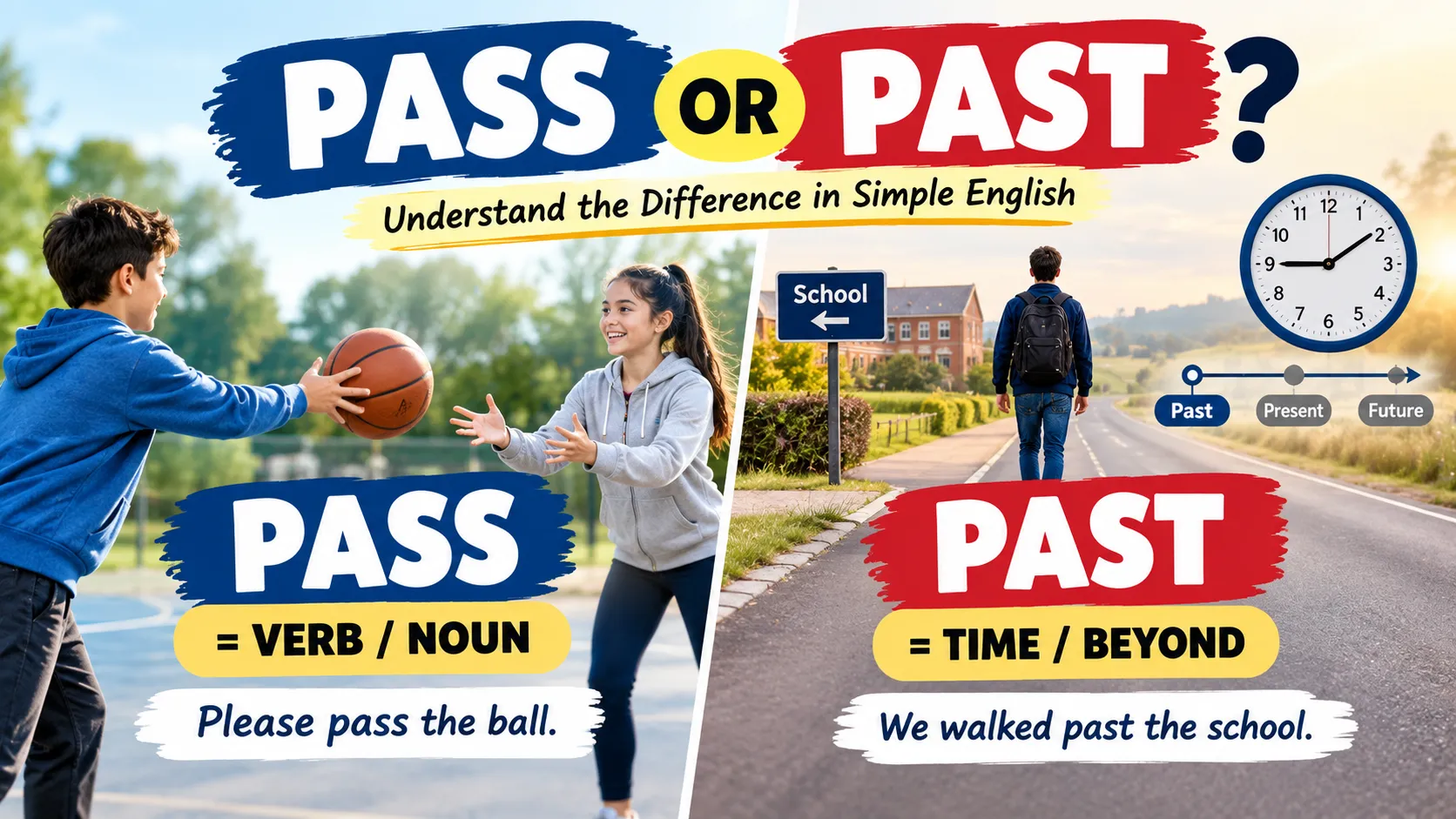
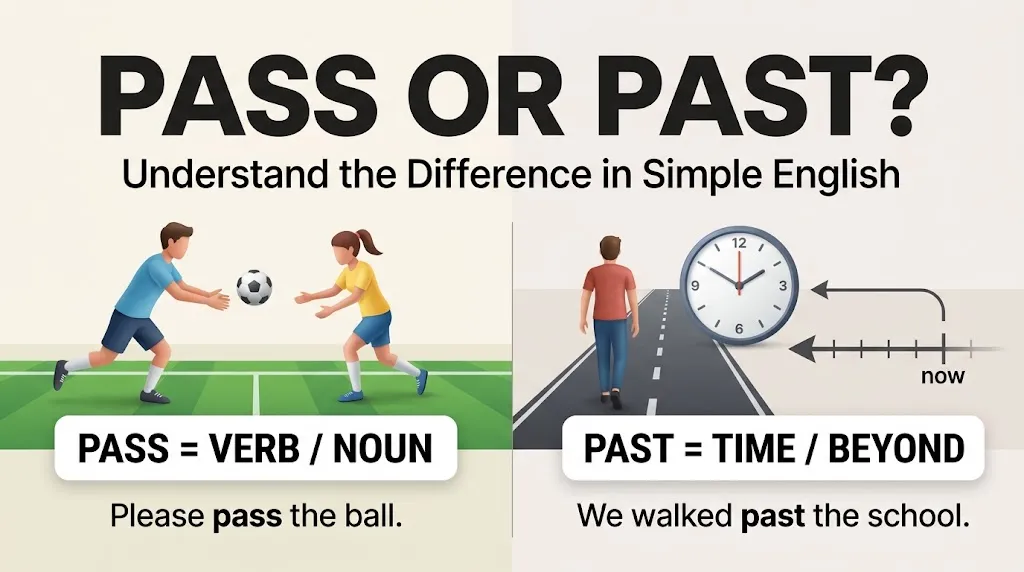
We walked past the school.
A simple rule is:
Pass = verb
Passed = past form of pass
Past = earlier time or beyond a point
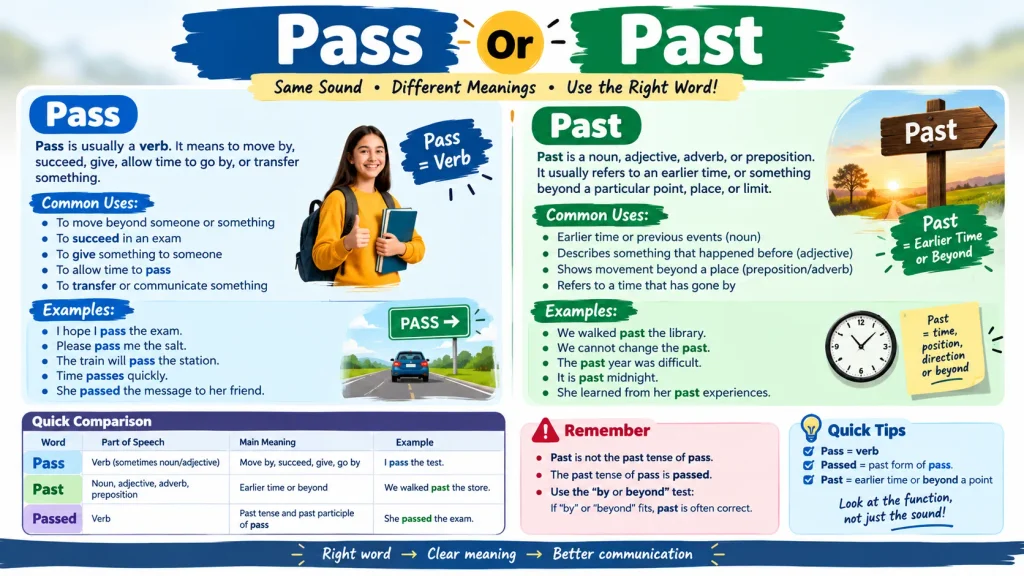
| Word | Main grammatical role | Common meaning | Example |
| pass | Verb; sometimes noun/adjective | Move by, succeed, give, go by | I hope I pass the test. |
| passed | Verb | Past form of pass | She passed the exam. |
| past | Noun, adjective, adverb, preposition | Earlier time or beyond | We walked past the store. |
Important: Past is not the past tense of pass. The past tense of pass is passed.
Pass vs. Past vs. Passed at a Glance
Compare these sentences:
I pass the bank every day.
And i passed the bank yesterday.
I walked past the bank yesterday.
And in the first sentence, pass is the present-tense verb.
In the second, passed is the past-tense form of pass.
In the third, walked is already the main verb. Past tells us where the walking took place in relation to the bank.
That is why:
I walked past the bank. ✅
is correct, while:
I walked passed the bank. ❌
is normally incorrect.
Current grammar references make the same grammatical distinction: passed functions as a verb form, while past can function as a noun, adjective, preposition, or adverb.
What Does “Pass” Mean?
Pass has several meanings, but it is most commonly used as a verb.
1. Pass = Move Beyond Someone or Something
Use pass when the action itself is described by the verb.
The car will pass the school.
The train passes the station every morning.
We passed several shops on our way home.
Here, pass describes the action of moving by or beyond something.
2. Pass = Succeed in an Exam
Pass can also mean to successfully complete a test, examination, course, or requirement.
I hope I pass my English exam.
She studied hard to pass the test.
You need to pass the final examination.
When talking about a completed exam, use passed:
She passed her English exam.
Not:
She past her English exam. ❌
3. Pass = Give Something to Someone
Pass can mean to give or hand something to another person.
Please pass me the water.
Could you pass the salt?
Please pass this document to the manager.
The past form is:
He passed me the book.
4. Pass = Go By or Elapse
We can use pass when something such as time goes by.
Time passes quickly.
The hours passed slowly.
Several days passed before we heard from them.
Notice the difference:
Time passes quickly. ✅
Three hours have passed. ✅
But:
It is past midnight. ✅
The first two use pass as a verb. The third uses past to mean “beyond.”
5. Pass = Transfer or Communicate Something
The message was passed from one employee to another.
Please pass the information to your supervisor.
He passed the ball to his teammate.
6. Pass as a Noun
Although pass is commonly a verb, it can also be a noun.
I need a bus pass.
She bought a season pass.
So it is not accurate to say that pass is always a verb. Its grammatical role depends on the sentence.
What Does “Past” Mean?
Past is a separate word from passed.
It can function as a:
- Noun
- Adjective
- Preposition
- Adverb
Its meanings often involve earlier time, a previous period, or movement beyond a point.
Past as a Noun
As a noun, past refers to an earlier period or previous events.
We cannot change the past.
She learned from her past.
The past can teach us valuable lessons.
Here, past is the thing being discussed.
Past as an Adjective
Past can describe something that happened previously.
We discussed our past experiences.
The past year has been challenging.
He learned from his past mistakes.
Here, past modifies a noun.
Past as a Preposition
Past can mean beyond a particular place or point.
We walked past the library.
The train went past the station.
Drive past the bank and turn left.
In these sentences, past connects the movement with a location.
Past as an Adverb
Past can also describe movement beyond something without directly introducing an object.
The car drove past.
He ran past without stopping.
This wider range of grammatical functions is one reason past cannot simply be treated as another form of pass.
What Does “Passed” Mean?
Passed is the past tense and past participle of the verb pass.
The basic pattern is:
pass → passed → passed
For example:
Present
I pass the store every morning.
Past
I passed the store yesterday.
Present Perfect
I have passed the store many times.
The same pattern works with different meanings of pass:
She passed the exam.
He passed the ball.
Time passed quickly.
The car passed us on the highway.
A useful comparison is:
walk → walked
talk → talked
jump → jumped
pass → passed
The Main Difference Between Pass and Past
The biggest difference is Grammatical Function.
Pass
Usually functions as a verb.
I pass the store every day.
Passed
Functions as the past tense or past participle of pass.
I passed the store yesterday.
Past
Usually describes earlier time, position, direction, or something beyond a point.
I walked past the store.
This three-way distinction is more useful than simply memorizing “pass means movement” and “past means time,” because past can describe movement beyond a place, while pass has many meanings besides movement.
When to Use “Pass”
Use pass when the sentence needs the verb pass.
Pass an Exam
I studied hard to pass the exam.
Pass Something to Someone
Could you pass the salt?
Pass a Place
The train will pass the station.
Pass the Time
We played a game to pass the time.
Pass a Message
Please pass the message to Sarah.
Pass a Law or Bill
The legislature may pass the bill.
The meaning changes according to context, but pass is functioning as the verb in these examples.
When to Use “Past”
Use past when you are referring to an earlier period or something beyond a point.
Earlier Time
We learned a lot from the past.
Previous Period
Over the past few months, sales have increased.
Beyond a Place
We walked past the museum.
Beyond a Time
It is past midnight.
Beyond a Limit
The temperature is past 30 degrees.
This is why:
We walked past the store. ✅
The word walked already supplies the verb, while past describes movement beyond the store.
When to Use “Passed”
Use passed when you need the past form of the verb pass.
She passed the test.
The car passed us.
We passed the restaurant.
Time passed quickly.
He passed the ball to his teammate.
One helpful test is to change the sentence to the present tense.
She passed the exam.
becomes:
She passes the exam.
That shows that passed is functioning as the past-tense verb pass.
Walk Past or Walk Passed?
The correct expression is usually:
walk past
not:
walk passed ❌
Correct
I walked past the school.
She walked past me.
We walked past the restaurant.
Incorrect
I walked passed the school. ❌
Why?
Because walked is already the main verb.
In:
I walked past the school.
- walked = main verb
- past = indicates movement beyond the school
You can also say:
I passed the school.
Here, passed itself is the verb.
So both sentences can be correct:
I walked past the school. ✅
I passed the school. ✅
The sentence structure is different.
The same “by/beyond” test is recommended by grammar resources for distinguishing past from passed: if by or beyond fits naturally, past is often the correct choice.
Drive Past or Drive Passed?
When drive is the main verb and you want to describe Movement beyond something, use past.
I drove past the bank.
We drove past the stadium.
The taxi drove past my house.
Do not write:
We drove passed the stadium. ❌
However, you can say:
We passed the stadium.
Compare:
I drove past the stadium.
- drove = verb
- past = indicates movement beyond the stadium
I passed the stadium.
- passed = verb
This is one of the clearest ways to understand the difference.
Pass Time or Past Time?
Both pass and past can appear with time, but they mean different things.
Pass the Time
Pass the time means to occupy yourself while waiting or to spend time doing something.
I read a book to pass the time.
We played cards to pass the time.
Here, pass is a verb.
Past Time
Past can describe a time that has gone beyond a particular point.
It is past lunchtime.
It is past midnight.
We are past the deadline.
So remember:
pass the time = occupy or spend time
past midnight = beyond a particular time
Past My Bedtime or Pass My Bedtime?
The usual expression is:
It is past my bedtime. ✅
Not:
It is pass my bedtime. ❌
Here, past means that the current time is beyond your normal bedtime.
More examples:
It is past my usual bedtime.
We stayed up past midnight.
The movie continued past 10 p.m.
But when you describe time itself moving forward:
Time passes quickly.
The distinction is:
It is past my bedtime. = The time is beyond bedtime.
Time passes quickly. = Time goes by.
Past 6 or Pass 6?
When talking about clock time, past is normally the correct word.
It is past 6 p.m.
We arrived past 6.
She stayed at work past midnight.
You also use past in standard time expressions:
It is ten past six.
And it is half past six.
It is quarter past three.
Here, past indicates that the time has gone beyond the reference hour.
So:
half past six ✅
half passed six ❌
past 6 p.m. ✅
pass 6 p.m. ❌
Come to Pass or Come to Past?
The correct expression is:
come to pass
It means to happen or occur.
Examples:
Nobody knew what would eventually come to pass.
The prediction eventually came to pass.
We waited to see what would come to pass.
Come to past is not the standard expression.
This is a fixed phrase, so it is best remembered as:
come to pass = happen
Related To Another Article: https://grammixo.com/loses-or-losses/
Can Pass and Past Both Be Correct?
Yes.
Sometimes both words can express a similar general idea, but the grammar is different.
Compare:
I pass the house every morning.
I walk past the house every morning.
Both are grammatical.
In the first sentence, pass is the main verb.
In the second, walk is the main verb and past describes movement beyond the house.
Another example:
The train passed the station.
The train went past the station.
Again, both can be correct because the sentence structures are different.
Common Mistakes With Pass, Past, and Passed
1. I Walked Passed the Store
❌ Incorrect:
I walked passed the store.
✅ Correct:
I walked past the store.
Why? Walked is already the verb. Past describes movement beyond the store.
2. I Hope I Past the Exam
❌ Incorrect:
I hope I past the exam.
✅ Correct:
I hope I pass the exam.
Why? The sentence describes a present or future hope, so the verb is pass.
3. She Passed the Exam
✅ Correct:
She passed the exam.
Why? Passed is the past tense of pass.
4. The Deadline Has Past
❌ Incorrect:
The deadline has past.
✅ Correct:
The deadline has passed.
Why? After has, this sentence needs the past participle of the verb pass: passed.
5. In the Passed Year
❌ Usually incorrect when referring to a previous period:
In the passed year…
✅ Correct:
In the past year…
Why? Here, past is an adjective describing the year.
6. Come to Past
❌ Incorrect:
The prediction came to past.
✅ Correct:
The prediction came to pass.
Why? The standard idiom is come to pass.
People Also Ask
No. The past tense of pass is passed.
Present: I pass the test.
Past: I passed the test.
Past is a separate word that can function as a noun, adjective, preposition, or adverb.
Pass is commonly a verb meaning to move by, succeed, give something to someone, or go by.
Past commonly refers to an earlier time or something beyond a particular point.
Use walk past when you mean moving by or beyond something.
I walked past the store.
Passed is the past form of pass, so it is not normally used after walked in this construction.
The normal expression is drive past.
We drove past the school.
You can also say:
We passed the school.
The difference is grammatical: drove is the verb in the first sentence, while passed is the verb in the second.
Use past my bedtime.
It is past my bedtime.
Here, past means beyond a particular time.
Final Takeaway
Pass, past, and passed are related, but they are not Interchangeable.
Use pass when you need the verb:
I hope I pass the exam.
Use passed when the verb pass refers to a completed action:
I passed the exam.
Use past when you mean an earlier time or something beyond a particular point:
We walked past the school.
The most useful rule is simple:
Pass = verb
Passed = past form of pass
Past = earlier time or beyond a point
Once you understand the grammatical role of each word, confusing expressions such as walk past, drive past, pass the time, past my bedtime, past midnight, and come to pass become much easier to use correctly.

1 thought on “Pass or Past: What’s the Difference? Complete Guide”