Introduction
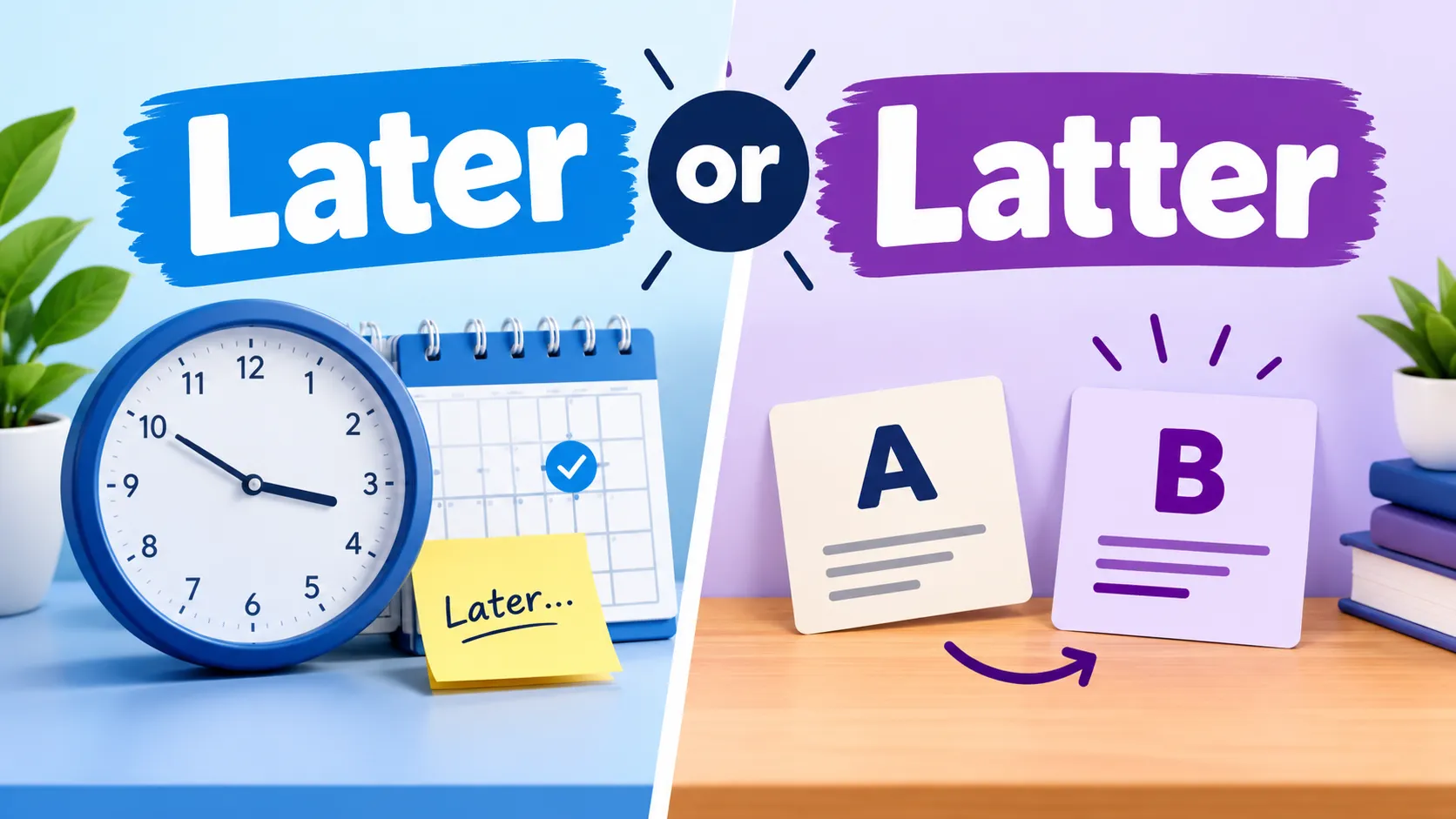
Later and latter look and sound similar, but they have different meanings and Grammatical uses. The easiest way to remember the difference is simple: later is mainly about time, while latter usually identifies the second of two things already mentioned.
For example:
- I’ll call you later.
- I like tea and coffee, but I prefer the latter.
In the first sentence, later refers to a future time. In the second, the latter refers to the second item mentioned, which is coffee.
Although the two words are easy to confuse, you can usually choose the correct one by asking a simple question: Are you talking about when something happens, or which of two things you mean?
This guide explains later vs. latter with clear definitions, examples, common mistakes, practical usage, and a short practice quiz.
Later or Latter: Quick Answer
The difference between later and latter can be summarized in one rule:
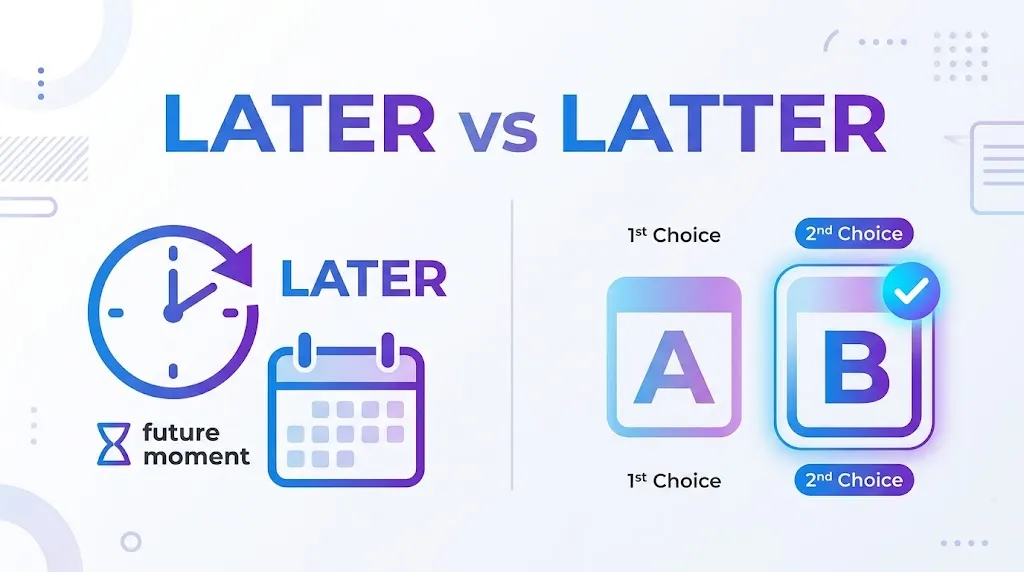
Later = a time after now or another point in time.
Latter = the second of two people or things already mentioned.
Compare these examples:
- I’ll finish my homework later.
- Between English and mathematics, I prefer the latter.
Here, later tells us when the homework will be finished. Latter tells us which one is preferred.
The easiest rule to remember
Think of the two words as answering different questions:
Later → When?
Latter → Which of the two?
If you are talking about a future or subsequent time, choose later. If you are referring back to the second of two previously mentioned things, choose latter.
Later vs. Latter: Side-by-Side Comparison
| Feature | Later | Latter |
| Main meaning | At a subsequent time | The second of two mentioned items |
| Common question | When? | Which one? |
| Main grammatical uses | Adverb and adjective | Noun-like reference and adjective |
| Common phrase | See you later | The latter |
| Related word | Earlier | Former |
| Example | I’ll call you later. | I prefer the latter. |
The words may look almost identical, but their jobs are different.
Later is connected mainly with time or sequence.
Latter is commonly used to refer to the second of two previously mentioned people, things, or groups. It can also describe something near the end of a period, as in the latter part of the year.
What Does “Later” Mean?
Later generally means after some time, at a subsequent time, or after a particular point that has already been mentioned.
For example:
- I’ll talk to you later.
- She arrived later than expected.
- We can discuss the problem later.
- He became interested in music later in life.
In each sentence, later has a connection with time.
Cambridge Dictionary lists later as an adverb for a time in the future or after a time already mentioned. It can also function as an adjective referring to something happening in the future, toward the end of a period, or more recently.
Later as an Adverb
An adverb can modify a verb or describe when an action happens.
Examples:
- I’ll call you later.
- She arrived later.
- We met later that evening.
- He explained the situation later.
- They returned later in the day.
In these examples, later tells us when something happened or will happen.
Later as an Adjective
Later can also appear before a noun.
Examples:
- We chose a later date.
- I took a later train.
- The later version included several improvements.
- They discussed the matter at a later meeting.
- The later stages of the project were more difficult.
Here, later describes a noun and indicates a time after another point.
Later Can Also Mean “More Recent”
The word later can describe something that came afterward in a sequence or something more recent.
For example:
- Her later work became more popular.
- The later models had improved features.
- His later books were more experimental.
This use is still related to sequence and time.
Common Expressions With Later
You will often see later in everyday expressions such as:
- See you later
- Later today
- Later tonight
- Later this week
- Later on
- At a later time
- At a later date
- Sooner or later
Examples:
- I’ll see you later.
- We can finish the report later today.
- She called me later on.
- The decision will be announced at a later date.
- Sooner or later, everyone makes mistakes.
These expressions all deal with time, which is a useful clue that later is the correct word.
What Does “Latter” Mean?
Latter has two closely related uses.
First, the latter refers to the second of two people, things, or groups that have already been mentioned.
Second, latter can describe something near or toward the end of a period.
For example:
- I considered tea and coffee, but I chose the latter.
- The latter part of the book was more interesting.
In the first example, the latter means coffee because coffee was the second of the two choices.
Cambridge Dictionary defines the latter as the second of two people, things, or groups previously mentioned. It also defines latter as an adjective meaning near or toward the end of something.
Latter Means the Second of Two
This is the use that causes the most confusion with later.
Consider this sentence:
Between apples and oranges, I prefer the latter.
Two things are mentioned:
- Apples
- Oranges
The second item is oranges, so the latter means oranges.
Another example:
Sarah considered a laptop and a tablet, but she bought the latter.
The two items are:
- Laptop
- Tablet
Therefore, the latter refers to the tablet.
How “Latter” Refers Back to Earlier Mentioned Things
The word latter normally depends on information that has already appeared in the sentence or nearby context.
For example:
The company considered two solutions, but the latter was less expensive.
The reader first sees two solutions. The latter then points back to the second solution.
Another example:
We could travel by train or bus. The latter would take longer.
Here, the latter refers to the second option: bus.
This is why latter is different from later. It is not primarily telling you when something happens. Instead, it identifies a previously mentioned item.
Latter in Formal and Academic Writing
The latter is particularly useful when writing about two previously mentioned ideas, methods, options, or groups.
Examples:
- The two methods produced different results; the latter was more efficient.
- Both proposals have advantages, but the latter requires less preparation.
- The study compared two approaches, and the latter produced more consistent results.
- The researchers examined two explanations and found the latter more convincing.
This construction can make formal writing concise because you do not need to repeat the complete noun phrase.
Latter as “Toward the End”
There is another important meaning of latter.
It can describe something that occurs near the end of a period, process, or sequence.
Examples:
- The latter part of the year was unusually busy.
- He became successful during the latter stages of his career.
- The latter half of the book contains the most important information.
- Problems appeared in the latter part of the project.
Notice that this use is about the end portion of a period, not the second of two choices.
So latter can have these two major meanings:
- The second of two previously mentioned things
- Near or toward the end of a period or sequence
Former vs. Latter: What’s the Difference?
Former and latter are often taught together because they work as a pair.
When two things are mentioned:
- Former = the first one
- Latter = the second one
For example:
Between science and history, I prefer the former.
Former refers to science because it was mentioned first.
Now compare:
Between science and history, I prefer the latter.
Latter refers to history because it was mentioned second.
Former and Latter Example
Consider this sentence:
The company considered hiring a designer or a developer. The former had more experience, while the latter had stronger technical skills.
Here:
- Former = designer
- Latter = developer
The order matters.
Easy Memory Trick for Former and Latter
A simple memory aid is:
Former → first
Latter → second
You can think of former as pointing backward to the first item and latter as pointing to the second.
Remember that this is a memory trick, not a replacement for understanding the sentence.
How to Choose Between Later and Latter
When you are unsure which spelling to use, follow these steps.
Ask “When?”
If the word answers a question about time, later is usually correct.
Examples:
- I’ll do it later.
- We can talk later.
- She arrived later than expected.
- They will announce the results later.
In each case, the word refers to a time.
Ask “Which One?”
If you are referring to the second of two previously mentioned things, use the latter.
Examples:
- I considered tea and coffee and chose the latter.
- We discussed two plans, and I preferred the latter.
- She could take the train or the bus; she chose the latter.
Here, latter identifies an item rather than a time.
Try Replacing “Latter” With “the Second One”
This is one of the easiest tests.
Consider:
I prefer the latter.
Ask:
Do I mean “I prefer the second one”?
If yes, latter is probably correct.
Try Replacing “Later” With “Afterward”
Now consider:
I’ll call you later.
You can think of it as:
I’ll call you afterward.
Because the meaning involves time, later is correct.
This substitution is not a rule for every sentence, but it can be a helpful quick check.
Later vs. Latter Example Sentences
Seeing the words in Complete sentences makes the distinction much easier.
Examples of “Later”
- I’ll finish the report later.
- We can discuss the issue later.
- She called me later that evening.
- He arrived later than expected.
- I’ll send the details later today.
- They decided to meet later.
- The train arrived later than scheduled.
- We can make a decision at a later date.
- She became interested in photography later in life.
- The company released a later version of the software.
All these examples involve time, sequence, or something occurring after another point.
Examples of “Latter”
- I offered tea and coffee, but she chose the latter.
- We discussed two plans, and I preferred the latter.
- Between a laptop and a tablet, he selected the latter.
- The two options were explained, and the latter seemed easier.
- The book has two major sections; the latter is more detailed.
- The latter part of the presentation contained the main findings.
- The latter stages of the project required more attention.
- Between the two proposals, the latter was more practical.
- The latter half of the film was more dramatic.
- The two methods were tested, but the latter produced different results.
Here, the latter either refers to the second of two previously mentioned things or describes the end portion of something.
Common Mistakes With Later and Latter
Because the spelling is similar, these words are frequently mixed up.
“See You Latter” vs. “See You Later”
The correct expression is:
See you later.
Why?
Because you are talking about seeing someone at another time in the future.
Later = time.
Incorrect:
See you latter.
Correct:
See you later.
“I Prefer the Later” vs. “I Prefer the Latter”
Suppose you write:
I prefer tea and coffee. I prefer the ___.
If you mean coffee, the correct word is:
I prefer the latter.
Why? Coffee is the second of the two items mentioned.
“At a Latter Time” vs. “At a Later Time”
The correct phrase is:
At a later time
For example:
We can discuss this at a later time.
The phrase refers to a future point in time, so later is required.
Using “Latter” When You Mean Time
This is another common mistake.
Incorrect:
I’ll finish the work latter.
Correct:
I’ll finish the work later.
The sentence is about when the work will be finished, so later is correct.
Using “Later” for the Second of Two Items
Incorrect:
I considered tea and coffee and chose the later.
Correct:
I considered tea and coffee and chose the latter.
The second item is coffee, so latter is the appropriate word.
Confusing the Words Because They Sound Similar
The words have similar spellings and pronunciations, but pronunciation should not determine the choice.
Instead, focus on meaning.
Ask:
Is this about time?
Use later.
Is this about the second of two previously mentioned things?
Use latter.
Later or Latter in Different Contexts
Understanding the context can make the choice much easier.
Later in Everyday Conversation
Later is extremely common in everyday speech.
Examples:
- I’ll call you later.
- See you later.
- Let’s talk later.
- I’ll do it later.
- Maybe we can meet later.
These sentences all concern a future time.
Latter in Everyday Conversation
Latter is less common in casual conversation when people can simply repeat the noun.
For example, instead of saying:
I considered pizza and pasta, and I chose the latter.
A person might simply say:
I considered pizza and pasta, and I chose pasta.
However, latter remains perfectly useful, especially when referring clearly to two previously mentioned items.
Later in Emails
Later is common in both casual and professional emails.
Examples:
I’ll send the revised document later today.
We can discuss the remaining points at a later time.
I’ll provide the additional information later this week.
Latter in Academic Writing
The latter can be useful in academic or formal writing when two ideas, methods, theories, or groups have already been introduced.
For example:
The researchers compared two methods. The latter produced more consistent results.
The word prevents unnecessary repetition.
However, clarity should always come first. If the reader might not know what the latter refers to, repeating the noun can be better.
Later in Professional Writing
Examples include:
- We will provide an update later.
- The changes will be implemented at a later stage.
- A later version of the document will include the missing information.
Latter in Formal English
Examples:
- The latter proposal requires additional funding.
- The latter approach offers greater flexibility.
- The latter part of the report discusses the results.
Later vs. Latter in Real-Life Situations
School Example
I’ll complete the assignment later.
Here, later refers to a future time.
Now consider:
The teacher offered two topics, history and science. I chose the latter.
Here, latter means science because science was mentioned second.
Workplace Example
We can discuss the budget later.
The word refers to a future time.
Compare:
The manager considered two proposals and selected the latter.
The word refers to the second proposal.
Email Example
I’ll send you the updated file later today.
Use later because the sentence concerns time.
Another example:
We reviewed two versions of the document. The latter contained the corrected figures.
Use latter because it identifies the second version.
Shopping Example
I’ll buy the shoes later.
The word refers to a future time.
Now:
I considered the black shoes and the brown shoes, but I chose the latter.
The latter means the brown shoes because they were mentioned second.
Travel Example
We can book the tickets later.
Time is involved, so later is correct.
Compare:
We could travel by train or bus. The latter is cheaper.
The latter means bus.
Conversation Example
I’ll explain the details later.
This means at another time.
But:
We could watch a movie or a documentary. I’d prefer the latter.
The latter refers to the documentary.
Is “Latter” Always Used for Two Things?
For the standard reference meaning, the latter is used most clearly and conventionally for the second of two previously mentioned people, things, or groups. Cambridge Dictionary specifically defines this use as the second of two.
For example:
We can travel by train or plane. The latter is faster.
There are exactly two options:
- Train
- Plane
So the meaning is clear.
What About Three or More Items?
Suppose you write:
We considered tea, coffee, and juice. I chose the latter.
The sentence can become unclear because there are three items. What exactly does latter refer to?
In careful writing, it is better to say:
We considered tea, coffee, and juice. I chose juice.
Or:
Of the three drinks, I chose juice.
This avoids ambiguity.
Why Clarity Matters
Even when a reader might understand your intended meaning, repeating the noun can make the sentence easier to follow.
Compare:
The team considered three proposals, and the latter was selected.
with:
The team considered three proposals, and the third proposal was selected.
The second version gives the reader a precise reference.
For two items, the latter is usually much clearer:
The team considered two proposals, and the latter was selected.
Related To Another article: https://grammixo.com/pass-vs-past/
Can Later and Latter Be Used Interchangeably?
No. Later and latter generally cannot be used Interchangeably because they perform different functions.
Compare:
I’ll call you later.
This means you will call at another time.
Now:
I considered tea and coffee and chose the latter.
This means you chose the second item.
Changing the words would change the meaning or make the sentence incorrect.
Compare These Pairs
Correct:
See you later.
Correct:
I prefer the latter.
Correct:
We can discuss it at a later date.
Correct:
Between the two options, I chose the latter.
A useful rule is:
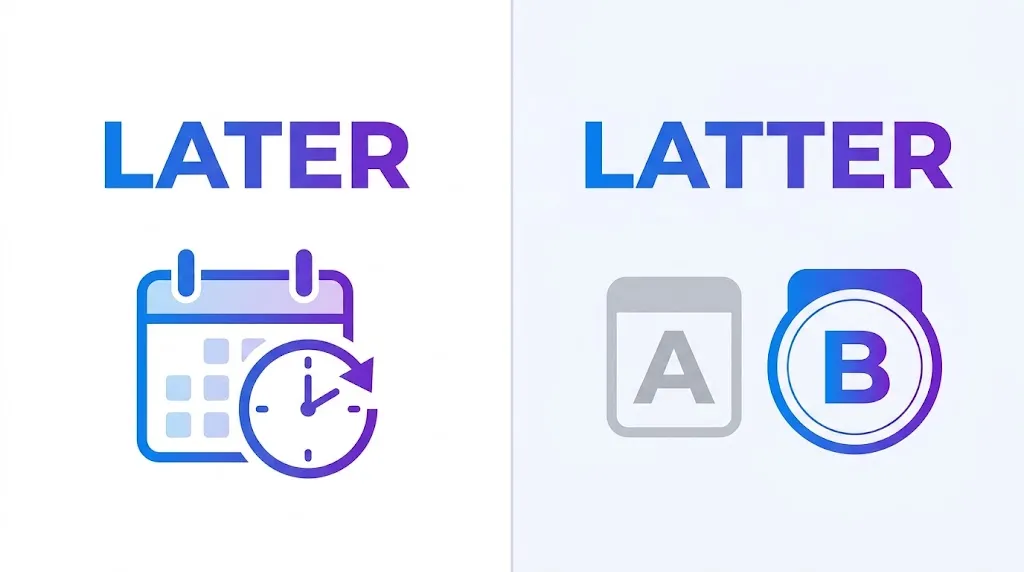
Later = time
Latter = second of two
Is “Later” an Adjective or Adverb?
Later can function as both an adverb and an adjective, depending on how it is used.
Later as an Adverb
Examples:
I’ll call later.
She arrived later.
We discussed the issue later.
Here, later describes when an action happens.
Later as an Adjective
Examples:
We chose a later date.
He took a later train.
The later version was more efficient.
Here, later describes a noun.
Dictionary definitions also recognize these adjective and adverb uses.
Is “Latter” an Adjective?
Yes, latter can function as an adjective.
For example:
The latter part of the year was difficult.
The latter stages of the project were more demanding.
The latter half of the book was easier to understand.
In these examples, latter describes a part or stage toward the end of something.
But the latter can also function as a noun-like reference to the second of two previously mentioned items.
For example:
I considered tea and coffee, but I chose the latter.
The noun being referred to is understood from the context.
Later vs. Latter vs. Former
These three words are easy to compare once their meanings are separated.
| Word | Meaning | Example |
| Later | At a subsequent time | I’ll call later. |
| Former | The first of two | I prefer the former. |
| Latter | The second of two | I prefer the latter. |
Consider this complete example:
The company considered a local supplier and an international supplier. The former was cheaper, while the latter had a wider range of products.
Here:
- Former = local supplier
- Latter = international supplier
Now compare:
The company will make its final decision later.
Here, later refers to time.
This is the key distinction among the three words.
Easy Memory Tricks for Later and Latter
Later = Time
Think:
Later → time
If you could answer the question “When?”, choose later.
Example:
I’ll do it later.
Latter = Second
Think:
Latter → second of two
If you could replace the latter with the second one, latter is likely correct.
Example:
I considered tea and coffee and chose the latter.
Meaning:
I considered tea and coffee and chose the second one.
Former + Latter Memory Pair
Remember:
Former = first
Latter = second
This pair is especially useful in formal writing.
Later or Latter Practice Quiz
Test yourself before checking the answers.
Choose “Later” or “Latter”
- I’ll call you ______.
- Between tea and coffee, I prefer the ______.
- We can discuss this at a ______ date.
- Sarah and Emma applied for the position; the ______ was selected.
- I’ll see you ______.
- The two plans were reviewed, and the ______ was approved.
- We can finish the project ______ this week.
- The ______ part of the book was difficult to understand.
- He promised to send the information ______.
- Between the two options, I chose the ______.
Answers
- later
- latter
- later
- latter
- later
- latter
- later
- latter
- later
- latter
Why Are These Answers Correct?
1. I’ll call you later.
The sentence refers to a future time, so use later.
2. I prefer the latter.
Tea and coffee are two items, and the second one is coffee, so use latter.
3. At a later date
The phrase refers to a future time, so later is correct.
4. The latter was selected
The word refers to the second person mentioned, so latter is correct.
5. See you later
This is a common expression used when saying goodbye and referring to another time.
6. The latter was approved
The sentence refers to the second of two plans.
7. Later this week
This refers to a future time within the week.
8. The latter part
Here, latter means the part toward the end.
9. Send the information later
Again, the word describes when the action will happen.
10. I chose the latter
The word refers to the second of two options.
People Also Ask
Later usually refers to a subsequent time, while latter commonly refers to the second of two previously mentioned people, things, or groups.
Example:
I’ll call you later.
I prefer the latter.
The correct expression is “see you later.”
It refers to another time in the future.
See you later!
Latter would not be correct in this expression.
The standard pair is former and latter when referring to two previously mentioned things.
For example:
Between tea and coffee, I prefer the former.
Here, former means the first item.
Between tea and coffee, I prefer the latter.
Here, latter means the second item.
Generally, no.
Later is primarily associated with time or sequence.
Latter is commonly used for the second of two previously mentioned things, and it can also describe something toward the end of a period.
In a sentence such as:
I considered a laptop and a tablet and chose the latter.
Latter means the second item mentioned: the tablet.
Later or Latter: Final Takeaway
The difference between later and latter becomes easy once you focus on meaning instead of spelling.
Later is used mainly for time or something Occurring after another point.
I’ll finish the project later.
Latter commonly refers to the second of two previously mentioned people, things, or groups.
I considered tea and coffee, but I chose the latter.
There is also another use of latter when it describes something near or toward the end of a period:
The latter part of the year was extremely busy.
So remember the simplest rule:
Later → When?
Latter → Which of the two?
Once you recognize whether the sentence is talking about time or the second of two things, choosing the correct word becomes much easier.

1 thought on “Later or Latter: What’s the Difference? Meaning & Examples”