Introduction
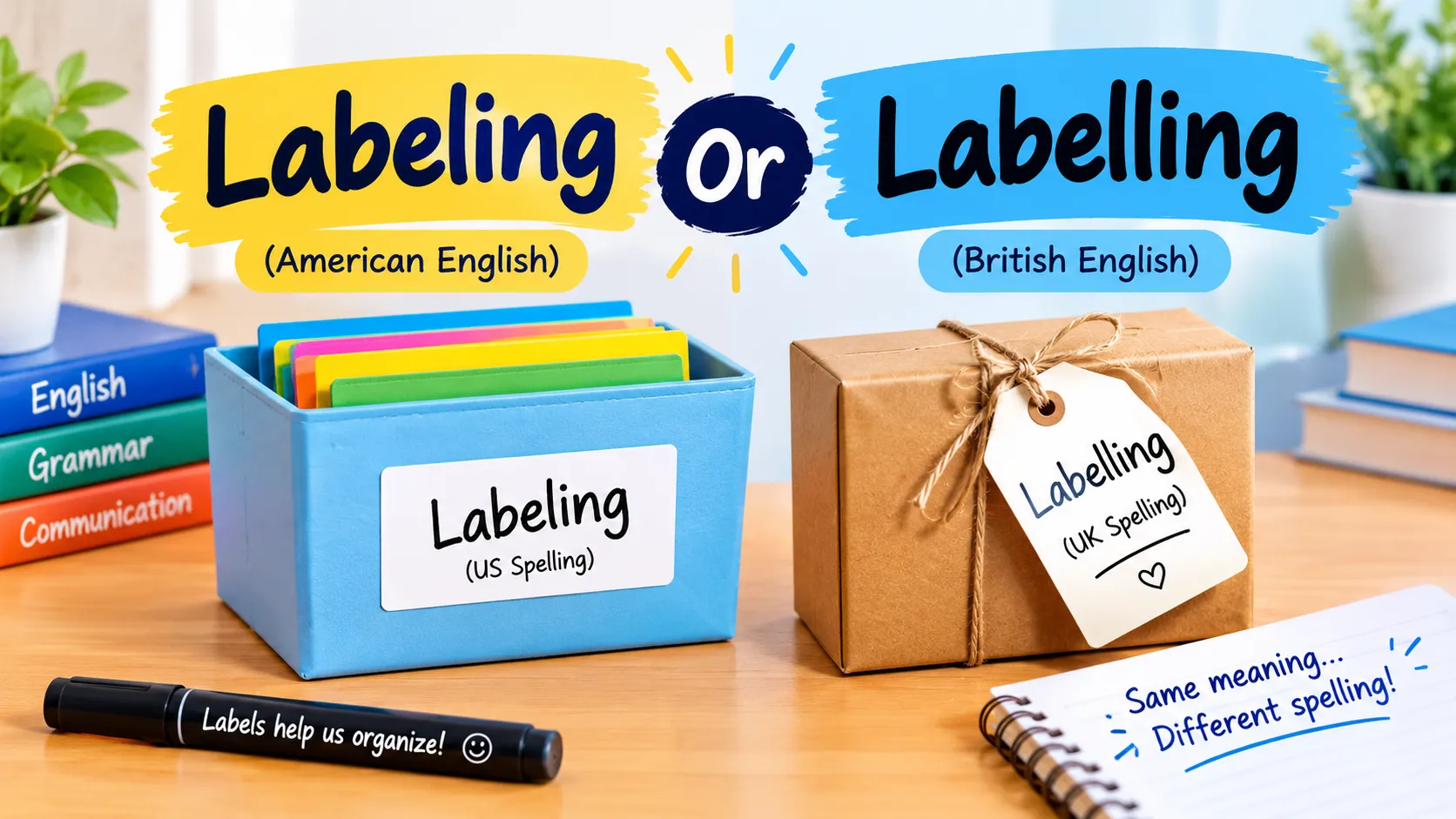
If you are unsure whether to write labeling or labelling, you are not alone. Both spellings are correct, but they belong to different varieties of English.
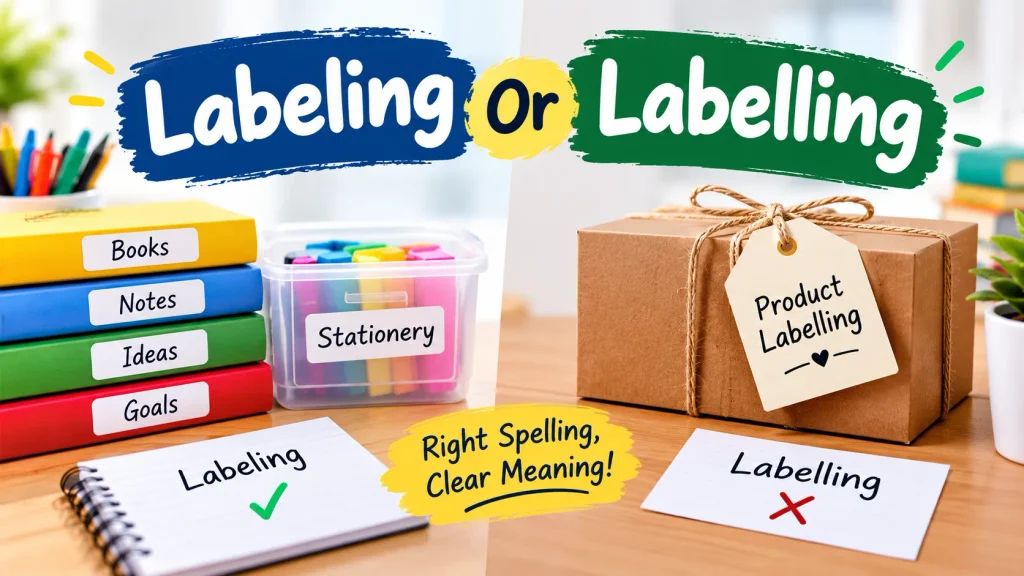
Labeling is the standard spelling in American English, while labelling is the standard spelling in British English and other varieties that generally follow British spelling Conventions. The meaning is the same in both cases.
The main difference is the extra l used in labelling.
Labeling or Labelling: Quick Answer
The correct spelling depends on which variety of English you are using:
- Labeling = American English
- Labelling = British English
- Both mean the same thing.
- Both function as the -ing form of the verb label.
- The difference is mainly a regional spelling convention.
For example:
American English:
The company is labeling the packages.
British English:
The company is labelling the packages.
The meaning of both sentences is identical.
Labeling vs Labelling at a Glance
| Feature | Labeling | Labelling |
| English variety | American English | British English |
| Base verb | label | label |
| -ing form | labeling | labelling |
| Meaning | Same | Same |
| Pronunciation | Essentially the same | Essentially the same |
| Past tense | labeled | labelled |
| Past participle | labeled | labelled |
| Common usage | US | UK and many British-style varieties |
The important thing to remember is that labeling and labelling are spelling variants, not different words with different meanings.
What Does Labeling Mean?
Labeling is the American English spelling of the -ing form of label.
The verb label can mean to put a label on something, identify something, classify it, or describe someone or something with a particular term.
Labeling as a Present Participle
As a present participle, labeling can be used with forms of be to describe an action that is happening.
For example:
- The worker is labeling the boxes.
- The team is labeling the files.
- The company is labeling its products.
In each sentence, labeling describes an action in progress.
Labeling as a Gerund
The same -ing form can also work as a noun, known as a gerund.
For example:
- Labeling the samples takes time.
- Accurate labeling is important in the laboratory.
- Product labeling helps customers identify ingredients.
Here, labeling refers to the activity itself.
Examples of Labeling in American English
- The teacher is labeling the parts of the diagram.
- The company is labeling every package before shipping.
- Proper labeling makes the files easier to organize.
- The researchers are labeling the samples carefully.
- The new system improves product labeling.
These examples use the standard American spelling.
What Does Labelling Mean?
Labelling is the British English spelling of the same -ing form.
It has the same meaning and grammatical function as labeling. The only major difference is the spelling.
Labelling in British English
British English commonly doubles the final l when forming labelling from label.
For example:
- The worker is labelling the boxes.
- The company is labelling its products.
- The teacher is labelling the diagram.
- Accurate labelling is essential.
- The team is labelling the files.
These sentences are grammatically equivalent to their American English versions.
Why Is It Labeling in American English but Labelling in British English?
The difference comes from Established spelling conventions in American and British English.
When the suffix -ing is added to label, American English generally writes:
label + ing = labeling
British English generally writes:
label + ling = labelling
This is why the two spellings look different even though the pronunciation and meaning remain essentially the same.
Why British English Doubles the “L”
British spelling conventions commonly use labelling with two ls.
The same pattern appears in other related forms:
- label → labelling
- label → labelled
- label → labeller
This convention is also found in a number of other British English spellings.
Why American English Uses One “L”
American English generally uses a single l in these forms:
- labeling
- labeled
- labeler
This is a regional spelling preference that developed as American English established its own spelling conventions.
It is better to treat this as a spelling convention rather than applying a simple rule to every English word ending in l. English spelling has several exceptions and variations.
Is Labeling or Labelling Correct?
Both are correct.
The choice depends on the variety of English you are writing.
Use labeling when following American English conventions.
Use labelling when following British English conventions.
For example:
US English:
The manufacturer is labeling the containers.
UK English:
The manufacturer is labelling the containers.
Neither sentence is incorrect.
The most important thing is to remain consistent throughout the same document.
Labeling vs Labelling: Does the Meaning Change?
No. Labeling and labelling normally have exactly the same meaning.
Both can describe:
- Putting a label on something
- Identifying an object
- Naming parts of a diagram
- Categorizing information
- Classifying something
- Describing someone or something with a particular term
For example:
US: The software is labeling the images automatically.
UK: The software is labelling the images automatically.
The spelling changes, but the meaning does not.
Labeling in American English
American English uses labeling in many different contexts.
1. Labeling in Academic Writing
- The students are labeling the parts of the cell.
- The researcher is labeling each sample.
- The diagram requires careful labeling.
2. Labeling in Business Writing
- Employees are labeling the new products.
- Proper labeling helps prevent shipping errors.
- The company updated its product labeling policy.
3. Labeling in Technology
- The application is labeling files automatically.
- The software allows users to customize image labeling.
- The system is labeling each data point.
4. Labeling in Everyday English
- I am labeling these boxes for storage.
- She is labeling the folders.
- We finished labeling the containers.
In all these examples, labeling follows American spelling.
Labelling in British English
British English uses labelling in the same situations.
1. Labelling in Academic Writing
- The students are labelling the parts of the cell.
- The researcher is labelling each sample.
- The diagram requires careful labelling.
2. Labelling in Business Writing
- Employees are labelling the new products.
- Proper labelling helps prevent shipping errors.
- The company updated its product labelling policy.
3. Labelling in Everyday English
- I am labelling these boxes for storage.
- She is labelling the folders.
- We finished labelling the containers.
The grammar and meaning remain the same. Only the regional spelling changes.
Label, Labeling, Labeled, and Labelling: The Complete Word Family
Understanding the complete word family makes the difference easier to remember.
| Form | American English | British English |
| Base verb | label | label |
| Third-person form | labels | labels |
| -ing form | labeling | labelling |
| Past tense | labeled | labelled |
| Past participle | labeled | labelled |
| Person noun | labeler | labeller |
For example:
American English:
The company labeled the products before labeling the boxes.
British English:
The company labelled the products before labelling the boxes.
Notice that the regional spelling pattern appears in more than one form.
Labeling or Labelling: Which One Should You Use?
The best choice depends on your audience.
Use Labeling for American English
Choose labeling if your content follows American English Conventions.
This is generally appropriate for writing intended for readers in the United States.
For example:
The manufacturer is labeling the packages.
Use Labelling for British English
Choose labelling if your content follows British English conventions.
For example:
The manufacturer is labelling the packages.
What Should You Use for a Global Audience?
For an international audience, either form can work.
The key is consistency.
If you choose American English, use forms such as:
- labeling
- labeled
- labeler
If you choose British English, use:
- labelling
- labelled
- labeller
Avoid switching between the two systems without a reason.
Common Mistakes With Labeling and Labelling
Several mistakes can make your writing look inconsistent.
Assuming One Spelling Is Always Wrong
It is incorrect to say that labeling is always wrong or that labelling is always wrong.
Both are established spellings.
Mixing US and UK Spellings
Using labeling in one paragraph and labelled in another can create unnecessary inconsistency if you are following one English variety.
Choose one spelling system and maintain it.
Confusing Spelling With Grammar
The difference between labeling and labelling is primarily a spelling difference.
It does not create a different grammatical tense or a different meaning.
Writing “Labbeling”
Labbeling is not the standard spelling.
The correct forms are:
- labeling in American English
- labelling in British English
Writing “Lableing”
Lableing is also incorrect.
The base word is label, not lable.
Labeling vs Labelling in Example Sentences
Here are some side-by-side examples:
| American English | British English |
| The worker is labeling the boxes. | The worker is labelling the boxes. |
| She is labeling the diagram. | She is labelling the diagram. |
| The company labeled the products. | The company labelled the products. |
| Proper labeling is important. | Proper labelling is important. |
| We are labeling the files. | We are labelling the files. |
The sentence structure and meaning remain the same.
Example With Products
US: The manufacturer is labeling each product.
UK: The manufacturer is labelling each product.
Example With Diagrams
US: The students are labeling the parts of the diagram.
UK: The students are labelling the parts of the diagram.
Example With Data
US: The software is labeling the data points.
UK: The software is labelling the data points.
Example With Food
US: The company is labeling the food containers.
UK: The company is labelling the food containers.
Labeling or Labelling Pronunciation
The extra l in labelling does not normally create a different pronunciation from labeling.
Both forms are pronounced essentially the same in ordinary English.
The difference is primarily visible in writing:
American: labeling
British: labelling
So you generally do not need to pronounce the additional written l as a separate sound.
- Related To Another Article: https://grammixo.com/modelling-or-modeling/
How to Remember the Difference
A simple way to remember the spelling is to connect each form with its English variety:
US → labeling
UK → labelling
You can extend the same memory pattern to the past tense:
US → labeled
UK → labelled
The British forms generally keep the doubled l, while the American forms generally use one.
Quick Practice: Labeling or Labelling?
Choose the spelling that matches the English variety.
- The teacher is ______ the parts of the diagram.
- The company is ______ its new products.
- The boxes were ______ before shipping.
- Accurate ______ makes the information easier to understand.
Answers
For American English:
- labeling
- labeling
- labeled
- labeling
For British English:
- labelling
- labelling
- labelled
- labelling
The correct choice depends on the spelling system you are following.
People Also Ask
Both are correct. Labeling is the standard American English spelling, while labelling is the standard British English spelling.
Labeling is American English.
Yes. Labelling is the standard British English spelling.
Yes. They normally have the same meaning and grammatical function. The difference is regional spelling.
Yes. Labeling is the -ing form of the verb label. It can function as a present participle or gerund depending on how it is used.
Final Verdict: Labeling or Labelling?
Labeling and labelling are both correct spellings.
The difference is simple:
- Labeling = American English
- Labelling = British English
- Both have the same basic meaning.
- Both are forms of the verb label.
- Labeled is American English, while labelled is British English.
- The best choice depends on your audience and the English style you are following.
If you are writing for American readers, choose labeling. If you are following British English, choose labelling. Most importantly, keep the spelling Consistent throughout your content.

1 thought on “Labeling or Labelling: Which Spelling Is Correct? US vs UK English”