Introduction
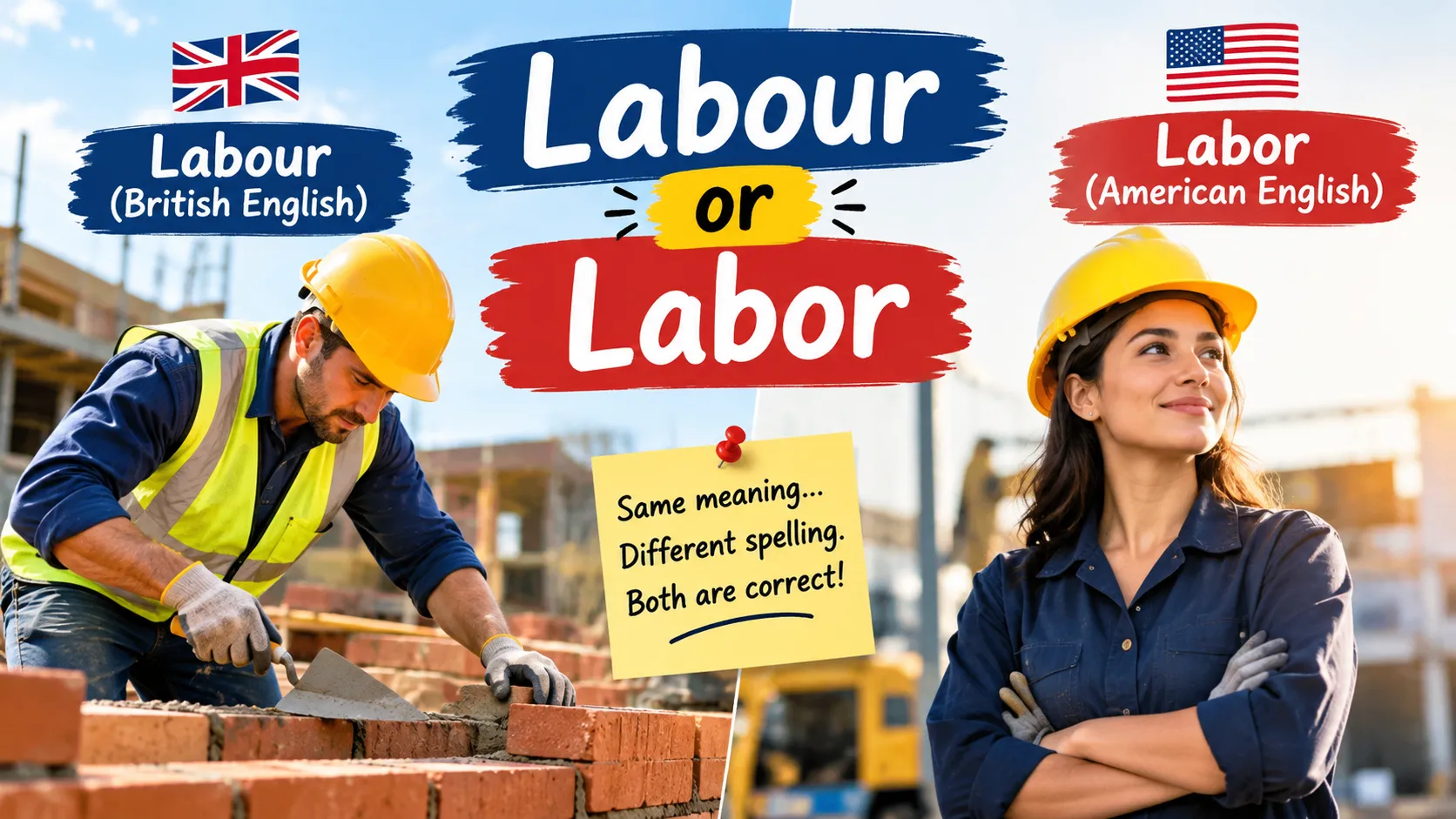
If you are unsure whether to write labour or labor, the answer usually depends on which variety of English you are using. Both Spellings are correct, and they generally have the same meanings. The main difference is regional spelling.
Labour is the standard spelling in British English, while labor is the standard spelling in American English. The spelling difference also appears in related forms such as labourer/laborer, laboured/labored, and labouring/laboring.
Labour or Labor: Quick Answer
Labour is used mainly in British English, while labor is used mainly in American English.
Both words can refer to:
- Physical or mental work
- Effort or exertion
- Workers as a group
- The process of giving birth
- A period of work or activity
For example:
- British English: The company depends on skilled labour.
- American English: The company depends on skilled labor.
The meaning remains the same; only the spelling changes.
Labour vs Labor at a Glance
| Feature | Labour | Labor |
| Main usage | British English | American English |
| Spelling | With u | Without u |
| Meaning | Work, effort, workforce, childbirth | Work, effort, workforce, childbirth |
| Noun | Yes | Yes |
| Verb | Yes | Yes |
| Pronunciation | Generally the same | Generally the same |
| Example | manual labour | manual labor |
What Does Labour Mean?
Labour is the British English spelling. It can function as both a noun and a verb.
Labour as a Noun
As a noun, labour can mean work, physical effort, or the workers involved in producing goods and services.
Examples:
- Manual labour can be physically demanding.
- The company needs more skilled labour.
- The project required a great deal of labour.
- Labour costs have increased this year.
In some contexts, labour can also refer to the process of giving birth.
Labour as a Verb
As a verb, labour means to work hard or make a great effort.
Examples:
- They laboured for several hours to complete the task.
- The workers laboured under difficult conditions.
- She laboured to find a solution to the problem.
The verb is less common in everyday conversation than simpler alternatives such as work or struggle, but it is perfectly correct.
Labour in Childbirth
In British English, labour is commonly used for the process of giving birth.
Examples:
- She went into labour early in the morning.
- The doctor said that she was in labour.
- The hospital has a dedicated labour ward.
In American English, the same meaning is spelled labor.
What Does Labor Mean?
Labor is the standard American English spelling of the word.
It has the same basic meanings as labour and can also be used as both a noun and a verb.
Labor as a Noun
As a noun, labor can mean work, effort, or the workforce involved in an activity.
Examples:
- The factory relies on skilled labor.
- Labor costs are rising.
- The project required considerable labor.
- The company is facing a shortage of labor.
Labor as a Verb
As a verb, labor means to work hard or make a sustained effort.
Examples:
- The workers labored throughout the day.
- He labored to complete the report.
- They labored under difficult conditions.
Labor in Childbirth
In American English, labor is used when referring to childbirth.
Examples:
- She went into labor last night.
- The doctor said she was in labor.
- The hospital has a labor and delivery unit.
Labour or Labor: Which Spelling Is Correct?
Both labour and labor are correct.
The choice depends mainly on your variety of English.
Use labour when writing in British English and use labor when writing in American English.
For example:
British English:
The company is looking for skilled labour.
American English:
The company is looking for skilled labor.
Neither sentence is incorrect. The spelling simply follows a different English convention.
Is Labour British or American English?
Labour is primarily the British English spelling.
It is commonly used in the United Kingdom and is also found in several other varieties of English that generally follow British spelling conventions.
Examples include:
- labour market
- labour force
- manual labour
- child labour
- labour costs
Is Labor British or American English?
Labor is the standard American English spelling.
American English commonly removes the u from several words that traditionally contain it in British English.
For example:
- labour → labor
- colour → color
- honour → honor
- favour → favor
This is why labor is normally expected in American English writing.
Labour vs Labor in Different English-Speaking Countries
English spelling conventions vary between countries, so regional usage matters.
Labour in British English
British English normally uses labour.
Example:
The country has introduced new labour laws.
Labor in American English
American English normally uses labor.
Example:
The country has introduced new labor laws.
What About Canada?
Canadian English often follows British spelling in words such as labour, although Canadian English also has many spelling conventions influenced by American English.
Therefore, labour is widely used in Canadian writing.
What About Australia?
Australian English generally uses labour.
For example:
The government announced changes to labour laws.
However, some names and organizations may use their own established spelling, so proper names should always be written exactly as officially styled.
Labour and Labor Word Forms
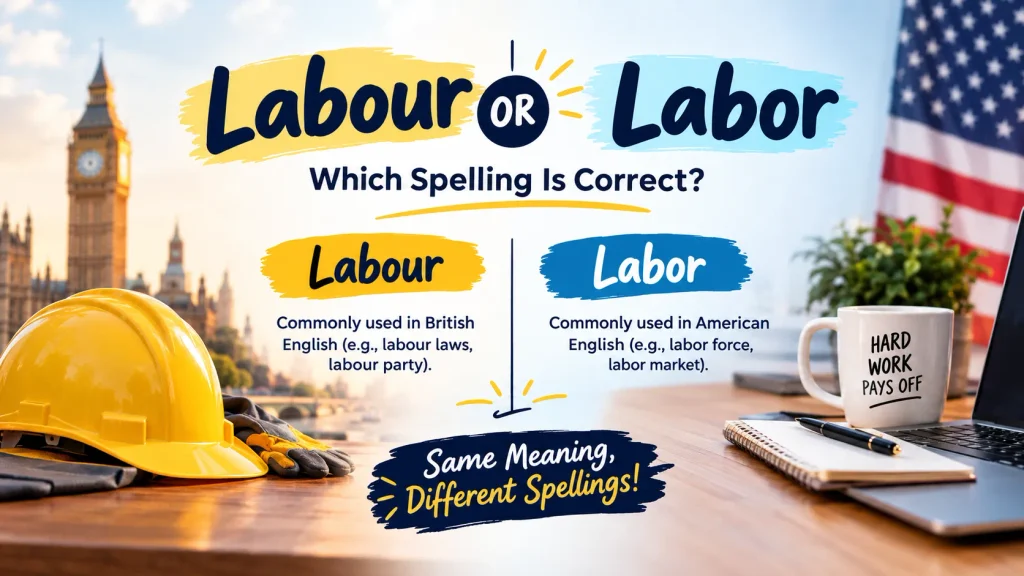
The spelling difference continues in related forms.
Labourer vs Laborer
A labourer is the British English spelling, while laborer is the American English spelling.
Examples:
- British: The labourer worked on the construction site.
- American: The laborer worked on the construction site.
Laboured vs Labored
The past-tense and past-participle forms follow the same regional pattern.
- British English: laboured
- American English: labored
Examples:
- British: He laboured over the final report.
- American: He labored over the final report.
Labouring vs Laboring
The -ing forms are also different.
- British English: labouring
- American English: laboring
Examples:
- British: They were labouring under difficult conditions.
- American: They were laboring under difficult conditions.
Labouring or Laboring: Which Is Correct?
Both are correct.
Use labouring in British English and laboring in American English.
The same regional spelling rule applies to the related forms:
British: labour → labourer → laboured → labouring
American: labor → laborer → labored → laboring
Labour vs Labor Pronunciation
Despite the spelling difference, labour and labor are generally pronounced the same.
In both varieties of English, the word is commonly pronounced approximately like LAY-buh(r), with minor differences depending on the speaker’s accent.
The important point is that the extra u in labour does not create a separate pronunciation.
Therefore:
labour = labor in pronunciation for most standard varieties.
Common Expressions With Labour and Labor
The word appears in many common expressions.
Manual Labour / Manual Labor
This refers to physical work.
- British: Manual labour can be demanding.
- American: Manual labor can be demanding.
Labour Market / Labor Market
This refers to the system in which workers offer their skills and employers offer jobs.
- British: The labour market is changing rapidly.
- American: The labor market is changing rapidly.
Labour Force / Labor Force
This refers broadly to people who are working or available to work.
- British: The labour force has grown this year.
- American: The labor force has grown this year.
Labour Costs / Labor Costs
This refers to the cost associated with employing workers.
- British: Labour costs have increased.
- American: Labor costs have increased.
Child Labour / Child Labor
This refers to the employment of children, especially in situations that are harmful or exploitative.
- British: The law aims to prevent child labour.
- American: The law aims to prevent child labor.
Labour Laws / Labor Laws
These are laws governing employment and workplace relationships.
- British: Employers must follow labour laws.
- American: Employers must follow labor laws.
Labour Party vs Labor Party
The spelling can also appear in political party names, but proper names should not be changed.
The UK’s major political party is officially known as the Labour Party, using the British spelling.
The Australian federal political party is known as the Australian Labor Party, using the spelling Labor.
This is a useful reminder that organization names should always be written according to their official spelling.
Labour or Labor in Different Types of Writing
Labour or Labor in Academic Writing
Choose the spelling that matches the English variety Required by your institution, instructor, publication, or style guide.
If you are writing in British English, use labour consistently. If you are writing in American English, use labor consistently.
Labour or Labor in Business Writing
Business writing should follow the spelling convention of your company, audience, and target market.
For an American audience, use labor. For a British audience, use labour.
Labour or Labor in Formal Writing
Both forms are formal and grammatically correct. The important factor is consistency.
Do not switch randomly between British and American spellings in the same document.
Labour or Labor in Emails
Use the spelling appropriate for the person or organization receiving the email.
For example, an email written for a UK company would normally use labour, while an email for a US company would normally use labor.

- Related To Another Article: https://grammixo.com/practising-or-practicing/
Should You Use Labour or Labor?
The easiest rule is to identify your target audience before choosing the spelling.
Choose Labour for British English
Use labour if your content follows British English spelling conventions.
This includes related forms such as:
- labourer
- laboured
- labouring
Choose Labor for American English
Use labor if your content follows American English spelling conventions.
The related forms are:
- laborer
- labored
- laboring
Keep Your Spelling Consistent
Consistency is more important than choosing one spelling as universally “correct.”
If an article is written in American English, using labour in one paragraph and labor in another can make the writing look inconsistent.
The same applies to other British and American spelling differences.
Common Mistakes With Labour and Labor
Mixing British and American Spellings
One common mistake is using both forms without a reason.
For example:
The labour market is affected by rising labor costs.
This may be acceptable when discussing a proper name or quotation, but in ordinary writing it is better to maintain one spelling system.
Assuming One Spelling Is Wrong
Labour is not a misspelling of labor, and labor is not a misspelling of labour.
They are standard regional variants.
Changing the Spelling Without Considering the Audience
A US-focused article should normally use labor, while a UK-focused article should normally use labour.
Always consider who will read your content.
Confusing Spelling Differences With Meaning Differences
In most ordinary contexts, labour and labor have the same meaning.
The main difference is spelling, not definition.
Labour vs Labor: Example Sentences
Examples With Labour
- The company needs more skilled labour.
- Manual labour can require considerable physical effort.
- Labour costs have increased this year.
- The government introduced new labour laws.
- She went into labour during the night.
- The workers laboured under difficult conditions.
Examples With Labor
- The company needs more skilled labor.
- Manual labor can require considerable physical effort.
- Labor costs have increased this year.
- The government introduced new labor laws.
- She went into labor during the night.
- The workers labored under difficult conditions.
British English vs American English Sentence Pairs
| British English | American English |
| Skilled labour is important. | Skilled labor is important. |
| Labour costs are rising. | Labor costs are rising. |
| The labour market is changing. | The labor market is changing. |
| He worked in manual labour. | He worked in manual labor. |
| She went into labour. | She went into labor. |
| The workers laboured all day. | The workers labored all day. |
Easy Way to Remember Labour vs Labor
A simple memory trick is to remember the U.
British English = Labour
American English = Labor
The same pattern appears in several other words:
- colour → color
- honour → honor
- favour → favor
- behaviour → behavior
So, when you see the British spelling labour, remember that it keeps the u.
When you see the American spelling labor, remember that the u is removed.
Labour or Labor: Practice Quiz
Choose the correct spelling for each sentence according to the English variety shown.
Fill in the Blanks
- British English: The company needs skilled ________.
- American English: The company needs skilled ________.
- British English: ________ costs have increased.
- American English: ________ costs have increased.
- British English: She went into ________.
- American English: She went into ________.
Practice Quiz Answers
- labour
- labor
- Labour
- Labor
- labour
- labor
People Also Ask
Both are correct. Labour is the standard British English spelling, while labor is the standard American English spelling.
The main difference is regional spelling. Both words generally have the same meanings, including work, effort, workforce, and childbirth.
Labour is primarily the British English spelling.
Labor is the standard American English spelling.
Yes. Labour is widely used in Canadian English, although Canadian spelling has its own mixture of British and American conventions.
Final Verdict: Labour or Labor?
Labour and labor are both correct spellings. The difference is mainly based on regional English.
Use labour for British English and other Varieties that follow British spelling conventions. Use labor for American English.
The same distinction continues in related words:
- labourer / laborer
- laboured / labored
- labouring / laboring
The best approach is simple: choose the spelling that matches your audience and use it consistently throughout your writing.
