Introduction
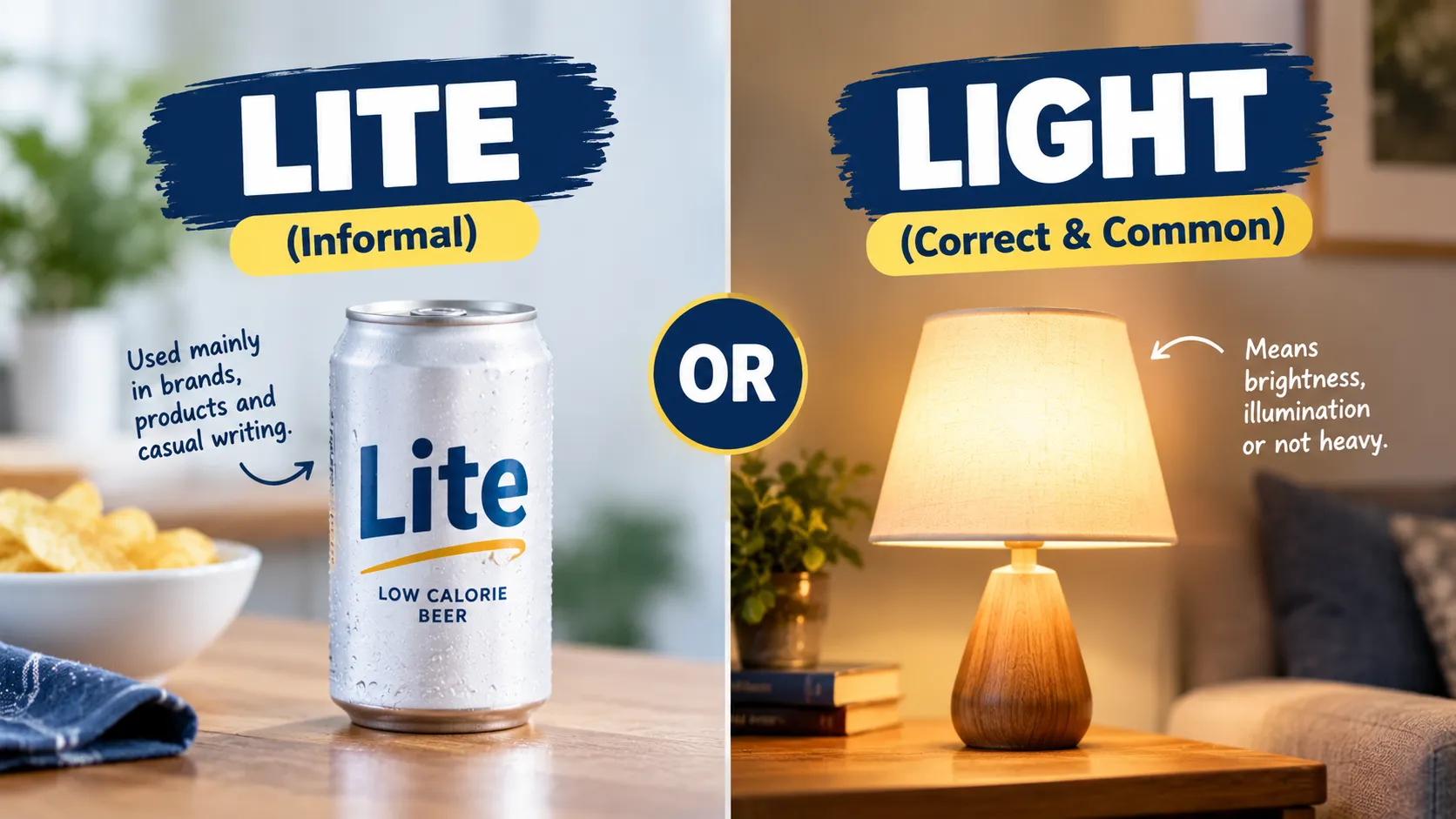
Have you ever wondered whether to write Lite Or Light? Although these two words are pronounced the same way, they are used differently in written English. Choosing the correct word depends on what you want to express.
Light is the standard English word used for illumination, something that is not heavy, a pale color, and several other meanings. Lite is an informal spelling commonly used in product names, food labels, and technology to describe a reduced or simplified version of something.
Understanding the difference between lite and light can help you avoid spelling mistakes and communicate more clearly. In this guide, you will learn what each word means, how to use it in a sentence, and which spelling is appropriate in different situations.
Lite or Light: The Quick Answer
The main difference between lite and light is their usage.
- Light is the standard spelling used in everyday, academic, and professional English.
- Lite is an informal variant generally associated with products that have reduced calories, fewer features, or a simplified design.
For example:
- The room needs more light.
- This suitcase is surprisingly light.
- I downloaded the lite version of the application.
- She chose a lite dressing advertised as having reduced calories.
Use light for ordinary meanings such as illumination and low weight. Choose lite when the context specifically calls for this informal spelling, especially in product names and marketing.
What Does Light Mean?
Light is a common English word with several meanings. Depending on the sentence, it can function as a noun, adjective, or verb.
Light as a Noun
As a noun, light commonly refers to the natural or artificial energy that makes things visible.
Examples:
- Sunlight filled the room with light.
- Please turn on the light before reading.
- The plant needs plenty of natural light.
- The streetlights provided enough light for the pedestrians.
Light can also refer to a source of illumination, such as a lamp or a traffic light.
Example: The traffic light turned green, and the cars began moving.
Light as an Adjective
As an adjective, light has several meanings, including not heavy, pale in color, or not intense.
1. Not heavy
- This backpack is light enough to carry comfortably.
- She packed a few light items for the trip.
- The lightweight jacket was perfect for the evening.
2. Pale in color
- He painted the bedroom a light blue.
- She prefers light-colored curtains.
- The walls have a light shade of gray.
3. Not intense or substantial
- We had a light lunch before the meeting.
- A light rain began falling in the afternoon.
- He prefers light exercise in the morning.
These examples show why light cannot always be replaced with lite. Its meaning changes according to the context.
Light as a Verb
Light can also function as a verb meaning to provide illumination or cause something to begin burning.
Examples:
- Please light the candle.
- They lit a fire to keep warm.
- The lamps light the pathway at night.
The past tense of light is commonly lit, although lighted is also correct in certain contexts.
Other Common Meanings of Light
Light appears in several familiar expressions:
- Light-hearted: Cheerful or not overly serious.
- Green light: Permission to proceed.
- Travel light: Carry very little luggage.
- In the light of: Considering particular information or circumstances.
- Light sleeper: Someone who wakes easily.
Examples:
- The manager gave the project the green light.
- We decided to travel light during our weekend trip.
- In the light of the new evidence, the decision was reconsidered.
In these expressions, light is the established spelling.
What Does Lite Mean?
Lite is an informal English Spelling Associated mainly with products and commercial descriptions. It often suggests that something has been reduced, simplified, or made less substantial than another version.
Unlike light, lite is not normally used as the standard spelling for illumination or low physical weight.
Lite on Food and Drink Labels
Food and beverage companies sometimes use lite to describe products with reduced calories, fat, alcohol content, or another characteristic.
Examples:
- The store sells a lite salad dressing.
- He selected a lite version of the beverage.
- The restaurant introduced a lite menu option.
However, the exact meaning of lite depends on the product and its labeling. The word does not automatically mean calorie-free, healthier, or free from sugar.
Always check the product’s nutritional information when these details matter.
Lite in Apps and Software
In technology, lite often describes a simplified version of an application or digital service.
A lite version may use fewer device resources, require less storage, or offer fewer features than the full version.
Examples:
- The company released a lite version of its mobile application.
- Users with limited storage may prefer the lite app.
- The lite edition offers the essential features without some advanced tools.
The specific differences depend on the product. A lite version does not necessarily have every feature available in the full edition.
Lite in Product Names and Marketing
Businesses may use lite in product names to communicate a reduced or simplified offering.
Examples:
- The company introduced a lite subscription plan.
- Customers can choose between the standard edition and the lite edition.
- The manufacturer advertised a lite model with fewer optional features.
In these cases, lite may be part of a brand’s official naming convention. If a company officially calls its product Lite, preserve that spelling when referring to the product.
What Is the Difference Between Lite and Light?
Although lite and light sound alike, their meanings and grammatical uses are different.
| Feature | Light | Lite |
| Standard spelling | Yes | Informal variant |
| Main usage | General English | Products and marketing |
| Illumination | Yes | No, not normally |
| Not heavy | Yes | No, not normally |
| Pale color | Yes | No, not normally |
| Reduced-calorie products | Sometimes in descriptions | Common in product labeling |
| Simplified software | Possible in a descriptive phrase | Common in product names |
| Formal writing | Appropriate | Usually limited to specific contexts |
The simplest rule is to use light for ordinary English meanings and lite when the context specifically calls for the informal product-related spelling.
Differences in Meaning and Spelling
Light is a versatile word with several established meanings. Lite generally signals a reduced or simplified version of something.
Compare these sentences:
- The box is light.
This means the box is not heavy. - The company introduced a lite edition of its software.
This suggests a simplified or reduced version. - There is not enough light in the room.
Here, light means illumination.
Changing light to lite in these examples would either change the intended meaning or make the sentence unnatural.
Differences in Formal and Informal Writing
Light is suitable for essays, business reports, academic assignments, emails, and everyday communication.
Lite is more appropriate when referring to a product name, a marketing description, or an intentionally informal label.
For example:
Formal: The application includes a simplified version for users with limited storage.
Product naming: The company calls its simplified application “Lite.”
Both sentences can be correct because the first uses a standard descriptive phrase, while the second identifies a product name.
When Can Lite Replace Light?
Lite can be used instead of light only in contexts where the informal spelling is appropriate.
For example:
- Light version: A general description that may refer to a simpler or less demanding version.
- Lite version: A common informal or marketing-style label for a reduced or simplified version.
The phrase light version is not automatically incorrect. It may be perfectly natural when light means less demanding, less substantial, or less intensive.
Similarly, a product called Lite may use that spelling as part of its official name.
When Is Lite Incorrect or Inappropriate?
Lite is generally inappropriate when you mean illumination, physical weight, or a pale color.
Incorrect: Please turn on the lite.
Correct: Please turn on the light.
Incorrect: This suitcase is very lite.
Correct: This suitcase is very light.
Incorrect: She painted the room lite green.
Correct: She painted the room light green.
These corrections apply to standard English. A deliberately stylized brand name may use Lite differently, but that does not change the usual spelling rules.
Lite vs. Light: Examples in Everyday English
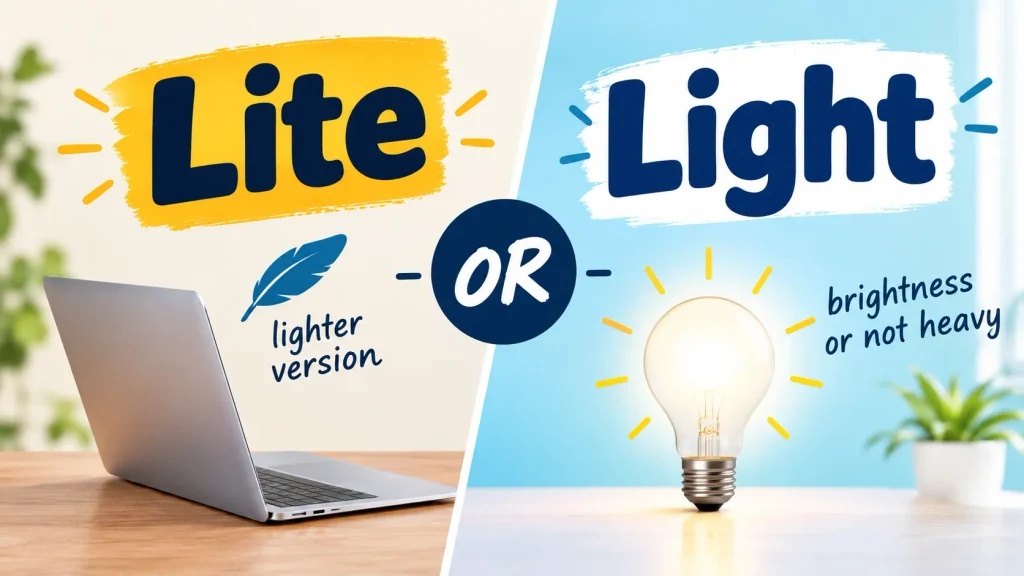
The best way to understand these words is to compare them in different situations.
Examples About Brightness and Illumination
Use light when referring to something that makes objects visible.
- The Morning Light entered through the window.
- Please switch off the light before leaving.
- The hallway needs better lighting.
- We could see the road clearly in the headlights.
- Natural light makes the room feel brighter.
In each example, light or a related form refers to illumination.
Examples About Weight and Texture
Use light when describing something that is not heavy or is relatively gentle.
- This laptop is light enough to carry in a small bag.
- She wore a light jacket on the cool evening.
- We prepared a light meal before the journey.
- The fabric is soft and light.
- He prefers light luggage when traveling.
Lite would not normally replace light in these sentences.
Examples About Food and Reduced Ingredients
Lite is sometimes used in commercial food descriptions.
- The supermarket stocks a lite salad dressing.
- The manufacturer introduced a lite beverage option.
- She compared the nutrition labels before choosing a product.
- The package uses the word lite to describe its reduced formulation.
Remember that the word alone does not establish exactly how many calories, grams of fat, or other nutrients a product contains.
Examples About Apps and Simplified Products
Lite commonly appears in product names for simplified digital services or editions.
- I installed the lite version of the application.
- The lite edition offers fewer advanced features.
- The company launched a lite plan for new users.
- This product is available in standard and lite versions.
These examples illustrate a common commercial use of lite rather than a universal rule that every simplified product must use that spelling.
Examples in Emails and Academic Writing
In formal communication, choose the word that expresses your intended meaning.
Example 1
Incorrect: The room needs more lite.
Correct: The room needs more light.
Example 2
Natural: The device is light and easy to carry.
This sentence describes physical weight.
Example 3
Formal: The company introduced a simplified version of its software.
This is a clear choice when you do not need to use a product’s official name.
Example 4
Correct when it is the official name: The company introduced Lite for users who need fewer features.
Here, Lite is treated as a product name.
Related To Another Article: https://grammixo.com/withdraw-or-withdrawal/
Lite or Light in British and American English
Light is the standard spelling in both British and American English for illumination, low weight, and other ordinary meanings.
Lite is also used in both varieties, particularly in commercial language, product names, and informal descriptions.
The distinction is therefore mainly about meaning and context, not a simple British-versus-American spelling rule.
Examples:
- British English: The bag is light.
- American English: The bag is light.
- British or American commercial usage: The company offers a Lite edition of its software.
If you are writing for an international audience, use standard light in ordinary sentences and retain lite when it is the appropriate product spelling.
Is Lite a Real Word or Just a Misspelling?
Lite is a recognized informal English word, not simply a spelling mistake. It is commonly used in product labels, marketing, and names for simplified versions of products or services.
However, its recognition does not mean that lite is interchangeable with light in every sentence.
For example:
- “The lamp gives off enough light” uses the standard word for illumination.
- “Download the Lite edition” may use the official name of a simplified software product.
If you are unsure which word to use, consider the intended meaning and whether you are referring to a specific product.
Common Mistakes When Using Lite and Light
Writers sometimes confuse these words because they sound identical. The following mistakes are easy to avoid.
Mistake 1: Using Lite for Illumination
Incorrect: The lite from the window was beautiful.
Correct: The light from the window was beautiful.
Use light when referring to brightness or illumination.
Mistake 2: Using Lite to Describe Low Weight
Incorrect: My new backpack is very lite.
Correct: My new backpack is very light.
In standard descriptive English, light means not heavy.
Mistake 3: Assuming Lite Always Means Healthy
Incorrect assumption: Every product labeled lite is automatically healthy.
Better understanding: Lite may indicate a reduced characteristic, but the exact meaning depends on the product and its labeling.
Read the ingredients and nutrition information rather than relying on the word alone.
Mistake 4: Calling Every Use of Lite Incorrect
Incorrect assumption: Lite is never a proper English word.
Better understanding: Lite is a recognized informal spelling that is common in commercial and product-related contexts.
The correct choice depends on how the word is being used.
Mistake 5: Replacing an Official Product Name
If a company officially names its product Lite, changing the name to Light may misidentify the product.
When discussing brands, applications, and named editions, follow the official spelling.
How to Choose Between Lite and Light
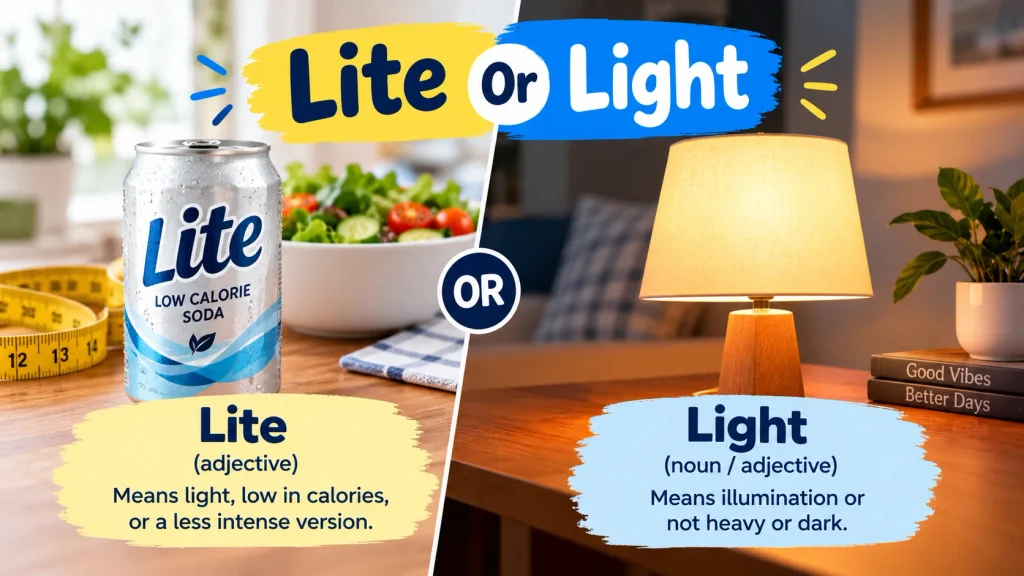
If you frequently confuse these words, use the following practical method.
A Simple Rule to Remember
Ask yourself what you want to say.
- Are you talking about brightness? Use light.
- Are you describing something that is not heavy? Use light.
- Are you describing a pale color? Use light.
- Are you referring to a product marketed as reduced or simplified? Lite may be appropriate.
- Are you writing formally without referring to a product name? Prefer standard light where its meaning fits, or use a phrase such as simplified version.
For example, write “a light bag” when discussing weight and “the Lite edition” when referring to a product that uses that name.
A Quick Editing Checklist
Before publishing or submitting your writing, check the following:
- Identify the intended meaning.
- Use light for ordinary meanings such as illumination and low weight.
- Use lite only when the informal or product-related context supports it.
- Check the official spelling of product names.
- Replace unnecessary informal wording in formal writing with clear standard English.
These simple checks can prevent many common spelling errors.
Lite or Light: Practice Questions
Test your understanding by choosing the correct word for each blank.
Fill in the Blanks
- The room was filled with natural ______.
- This suitcase is surprisingly ______.
- The company released a ______ version of its application.
- Please turn off the ______ before leaving.
- She painted the walls a ______ shade of blue.
- The manufacturer introduced a product marketed as ______.
Answers and Explanations
- Light — It refers to natural illumination.
- Light — It means the suitcase is not heavy.
- Lite — This is a common informal label for a simplified application.
- Light — It refers to a source of illumination.
- Light — It describes a pale shade of blue.
- Lite — It fits the stated product-marketing context.
The important lesson is that context determines the correct choice.
People Also Ask
A: Both spellings exist, but they have different uses. Light is the standard spelling for illumination, low weight, and several other meanings. Lite is an informal variant commonly used in product names and descriptions of reduced or simplified versions.
A: Lite can indicate a reduced-calorie product, but the exact meaning depends on the product and applicable labeling rules. Do not assume that every product labeled lite is calorie-free or automatically healthier.
A: Generally, use light in formal writing when discussing ordinary meanings. Lite may be appropriate when referring to an official product name, a quoted label, or a context where the informal spelling is specifically intended.
A: Lite is used in American English and other varieties of English, particularly in commercial and product-related contexts. Light remains the standard spelling for ordinary meanings in both British and American English.
A: Yes. In standard English pronunciation, lite and light are generally pronounced /laɪt/. Because they sound alike, their correct spelling must be determined from context.
Conclusion
The difference between Lite And Light becomes simple once you understand their usual meanings. Light is the standard English word for illumination, low weight, pale colors, and several other concepts. Lite is an informal spelling commonly associated with reduced or simplified products, food labels, and technology.
When writing an ordinary sentence, choose light if it expresses your intended meaning. Use lite when the context specifically calls for the informal spelling or when it forms part of an official product name.
Remember this simple rule: Light is the standard choice for everyday English, while lite is mainly used in specific commercial and informal contexts.

1 thought on “Lite or Light: What’s the Difference?”