
Introduction
Have you ever wondered whether to write Himself Or Hisself? Although these words may sound similar in conversation, they are not interchangeable in standard English. Understanding the difference will help you write more clearly and avoid common grammatical mistakes.
Himself is the correct form in standard English. It is a reflexive or intensive pronoun used when referring to a male person. Hisself, on the other hand, is a nonstandard form found in some regional dialects and informal speech.
In this guide, you will learn what both words mean, how to use himself correctly, why some speakers say hisself, and which form is appropriate for different writing situations.
Quick Answer: Himself or Hisself?
Himself is the correct choice in standard written and spoken English. Hisself occurs in some dialects but is generally avoided in formal writing, academic assignments, professional emails, and other situations that require standard English.
Consider these examples:
- Correct: He prepared himself for the interview.
- Nonstandard: He prepared hisself for the interview.
- Correct: James completed the project himself.
- Nonstandard: James completed the project hisself.
In both examples, himself follows standard English grammar. Although you may encounter hisself in regional speech or fictional dialogue, use himself when writing in standard English.
What Does Himself Mean?
Himself is a reflexive or intensive pronoun that refers back to a male person previously mentioned or understood from the context.
It has two main grammatical functions. It can show that the subject performs an action on himself, or it can emphasize that he performs an action personally.
Himself as a Reflexive Pronoun
A reflexive pronoun is used when the subject and object of a sentence refer to the same person or thing.
For example:
- Daniel taught himself to play the guitar.
- He blamed himself for the mistake.
- Mark looked at himself in the mirror.
- The boy introduced himself to the new teacher.
- He reminded himself to finish the assignment.
In these sentences, the actions refer back to the person performing them.
For instance, in “Daniel taught himself to play the guitar,” Daniel is both the person learning and the person receiving the instruction.
This is why himself is the appropriate pronoun.
Himself as an Intensive Pronoun
An intensive pronoun emphasizes a noun or pronoun in a sentence. Unlike a reflexive pronoun, it is not essential to the basic grammatical structure of the sentence.
Consider these examples:
- The principal himself welcomed the visitors.
- Daniel himself organized the entire event.
- He himself admitted that he was wrong.
- The author himself attended the book launch.
- Robert himself repaired the broken chair.
In these sentences, himself adds emphasis by highlighting the person responsible for an action.
For example, “Daniel organized the entire event” is a complete sentence. Adding himself emphasizes that Daniel personally organized it.
Examples of Himself in Everyday English
Here are some additional examples showing how to use himself naturally:
- He cooked dinner for himself.
- Michael taught himself English.
- The athlete pushed himself to improve.
- He introduced himself to his neighbors.
- David completed the assignment himself.
- The child dressed himself without assistance.
Notice that the appropriate use of himself depends on the sentence’s meaning and grammatical structure.
What Does Hisself Mean?
Hisself is a nonstandard English reflexive form used by some speakers in particular regional dialects and informal speech.
It generally serves the same intended function as himself. However, it is not the standard form expected in formal English writing.
For example:
- Nonstandard: He fixed the computer hisself.
- Standard: He fixed the computer himself.
Both sentences communicate that the person repaired the computer without someone else doing the work. However, the second sentence follows standard English conventions.
Is Hisself a Real Word?
Yes, hisself is a documented word found in some dialects and varieties of English. Calling it nonstandard does not mean that nobody uses it or that it has no linguistic significance.
Languages naturally develop regional differences in pronunciation, vocabulary, and grammar. Some dialects preserve forms that differ from those used in formal writing.
However, there is an important distinction between a word’s existence in a dialect and its acceptance in standard edited English.
If you are writing an academic essay, business email, professional article, or school assignment, himself is the appropriate choice.
Why Do Some People Say Hisself?
Several factors can explain why a speaker uses hisself instead of himself.
1. Regional dialects
Some regional varieties of English use grammatical forms that differ from standard written English. Hisself is one example of a form found in certain dialects.
2. Language patterns learned in childhood
People generally learn their first language patterns through family, friends, and their surrounding community. These patterns can influence the forms they use in adulthood.
3. Informal conversation
In casual conversation, speakers may use expressions that are not normally accepted in formal writing.
These differences are part of how language varies across communities. They do not automatically indicate a speaker’s intelligence or ability to communicate.
Is Hisself Considered Standard English?
No. In standard English, himself is the established reflexive and intensive pronoun corresponding to he.
Although hisself may appear in dialectal speech, dialogue, or informal language, it is generally considered nonstandard.
Use himself when your goal is to follow conventional English grammar and spelling.
Himself vs. Hisself: Key Differences
The main difference between these words is their status in standard English.
Himself is the accepted standard form, while hisself is a nonstandard variant associated with some dialects.
| Feature | Himself | Hisself |
| Standard English | Correct | Nonstandard |
| Grammatical role | Reflexive or intensive pronoun | Used as a reflexive form in some dialects |
| Formal writing | Appropriate | Generally avoided |
| Academic assignments | Recommended | Generally inappropriate |
| Regional speech | Used widely in standard English | Found in certain dialects |
| Meaning in typical usage | Refers back to a male person | Usually intended to refer back to a male person |
| Professional communication | Recommended | Not recommended |
Which Form Should You Use?
Choose himself in almost all ordinary writing situations.
For example:
- Write “He prepared himself for the examination,” not “He prepared hisself for the examination.”
- Write “The manager himself approved the request,” not “The manager hisself approved the request.”
- Write “He reminded himself about the appointment,” not “He reminded hisself about the appointment.”
If you are documenting someone’s actual speech, writing dialogue for a fictional character, or discussing a dialect, hisself may be appropriate when it serves a clear purpose.
Does Himself Mean Something Different from Hisself?
In many dialectal uses, hisself expresses the same intended meaning as himself. The primary difference is grammatical convention rather than a distinct meaning.
For example, both forms in the following sentences are intended to refer to the same person:
- Standard: He completed the task himself.
- Nonstandard: He completed the task hisself.
The first sentence follows standard English usage. The second reflects a nonstandard form.
When Should You Use Himself?
You can use himself in several common grammatical situations. Understanding these patterns will make it easier to choose the right pronoun.
1. When the Subject and Object Are the Same Person
Use himself when a male subject performs an action that refers back to him.
Examples:
- He accidentally hurt himself while playing.
- James taught himself how to swim.
- The man prepared himself for the journey.
- He looked at himself in the photograph.
- The boy introduced himself to the class.
In each sentence, the pronoun refers to the person performing the action.
2. When You Want to Add Emphasis
Use himself to emphasize that a particular person performed an action.
Examples:
- The director himself announced the results.
- John himself delivered the package.
- The teacher himself explained the difficult concept.
- The president himself attended the ceremony.
These sentences highlight the individual’s personal involvement.
3. When Referring to Independent Action
Himself can emphasize that someone completed an activity personally rather than relying on another person.
Examples:
- He built the bookshelf himself.
- Daniel completed the assignment himself.
- My brother repaired the bicycle himself.
- He prepared the presentation himself.
This usage is particularly common in everyday English.
4. In Everyday Conversation
Himself is appropriate in both formal and informal standard English.
Examples:
- He made himself a cup of tea.
- He introduced himself to everyone.
- He promised himself that he would study harder.
- He enjoyed himself at the party.
You do not need to replace himself with another form simply because the conversation is casual.
When Is Hisself Used?
Although hisself is not the standard choice, Understanding where it occurs can help you recognize it in conversation and written material.
Hisself in Regional Dialects
English is spoken in many regions, and different communities may follow different grammatical patterns.
In some regional dialects, speakers use hisself in places where standard English uses himself.
For example, a speaker might say:
“He did the work hisself.”
In standard English, the sentence would be:
“He did the work himself.”
The difference reflects a variation in language use. It is important to recognize this distinction without assuming that every dialect follows the same rules as formal written English.
Hisself in Informal Speech
You may encounter hisself in informal conversations, particularly among speakers whose dialect includes this form.
However, informality alone does not make hisself standard English.
If you want your everyday speech to follow standard English conventions, himself remains the recommended choice.
Hisself in Fictional Dialogue and Quotations
Writers sometimes use dialectal expressions to represent how a particular character speaks.
For example:
“He said he could handle the job hisself,” Mark explained.
A writer might choose this wording to reflect a character’s established speech patterns.
Similarly, if you are quoting someone directly, you may preserve the speaker’s original words.
However, if you are paraphrasing the statement or writing the narration in standard English, use himself.
Why Dialect Forms Differ from Standard Written English
Standard English is a conventional form used in many educational, professional, and publishing contexts. It provides shared grammatical and spelling expectations for readers.
Regional dialects, meanwhile, may have their own consistent linguistic patterns.
A form can therefore be meaningful and recognizable within a dialect without being the preferred form in formal writing.
Understanding this difference helps writers communicate appropriately without treating every regional language variation as a mistake in every context.
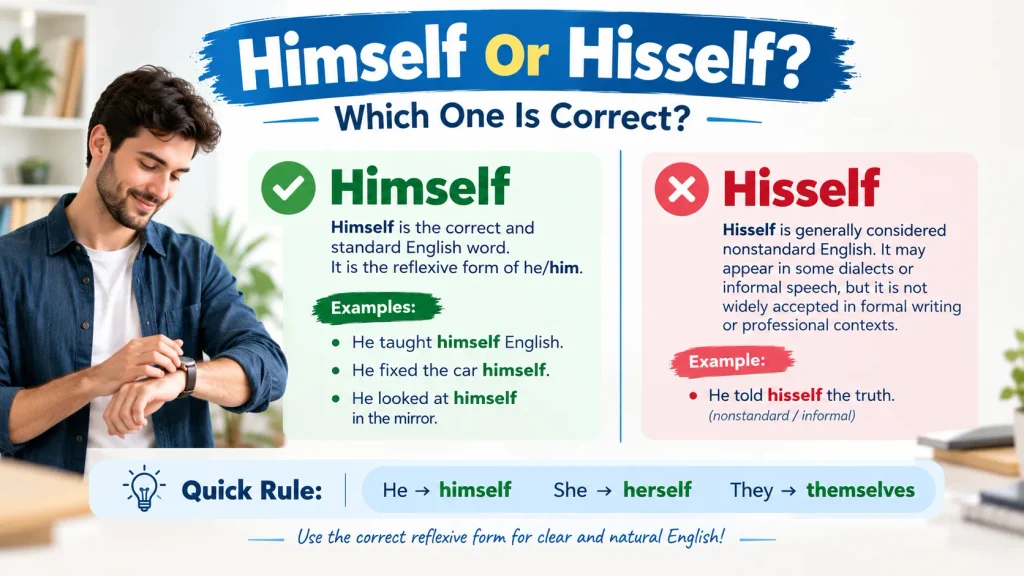
Himself or Hisself: Correct and Incorrect Examples
The easiest way to understand the distinction is to compare complete sentences.
| Nonstandard sentence | Standard English sentence |
| He taught hisself to cook. | He taught himself to cook. |
| John hurt hisself while running. | John hurt himself while running. |
| He completed the work hisself. | He completed the work himself. |
| The boy introduced hisself to the teacher. | The boy introduced himself to the teacher. |
| He prepared hisself for the interview. | He prepared himself for the interview. |
| Robert blamed hisself for the error. | Robert blamed himself for the error. |
The standard versions use himself because it is the accepted reflexive pronoun corresponding to he.
How to Correct Hisself in Standard English
When editing a sentence, check whether hisself is being used as a reflexive or intensive pronoun.
If it is, replace it with himself when writing in standard English.
For example:
Original: He reminded hisself to call his mother.
Corrected: He reminded himself to call his mother.
Original: The coach hisself spoke to the players.
Corrected: The coach himself spoke to the players.
Original: He completed the project hisself.
Corrected: He completed the project himself.
Remember that a direct quotation or intentional representation of dialect may require different treatment. Do not automatically alter someone’s exact words when preserving the original speech is important.
Himself, Him, and His: Understanding the Difference
Writers sometimes confuse himself with him and his. Although all three words can refer to a male person, they serve different grammatical functions.
When to Use Him
Him is an object pronoun. It usually refers to a male person who receives an action or follows a preposition.
Examples:
- I called him yesterday.
- Sarah gave him a present.
- We spoke to him after the meeting.
- The teacher helped him with his homework.
In these sentences, him refers to someone other than the grammatical subject performing the action.
When to Use His
His is commonly used as a possessive determiner before a noun. It indicates that something belongs or relates to a male person.
Examples:
- His car is parked outside.
- I borrowed his book.
- His brother lives in London.
- The teacher praised his work.
In these examples, his identifies a relationship between a person and something associated with him.
His can also function as a possessive pronoun without a following noun, as in “The blue bag is his.”
When to Use Himself
Himself is a reflexive or intensive pronoun.
Examples:
- He taught himself to drive.
- He blamed himself for the mistake.
- The manager himself approved the proposal.
It can refer back to the subject or add emphasis to a sentence.
Simple Comparison Table
| Word | Grammatical function | Example |
| Him | Object pronoun | I called him. |
| His | Possessive determiner | His phone is ringing. |
| His | Possessive pronoun | The phone is his. |
| Himself | Reflexive pronoun | He prepared himself. |
| Himself | Intensive pronoun | He himself prepared the meal. |
A useful way to remember the difference is to examine the word’s role in the sentence rather than choosing a pronoun based only on how it sounds.
Is Himself Correct in British and American English?
Yes. Himself is the standard form in both British English and American English.
Although British and American English differ in some vocabulary, spelling, and usage conventions, this particular pronoun does not have separate standard forms in the two varieties.
Himself in American English
American English uses himself as both a reflexive and an intensive pronoun.
Examples:
- He taught himself to play basketball.
- The principal himself announced the decision.
- He reminded himself to finish the assignment.
These sentences follow standard American English grammar.
Himself in British English
British English uses himself in the same grammatical functions.
Examples:
- He introduced himself to the new neighbors.
- The headteacher himself welcomed the students.
- He prepared himself for the examination.
The vocabulary in these sentences may reflect a British context, but the pronoun follows the same standard grammatical rule.
Is Hisself Accepted in Either Variety?
Hisself can occur in dialects within English-speaking regions, including areas where British or American English is spoken.
However, it is not the standard reflexive pronoun in either standard British English or standard American English.
For formal writing, use himself regardless of which variety of English you follow.
Common Mistakes to Avoid
Learning the difference between himself and hisself is straightforward, but a few related mistakes are worth understanding.
1. Using Hisself in Formal Writing
Incorrect for standard edited English: He Completed the assignment hisself.
Correct: He completed the assignment himself.
Use the standard form in essays, reports, business correspondence, and professional articles.
2. Confusing Himself with Him
Incorrect: He gave the book to himself’s brother.
Correct: He gave the book to his brother.
The possessive determiner his is needed before brother. The word himself does not replace every form of he or him.
3. Confusing Himself with His
Incorrect: He forgot himself keys at home.
Correct: He forgot his keys at home.
Use his to show possession. Use himself when the sentence requires a reflexive or intensive pronoun.
4. Using Himself Without a Clear Reference
A reflexive pronoun generally needs an appropriate antecedent or grammatical relationship.
Awkward: The teacher gave himself a book to the student.
Clearer: The teacher gave the student a book.
Alternatively, if the teacher received the book, you could write, “The teacher gave himself a book.”
Choose the pronoun that matches the intended meaning and sentence structure.
5. Assuming Dialectal Forms and Standard Forms Are Identical
A form used in regional speech may differ from the conventional form used in formal writing.
Recognizing this distinction helps you edit effectively while respecting the linguistic patterns of different communities.
How to Choose Between Himself and Hisself
If you are unsure which word to use, follow these simple guidelines.
A Simple Rule for Standard English
Use himself in standard English.
This rule applies to school assignments, workplace communication, articles, reports, and most other writing situations.
Use hisself only when there is a specific reason to preserve or discuss its dialectal usage.
A Quick Proofreading Checklist
Before publishing or submitting your writing, ask yourself:
- Am I referring to a male person using a reflexive or intensive pronoun?
- Does the sentence require himself?
- Have I accidentally written hisself in standard English prose?
- Am I preserving a direct quotation or intentionally representing a dialect?
- Have I used him, his, and himself according to their grammatical functions?
These checks can help you identify errors without making the editing process complicated.
An Easy Way to Remember Himself
Think of the standard pronoun as the form you should use whenever you would normally use he in a reflexive or intensive construction.
For example:
- He blamed himself.
- He introduced himself.
- He completed the task himself.
In each case, himself is the standard form.
Related To Another Article: https://grammixo.com/lite-or-light/
Practice: Himself or Hisself?
Test your understanding with the following sentences. Choose the correct form for standard English.
Choose the Correct Word
1. Daniel taught ______ how to play the piano.
a) hisself
b) himself
2. The manager ______ approved the proposal.
a) hisself
b) himself
3. He blamed ______ for the mistake.
a) hisself
b) himself
4. The boy introduced ______ to his classmates.
a) hisself
b) himself
5. Robert completed the project ______.
a) hisself
b) himself
Fill in the Blanks
Complete each sentence using himself.
- He looked at ______ in the mirror.
- Michael prepared ______ for the interview.
- The student reminded ______ to study.
- He repaired the bicycle ______.
- The author ______ attended the event.
Check Your Answers
Multiple-choice answers:
- b) himself
- b) himself
- b) himself
- b) himself
- b) himself
Fill-in-the-blank answers:
- himself
- himself
- himself
- himself
- himself
All these answers follow standard English conventions. In each sentence, himself functions as a reflexive or intensive pronoun.
People Also Ask
A: Himself is correct in standard English. Hisself is a nonstandard form found in some regional dialects and informal speech. Use himself in formal and professional writing.
A: Yes. Hisself is a documented dialectal form used by some English speakers. However, it is not the standard reflexive pronoun expected in formal English.
A: Some speakers use hisself because of regional dialect patterns or language habits learned in their communities. Dialects can have grammatical features that differ from standard written English.
A: For a typical academic essay, use himself. You may retain hisself when discussing dialects, quoting someone directly, or analyzing language where the form itself is relevant.
A: It can be described as a nonstandard form rather than simply dismissed as a misspelling in every context. In standard English writing, however, himself is the expected form.
Conclusion
The choice between Himself And Hisself depends on whether you are following standard English conventions or representing a particular dialect.
Himself is the correct standard form for both reflexive and intensive uses. It is appropriate for academic writing, professional communication, everyday standard English, and published articles.
Hisself appears in some regional dialects and informal speech, but it is generally avoided in standard written English.
For clear and grammatically conventional writing, remember this simple rule: Use himself, not hisself, in standard English.

1 thought on “Himself or Hisself: Which Is Correct?”