Introduction
Have you ever wondered whether to write Lovable Or Loveable? Both spellings appear in English, which can make it difficult to know which one to choose. Although they look slightly different, they share the same meaning and pronunciation.
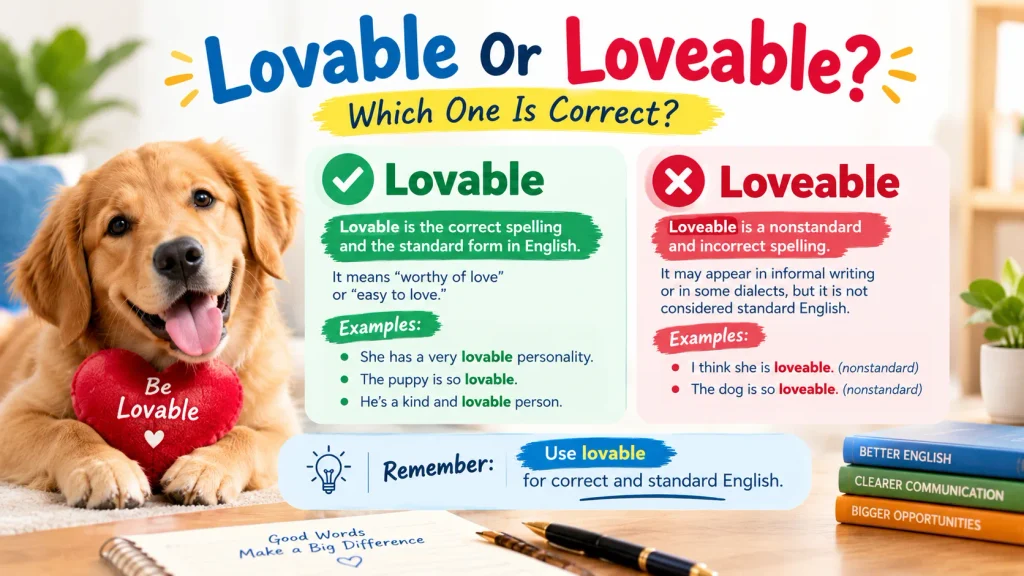
Lovable is the more common and generally preferred spelling in modern English. However, loveable is also an accepted alternative, so it is not automatically incorrect.
In this guide, you will learn what both words mean, how to use them in sentences, why their spellings differ, and which version is best for your writing.
Lovable or Loveable: The Quick Answer
Both lovable and loveable mean deserving of love, affection, or fondness. The main difference is their spelling frequency rather than their meaning.
- Lovable: The more common spelling and the best default choice for most writing.
- Loveable: An accepted alternative spelling with the same meaning.
- Pronunciation: Both are generally pronounced the same way.
- Part of speech: Both function as adjectives.
For example:
- The puppy is incredibly lovable.
- The puppy is incredibly loveable.
Both sentences are correct. However, choosing lovable is usually the simplest option when you want to follow common modern usage.
What Does Lovable Mean?
The adjective lovable describes someone or something that inspires affection, warmth, or fondness. It can refer to a person, an animal, a fictional character, or even a personality trait.
In simple English, a lovable person is someone who makes others feel affection toward them.
Lovable Meaning in Simple English
Something is lovable when it has qualities that make people feel affection for it.
For example, a friendly child, an affectionate pet, or a fictional character with a kind personality might be described as lovable.
Consider this sentence:
Example: Everyone in the neighborhood thinks the little dog is lovable.
This means the dog has qualities that make people feel fond of it.
Lovable Meaning in Urdu
The Urdu meanings of lovable include:
- قابلِ محبت
- پیارا
- محبت کے قابل
- دل کو بھانے والا
In Roman Urdu, lovable ka matlab hai aisa shakhs ya cheez jo pyari lage aur jis se mohabbat ya apnayat ka ehsaas paida ho.
For example:
Sentence: She has a lovable personality.
Urdu meaning: Us ki shakhsiyat bohat pyari hai aur log us se apnayat mehsoos karte hain.
How to Pronounce Lovable
Lovable is commonly pronounced LUHV-uh-buhl.
Its pronunciation is represented approximately as /ˈlʌv.ə.bəl/.
The first syllable receives the main stress. The alternative spelling loveable is generally pronounced in the same way.
Remember that the spelling changes slightly, but the usual pronunciation and meaning remain the same.
Lovable vs Loveable: What Is the Difference?
The difference between lovable and loveable is primarily a matter of spelling preference.
Both words describe someone or something that inspires love or affection. The shorter form, lovable, is more widely used in contemporary English, while loveable remains a recognized alternative.
| Feature | Lovable | Loveable |
| Spelling | One e in the middle | Includes an additional e |
| Meaning | Deserving of love or affection | Deserving of love or affection |
| Part of speech | Adjective | Adjective |
| Pronunciation | LUHV-uh-buhl | LUHV-uh-buhl |
| Usage | More common and generally preferred | Accepted alternative |
| Best use | General, academic, and professional writing | When following a preferred or established spelling |
The important point is that these words do not have different meanings. You can generally use either spelling without changing the message of your sentence.
Is Loveable an Incorrect Spelling?
No. Loveable is an accepted spelling variant of lovable.
Some writers assume that the additional e automatically makes the word incorrect. However, both forms have a history of use in English.
Nevertheless, lovable is the more common choice in modern writing. If you are unsure which form to use, choosing lovable is a practical decision.
For example:
Preferred: The main character is lovable despite his flaws.
Also acceptable: The main character is loveable despite his flaws.
Both sentences communicate the same idea.
Why Is Lovable Spelled Without the E?
To Understand the spelling, it helps to look at the base word and the suffix used to form the adjective.
The word love is the base, while -able is a suffix that helps form adjectives describing something that can be experienced, done, or characterized in a particular way.
In lovable, the final e of love is omitted before the suffix is added.
The result is:
Love + -able = Lovable
The alternative spelling loveable retains the e:
Love + -able = Loveable
English spelling does not follow one perfectly consistent rule for every word. Some words drop a final e before a suffix, while others retain it. Established usage and dictionary recognition matter, so the spelling pattern alone does not make loveable incorrect.
The Base Word Love and the Suffix -Able
The base word love can function as both a noun and a verb.
As a noun, it describes a feeling of deep affection.
Example: Their love for their family is clear.
As a verb, it describes the act of feeling or expressing affection.
Example: I love spending time with my friends.
Adding -able creates an adjective that describes someone or something capable of inspiring that affection.
Example: The story features a lovable character.
Understanding how words are formed can help English learners recognize related vocabulary and improve their spelling.
Why Loveable Is Also Used
The spelling loveable preserves the final e in the base word love. English has variations in how certain words are formed and spelled, and both forms have become established in usage.
Therefore, the additional e does not automatically make the word a spelling mistake.
The practical distinction is straightforward: lovable is more common, but loveable is also accepted.
If you are writing for a publication, school, or organization that follows a particular dictionary or style guide, follow its preferred spelling consistently.
Lovable vs Loveable in British and American English
Both lovable and loveable can be encountered in British and American English. It is misleading to claim that one spelling belongs exclusively to Britain while the other belongs exclusively to the United States.
The spelling lovable is widely used in both varieties of English and is generally the safer default.
For example:
American English: The movie introduces a lovable character.
British English: The film introduces a lovable character.
The spelling works naturally in both sentences.
You may also encounter loveable in British or American publications. Its presence does not necessarily indicate a regional spelling rule.
When writing for an international audience, choose lovable unless you have a specific reason to retain the alternative spelling.
Examples of Lovable and Loveable in Sentences
Seeing the words in context makes their Meaning and usage easier to understand. The following examples demonstrate how both spellings can describe people, animals, fictional characters, and everyday experiences.
Examples Describing a Person
- Her lovable personality makes everyone feel welcome.
- He is a lovable friend who always offers support.
- The teacher is known for her lovable sense of humor.
- Despite his nervousness, the new student seemed lovable.
- His lovable nature helped him build lasting friendships.
In these sentences, lovable describes qualities that inspire affection or fondness.
Examples Describing Animals and Pets
- Our new puppy is playful and lovable.
- The rescue cat has a lovable personality.
- The children quickly became attached to their lovable rabbit.
- Even when the dog makes a mess, its lovable behavior wins everyone over.
- The little kitten is so lovable that visitors always stop to admire it.
The word is particularly useful when describing animals whose behavior makes people feel affection toward them.
Examples in Books, Movies, and Stories
- The novel introduces a lovable character with an unusual sense of humor.
- Viewers enjoyed the lovable hero’s journey.
- The film turns an ordinary character into someone surprisingly lovable.
- Her flaws make the fictional character more relatable and lovable.
- The story follows a lovable robot learning about friendship.
Writers often use lovable to describe fictional characters who attract an audience’s affection through their actions, personalities, or imperfections.
Examples in Everyday and Professional Writing
- The children’s book features a lovable main character.
- Our company mascot has a friendly and lovable design.
- The advertisement presents the dog as a lovable family companion.
- The author created a lovable character for young readers.
- His approachable manner makes him a lovable colleague.
Although lovable is often associated with informal descriptions, it can also appear in professional writing when the context calls for a warm, expressive tone.
Examples Using Loveable
Because loveable is an accepted alternative, it can replace lovable in many of the examples above without changing their meaning.
- The puppy has a loveable personality.
- She created a loveable character for her new story.
- Their loveable dog quickly became a family favorite.
- The film features a loveable hero with a good heart.
- He is a loveable person who cares about others.
For clarity, it is generally best to choose one spelling and use it consistently throughout the same article or document.
Lovable vs Loving vs Likable
Lovable, loving, and likable are related in meaning, but they are not interchangeable in every sentence.
Understanding their differences helps you select the most accurate word for the situation.
What Does Lovable Mean?
Lovable describes someone or something that inspires affection.
Example: The lovable puppy follows its owner everywhere.
The sentence emphasizes the puppy’s ability to make people feel fond of it.
What Does Loving Mean?
Loving usually describes someone who shows love, care, kindness, or affection toward another person.
Example: She is a loving mother who always supports her children.
Here, loving describes the mother’s expression of care rather than simply the affection she inspires in others.
What Does Likable Mean?
Likable describes someone who is pleasant, agreeable, or easy to like.
Example: Our new neighbor is friendly and likable.
A likable person may be pleasant to spend time with, but the word does not necessarily imply the deeper affection that lovable can suggest.
Comparison Table
| Word | Main Meaning | Example |
| Lovable | Inspires affection | The character is lovable. |
| Loving | Shows love or care | He is a loving father. |
| Likable | Pleasant and easy to like | She is a likable colleague. |
Choose lovable when emphasizing the affection someone inspires, loving when emphasizing the affection someone gives, and likable when describing a pleasant personality.
Related To Another Article: https://grammixo.com/anyways-or-anyway/
Common Mistakes When Using Lovable and Loveable
Although these spellings are easy to understand, writers can still make mistakes when choosing between them or using related words.
Here are some common problems to avoid.
Assuming Loveable Is Always Wrong
One common mistake is treating loveable as an incorrect spelling in every context.
Incorrect claim: Loveable is never a real English word.
Better explanation: Loveable is an accepted alternative spelling, although lovable is more common.
Recognizing both forms helps you avoid incorrectly correcting someone else’s writing.
Confusing Lovable With Loving
These adjectives express different ideas.
Incorrect usage: The lovable mother cared deeply for her children.
This sentence is not grammatically wrong, but it may not express the intended meaning as clearly as loving mother.
Better choice: The loving mother cared deeply for her children.
Use loving to emphasize the care someone gives. Use lovable to emphasize the affection someone inspires.
Switching Between Spellings Without a Reason
Using both spellings in the same document is not necessarily a grammatical error. However, switching between them without a clear reason can make the writing look inconsistent.
For example:
The lovable puppy played in the garden. Later, the loveable puppy went to sleep.
Both sentences are understandable, but a single spelling would make the paragraph more consistent.
A clearer version is:
The lovable puppy played in the garden. Later, the lovable puppy went to sleep.
Choose the spelling that suits your writing and keep it consistent unless you are quoting a source that uses the alternative.
Using Lovable When Another Word Is More Precise
Not every positive quality is best described as lovable.
Consider these examples:
- Endearing: Her endearing smile made people feel warmly toward her.
- Adorable: The adorable kitten slept in a basket.
- Charming: His charming personality made a strong impression.
- Likable: She is a likable person who gets along with others.
These words overlap in meaning, but each emphasizes a slightly different quality. Choosing the most precise adjective makes your writing clearer.
Related Words and Word Forms
Learning related words can help you understand how lovable fits into the broader family of English vocabulary.
Love, Loved, and Loving
These words are connected to the base word love, but their grammatical roles differ.
Love: Can be a noun or a verb.
Example: I love this book.
Loved: Commonly functions as the past tense or past participle of love. It can also describe someone or something that receives affection.
Example: The author wrote about a much-loved character.
Loving: Can describe someone who expresses affection or appear in verb constructions.
Example: She gave her friend a loving smile.
Each word serves a different purpose, so choose the form that fits your sentence.
Lovable as an Adjective
Lovable is an adjective. It describes a quality of a person, animal, character, or thing.
Examples:
- A lovable child
- A lovable dog
- A lovable character
- A lovable personality
Adjectives generally do not change to form a plural in English.
For example:
Singular: The puppy is lovable.
Plural: The puppies are lovable.
The adjective remains lovable in both sentences.
The same principle applies to loveable.
Synonyms for Lovable
Several English adjectives can express ideas similar to lovable. However, their precise meanings depend on the context.
Endearing
Endearing describes something that creates affection or goodwill.
Example: His endearing habit of helping others made him popular.
This word often emphasizes a particular behavior or quality that attracts affection.
Adorable
Adorable describes someone or something that inspires strong affection, often because it seems cute or appealing.
Example: The baby wore an adorable little hat.
It is particularly common when describing young children, pets, and charming objects.
Charming
Charming describes someone or something that attracts people through appealing qualities, manners, or personality.
Example: The charming host made everyone feel comfortable.
Unlike lovable, it often emphasizes attractiveness, pleasant manners, or social appeal.
Likable
Likable describes a person who is pleasant and easy to like.
Example: The main character is honest, friendly, and likable.
It is a useful alternative when you want to describe a positive personality without specifically emphasizing affection.
Which Spelling Should You Use in Your Writing?
For most writers, lovable is the best default choice because it is the more common spelling.
However, the best choice can depend on your audience, publication, or style guide.
Consider the following situations:
For school assignments: Use lovable unless your teacher or reference material specifies another accepted form.
For professional writing: Prefer lovable for a straightforward, widely recognized spelling.
For blog posts: Use lovable consistently, especially when writing for a broad English-speaking audience.
For creative writing: Either spelling may be suitable. Consistency matters more than choosing between these two accepted variants.
When quoting a source: Preserve the spelling used in the original quotation.
If you already use loveable in a published document, you do not necessarily need to change every instance. Consider your publication’s style requirements and whether consistent spelling is important for the project.
People Also Ask
A: Yes. Loveable is an accepted alternative spelling of lovable. Both words have the same meaning, although lovable is more common in modern English.
A: Generally, yes. Both spellings describe someone or something that inspires love or affection. The choice usually concerns spelling preference rather than meaning.
A: Lovable is used in both British and American English. Loveable can also appear in both varieties, so the distinction is not simply British versus American spelling.
A: Lovable is commonly pronounced LUHV-uh-buhl, with the stress on the first syllable. Loveable is generally pronounced the same way.
A: Yes. Lovable is an adjective that describes someone or something that inspires affection.
Example: The story features a lovable character.
Conclusion
Both lovable and loveable are Accepted English Spellings with the same meaning. The difference is not in their definition but in how they are written and how commonly they are used.
Lovable is the more common and generally preferred form, making it the best default choice for essays, blog posts, professional documents, and everyday writing. Loveable remains an acceptable alternative and should not automatically be treated as a spelling error.
When in doubt, choose lovable, use it consistently, and focus on expressing your meaning clearly.

1 thought on “Lovable or Loveable: Which Spelling Is Correct?”