Introduction
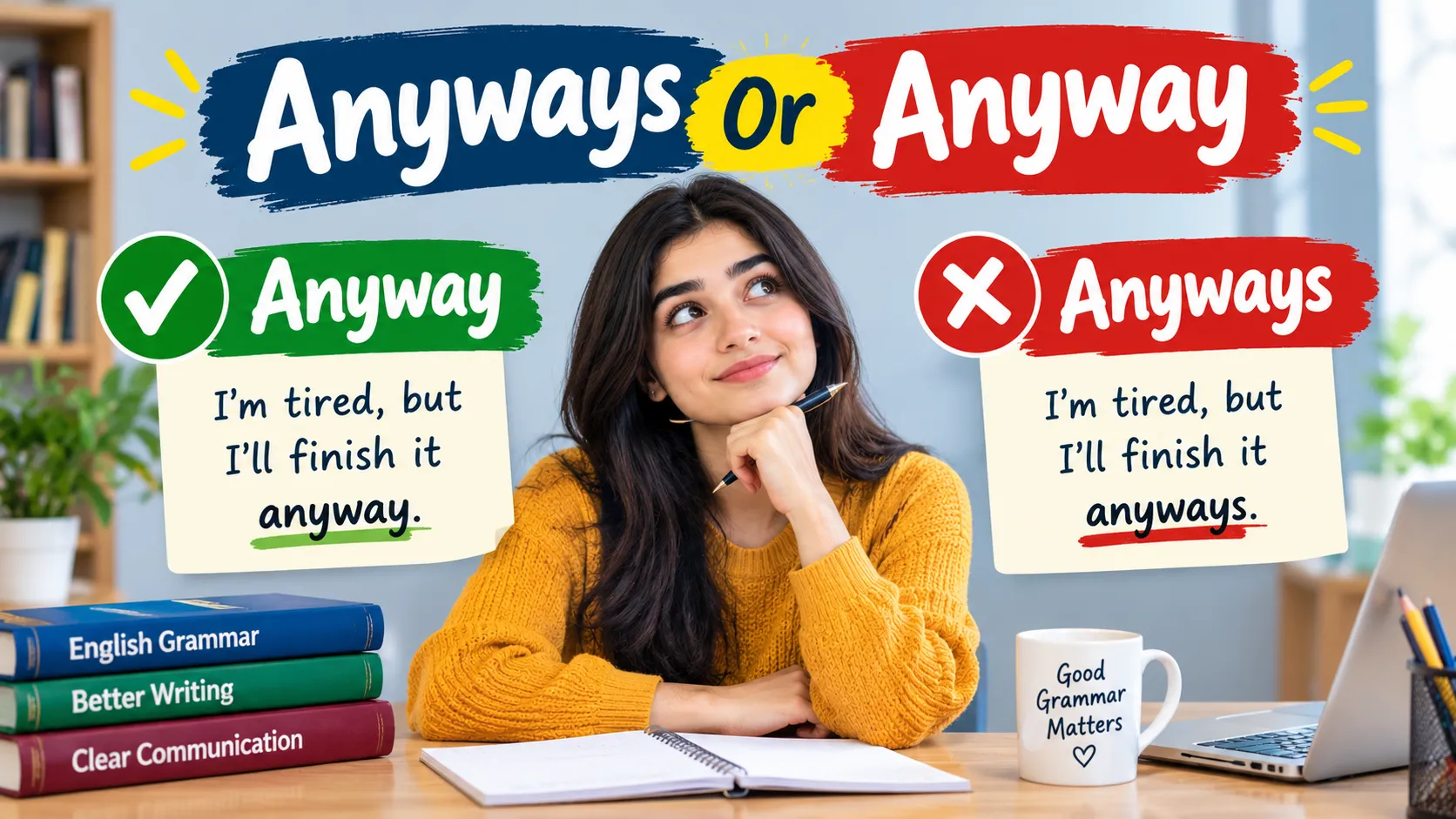
Have you ever wondered whether to write Anyways Or Anyway? Both forms appear in everyday English, but they are not equally suitable for every situation. Choosing the right word can make your writing clearer and more appropriate for your audience.
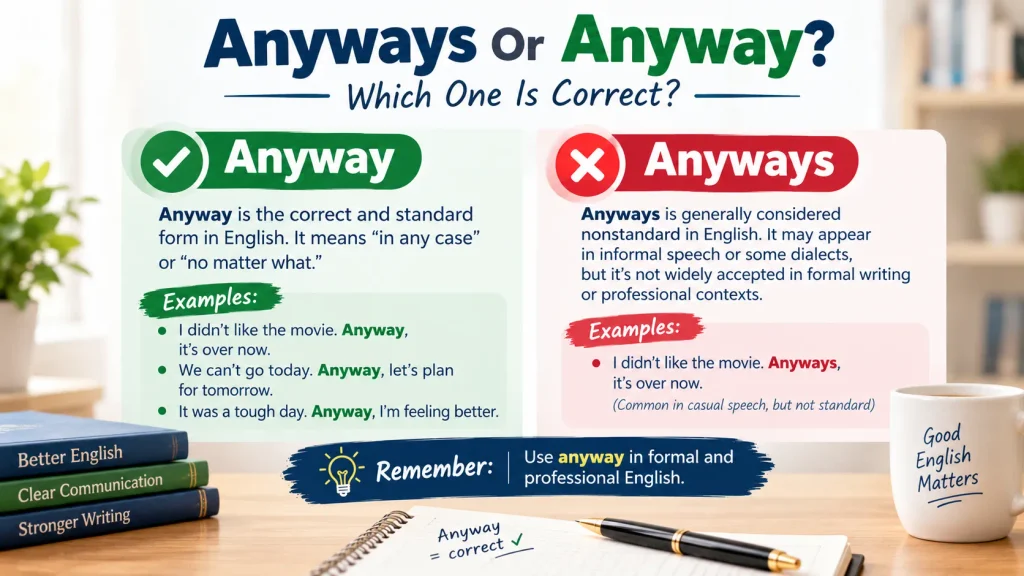
Anyway is the preferred form in standard English, especially in formal and professional writing. Anyways is also used in informal conversations, text messages, and casual writing. However, if you want to use the safest and most widely accepted option, choose anyway.
There is another expression worth knowing: any way. Although it sounds similar, it has a different meaning and grammatical structure.
In this guide, you will learn the difference between anyways and anyway, understand when to use each form, explore practical examples, and discover how any way fits into the picture.
Quick Answer: Anyways or Anyway?
Anyway is the preferred choice in standard English, while anyways is an informal variant. Both appear in everyday communication, but anyway is generally the better option for academic assignments, professional emails, and formal documents.
Consider these examples:
- Anyway: I was tired, but I finished the assignment anyway.
- Anyways: Anyways, let’s talk about something else.
- Any way: Is there any way to improve this sentence?
The first sentence uses anyway to mean that something happened despite a difficulty. The second uses anyways to shift the conversation. The third uses any way to refer to a possible method or solution.
Remember this simple rule: use anyway when you are unsure which form to choose, and reserve anyways for contexts where an informal tone is appropriate.
What Does Anyway Mean?
Anyway is an adverb with several related uses. It can mean regardless, introduce a change of subject, return to an earlier point, or add emphasis to a statement.
The exact meaning depends on the sentence and the surrounding conversation.
1. Anyway Meaning Regardless
One common use of anyway is to show that something happens despite a problem, objection, or circumstance.
Examples:
- It was raining, but we went for a walk anyway.
- She was nervous, but she delivered her presentation anyway.
- The shop was far away, yet he decided to visit it anyway.
- I did not have much time, but I completed the task anyway.
In these sentences, anyway suggests that the action happened despite the situation.
2. Anyway to Change the Subject
Speakers often use anyway when moving from one topic to another. It can signal that they want to leave the current discussion and begin talking about something else.
Examples:
- Anyway, what are your plans for tomorrow?
- Anyway, let’s discuss the next chapter.
- Anyway, have you heard about the new library?
- Anyway, we should get back to work.
This usage is especially common in casual conversations.
3. Anyway to Return to an Earlier Topic
Sometimes a conversation moves away from its original subject. Anyway can help the speaker return to the main point.
Examples:
- We were talking about the school trip. Anyway, when are we leaving?
- I got distracted for a moment. Anyway, let’s continue the lesson.
- We discussed several other things, but anyway, the main question remains unanswered.
Here, anyway helps bring the conversation back to what matters.
4. Anyway to Add Emphasis
Anyway can also emphasize a statement or reinforce a point that the speaker considers important.
Examples:
- I did not want to attend the event anyway.
- He was not interested in buying the car anyway.
- We had already completed the project, so there was nothing else to do anyway.
In these examples, anyway adds emphasis to the speaker’s position.
What Does Anyways Mean?
Anyways is an informal variant of anyway. It is widely encountered in casual speech and informal writing, particularly when people are talking naturally or communicating with friends.
Its meaning is often the same as anyway, but its tone can sound more conversational.
Examples:
- Anyways, what happened after the meeting?
- I was going to call you anyways.
- Anyways, let’s finish this discussion later.
- We can try again tomorrow anyways.
Although these sentences may sound natural in casual conversation, anyway is generally the more suitable choice in formal writing.
Is Anyways a Real Word?
Yes. Anyways is a recognized English word, not simply a spelling mistake. Dictionaries record it as an informal variant of anyway.
However, being a recognized word does not mean it is appropriate in every context.
For example:
Informal conversation: Anyways, I’ll see you tomorrow.
Professional email: Anyway, I will follow up with you tomorrow.
The first sentence may suit a casual exchange, while the second is generally a better choice for professional communication.
The important distinction is between informal usage and standard formal writing, not simply between a real word and an incorrect word.
Anyways vs. Anyway: What Is the Difference?
The main difference between anyway and anyways is their level of formality and preferred usage.
Both can express similar meanings, but anyway is more widely appropriate across different writing situations.
Comparison Table
| Feature | Anyway | Anyways |
| Word type | Adverb | Informal adverbial variant |
| General meaning | Regardless; in any case; a conversational transition | Usually the same as anyway |
| Formal writing | Preferred | Generally avoided |
| Academic writing | Usually appropriate | Usually better avoided |
| Professional emails | Recommended | Often too informal |
| Casual conversations | Common | Common in some varieties of English |
| Text messages | Appropriate | Appropriate in informal contexts |
| Safest general choice | Yes | No |
Which Word Is More Grammatically Correct?
Anyway is the preferred form in standard written English. It is appropriate in formal and informal contexts and is the safer option when you want your writing to sound neutral and polished.
Anyways is also established in informal English. It is not accurate to describe it as universally incorrect, but some readers may consider it less polished in formal or academic writing.
For example:
Preferred in formal writing: The results were unexpected, but the experiment was successful anyway.
Informal alternative: Anyways, the experiment was successful.
The best choice depends on your audience, purpose, and the tone you want to create.
When Should You Use Anyway?
Use anyway when you want a versatile expression that works in most everyday and professional situations.
Here are the most common contexts in which it is useful.
1. Use Anyway to Mean Despite Something
When an action happens regardless of an obstacle, anyway is usually the natural choice.
Examples:
- The road was crowded, but we arrived on time anyway.
- She had little experience, yet she applied for the position anyway.
- I was feeling tired, but I finished reading the chapter anyway.
In each sentence, anyway shows that the outcome occurred despite a difficulty.
2. Use Anyway to Introduce a New Topic
When changing the subject in a conversation, anyway can help the transition sound natural.
Examples:
- Anyway, how was your weekend?
- Anyway, let’s move on to the next question.
- Anyway, I wanted to ask you about the schedule.
This usage is common in both spoken and informal written English.
3. Use Anyway to Return to the Main Point
If a conversation becomes distracted, anyway can help bring attention back to the original subject.
Examples:
- Anyway, let’s return to the problem we were solving.
- Anyway, the important thing is that everyone understands the instructions.
- Anyway, we still need to decide where to meet.
4. Use Anyway at the End of a Sentence
Anyway can appear at the end of a sentence, especially when it means regardless or adds emphasis.
Examples:
- I was not going to buy it anyway.
- They decided to continue anyway.
- We would have enjoyed the trip anyway.
In these sentences, anyway usually does not need a comma immediately before it.
When Is Anyways Acceptable?
Anyways is most appropriate when the communication is informal and the audience is comfortable with conversational English.
1. Casual Conversations
Friends and family members may use anyways naturally when changing topics or continuing a discussion.
Example:
“Anyways, what are we doing this weekend?”
The word helps create a casual, conversational tone.
2. Text Messages and Social Media
Informal online communication often includes conversational expressions that people might avoid in professional documents.
Examples:
- Anyways, I’ll message you later.
- I forgot to tell you something anyways.
- Anyways, thanks for helping me today!
These are examples of informal usage, not recommendations for every writing situation.
3. Informal Dialogue
Writers sometimes use anyways in dialogue to reflect how a character speaks.
Example:
“Anyways, we should probably leave before it gets too late.”
This can sound natural when the character is speaking casually.
However, if you are writing a formal report, academic essay, business proposal, or official letter, anyway is generally the better choice.
Anyway vs. Any Way: What Is the Difference?
Although Anyway and any way sound similar, they do not serve exactly the same grammatical purpose.
Anyway is an adverb that can mean regardless, in any case, or used to shift a conversation.
Any way is a two-word expression consisting of the determiner any and the noun way. It generally refers to a possible method, manner, or route.
Examples of Anyway
- I was busy, but I helped him anyway.
- Anyway, we should begin the meeting.
- She did not need the extra information anyway.
Examples of Any Way
- Is there any way to solve this problem?
- Can you find any way to improve the design?
- Is there any way to contact the manager?
- We could not find any way to reach the village before sunset.
In these examples, any way refers to a method or possibility.
How to Choose Between Anyway and Any Way
Use this simple test: if you are talking about a method or possibility, you probably need any way. If you mean regardless or in any case, you probably need anyway.
Compare these sentences:
Correct: Is there any way to repair this computer?
Correct: The computer is old, but it still works anyway.
In the first sentence, any way refers to a possible method of repairing the computer. In the second, anyway indicates that the computer works despite its age.
One useful clue is that any way can often be followed by a phrase beginning with to.
For example: “Is there any way to contact her?”
This is a helpful clue, although the entire sentence should always determine which expression is appropriate.
Anyway in American and British English
Anyway is commonly used in both American and British English. It is a standard form across these varieties and is appropriate in formal as well as informal contexts.
Anyways also appears in both varieties, particularly in informal conversation. Its frequency and naturalness may vary depending on the speaker, region, and context.
There is no need to treat anyway as exclusively American or British. Both varieties use it.
Examples in American English
- Anyway, I’ll call you after work.
- We decided to go anyway.
- Is there any way to make the process easier?
Examples in British English
- Anyway, I’ll see you tomorrow.
- We went for a walk anyway.
- Is there any way to reach the station on foot?
The examples demonstrate that anyway and any way are useful in both varieties of English.
For formal writing, readers in both the United States and the United Kingdom will generally find anyway the safer choice over anyways.
How to Use Anyway in a Sentence
Anyway is flexible and can appear at the beginning, middle, or end of a sentence. Its placement depends on the meaning you want to express.
Anyway at the Beginning of a Sentence
At the beginning of a sentence, anyway often introduces a new topic, returns to a previous point, or signals a transition.
Examples:
- Anyway, let’s start the meeting.
- Anyway, I have another question.
- Anyway, we should focus on the main issue.
When anyway functions as a conversational introductory word, a comma commonly follows it.
Anyway in the Middle of a Sentence
In the middle of a sentence, anyway can express contrast or add emphasis. Commas may be used when the word interrupts the main sentence or functions as a parenthetical comment.
Examples:
- She was, anyway, determined to finish the project.
- The plan was, anyway, worth considering.
- We could still, anyway, try another approach.
The commas in these examples set off anyway as an interruption. In many other sentences, commas are unnecessary.
Anyway at the End of a Sentence
At the end of a sentence, anyway commonly means regardless or adds emphasis.
Examples:
- I was planning to visit anyway.
- They decided to continue anyway.
- He did not need the extra information anyway.
A comma is not normally required immediately before anyway in these examples.
Punctuation Rules for Anyway and Anyways
Correct Punctuation helps your sentences remain clear and easy to read.
Should You Put a Comma After Anyway?
A comma is commonly used after anyway when it introduces a sentence as a transition or conversational marker.
Examples:
- Anyway, let’s begin.
- Anyway, I wanted to ask you something.
- Anyway, we can discuss this later.
However, a comma is not automatically required every time anyway appears at the beginning of a sentence. Its grammatical role and the sentence structure matter.
For example:
- I will finish the work anyway.
- She decided to attend anyway.
Neither sentence requires a comma before anyway.
Should You Put a Comma Before Anyway?
A comma is not usually necessary before anyway when it appears at the end of a sentence.
Examples:
- We went anyway.
- I would have helped anyway.
- The team continued anyway.
However, punctuation may change when anyway is part of a longer sentence or functions as an interrupting expression.
Can You Use Anyway After a Semicolon?
Yes, but the semicolon must connect two closely related independent clauses.
Example:
“The weather was poor; anyway, we decided to continue the trip.”
The semicolon separates two independent clauses, and the comma after anyway marks the transition into the second clause.
A semicolon is not necessary in every sentence containing anyway. In ordinary writing, a full stop or a conjunction may be simpler.
Common Mistakes to Avoid
Understanding the distinction between anyway, anyways, and any way can help you avoid several common errors.
Mistake 1: Using Anyways in Formal Writing
Anyways is not automatically incorrect, but it can sound too conversational in formal contexts.
Less suitable for a formal report: Anyways, the results support our conclusion.
Better: Anyway, the results support our conclusion.
For particularly formal academic writing, consider whether anyway is necessary at all. You may be able to express the relationship more precisely.
Mistake 2: Confusing Anyway With Any Way
These expressions have different grammatical functions.
Incorrect for the intended meaning: Is there anyway to fix the printer?
Correct: Is there any way to fix the printer?
Here, the sentence asks whether a method exists, so any way should be written as two words.
Compare that with:
Correct: The printer is old, but it works anyway.
In this sentence, anyway means that the printer works regardless of its age.
Mistake 3: Adding an Unnecessary Comma
Do not automatically place a comma before anyway at the end of a sentence.
Unnecessary comma: We decided to leave, anyway.
Preferred: We decided to leave anyway.
A comma might be appropriate for a specific stylistic reason, but it is not normally needed in this simple construction.
Mistake 4: Using Anyway Too Frequently
Repeating anyway in every other sentence can make your writing sound repetitive.
For example:
“Anyway, we started the meeting. Anyway, we discussed the budget. Anyway, we finished early.”
A smoother version would be:
“We started the meeting, discussed the budget, and finished early.”
Use anyway when it contributes to the meaning or flow of the sentence, rather than adding it automatically.
Mistake 5: Assuming Anyways Is Always Wrong
Although anyway is the preferred form in standard writing, anyways is established in informal English.
Calling it incorrect in every situation ignores actual English usage.
Instead, remember the practical distinction: anyway is the more versatile standard form, while anyways is generally more casual.
Related To Another Article: https://grammixo.com/himself-or-hisself/
Anyway vs. Anyways: Examples in Everyday Situations
The best way to understand the difference is to see how these forms work in different settings.
Professional Emails
In professional communication, anyway is usually the better choice.
Examples:
- Anyway, I will send the revised document this afternoon.
- We encountered a delay but completed the task anyway.
- I would appreciate your feedback. Anyway, please let me know if you need additional information.
The last example is grammatically possible, but the transition may feel unnecessary. In a polished email, a more direct sentence might work better.
For example: “Please let me know if you need additional information.”
Academic Writing
Academic writing generally benefits from precise and direct language.
Examples:
- The findings were consistent with the original hypothesis.
- The experiment was repeated despite the initial difficulty.
- The results remained significant despite the change in conditions.
Although anyway can be grammatically acceptable, it may be less precise than an expression that directly describes the relationship between the ideas.
Avoid using anyways in formal academic assignments unless you are quoting dialogue or discussing informal language itself.
Casual Conversations
Both anyway and anyways may appear in everyday conversation.
Examples:
- Anyway, what time does the movie start?
- Anyways, I’ll see you at school tomorrow.
- I was tired, but I went to the event anyway.
- Anyways, let’s talk about something more interesting.
The choice depends on personal speaking habits and the tone of the conversation.
Text Messages
Text messages often use informal language, so either form may appear.
Examples:
- Anyway, I’ll call you tonight.
- Anyways, are we still meeting tomorrow?
- I forgot to ask you earlier anyway.
- Anyways, thanks for the update!
If you are texting a teacher, manager, or professional contact, anyway is generally the safer option.
Synonyms for Anyway and When to Use Them
Several expressions can replace anyway, but they are not interchangeable in every sentence. Choose a synonym according to the intended meaning.
Anyway vs. Anyhow
Anyhow can mean regardless or be used as a conversational transition. It often has an informal or conversational tone.
Examples:
- We were tired, but we continued anyhow.
- Anyhow, let’s get back to the discussion.
Anyway is generally the safer choice in neutral standard writing.
Anyway vs. In Any Case
In any case often means regardless of the circumstances or whatever happens.
Examples:
- We might miss the bus, but we can walk in any case.
- In any case, we should prepare for the meeting.
This expression can sound more deliberate than anyway, depending on the context.
Anyway vs. Regardless
Regardless emphasizes that something remains true or happens without being affected by a particular circumstance.
Examples:
- Regardless of the weather, the event will continue.
- The event will continue anyway.
Regardless is useful when you want to identify the circumstance that does not change the outcome.
Anyway vs. Nevertheless
Nevertheless means despite what has just been stated. It is often more formal than anyway.
Examples:
- The task was difficult; nevertheless, she completed it.
- The task was difficult, but she completed it anyway.
Nevertheless often suits formal prose, while anyway is more conversational and versatile.
Practice Quiz: Anyway, Anyways, or Any Way?
Test your understanding by choosing the expression that best completes each sentence.
1. Is there ______ to make this explanation clearer?
A. anyway
B. anyways
C. any way
2. It was getting late, but we decided to continue ______.
A. anyway
B. any way
C. any ways
3. ______, let’s move on to the next topic.
A. Any way
B. Anyways
C. Any ways
4. She did not particularly enjoy the film, but she watched it ______.
A. any way
B. anyway
C. anyways to
5. Can you think of ______ to solve this problem?
A. any way
B. anyway
C. anyways
6. Which form is generally preferred in formal writing?
A. Anyways
B. Any ways
C. Anyway
Answer Key With Explanations
1. C — any way. The sentence asks whether a method exists, so the two-word expression is appropriate.
2. A — anyway. Anyway means that the group continued despite the late hour.
3. B — Anyways. This is a possible informal conversational transition. Anyway would also be correct and is the more versatile standard choice.
4. B — anyway. The word means that she watched the film despite not particularly enjoying it.
5. A — any way. The sentence asks about a possible method of solving the problem.
6. C — Anyway. Anyway is the preferred form in standard formal writing.
If you answered most of these correctly, you understand the main distinction between the three expressions.
People Also Ask
A: Yes. Anyways is recognized as an informal variant of anyway. It appears in everyday conversation and casual writing, but anyway is generally preferred in standard formal English.
A: Anyway is the more versatile and widely preferred form in standard English. However, describing anyways as universally incorrect would be misleading because it is an established informal variant.
A: It is generally better to avoid anyways in a formal essay. Use anyway when appropriate, or choose a more precise expression that communicates your intended meaning.
A: Yes. Anyways is used by some American English speakers, particularly in informal conversations. Its frequency varies among speakers and contexts. Anyway is also widely used in American English and is the safer choice in formal writing.
A: Anyways is best described as an informal variant of anyway. Although it is common in casual communication, it is not simply a meaningless expression or necessarily slang in every context.
Conclusion
If you are deciding between Anyways And Anyway, choose anyway in most situations. It is the preferred form in standard English and works in formal writing, professional communication, academic contexts, and everyday conversation.
Anyways is also used in informal English, particularly when speakers change topics or continue a casual discussion. You do not need to treat it as incorrect in every context, but it is usually not the best choice for formal writing.
Finally, remember that any way is a separate expression. Use it when you mean a method, possibility, or manner of doing something.
Keep these three examples in mind:
- Anyway: We were tired, but we continued anyway.
- Anyways: Anyways, let’s discuss something else. (Informal)
- Any way: Is there any way to improve the result?
Understanding this distinction will help you choose the right expression and communicate more clearly. When in doubt, anyway is the simplest and safest choice.

1 thought on “Anyways or Anyway: Which Is Correct? Meaning & Usage”