Introduction
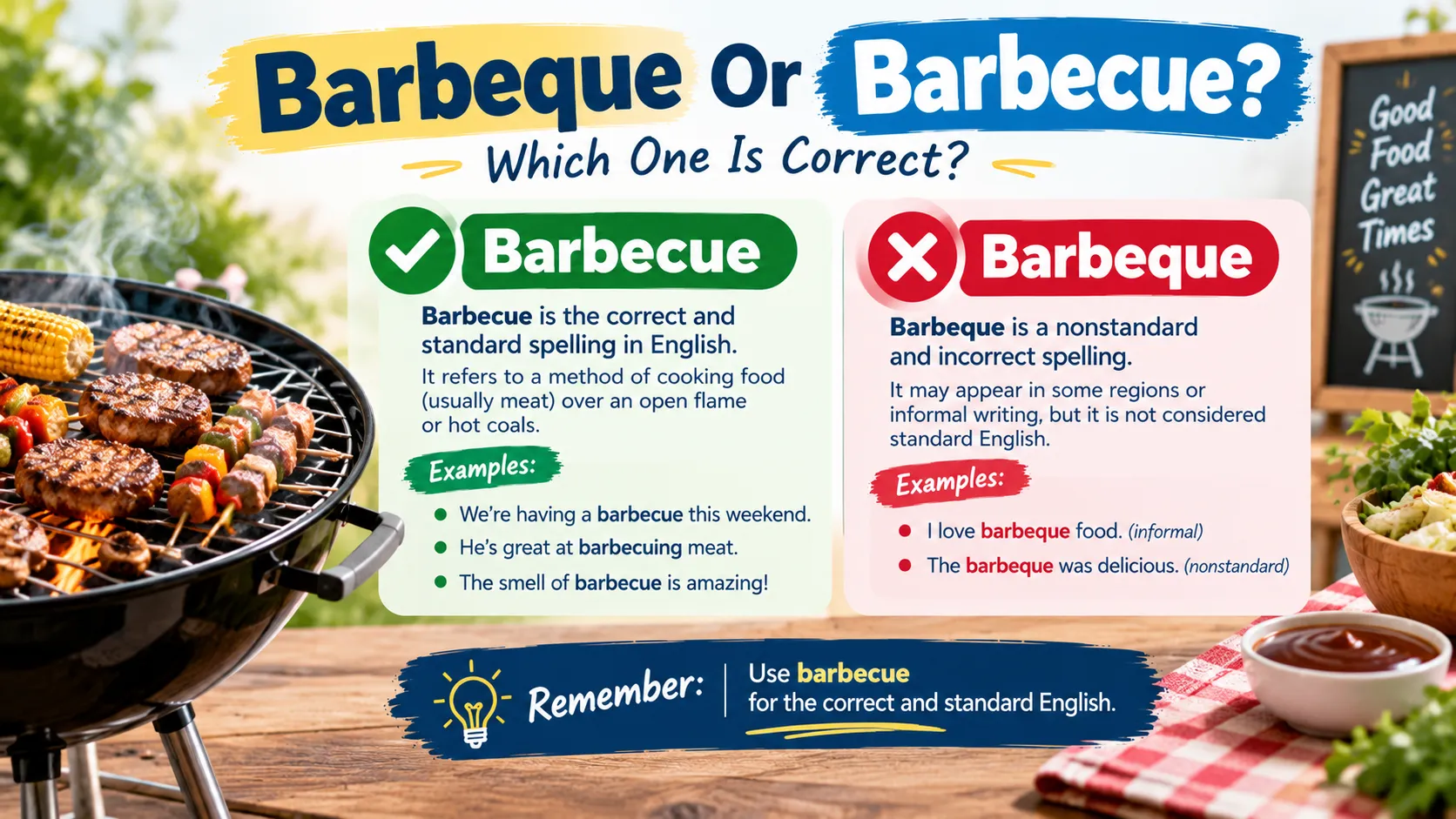
If you have ever wondered whether to write barbeque or barbecue, you are not alone. Both spellings appear in English, particularly in restaurant names, food advertisements, menus, and everyday conversations. However, one spelling is generally preferred in standard English writing.
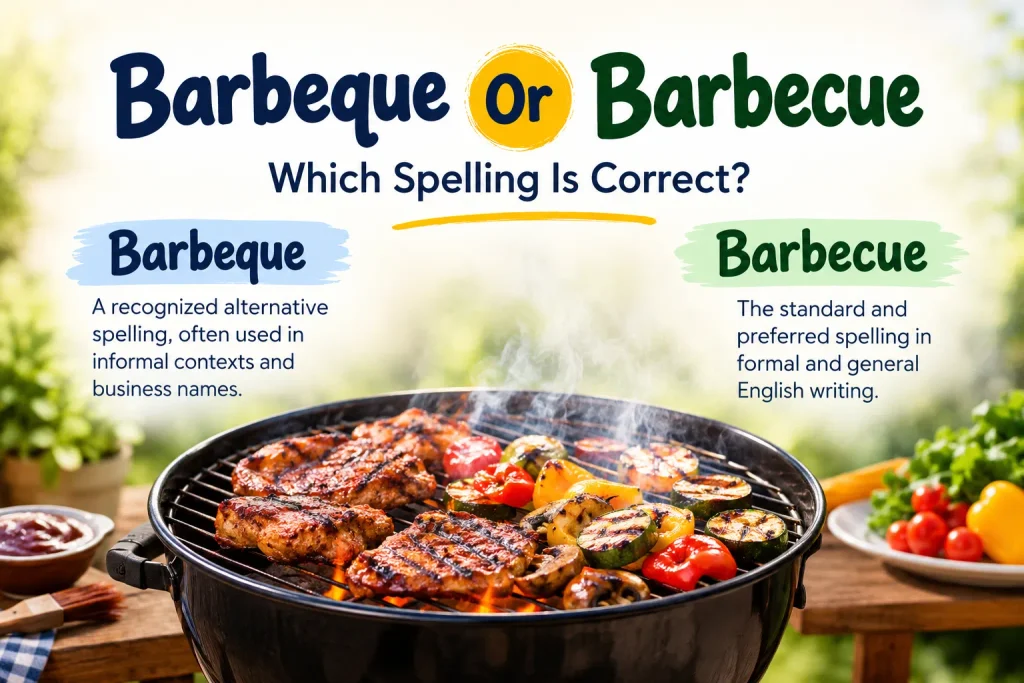
Barbecue is the Standard And Preferred spelling, while barbeque is a recognized alternative. Although both forms usually refer to the same cooking method, food, or outdoor gathering, barbecue is the safer choice for academic assignments, professional documents, and most published content.
In this guide, you will learn the difference between barbeque and barbecue, how to use each spelling, what BBQ means, and which form to choose in different situations.
Barbeque or Barbecue: The Quick Answer
Barbecue is the preferred spelling in standard English. Barbeque is also used as an alternative spelling, particularly in informal contexts and some business names.
Here is a quick comparison:
| Word | Usage | Example |
| Barbecue | Standard spelling | We are planning a barbecue this weekend. |
| Barbeque | Alternative spelling | The restaurant advertises its barbeque specials. |
| BBQ | Informal abbreviation | We are hosting a BBQ on Sunday. |
If you are unsure which form to use, choose barbecue. It is widely recognized and appropriate for both formal and informal writing.
What Does Barbecue Mean?
The word barbecue has several related meanings. It can refer to a cooking method, food prepared using that method, or a social gathering where food is cooked and shared.
Understanding these meanings will help you use the word correctly in different sentences.
Barbecue as a Noun
As a noun, barbecue can describe a cooking device, a style of cooking, or an outdoor social event.
For example:
- We invited our neighbors to a barbecue.
- The barbecue is ready for the vegetables.
- Our family organizes a barbecue every summer.
- The restaurant is famous for its barbecue dishes.
In these examples, barbecue refers to a thing, cooking style, or event rather than an action.
Barbecue as a Verb
Barbecue can also function as a verb. It means to cook food using a barbecue or a suitable outdoor cooking method.
For example:
- We will barbecue the corn this evening.
- My uncle likes to barbecue vegetables in the garden.
- They barbecued the food for the family gathering.
- She is barbecuing dinner for her guests.
Here, the word describes the action of cooking.
Barbecue as a Social Event
A barbecue can also be a gathering where people prepare and enjoy food together. These events are often associated with outdoor meals, family celebrations, and friendly get-togethers.
For example:
- Our school organized a barbecue for the graduating class.
- The neighborhood barbecue attracted dozens of families.
- We are planning a barbecue to celebrate the holidays.
In this context, the word describes the event rather than a particular dish.
Is It Barbeque or Barbecue?
Both barbeque and barbecue are used in English, but they do not have equal standing as spelling choices.
Barbecue is the preferred spelling for general writing. It is the conventional form used in edited English, dictionaries, publications, and many food-related contexts.
Barbeque is a recognized variant. You may encounter it in informal writing, advertising, or established business names.
The main difference is spelling preference, not meaning. In ordinary usage, both forms generally refer to the same cooking method, food, or social gathering.
Why Is Barbecue the Preferred Spelling?
The spelling barbecue is the established standard form in English. It is suitable for a broad range of situations, from casual messages to professional writing.
For example:
- The hotel is hosting a barbecue for its guests.
- We bought barbecue sauce for dinner.
- The chef specializes in barbecue cooking.
- Our company arranged a barbecue for its employees.
Using the standard spelling helps maintain consistency and avoids unnecessary confusion.
Is Barbeque an Incorrect Spelling?
Not necessarily. Barbeque is used as an alternative spelling, so it should not automatically be treated as a spelling mistake in every context.
However, it is generally better to use barbecue when writing an academic paper, professional article, school assignment, or formal report.
If a restaurant or business officially uses Barbeque in its name, preserve that spelling when referring to the business.
For example:
- The restaurant promotes its barbeque menu.
- We visited a local barbecue restaurant.
- The business uses the word Barbeque in its official name.
The first example illustrates an alternative spelling, while the final example shows why official names should retain their established form.
What Is the Difference Between Barbeque and Barbecue?
The difference is primarily conventional spelling preference.
| Feature | Barbecue | Barbeque |
| Spelling status | Standard and preferred | Recognized alternative |
| Meaning | Cooking method, food, or event | Generally the same |
| Formal writing | Recommended | Usually avoid unless appropriate to the context |
| Informal writing | Suitable | Sometimes used |
| Business names | Used by many businesses | May appear in established names |
| General recommendation | Best default choice | Use when the context calls for it |
For everyday writing, choosing barbecue is the simplest way to avoid uncertainty.
Barbecue vs. Barbeque: Key Differences
Although the two spellings generally share the same meaning, understanding their usage can help you make better writing decisions.
Spelling and Standard Usage
The most important distinction is that barbecue is the conventional spelling, whereas barbeque is an alternative.
Consider these sentences:
- We prepared a barbecue for our guests.
- We prepared a barbeque for our guests.
Both sentences are understandable, but the first uses the preferred spelling.
For articles, educational materials, and professional communication, consistency and standard usage matter more than choosing a less common variant.
Meaning and Pronunciation
In ordinary English usage, barbecue and barbeque generally have the same meaning and pronunciation.
The difference is in how the word is written, not in the cooking method or event it describes.
For example:
- The barbecue was held in the backyard.
- The barbeque was held in the backyard.
Both sentences communicate the same basic idea.
Formal and Informal Writing
Your choice may depend on the type of content you are producing.
For formal writing: Use barbecue in reports, essays, articles, and professional documents.
And for informal writing: Barbecue remains an excellent choice, although barbeque may appear in casual contexts.
For business names: Follow the spelling officially used by the business.
For short advertisements: BBQ is often convenient when space is limited.
The key is to select a spelling that suits the context and use it consistently.
British English vs. American English: Barbeque or Barbecue
English spelling sometimes differs between British and American English. For example, British English often uses colour, while American English generally uses color.
However, the choice between barbeque and barbecue is not a straightforward British-versus-American spelling difference.
Preferred Spelling in American English
In American English, barbecue is the standard spelling for general writing.
Examples:
- We are hosting a barbecue this weekend.
- The restaurant serves traditional barbecue dishes.
- They bought a new barbecue grill.
The alternative barbeque may also appear, particularly in commercial names and informal contexts.
Preferred Spelling in British English
In British English, barbecue is also the standard spelling.
Examples:
- We invited our friends to a barbecue.
- The weather was perfect for a garden barbecue.
- They prepared barbecue vegetables for lunch.
Although regional vocabulary and cooking traditions can vary, there is no need to switch to barbeque simply because you are writing for a British audience.
Usage in Australian and Other English Varieties
The spelling barbecue is also widely understood in Australian and other English-speaking contexts.
For example:
- We are having a barbecue at the beach.
- The family planned a barbecue for the holiday.
- The community organized a weekend barbecue.
In some regions, people may use local terms for particular outdoor cooking traditions. Nevertheless, barbecue remains a useful general spelling for an international audience.
Barbecue, Barbeque, and BBQ: What’s the Difference?
The words barbecue and barbeque are alternative spellings, while BBQ is an abbreviation commonly associated with barbecue.
Although these forms are related, they are not used in exactly the same way in every situation.
When to Write Barbecue
Use barbecue when you want a complete, standard word that works in most contexts.
Examples:
- The barbecue begins at noon.
- We ordered barbecue chicken for dinner.
- The restaurant offers several barbecue sauces.
- They are planning a barbecue for their colleagues.
This spelling is particularly suitable for educational writing, formal communication, and published articles.
When to Use Barbeque
Use barbeque when it is appropriate to the context, such as when reproducing a business’s official name or preserving an established spelling in a quotation.
For example:
- The store advertises its barbeque equipment.
- We visited a restaurant whose name includes Barbeque.
In your own general writing, however, barbecue is usually the better choice.
When Is BBQ Appropriate?
BBQ is a widely recognized abbreviation for barbecue. It is particularly common in casual communication, restaurant menus, event invitations, and advertising.
Examples:
- Join us for a BBQ on Saturday.
- The cafe offers a BBQ lunch special.
- Please bring a side dish to the neighborhood BBQ.
For formal writing, consider using the full word the first time it appears. You can then use the abbreviation if it suits the document.
For example:
“Our organization will host a barbecue (BBQ) for local families.”
After introducing the abbreviation, you can use BBQ when appropriate.
How to Use Barbecue in a Sentence
The best way to Understand a word is to see how it functions in different situations. The following examples demonstrate common uses of barbecue.
Examples of Barbecue as a Noun
When used as a noun, barbecue can refer to an event, a cooking appliance, or a style of food preparation.
- We arranged a barbecue for our relatives.
- The barbecue was moved indoors because of the rain.
- Our neighbors invited us to their summer barbecue.
- The restaurant is known for its barbecue sauce.
- They purchased a new barbecue for the garden.
- The community barbecue raised money for a local project.
In each sentence, the word identifies a thing, event, or cooking-related concept.
Examples of Barbecue as a Verb
As a verb, barbecue describes cooking food using a barbecue or a related cooking method.
- We barbecue vegetables whenever the weather is pleasant.
- My father will barbecue the corn for dinner.
- They barbecued the food before the guests arrived.
- She is barbecuing mushrooms for the evening meal.
- We often barbecue outdoors during the summer.
- The chef barbecues fresh ingredients for the restaurant’s menu.
Notice that the spelling changes when the verb is used in different tenses.
Examples of Barbecue in Everyday English
Here are some natural sentences you might encounter in everyday conversation:
- Are you coming to our barbecue tomorrow?
- We need to buy barbecue sauce.
- The weather is perfect for a barbecue.
- They invited the whole family to a barbecue.
- We enjoyed barbecue food at the festival.
- The outdoor barbecue was a success.
These examples show why the word is useful in conversations about food, cooking, and social activities.
Examples in Formal and Professional Writing
In formal writing, use barbecue when referring to a planned event, catering service, cooking activity, or food-related business.
Examples:
- The organization hosted a barbecue to welcome new members.
- The restaurant specializes in traditional barbecue dishes.
- Employees attended a barbecue organized by the management team.
- The event included outdoor cooking and refreshments.
- The school arranged a barbecue to celebrate the end of the academic year.
These sentences use the standard spelling in clear, professional language.
Barbecue Word Forms and Spelling Rules
Understanding related word forms will help you avoid common spelling errors.
The word barbecue can be used as a noun or a verb. When forming plurals and verb tenses, follow the standard spelling patterns shown below.
What Is the Plural of Barbecue?
The plural of barbecue is barbecues.
Add -s to the end of the word to refer to more than one barbecue.
Examples:
- The town organizes several barbecues each year.
- We attended two barbecues during the holidays.
- Local restaurants offer outdoor barbecues in summer.
Remember that barbecues can refer to multiple cooking devices or multiple social events, depending on the sentence.
What Is the Past Tense of Barbecue?
The simple past tense is barbecued.
To form it, add -d to the word barbecue.
Examples:
- We barbecued vegetables for lunch.
- They barbecued the food before sunset.
- She barbecued fresh corn for her guests.
The past participle is also barbecued.
For example:
“The vegetables were barbecued over an open flame.”
This construction describes food that has already been cooked.
Is It Barbecuing or Barbequing?
Barbecuing is the standard spelling of the present participle and gerund.
The final e in barbecue is dropped before adding -ing.
Correct: Barbecuing
Less-preferred variant: Barbequing
Examples:
- We are barbecuing vegetables tonight.
- Barbecuing outdoors is a popular summer activity.
- He enjoys barbecuing for his family.
- They spent the afternoon barbecuing in the garden.
If you want the safest spelling for general writing, use barbecuing.
How to Use Barbecued Correctly
Barbecued can function as the simple past tense or past participle of the verb barbecue. It can also describe food cooked using that method.
Examples:
- We barbecued the vegetables yesterday.
- She prepared barbecued corn for dinner.
- The guests enjoyed barbecued mushrooms.
- They served barbecued food at the festival.
Use barbecued when referring to a completed cooking action or food prepared through barbecue cooking.
The Origin and History of the Word Barbecue
The history of barbecue is connected to cooking traditions in the Caribbean and the development of the word barbacoa in Spanish.
The English word is generally traced through Spanish barbacoa, which is associated with Indigenous Caribbean terminology, commonly linked to the Taíno language.
The term’s historical development reflects the movement of words between languages and cultures.
The Connection to the Word Barbacoa
The Spanish word barbacoa is closely related to the English word barbecue.
Early uses of the term were associated with Indigenous Caribbean cooking practices and structures used for preparing food. As European explorers and settlers encountered these practices, the word entered wider Spanish usage and eventually influenced English.
The exact details of the word’s earliest development are a matter of historical and linguistic study, so it is best to avoid oversimplified claims about a single origin event.
How Barbecue Became the Standard Spelling
Over time, barbecue became the conventional spelling in English dictionaries and general writing.
Its widespread use across food writing, restaurant menus, cookbooks, and everyday communication helped establish it as the preferred form.
Today, the spelling is used internationally and is understood in a variety of English-speaking communities.
How Alternative Spellings Developed
English has many words with alternative spellings, especially when pronunciation influences how people write them.
Barbeque is one such variant. It reflects an alternative way of representing the familiar sound of the word.
Although it remains recognizable, barbecue is the more reliable choice for standard written English.
Common Barbecue and Barbeque Mistakes
Writers sometimes become confused about which spelling to choose or how to use the word grammatically.
Avoiding the following mistakes can make your writing clearer.
Using an Alternative Spelling in Formal Writing
One common issue is using barbeque in a formal document when the standard spelling would be more appropriate.
For example:
Less-preferred for general formal writing: “The university organized a barbeque for its students.”
Preferred: “The university organized a barbecue for its students.”
The first sentence is understandable, but the second uses the conventional spelling.
Confusing BBQ with the Full Word
BBQ is an abbreviation, not a completely different word with an unrelated meaning.
For example:
Informal: “We are going to a BBQ tonight.”
More formal: “We are going to a barbecue tonight.”
Both are understandable. The choice depends on the style and audience of your writing.
Misspelling Barbecuing
The spelling of the -ing form can be confusing because the original word ends in e.
Correct: “They are barbecuing vegetables.”
Avoid using inconsistent spellings within the same article. If you choose standard English, use barbecuing throughout.
Inconsistency Within the Same Article
Switching randomly between barbecue and barbeque can make a document look inconsistent.
For example:
“We planned a barbecue for Sunday. The barbeque will begin at noon, and our guests should arrive early.”
Although readers can understand this paragraph, using one spelling consistently would make it more polished.
A clearer version is:
“We planned a barbecue for Sunday. The barbecue will begin at noon, and our guests should arrive early.”
Consistency is especially important in educational articles, professional documents, and website content.
Related To Another Article: https://grammixo.com/lovable-or-loveable/
Barbecue or Barbeque: Which Should You Use?
The best spelling depends on the context, but barbecue is the most practical default for general English writing.
Here is how to choose the appropriate form in common situations.
For School and Academic Writing
Use barbecue in essays, assignments, research papers, and other academic work.
For example:
“The community organized a barbecue to raise funds for the school library.”
This spelling is the conventional choice and helps keep your writing consistent with standard English.
For Blogs, Articles, and Emails
For website articles, business emails, newsletters, and other written communication, barbecue is generally preferable.
Examples:
- Our latest article explains how to prepare barbecue vegetables.
- The company is organizing a barbecue for its employees.
- We would like to invite you to a barbecue next weekend.
If you are writing about a business with Barbeque in its official name, preserve that spelling when necessary.
For Restaurant Menus and Business Names
Restaurants and food businesses sometimes use alternative spellings as part of their branding.
If a business officially spells its name with Barbeque, do not automatically change it to Barbecue.
For example, when reproducing a restaurant’s registered or advertised name, follow the business’s own spelling.
In menu descriptions written by you, however, barbecue is the standard choice unless the brand’s style guide specifies otherwise.
For Social Media and Casual Messages
In social media posts, text messages, and casual invitations, both barbecue and BBQ are common choices.
Examples:
- Come over for a barbecue this weekend!
- We are having a BBQ on Saturday.
- Who wants to join us for a backyard barbecue?
Barbeque may also appear in casual contexts, but you do not need to use it simply to sound informal.
People Also Ask
A: Barbecue is the standard and preferred spelling. Barbeque is also a recognized alternative, so it is not accurate to describe it as universally incorrect.
For general and formal writing, choose barbecue.
A: Yes. Barbeque appears in English usage, particularly in informal contexts and some business names. However, barbecue is the conventional spelling recommended for most writing.
A: Generally, no. Both spellings refer to the same cooking method, food, or social gathering. The main distinction is spelling preference rather than meaning.
A: Yes. BBQ is a common abbreviation for barbecue. It is frequently used in menus, invitations, advertisements, and casual messages.
A: The standard spelling in American English is barbecue. The alternative barbeque also appears, but barbecue is the safer choice for general writing.
Conclusion
When choosing between Barbeque And Barbecue, the simplest rule is to use barbecue in standard English writing.
Although barbeque is a recognized alternative, barbecue is the preferred spelling for articles, academic assignments, professional documents, and most everyday communication.
Remember these three points:
- Barbecue: The standard and recommended spelling.
- Barbeque: A recognized alternative spelling, sometimes used in informal contexts and business names.
- BBQ: A common abbreviation for barbecue, especially in casual communication.
Whether you are writing a school assignment, publishing a blog post, or inviting friends to an outdoor meal, choosing barbecue will usually be the clearest and safest option.

1 thought on “Barbeque or Barbecue: Which Spelling Is Correct?”