
Introduction
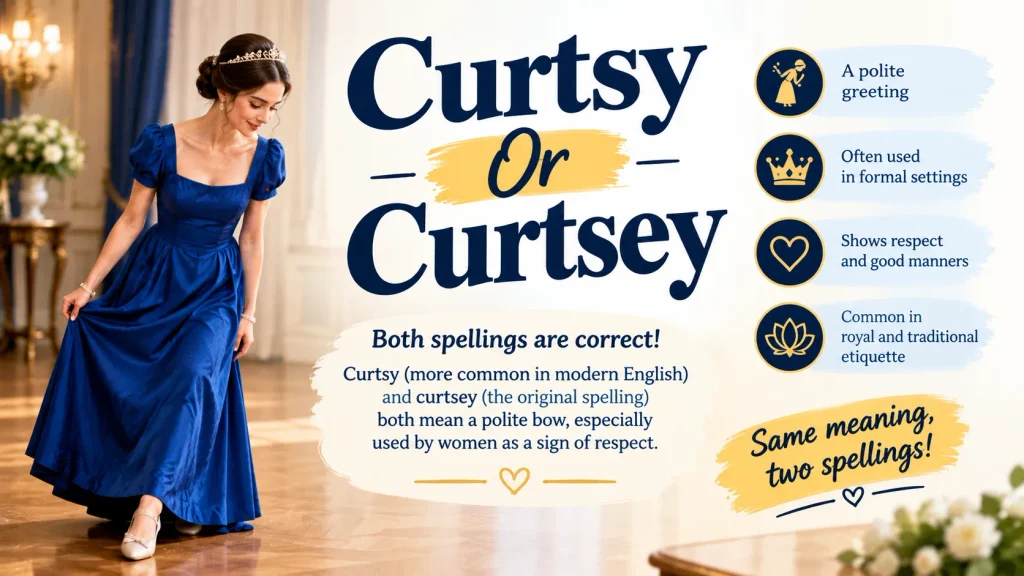
Have you ever wondered whether to write Curtsy Or Curtsey? Both spellings are correct, and they refer to the same respectful gesture in which a person bends their knees and lowers their body, traditionally as a sign of respect or greeting. However, curtsy is generally the preferred spelling in modern English.
Although the difference between these words is small, understanding their spelling, meaning, pronunciation, and grammatical forms can help you use them confidently. Whether you are writing an article, describing a dance performance, or discussing a formal ceremony, knowing how these words work will make your writing clearer.
Let’s explore the difference between curtsy and curtsey, with practical examples and simple grammar rules.
Curtsy or Curtsey: The Quick Answer
Curtsy and curtsey are both correct spellings of the same word. They can function as either a noun or a verb, and the choice between them does not change the basic meaning.
- Curtsy: The generally preferred modern spelling.
- Curtsey: An accepted alternative spelling.
- Meaning: A respectful gesture performed by bending the knees and lowering the body.
For example:
- The young dancer performed a graceful curtsy.
- The young dancer performed a graceful curtsey.
Both sentences are correct. The first spelling is a practical choice for most modern writing, but the second is also acceptable.
What Does Curtsy Mean?
The word curtsy describes a traditional gesture associated with respect, greeting, or formal acknowledgment. It is commonly connected with royal ceremonies, traditional etiquette, dance performances, and historical settings.
A person performing a curtsy typically bends their knees and lowers their body while maintaining an upright posture.
The word has two main grammatical uses.
Curtsy as a Noun
As a noun, curtsy refers to the gesture itself. It can describe a single movement or one performed during a formal occasion.
Examples:
- The princess greeted her guests with a graceful curtsy.
- Her curtsy impressed everyone at the ceremony.
- The young performer finished the show with a polite curtsy.
- The actress gave a small curtsy before leaving the stage.
In each example, curtsy names an action or gesture.
Curtsy as a Verb
As a verb, curtsy means to perform the gesture.
Examples:
- The dancer learned to curtsy during her etiquette lessons.
- She curtsied before greeting the royal guest.
- The performers will curtsy at the end of the show.
- The little girl curtsied politely to her grandmother.
Here, the word describes what someone does rather than naming the gesture.
What Does Curtsey Mean?
Curtsey has the same basic meaning as curtsy. It can also function as both a noun and a verb.
The spelling differs, but the underlying concept remains the same: a gesture traditionally used to show respect or acknowledge someone.
Examples:
- The performer gave a graceful curtsey after the show.
- She curtseyed before the formal introduction.
- The historical novel described a traditional curtsey.
- The young dancers practiced how to curtsey correctly.
These sentences are grammatically acceptable. However, if you want a straightforward spelling choice for a modern English article, curtsy is generally the better default.
Curtsy vs. Curtsey: Key Differences
The main difference between curtsy and curtsey is their spelling, not their meaning.
| Feature | Curtsy | Curtsey |
| Correct spelling | Yes | Yes |
| Meaning | A respectful gesture | The same respectful gesture |
| Part of speech | Noun and verb | Noun and verb |
| General modern preference | Usually preferred | Accepted alternative |
| Plural noun | Curtsies | Curtseys |
| Simple past tense | Curtsied | Curtseyed |
| Present participle | Curtsying | Curtseying |
| Pronunciation | Generally the same | Generally the same |
Both forms communicate the same idea. Your choice may depend on your preferred spelling, the conventions of your publication, or the wording used in the source you are following.
Which Spelling Should You Use: Curtsy or Curtsey?
If you are unsure which spelling to choose, curtsy is a sensible default. It is widely recognized and offers a simple, consistent choice for everyday and professional writing.
However, curtsey should not automatically be treated as a spelling mistake.
Curtsy or Curtsey in American English
In American English, curtsy is a practical spelling choice for most contemporary writing.
For example:
The performer gave a graceful curtsy before leaving the stage.
This spelling is clear and suitable for general articles, educational materials, and descriptions of formal gestures.
Curtsy or Curtsey in British English
Both spellings can be encountered in British English. Although some writers may prefer curtsey, it is not accurate to claim that this spelling belongs exclusively to British English.
If you are writing for a British audience, consider the conventions of your publication or the dictionary it follows. Consistency is more useful than assuming that one spelling is always correct in Britain and the other is always correct in America.
Which Spelling Is Better for Formal Writing?
For academic papers, professional articles, educational content, and other formal documents, choose one spelling and use it consistently.
For example, if you begin with curtsy, continue using forms such as curtsies, curtsied, and curtsying.
If you choose curtsey, use the corresponding forms curtseys, curtseyed, and curtseying.
This approach makes your writing easier to follow and prevents unnecessary spelling inconsistencies.
How to Pronounce Curtsy and Curtsey
Despite their Different Spellings, curtsy and curtsey are generally pronounced the same way.
The word has two syllables, with the stress on the first syllable.
- American English: /ˈkɝːt.si/
- British English: /ˈkɜːt.si/
The main difference between these pronunciations is the vowel sound, which reflects common differences between American and British English.
You do not need to pronounce the extra letter in curtsey as a separate sound. Both spellings refer to the same word and are ordinarily pronounced alike.
A useful way to learn the pronunciation is to listen to a reputable dictionary’s audio recording and repeat the word aloud.
Curtsy and Curtsey Word Forms
Understanding the different forms of these words will help you use them correctly in sentences.
Although curtsy and curtsey are alternative spellings, their related grammatical forms follow different spelling patterns.
What Is the Plural of Curtsy?
The plural of the noun curtsy is curtsies.
When a noun ends in a consonant followed by y, the y generally changes to ies to form the plural.
Examples:
- The dancers performed several curtsies.
- Her curtsies were graceful and controlled.
- The ceremony included traditional bows and curtsies.
The plural form of curtsey is curtseys.
Examples:
- The performers exchanged bows and curtseys.
- Several curtseys were performed during the ceremony.
Remember that curtsies is the plural of curtsy, while curtseys is the plural of curtsey.
What Is the Past Tense of Curtsy?
The simple past tense of curtsy is curtsied.
Examples:
- She curtsied before the royal guest.
- The dancer curtsied at the end of the performance.
- The child curtsied politely when introduced.
The past tense of curtsey is curtseyed.
Example:
She curtseyed before taking her place in the ceremony.
Both forms are acceptable when used with their corresponding spellings.
What Is the Present Participle of Curtsy?
The present participle of curtsy is curtsying.
It is used in continuous verb forms and other grammatical constructions.
Examples:
- The dancer is curtsying before the audience.
- She was curtsying when the music ended.
- The performers are curtsying together.
The corresponding form of curtsey is curtseying.
Example:
The actress was curtseying as the audience applauded.
These forms allow you to describe an action that is happening or was in progress.
Curtsy or Curtsey: Verb Forms at a Glance
| Grammatical form | Curtsy | Curtsey |
| Base form | Curtsy | Curtsey |
| Third-person singular | Curtsies | Curtseys |
| Simple past | Curtsied | Curtseyed |
| Present participle | Curtsying | Curtseying |
| Past participle | Curtsied | Curtseyed |
Using the correct form is just as important as choosing the correct spelling.
Curtsy vs. Courtesy: What Is the Difference?
Curtsy and courtesy may look somewhat similar, but they have different meanings in modern English.
Curtsy refers to a particular gesture. Courtesy refers to polite behavior, consideration, or respectful treatment.
Understanding this distinction is important because the two words are not interchangeable.
When to Use Curtsy
Use curtsy when describing the physical gesture.
Examples:
- The dancer performed a curtsy after the show.
- She curtsied to acknowledge the royal guest.
- The historical story included a formal curtsy.
Each example refers to a specific movement.
When to Use Courtesy
Use courtesy when discussing politeness, consideration, or a respectful act.
Examples:
- Thank you for your courtesy.
- Good manners are an important part of professional courtesy.
- The staff treated every visitor with courtesy.
- As a courtesy, the organizer notified everyone about the schedule change.
In these examples, courtesy describes considerate behavior rather than a physical gesture.
An Easy Way to Remember the Difference
Think of curtsy as a gesture and courtesy as a way of behaving.
If someone bends their knees in a traditional greeting, the word you need is curtsy. If someone speaks politely, offers consideration, or treats another person respectfully, courtesy is usually the appropriate word.
Examples of Curtsy and Curtsey in Sentences
Sentence examples can help you understand how these spellings work in everyday writing.
Examples Using Curtsy as a Noun
- The young dancer performed a graceful curtsy.
- Her curtsy showed respect for the guest.
- The ceremony ended with a traditional curtsy.
- The audience applauded as the performer completed her curtsy.
- The instructor demonstrated the correct posture for a curtsy.
- The character greeted the queen with a formal curtsy.
In each sentence, curtsy refers to the gesture itself.
Examples Using Curtsy as a Verb
- The dancer learned to curtsy during her lessons.
- She curtsied before leaving the stage.
- The performers will curtsy after the final song.
- The young student curtsied politely during the demonstration.
- The actress was curtsying when the audience began to applaud.
- The children practiced how to curtsy for the school performance.
These examples demonstrate how the verb changes according to tense and sentence structure.
Examples Using Curtsey
- The actress gave a curtsey after the performance.
- She curtseyed before the formal introduction.
- The historical novel described a traditional curtsey.
- The performers practiced their curtseys before the ceremony.
- The character was curtseying when the guests entered the room.
- The instructor explained how to perform a proper curtsey.
These examples show that the alternative spelling can be used naturally in different grammatical contexts.
Common Mistakes to Avoid
Although the difference between curtsy and curtsey is simple, several mistakes can cause confusion.
Assuming Curtsey Is Incorrect
One common mistake is believing that curtsey is always wrong.
That is not correct. Both curtsy and curtsey are accepted spellings.
For example:
- Correct: She performed a curtsy.
- Correct: She performed a curtsey.
You can use either spelling, although curtsy is generally the more practical modern default.
Confusing Curtsy With Courtesy
These words have different meanings, so substituting one for the other can change your sentence.
- Correct: She gave a curtsy to the guest.
- Correct: She thanked the guest for the courtesy.
A curtsy is a gesture; courtesy is politeness or consideration.
Using the Wrong Past-Tense Form
The past tense must match the spelling you have chosen.
- Correct: She curtsied before the audience.
- Correct: She curtseyed before the audience.
- Incorrect: She curtsieded before the audience.
The form curtsieded incorrectly adds another past-tense ending.
Mixing the Two Spelling Systems Unnecessarily
Using both spellings in one article can confuse readers if the change is accidental.
For example, switching between curtsy, curtseys, and curtseyed without a clear reason may make your writing appear inconsistent.
Choose one spelling system for your article and follow it throughout.
Assuming the Word Is Only a Noun
Curtsy and curtsey can both function as nouns and verbs.
Compare these sentences:
- Noun: Her curtsy was graceful.
- Verb: She curtsied gracefully.
Recognizing the difference helps you construct grammatically correct sentences.
Related To Another Article: https://grammixo.com/barbeque-or-barbecue/
When Is a Curtsy Used?
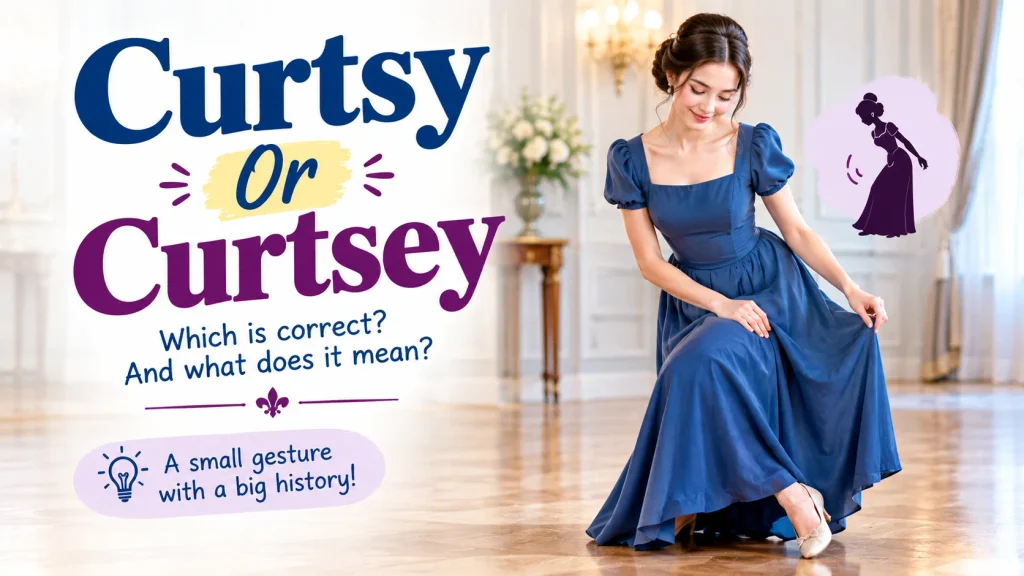
A curtsy is associated with particular social, cultural, and performance settings. Although it is less common in ordinary everyday interactions, it remains relevant in several contexts.
Royal and Formal Ceremonies
A curtsy has traditionally been associated with formal greetings and expressions of respect, including certain royal and ceremonial settings.
Its meaning and expected use can vary according to cultural traditions and the occasion.
Dance and Stage Performances
Dancers may perform a curtsy at the end of a performance to acknowledge the audience.
The gesture can serve a similar purpose to a bow, depending on the tradition and style of the performance.
For example:
The ballet dancers performed a curtsy as the audience applauded.
Historical Fiction and Literature
Writers often use the word curtsy when describing historical social customs, formal introductions, or characters interacting according to traditional etiquette.
For example:
The young noblewoman offered a curtsy before addressing the royal court.
In this context, the word helps establish the setting and social conventions of the story.
Modern Etiquette and Everyday Life
Today, a curtsy may appear in dance classes, theatrical performances, historical reenactments, and selected formal settings.
It is not a gesture that people generally need to perform in everyday conversation. Its appropriateness depends on the occasion, cultural expectations, and personal choice.
Is Curtsy Still Used in Modern English?
Yes. Curtsy remains a recognized English word, especially when discussing dance, traditional etiquette, formal gestures, and historical settings.
The word may be Less Common in everyday conversation than words such as bow or greet, but it continues to have a clear and specific meaning.
For contemporary writing, curtsy is a useful default spelling because it is widely recognized and easy to use consistently.
The alternative curtsey is also acceptable. You do not need to change it when quoting a source or following an established publication style that uses that spelling.
The important point is to understand the word’s meaning and choose the spelling that best suits your writing.
People Also Ask
A: Both curtsy and curtsey are correct. They have the same basic meaning, although curtsy is generally preferred as a modern default.
A: There is no basic difference in meaning. Both words describe a respectful gesture performed by bending the knees and lowering the body. The difference is simply the spelling.
A: Curtsey is used in British English, but it is not exclusively British. Both spellings are accepted, and usage can vary among writers and publications.
A: Curtsy can be both a noun and a verb. As a noun, it names the gesture. As a verb, it describes performing that gesture.
A: The plural of curtsy is curtsies. The plural of curtsey is curtseys.
Conclusion
Both Curtsy And Curtsey are correct spellings of the same English word. They describe a traditional gesture of respect and can function as either a noun or a verb.
For most modern writing, curtsy is the recommended default, while curtsey remains an acceptable alternative. Remember that their grammatical forms differ in spelling, so use curtsies, curtsied, and curtsying with curtsy, or curtseys, curtseyed, and curtseying with curtsey.
By understanding these spelling patterns and the difference between curtsy and courtesy, you can write more accurately and confidently.

1 thought on “Curtsy or Curtsey: Which Spelling Is Correct?”