Introduction
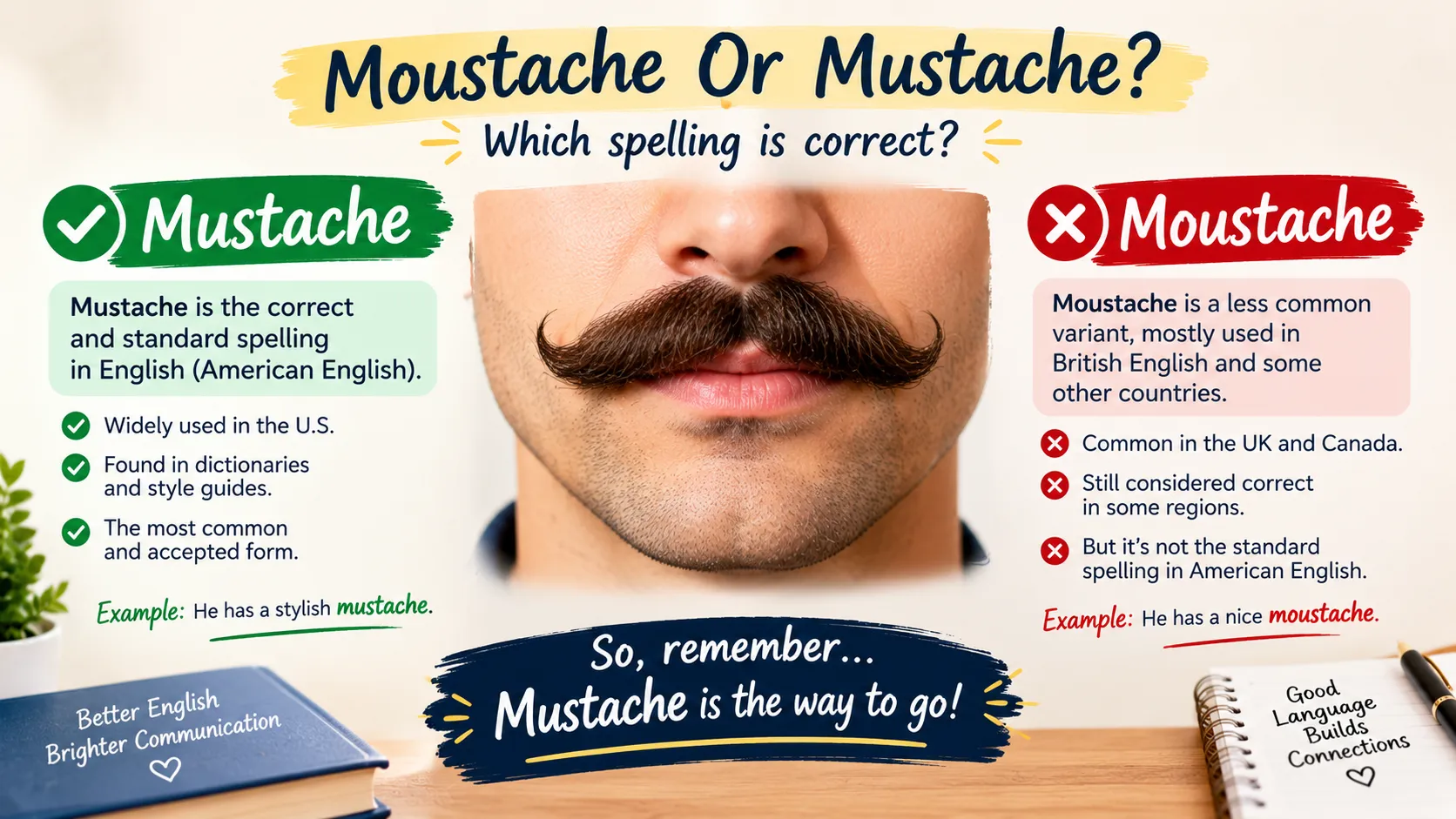
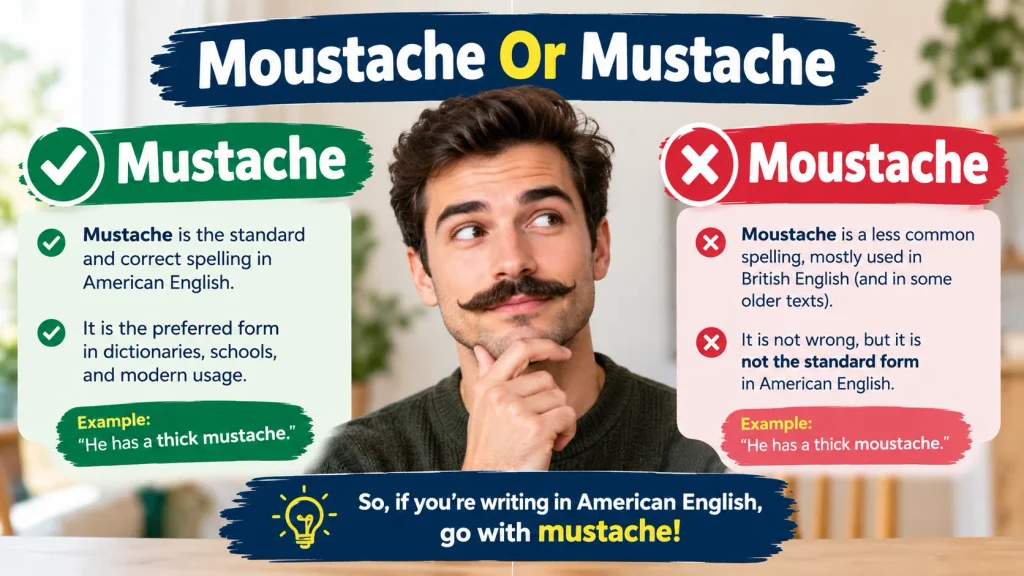
Have you ever wondered whether to write moustache or mustache? Both spellings are correct, and they refer to the same thing: facial hair that grows above the upper lip. The main difference is regional spelling preference. Moustache is more common in British English, while mustache is the standard preference in American English.
Understanding this distinction can help you choose the appropriate spelling for your audience and keep your writing consistent. Whether you are writing a blog post, an academic assignment, or a casual message, both forms are acceptable when used according to the relevant English convention.
Quick Answer: Moustache or Mustache?
Both moustache and mustache are correct spellings of the same word.
- Moustache: The preferred spelling in British English and commonly used in other varieties of English.
- Mustache: The preferred spelling in American English.
- Meaning: Hair that grows above the upper lip.
- Plural forms: Moustaches and mustaches.
- Best choice: Use moustache for British English and mustache for American English.
Neither spelling is inherently wrong. Your choice should depend on your intended audience, publication requirements, and preferred style of English.
What Is the Difference Between Moustache and Mustache?
The difference between moustache and mustache is primarily a matter of spelling. Both words have the same meaning, and the extra letter o in moustache does not change the word’s definition.
The two spellings reflect different regional preferences. British English generally favors moustache, whereas American English generally favors mustache.
Consider these examples:
- British English: He grew a thick moustache over the summer.
- American English: He grew a thick mustache over the summer.
Both sentences are grammatically correct. The spelling changes, but the meaning remains exactly the same.
Moustache: Meaning and Usage
Moustache is a noun that refers to facial hair growing on the upper lip. It is the usual spelling in British English and is also used in several other English-speaking regions.
People commonly use the word when describing someone’s appearance, discussing grooming habits, or referring to a particular facial hairstyle.
Examples:
- My grandfather has a thick grey moustache.
- He decided to trim his moustache before the wedding.
- The actor wore a black moustache for his new role.
- She recognized the man by his distinctive moustache.
In each example, moustache refers to hair growing above the upper lip.
Mustache: Meaning and Usage
Mustache has exactly the same meaning as moustache. It is the standard American English spelling and is widely used in American books, newspapers, websites, and everyday communication.
The word can describe facial hair of different lengths, colors, and styles.
Examples:
- My father has had a mustache for many years.
- He shaved his mustache before the interview.
- The detective had a neatly trimmed mustache.
- His new mustache made him look different.
If you are writing primarily for an American audience, mustache is generally the better choice.
Do Moustache and Mustache Mean the Same Thing?
Yes. Moustache and mustache mean exactly the same thing. Both describe the hair that grows above the upper lip.
The difference is not grammatical or semantic. It is a regional spelling variation.
For example, a British writer might describe someone as having a long moustache, while an American writer might describe the same person as having a long mustache.
Both descriptions communicate the same information.
Moustache vs. Mustache in British and American English
British and American English share most of their vocabulary, but certain words have different spellings. Examples include colour and color, centre and center, and travelling and traveling.
Moustache and mustache follow a similar pattern.
| Feature | Moustache | Mustache |
| Preferred variety | British English | American English |
| Meaning | Hair above the upper lip | Hair above the upper lip |
| Word type | Noun | Noun |
| Singular form | Moustache | Mustache |
| Plural form | Moustaches | Mustaches |
| Correct spelling | Yes | Yes |
These are general regional preferences rather than absolute restrictions. Either spelling may appear outside its usual region.
Which Spelling Is Used in British English?
Moustache is the traditional and generally preferred spelling in British English.
British dictionaries and publications commonly use this form. If you are writing an article, school assignment, or professional document in British English, moustache is usually the most appropriate choice.
Examples:
- The gentleman had a neatly groomed moustache.
- He decided to grow a moustache during the winter.
- His moustache turned white as he grew older.
Using moustache helps maintain consistency with other British spellings.
Which Spelling Is Used in American English?
Mustache is the standard American English spelling.
American writers generally use this form in newspapers, magazines, books, and online content. If your target audience is primarily in the United States, choosing mustache is usually the best approach.
Examples:
- He grew a mustache for his Halloween costume.
- The barber helped him shape his mustache.
- His mustache became part of his recognizable appearance.
Although moustache is understandable to American readers, mustache is the more conventional American spelling.
Moustache or Mustache in Canadian and Australian English
English spelling preferences can vary across Canada, Australia, and other English-speaking regions.
Canadian English often follows British spelling conventions, but American spellings are also used in some contexts. Australian English generally favors British-style spellings, including moustache.
However, usage can vary between dictionaries, publishers, and individual writers. Therefore, it is best to consult the relevant style guide when writing for a specific publication.
Which Spelling Should International English Writers Use?
If you write for an international audience, either spelling is acceptable.
The most important consideration is consistency. Choose the spelling that suits your target audience and use it throughout your article or document.
For example, if your article follows British English, use moustache consistently. If it follows American English, use mustache.
Avoid switching between the two forms without a specific reason, as doing so can make your writing appear inconsistent.
Moustache or Mustache: Example Sentences
Example sentences make it easier to understand how each spelling works in everyday English.
Although the spelling differs, both words can be used in the same Grammatical situations.
Examples Using Moustache
Here are some original sentences using moustache:
- My uncle grew a thick moustache during his university years.
- The barber carefully trimmed the man’s moustache.
- His grey moustache made him look older than he was.
- The actor wore a fake moustache for the comedy scene.
- He decided to shave his moustache before the family gathering.
- A neatly styled moustache can change someone’s appearance.
- The photograph showed a man with a long, dark moustache.
- He used a small comb to tidy his moustache.
- The character’s unusual moustache made him easy to recognize.
- My friend is considering growing a moustache for the winter.
These examples demonstrate how moustache is used when describing appearance, grooming, and personal style.
Examples Using Mustache
Here are comparable sentences using the American spelling mustache:
- My neighbor has a thick mustache.
- The barber trimmed his mustache before the ceremony.
- He decided to grow a mustache for a charity event.
- The actor wore a fake mustache during filming.
- His mustache turned grey as he got older.
- She recognized the character by his distinctive mustache.
- He bought a grooming kit to maintain his mustache.
- The photograph showed a man with a curled mustache.
- My brother shaved his mustache for a job interview.
- The comedian’s mustache became part of his stage appearance.
The meaning of mustache in these sentences is identical to that of moustache in the previous examples.
Common Phrases With Moustache and Mustache
Both spellings appear in common descriptive phrases.
Examples include:
- Thick moustache
- Thin moustache
- Grey moustache
- Trimmed moustache
- Fake moustache
- Curly moustache
- Thick mustache
- Thin mustache
- Grey mustache
- Trimmed mustache
- Fake mustache
- Curly mustache
Choose the appropriate spelling according to your preferred English convention.
How to Pronounce Moustache and Mustache
Moustache and mustache are generally pronounced the same way within a given accent. A common pronunciation can be represented as muh-STASH.
The first syllable is usually unstressed, while the second syllable receives the emphasis.
Pronunciation can vary slightly between speakers and regional accents. However, the spelling difference does not ordinarily indicate a difference in meaning or a fundamentally different pronunciation.
If you want to improve your pronunciation, listen to the word spoken by native speakers of the English variety you are learning.
Is the Pronunciation Different in British and American English?
There can be small differences in vowel sounds and accent between British and American speakers. Nevertheless, moustache and mustache are not distinguished by a consistent pronunciation rule based on the extra letter o.
Both spellings refer to the same word, and the exact sound may depend on the speaker’s accent.
For accurate pronunciation, consult a reputable dictionary that provides audio recordings.
What Is the Plural of Moustache or Mustache?
The plural forms are moustaches and mustaches.
Both words form their plurals by adding -es to the singular form.
| Singular | Plural |
| Moustache | Moustaches |
| Mustache | Mustaches |
Examples:
- The photographs showed men with different moustaches.
- The costume shop sold fake moustaches.
- Several actors wore mustaches in the film.
- The exhibition featured portraits of men with impressive moustaches.
The same regional spelling preferences apply to the plural forms.
Moustache vs. Moustaches
Moustache is singular, while moustaches is plural.
Use moustache when referring to one moustache and moustaches when referring to more than one.
Examples:
- He has a thick moustache.
- The barber displayed several different moustaches in the photographs.
The first sentence refers to one person’s facial hair, while the second refers to multiple examples.
Mustache vs. Mustaches
Similarly, mustache is singular and mustaches is plural in American English.
Examples:
- My brother has a short mustache.
- The actors wore different mustaches for their roles.
Both forms are grammatically correct. The choice depends on the spelling convention you are following.
Is Mustaches or Moustaches Correct?
Both mustaches and moustaches are correct plural spellings.
Moustaches is generally preferred in British English, while mustaches is generally preferred in American English.
Neither form is universally more correct than the other. Choose the version that matches the variety of English used in your writing.
Word Origin: Where Do Moustache and Mustache Come From?
The word moustache entered English through French, with earlier roots associated with Italian and other European language forms. Its history is commonly traced to Italian mostaccio and ultimately to Greek mystax, meaning the upper lip or moustache.
The spelling developed over time as the word became established in English.
The forms moustache and mustache eventually became associated with different regional spelling preferences. The American form generally omits the o, while the British form retains it.
Today, both spellings are recognized in standard English, and their historical development does not create a difference in meaning.
Related To Another Article: https://grammixo.com/curtsy-or-curtsey/
Related Words: Mustachio, Mustachioed, and Mustached
Several related words describe moustaches or people who have them. Understanding these terms can help expand your vocabulary.
What Does Mustachio Mean?
Mustachio is a noun referring to a moustache, particularly one that is large, elaborate, or distinctive.
The word can appear in descriptive or humorous writing, especially when emphasizing an unusual facial hairstyle.
Example:
The fictional detective was famous for his enormous mustachio.
Although mustachio is a recognized word, moustache and mustache are more common in everyday English.
What Does Mustachioed Mean?
Mustachioed is an adjective describing a person who has a moustache.
It is often used in literary descriptions, storytelling, and character portrayals.
Examples:
- The mustachioed gentleman greeted the visitors.
- A mustachioed officer stood beside the entrance.
The word provides a concise way to describe someone’s appearance.
Is Mustached or Moustached Correct?
Both mustached and moustached are recognized forms used to describe someone who has a moustache.
Their spelling reflects the same regional preferences found in mustache and moustache.
Examples:
- The mustached actor appeared in the historical drama.
- The moustached gentleman smiled for the camera.
These forms are less common than simply saying that someone has a moustache or mustache.
Common Mistakes When Using Moustache or Mustache
Although the difference between these words is straightforward, writers sometimes Misunderstand their spelling and usage.
Assuming One Spelling Is Always Wrong
A common mistake is believing that moustache is incorrect because it contains an extra letter, or that mustache is misspelled because it omits that letter.
Both assumptions are incorrect.
The two forms are accepted spellings, with different regional preferences.
Remember: The preferred spelling depends on the variety of English you are using.
Mixing British and American Spellings
Another common mistake is switching between British and American spelling conventions in the same article without a reason.
For example, a writer might use moustache in one paragraph and mustache in the next.
Although readers can understand both, inconsistent spelling can make an article look less polished.
Choose one convention and follow it throughout your content.
Confusing a Moustache With a Beard
A moustache is facial hair growing above the upper lip. A beard generally refers to facial hair growing on the chin, cheeks, and jaw.
Although someone can have both, the terms do not mean the same thing.
For example:
- He shaved his moustache but kept his beard.
- He grew a beard and a moustache.
Understanding this distinction helps you describe facial hair accurately.
Assuming the Extra O Changes the Meaning
The letter o in moustache does not create a separate meaning.
Both spellings describe the same type of facial hair. The difference reflects regional spelling preferences rather than a grammatical distinction.
Moustache or Mustache: Which One Should You Choose?
The best spelling depends on your audience and the English convention you follow.
Use these guidelines when deciding between the two forms:
- For British English: Choose moustache.
- For American English: Choose mustache.
- For Australian English: Moustache is generally the preferred form.
- For Canadian English: Check the style guide or dictionary used by your publication.
- For international content: Choose one spelling and use it consistently.
- For professional writing: Follow your organization’s or publisher’s style guide.
If you are writing an article for Grammixo.com, you can use either spelling depending on the audience you want to reach. The important thing is to explain the regional difference clearly and avoid treating either accepted form as universally incorrect.
People Also Ask
A: Both moustache and mustache are correct. Moustache is generally preferred in British English, while mustache is the standard American English spelling.
A: American English generally favors mustache, a spelling that omits the o found in the British-preferred form moustache. Both spellings have the same meaning.
A: Moustache is generally associated with British English, although it is also used in other varieties of English. American English usually favors mustache.
A: No. Both words refer to facial hair growing above the upper lip. The difference is spelling, not meaning.
A: The plural of moustache is moustaches. For example, “The photographs showed men with different moustaches.”
Conclusion
The difference between moustache and mustache is simple: both are correct spellings of the same word, but their regional preferences differ.
Moustache is generally Preferred in British English, while mustache is the standard American English spelling. Both refer to hair growing above the upper lip, and their plural forms are moustaches and mustaches.
When choosing between them, consider your audience, follow the appropriate spelling convention, and remain consistent throughout your writing. Once you understand this distinction, you can use either spelling confidently and correctly.

1 thought on “Moustache or Mustache: Which Spelling Is Correct?”