Introduction
Have you ever wondered whether to use calf or calve in a sentence? Although these words look and sound similar, they have different meanings and grammatical functions. Choosing the correct word depends on what you want to express.
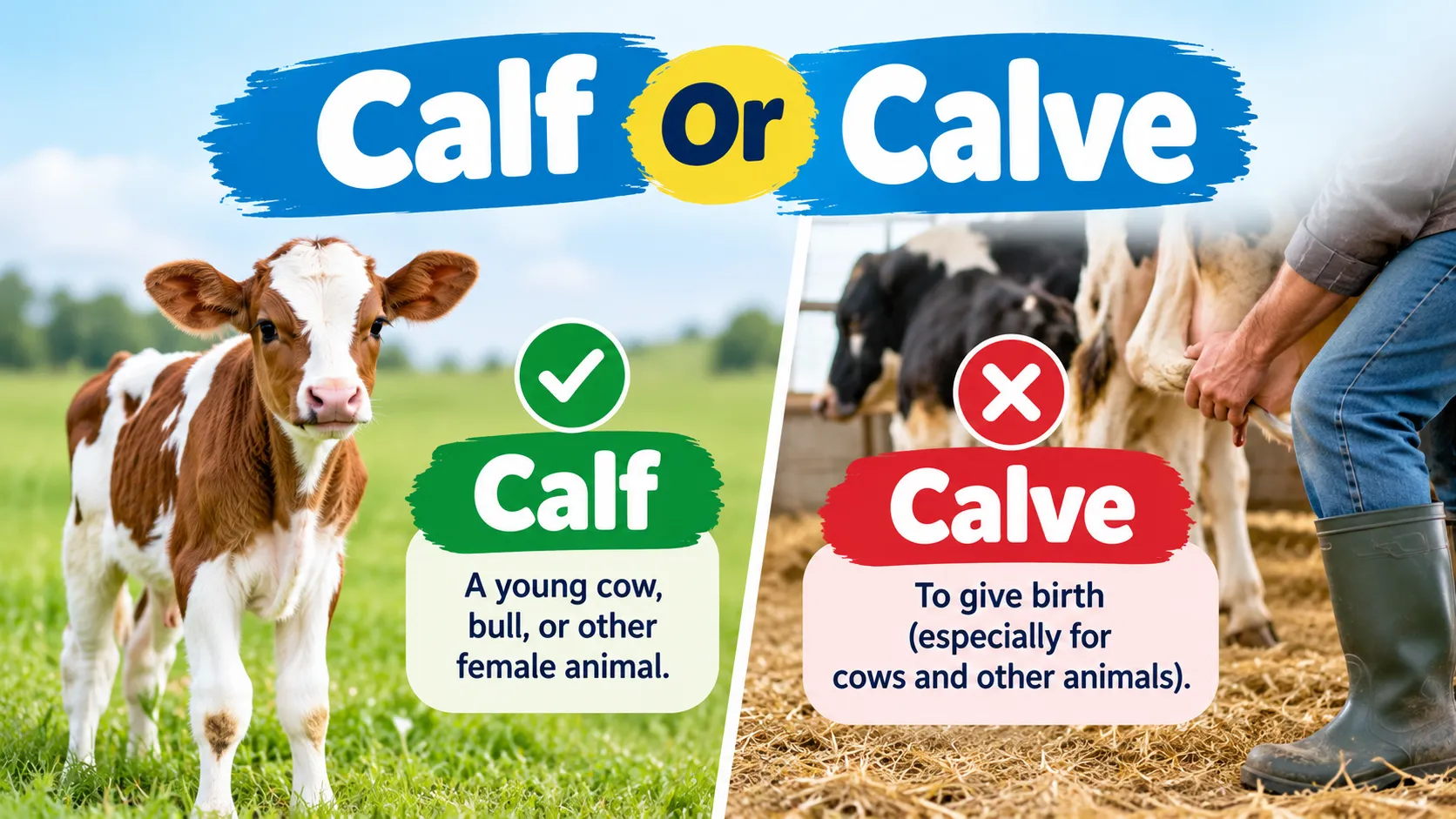
Calf is a noun that refers to a young animal, such as a young cow, or the muscular back part of the lower human leg. Calve is a verb that means to give birth to a calf. It can also describe a large piece of ice breaking away from a glacier.
For example, you might say, “The calf is standing beside its mother,” but “The cow will calve in the spring.”
In this guide, you will learn the difference between calf and calve, their grammatical forms, common usage mistakes, and practical examples to help you use both words correctly.
Calf or Calve: Quick Answer
The main difference between calf and calve is their meaning and part of speech.
- Calf: A noun referring to a young animal or the muscular back part of the lower leg.
- Calve: A verb meaning to give birth to a calf or, in glaciology, to release a piece of ice from a glacier or ice shelf.
Here are two simple examples:
- The calf followed its mother across the field.
- The farmer expects the cow to calve soon.
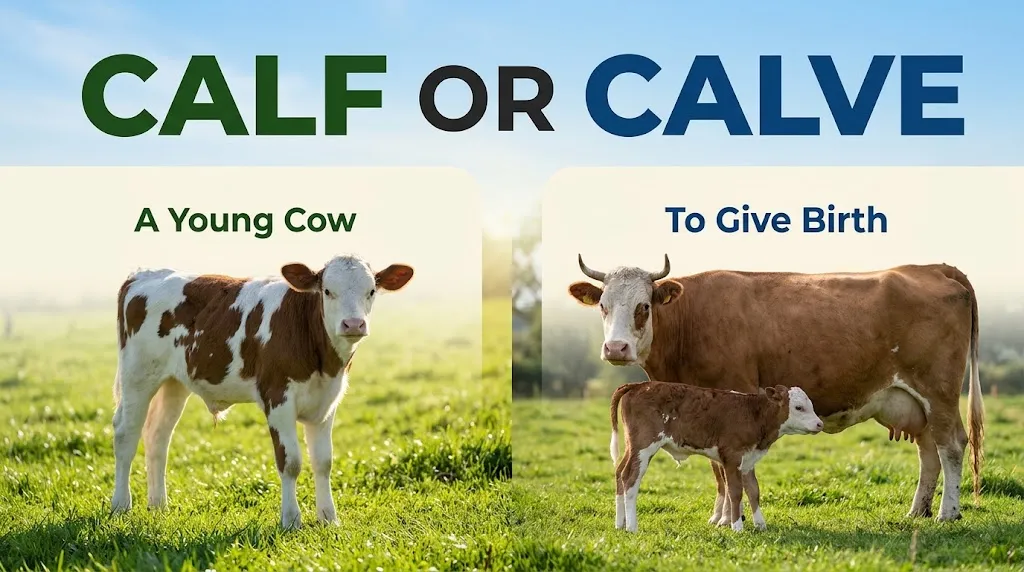
Easy rule to remember: Use calf when naming an animal or a part of the leg. Use calve when describing the action of giving birth or ice breaking away from a glacier.
What Is the Difference Between Calf and Calve?
Although the words differ by only one letter, they perform different jobs in a sentence.
Meaning and Part of Speech
The word calf is a noun. It identifies a living animal or a part of the human body.
The word calve is a verb. It describes an action, usually the birth of a young animal.
Compare these sentences:
- The calf is drinking milk. (Noun)
- The cow may calve next week. (Verb)
In the first sentence, calf names an animal. In the second, calve describes what the cow may do.
Calf vs. Calve Comparison Table
| Feature | Calf | Calve |
| Part of speech | Noun | Verb |
| Main meaning | A young animal or lower-leg muscle | To give birth to a calf |
| Plural or related form | Calves | Calves, calved, calving |
| Example | The calf is healthy. | The cow will calve soon. |
| Typical context | Animals and anatomy | Farming and glaciers |
Notice that calves can belong to either word. It is the plural of the noun calf, but it is also the third-person singular form of the verb calve.
When Should You Use Each Word?
Use calf when you are talking about an animal, such as a young cow, elephant, or whale, or the muscular back part of the lower leg.
Examples:
- The elephant calf stayed close to its mother.
- My calf muscles feel tired after walking.
Use calve when you are describing an animal giving birth or a glacier releasing a piece of ice.
Examples:
- The cow is expected to calve soon.
- The glacier may calve into the sea.
The surrounding words and the sentence’s meaning usually make the correct choice clear.
What Does Calf Mean?
A calf is a noun with two common meanings in everyday English: a young animal and the muscular back part of the lower leg.
Calf as a Young Animal
A calf is a young animal, particularly the young of cattle. The word is also used for the young of several other large mammals, including elephants, whales, and giraffes.
Examples:
- The newborn calf rested beside its mother.
- The farmer fed the calf fresh milk.
- A young elephant calf walked with the herd.
- The whale calf swam near the surface.
The plural form is calves, not calfs. This spelling follows the English plural rule that changes the f in certain nouns to ves.
For example:
- Singular: One calf is sleeping.
- Plural: Three calves are sleeping.
Calf as a Part of the Human Leg
In anatomy, the calf is the muscular area at the back of the lower leg, below the knee and above the ankle.
The calf muscles help you walk, run, jump, and stand on your toes.
Examples:
- My left calf feels sore after the hike.
- She stretched her calf muscles before running.
- The athlete developed strong calf muscles through regular training.
In this context, calf has nothing to do with a young animal. The intended meaning becomes clear from the sentence.
Calf in Everyday English Sentences
Here are more examples showing how calf works as a noun:
- The little calf followed the farmer.
- The veterinarian examined the newborn calf.
- Two calves were resting in the barn.
- He felt a slight pull in his right calf.
- The runner stretched both calf muscles after exercise.
In each sentence, calf or calves identifies an animal or a part of the body.
What Does Calve Mean?
Calve is a verb that describes giving birth to a calf. It is commonly used in farming, animal care, and discussions about cattle.
The word also has a specialized meaning in glaciology, where it describes ice breaking away from a glacier or ice shelf.
Calve as a Verb for Giving Birth
When a cow or another animal gives birth to a calf, it can be described As Calving.
Examples:
- The cow will calve in early spring.
- The farmer prepared a clean area for the cow to calve.
- The veterinarian monitored the cow as she began to calve.
- Several cows may calve during the same season.
The verb focuses on the action of giving birth, rather than the young animal itself.
Compare these examples:
- The calf was born yesterday.
- The cow calved yesterday.
Both sentences describe the same general event from different grammatical perspectives. The first emphasizes the young animal, while the second emphasizes the mother’s action.
Calve in Farming and Animal Care
Farmers use the term calving when discussing the birth of calves, particularly in cattle herds.
The word may appear in conversations about breeding schedules, animal health, and the care of pregnant cows.
Examples:
- The farm has a calving season in the spring.
- The farmer recorded the date each cow calved.
- Proper preparation can help farmers monitor cows during calving.
The word is especially useful in agricultural writing because it expresses the process of giving birth to a calf in one concise term.
Calve in Glaciology: When Ice Breaks Away
In glaciology, calve has a different but established meaning. It describes a piece of ice breaking away from the edge of a glacier or an ice shelf.
This process can produce icebergs when large pieces of ice enter the ocean.
Examples:
- The glacier may calve a large iceberg into the sea.
- Scientists observed the ice shelf calving near its edge.
- A large section of ice calved from the glacier.
In this context, calve does not refer to animal birth. It describes the separation of ice from a larger mass.

Calf, Calves, Calve, Calved, and Calving Explained
Understanding the different word forms makes it easier to choose the correct spelling in a sentence.
Calf vs. Calves
Calf is the singular noun, while calves is its plural form.
Examples:
- One calf is standing in the field.
- Several calves are standing in the field.
The spelling changes from f to ves. This is why calves is correct and calfs is generally incorrect for the standard plural of this noun.
The same plural form applies when calf refers to the lower-leg muscle:
- My left calf hurts.
- Both calves feel tired.
Calve vs. Calves
Calves is also the present-tense form of the verb calve used with a third-person singular subject, such as the cow, she, or it.
Compare the following:
- The calves are healthy. (Plural noun)
- The cow calves in the spring. (Verb)
In the first sentence, calves refers to young animals. In the second, it describes what the cow does.
The subject and sentence structure help you determine the intended meaning.
Calved and Calving: Verb Forms
The verb calve has several useful forms:
| Verb form | Usage | Example |
| Calve | Base form | The cow may calve soon. |
| Calves | Present tense with he, she, or it | The cow calves in spring. |
| Calved | Simple past and past participle | The cow calved last night. |
| Calving | -ing form | The cow is calving. |
Examples in context:
- The farmer hopes the cow will calve safely.
- This cow usually calves in March.
- The cow calved during the night.
- The veterinarian is monitoring a cow that is calving.
Remember that calved is the regular past-tense form of calve. You do not need to write calveded or calveed.
Calf or Calve in Example Sentences
These examples show how the words are used in different contexts.
1. Examples Related to Animals
- The Calf Drank Milk from its mother.
- The farmer checked whether the calves had enough food.
- The cow is expected to calve next month.
- The cow calved during the early hours of the morning.
- The farm prepared a separate area for calving.
2. Examples Related to Leg Muscles
- My calf muscles feel tired after the long walk.
- He stretched his right calf before exercising.
- Both calves were sore after the race.
- The physiotherapist examined the muscle in her calf.
3. Examples in Everyday and Formal Writing
- The wildlife team observed a young elephant calf.
- The farmer expects several cows to calve this season.
- The glacier could calve a large piece of ice into the ocean.
- Researchers documented the glacier calving event.
- The calf remained close to its mother throughout the day.
These examples illustrate that calf names something, while calve describes an action.
Common Mistakes When Using Calf and Calve
Because the two words look similar, writers sometimes confuse them. The following mistakes are easy to avoid once you understand their grammatical roles.
Using Calve Instead of Calf
Incorrect: The calve followed its mother.
Correct: The calf followed its mother.
Explanation: The sentence refers to a young animal, so it needs the noun calf, not the verb calve.
Using Calf Instead of Calve
Incorrect: The cow will calf next month.
Correct: The cow will calve next month.
Explanation: After the modal verb will, use the base form of the main verb. Here, calve describes the action of giving birth.
Confusing Calves the Noun with Calves the Verb
Consider these sentences:
- The calves are playing in the field.
- The cow calves in the spring.
The first sentence uses calves as a plural noun. The second uses calves as a verb.
To identify the correct meaning, look at the subject and the surrounding words.
Writing Calfs Instead of Calves
Incorrect: Three calfs were resting in the barn.
Correct: Three calves were resting in the barn.
Explanation: The standard plural of the noun calf is calves. Remember the spelling change from f to ves.
Using the Wrong Verb Form
Incorrect: The cow calving yesterday.
Correct: The cow calved yesterday.
Explanation: The sentence describes a completed event in the past, so calved is the appropriate simple past form.
However, calving is correct in a sentence such as, “The cow is calving now.”
Is There a Difference Between British and American English?
There is no meaningful spelling difference between British and American English for these words. Both varieties use calf, calves, calve, calved, and calving with the same basic meanings.
Examples in either variety include:
- The calf is healthy.
- The cow will calve soon.
- The farmer recorded the calving dates.
Pronunciation can vary slightly by regional accent, but these differences do not change the standard spelling or grammatical rules.
Therefore, you do not need to choose between calf and calve based on whether you are writing for a British or American audience. Choose the word that matches the meaning and grammatical structure of your sentence.
Related To Another Article: https://grammixo.com/below-or-bellow/
Calf or Calve: Test Your Understanding
Test your knowledge by choosing the correct word or form for each sentence.
Fill in the Blanks
1. The young _____ stayed close to its mother.
a) calf
b) calve
2. The farmer expects the cow to _____ next week.
a) calf
b) calve
3. Two _____ were resting near the barn.
a) calfs
b) calves
4. The cow _____ during the night.
a) calved
b) calving
5. The glacier may _____ a large piece of ice.
a) calf
b) calve
6. The farmer is monitoring a cow that is _____.
a) calve
b) calving
Answers and Explanations
- Calf — The sentence names a young animal.
- Calve — The verb follows to and describes giving birth.
- Calves — This is the standard plural of calf.
- Calved — The sentence describes an event completed in the past.
- Calve — In glaciology, the verb describes ice breaking away.
- Calving — The present continuous construction uses is followed by the -ing form.
If you answered all six correctly, you understand the main difference between calf and calve and how to use their related forms.
People Also Ask
A: Both words are correct, but they have different meanings. Calf is a noun for a young animal or the muscular back part of the lower leg. Calve is a verb meaning to give birth to a calf or, in glaciology, to release a piece of ice.
A: Calf is normally a noun. It identifies a young animal or the muscular back part of the lower leg.
Example: The calf is resting beside its mother.
A: The plural of calf is calves.
Example: The calves are grazing in the field.
A: Yes. Calves is the third-person singular present-tense form of the verb calve.
Example: The cow calves in the spring.
It can also be a plural noun referring to young animals or the muscles in the lower legs.
A: The simple past tense of calve is calved.
Example: The cow calved last night.
Conclusion
The difference between Calf And Calve becomes simple once you understand their grammatical roles. Use calf when referring to a young animal or the muscular back part of the lower leg. Use calve when describing an animal giving birth or ice breaking away from a glacier.
Remember these examples: “The calf is healthy” and “The cow will calve soon.” Learning the distinction, along with the related forms calves, calved, and calving, will help you write more clearly and avoid common spelling and grammar mistakes.

1 thought on “Calf or Calve: Meaning, Differences, and Examples”