
Introduction
Choosing Or Chosing: which spelling is correct? The correct spelling is choosing, with two o’s. Chosing is a common spelling mistake and is not accepted in standard English.
The word choosing comes from the verb choose, which means to select someone or something from two or more options. When adding -ing to choose, you remove the final silent e but keep both o’s. This gives you choosing, not chosing.
For example, you might say, “I am choosing a book to read tonight.” In this sentence, choosing describes an action that is happening now.
In this guide, you will learn why choosing is correct, how to use it in different sentences, how it differs from other forms of choose, and how to avoid common spelling mistakes.
Choosing or Chosing: Quick Answer
You know that Choosing is the correct spelling, while chosing is incorrect in standard English.
Choosing is the -ing form of the verb choose. It can describe an action in progress or function as a gerund, which is a verb form used as a noun.
Here is a quick comparison:
| Word | Correct or Incorrect | Explanation |
| Choosing | Correct | The standard -ing form of choose |
| Chosing | Incorrect | Leaves out one of the original o’s |
| Choose | Correct | The base form of the verb |
| Chose | Correct | The simple past tense of choose |
| Chosen | Correct | The past participle of choose |
Example: She is choosing a dress for the party.
Remember: always write choosing with two o’s.
What Is the Difference Between Choosing and Chosing?
The difference is spelling. Choosing follows the standard English spelling rule for adding -ing to a verb that ends in a silent e. Chosing incorrectly removes the final e and also omits one o.
Choosing is used in everyday conversations, academic writing, professional communication, and many other contexts. Chosing should be corrected whenever it appears in standard English writing.
Consider these examples:
- Correct: We are choosing a topic for our presentation.
- Incorrect: We are chosing a topic for our presentation.
- Correct: Choosing the right words can improve your writing.
- Incorrect: Chosing the right words can improve your writing.
The mistake often happens because people remember to remove the final e but accidentally remove or overlook another letter. The easiest way to avoid it is to remember the original spelling of choose.
What Does Choosing Mean?
Choosing means selecting, deciding on, or picking someone or something from available options. It is the present participle and gerund form of the verb choose.
The word can be used when making small everyday decisions or important choices about education, work, relationships, and future plans.
For example:
- I am choosing a meal from the menu.
- He is choosing a university for his studies.
- Choosing a suitable career takes time.
- They are choosing the best location for their new office.
In each example, choosing relates to making a selection or decision.
Choosing as a Verb Form
Choosing functions as a verb form when it describes an action, particularly in continuous verb tenses.
For example:
- She is choosing a gift for her friend.
- We were choosing our seats when the lights went out.
- They will be choosing the team captain tomorrow.
In the first sentence, is choosing describes an action happening now. And in the second, were choosing describes an action that was in progress in the past. In the third, will be choosing describes an action that will be in progress in the future.
Choosing as a Gerund
A gerund is an -ing form of a verb that functions as a noun. Choosing can be a gerund when it names the activity of making a decision.
For example:
- Choosing wisely is important.
- I enjoy choosing books for my collection.
- Choosing between two good options can be difficult.
In the first example, choosing is the subject of the sentence. And in the second, it follows the verb enjoy. In the third, the entire activity of making a selection is being discussed.
Simple Examples of Choosing in Everyday English
Here are some additional examples showing how choosing is used naturally:
- I am choosing a new notebook for school.
- She spent an hour choosing the right gift.
- We are choosing a restaurant for dinner.
- Choosing healthy habits can support your well-being.
- They were choosing colors for their bedroom.
- He is choosing between two job offers.
- Choosing a password carefully can improve account security.
- My sister enjoys choosing flowers for the garden.
These examples demonstrate that choosing works in different situations and sentence structures.
Why Is Choosing the Correct Spelling?
Choosing is correct because it follows the standard spelling rule for adding -ing to the verb choose.
The base verb is spelled c-h-o-o-s-e. When you form choosing, you remove the final silent e and add -ing. The two o’s remain unchanged.
The spelling process is:
Choose − final e + ing = Choosing
The result is choosing, not chosing.
This rule is straightforward once you recognize that the final e is removed, while the other letters remain in place.
The Spelling Rule for Adding -ing to Choose
Many English verbs ending in a silent e drop that final e before adding -ing.
Examples include:
| Base Verb | Add -ing | Correct Form |
| Choose | Choose − e + ing | Choosing |
| Make | Make − e + ing | Making |
| Write | Write − e + ing | Writing |
| Dance | Dance − e + ing | Dancing |
| Hope | Hope − e + ing | Hoping |
| Take | Take − e + ing | Taking |
The same basic spelling pattern explains why choose becomes choosing.
However, English has exceptions and additional spelling rules. For instance, verbs such as see form seeing, retaining both e’s. It is always best to check the spelling of an unfamiliar verb rather than assume every verb follows exactly the same pattern.
Why the Double O Stays in Choosing
The word choose already contains two o’s before its final e. Removing the final e does not change those o’s.
The transformation is:
- Original Word: choose
- Remove the final e: choos
- Add -ing: choosing
The important point is that the spelling changes only where the rule requires it. The double o remains part of the word.
Compare these words:
- Choose → Choosing
- Loose → Loosening
- Prove → Proving
The exact spelling pattern differs depending on the word, so learning the base form helps prevent mistakes.
Choose vs. Choosing: Understanding the Difference
They are both correct, but they are used differently.
Choose is the base form of the verb. It is used with subjects and structures that require the base form, including commands and many future constructions.
Choosing is the -ing form. It commonly appears in continuous tenses or functions as a gerund.
Examples:
- Please choose a seat.
- I choose the blue one.
- I am choosing a seat.
- Choosing a seat near the window is my preference.
The correct form depends on the sentence’s grammar and intended meaning.
Why Is Chosing Incorrect?
Chosing is incorrect because it does not follow the standard spelling of choose when adding -ing. The correct form retains both o’s and removes only the final e.
Although a reader may understand what someone means by chosing, that does not make it an accepted spelling in standard English.
For school assignments, professional emails, website articles, and other formal writing, use choosing.
The Common Mistake Behind Chosing
Writers sometimes remember that a silent e is removed before adding -ing but accidentally leave out another letter.
For example:
- Incorrect: I am chosing my favorite song.
- Correct: I am choosing my favorite song.
Another example:
- Incorrect: Chosing a suitable course can be challenging.
- Correct: Choosing a suitable course can be challenging.
A useful proofreading technique is to compare the word with its base form, choose. Once you see the double o in choose, it becomes easier to retain both letters in choosing.
Why Choosing Is Not a British or American Spelling Variation
Choosing is the standard spelling in both British and American English. Unlike words such as colour and color, the spelling does not change between these two varieties of English.
Examples:
- British English: She is choosing a new schoolbag.
- American English: She is choosing a new schoolbag.
Both sentences use the same spelling.
Therefore, you should not use chosing as an alternative spelling in either variety of English.
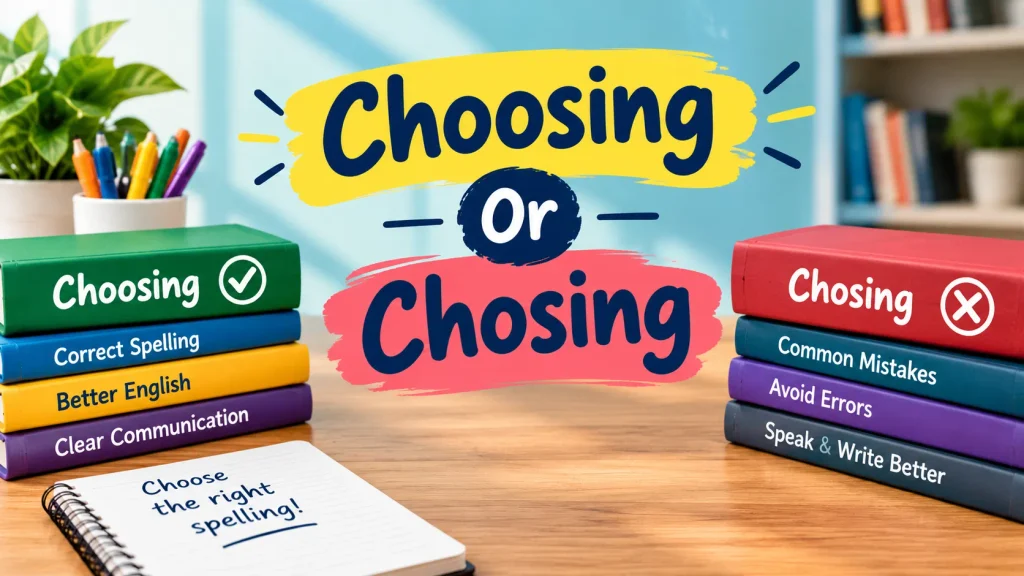
Choosing, Chosing, Choose, Chose, or Chosen?
These words can be confusing because they look similar, but they have different grammatical roles.
Choosing is the -ing form, choose is the base form, chose is the simple past tense, and chosen is the past participle. Chosing is the incorrect spelling.
Choose vs. Choosing
Choose and choosing are both correct forms of the same verb.
Use choose when the sentence requires the base form. Use choosing when describing an ongoing action or referring to the activity of making a selection.
Examples:
- I need to choose a subject.
- I am choosing a subject.
- She wants to choose her own clothes.
- She enjoys choosing her own clothes.
Choose vs. Chose
Choose is the base form, while chose is the simple past tense.
Use chose when the selection happened in the past.
Examples:
- I choose the same route every morning.
- Yesterday, I chose a different route.
- They choose their meals in advance.
- They chose their meals before arriving.
Remember that chose does not contain a double o followed by an e. Its spelling is different because it is an irregular past-tense form.
Chose vs. Chosen
Chose is the simple past tense, whereas chosen is the past participle.
Chosen is usually used with an auxiliary verb, such as have, has, or had, and in some passive constructions.
Examples:
- She chose a new laptop yesterday.
- She has chosen a new laptop.
- We chose the winning design.
- We had chosen the winning design before the meeting.
A simple way to remember the distinction is that chose often stands alone as the past-tense verb, while chosen commonly appears with a helping verb.
Complete Verb Forms of Choose
Use this table to understand the main forms of choose.
| Verb Form | Word | Example |
| Base form | Choose | I choose carefully. |
| Third-person singular | Chooses | He chooses carefully. |
| Present participle / gerund | Choosing | She is choosing carefully. |
| Simple past | Chose | They chose carefully. |
| Past participle | Chosen | We have chosen carefully. |
The verb choose is irregular because its past tense and past participle do not follow the usual pattern of adding -ed.
Learning these forms together makes it easier to choose the correct word when writing.
How to Use Choosing in a Sentence
Choosing can be used in several Grammatical structures. The correct structure depends on whether you are describing an ongoing action, discussing the activity of making a decision, or explaining a selection process.
Choosing in Everyday Conversations
In everyday English, choosing often describes decisions about food, clothes, entertainment, travel, or other personal preferences.
Examples:
- I am choosing a movie for tonight.
- Are you choosing the blue shirt or the black one?
- We spent the afternoon choosing gifts.
- She is choosing what to cook for dinner.
These sentences show how the word fits naturally into ordinary conversation.
Choosing in Academic and Professional Writing
Choosing is also useful when discussing research, education, business decisions, and professional responsibilities.
Examples:
- Choosing an appropriate research method is essential.
- The committee is choosing a candidate for the position.
- Choosing reliable sources improves the quality of an academic paper.
- The company is choosing a supplier for its new project.
In formal writing, use choosing when it accurately expresses the intended action or activity. Avoid replacing it with a different verb merely to sound more sophisticated.
Choosing When Comparing Two or More Options
The word frequently appears when a person must select from multiple possibilities.
Examples:
- She is choosing between two universities.
- We are choosing a suitable venue for the event.
- He had difficulty choosing between the available options.
- Choosing the right course requires careful consideration.
The word between is often used when discussing two alternatives, although it can also be used for more than two clearly identified options.
Choosing at the Beginning of a Sentence
Choosing can begin a sentence when it functions as a gerund or part of a gerund phrase.
Examples:
- Choosing the right words makes communication clearer.
- Choosing a reliable laptop requires research.
- Choosing wisely can help you avoid unnecessary expenses.
- Choosing a suitable study schedule can improve organization.
In these examples, choosing introduces the activity being discussed. The whole gerund phrase acts as the subject of the sentence.
Choosing Pronunciation and Syllables
Knowing how to pronounce choosing can help you recognize and remember the word.
The word has two syllables: choos-ing.
Its pronunciation is commonly represented as /ˈtʃuː.zɪŋ/ in IPA. The first syllable sounds like “choose,” while the second sounds like “ing.”
How to Pronounce Choosing
Follow these simple steps:
- Begin with the sound “choo.”
- Continue with the sound “zing,” using the ending heard in words such as reading and writing.
- Join the two parts smoothly: CHOO-zing.
The main stress falls on the first syllable.
Practising the word aloud while looking at its spelling can help reinforce the correct form. Remember that pronunciation is useful for learning, but it does not always reveal every letter in English spelling.
Choosing Phonetic Spelling and Sound
Here is a quick pronunciation reference:
| Feature | Explanation |
| Word | Choosing |
| Syllables | 2 |
| Syllable division | choos-ing |
| IPA | /ˈtʃuː.zɪŋ/ |
| Main stress | First syllable |
| Ending | -ing |
The double o represents the long /uː/ vowel sound heard in choose. The spelling remains the same when the word becomes choosing.
Choosing or Chosing: Correct and Incorrect Examples
Examples make the spelling rule easier to apply. In standard English, choosing is correct and chosing is incorrect.
10 Correct Sentences Using Choosing
- I am choosing a birthday gift for my brother.
- She is choosing a book for her next assignment.
- We are choosing a destination for our summer trip.
- Choosing the right words can prevent misunderstandings.
- He enjoys choosing music for family gatherings.
- They were choosing a team name when the teacher arrived.
- Choosing a suitable university takes careful planning.
- My parents are choosing new furniture for the living room.
- She had difficulty choosing between the two designs.
- Choosing a healthy routine can support long-term well-being.
Each sentence uses choosing correctly as an ongoing action or a gerund.
Common Incorrect Sentences and Their Corrections
The following examples demonstrate common mistakes and their correct versions.
| Incorrect Sentence | Correct Sentence |
| I am chosing a new phone. | I am choosing a new phone. |
| She is chosing a dress. | She is choosing a dress. |
| We were chosing a team leader. | We were choosing a team leader. |
| Chosing the right words is important. | Choosing the right words is important. |
| He enjoys chosing books. | He enjoys choosing books. |
| They are chosing a restaurant. | They are choosing a restaurant. |
The correction is the same in every case: replace chosing with choosing. The surrounding sentence structure does not change.
Common Mistakes to Avoid When Writing Choosing
Even when you understand the meaning, it is possible to confuse choosing with other forms of choose. A few simple checks can help you avoid these errors.
Writing Chosing Instead of Choosing
This is the most direct spelling mistake.
Incorrect: We are chosing a new class representative.
Correct: We are choosing a new class representative.
Remember that the final e is removed, but the two o’s remain.
Confusing Choosing with Chose
Choosing generally describes an ongoing action or the activity of making a selection. Chose describes a completed action in the past.
Incorrect: Yesterday, I choosing the red notebook.
Correct: Yesterday, I chose the red notebook.
However, choosing can also appear in a past continuous sentence:
Correct: Yesterday, I was choosing a notebook when my friend called.
The appropriate form depends on the sentence’s tense and structure.
Confusing Choosing with Chosen
Chosen is the past participle, while choosing is the -ing form.
Incorrect: She has choosing a new topic.
Correct: She has chosen a new topic.
Another correct example is: She is choosing a new topic.
The verb following a helping verb must fit the grammatical structure of the sentence.
Adding -ing Without Applying the Correct Spelling Rule
Do not remove letters that belong to the base word simply because you are adding -ing.
For choose, the correct transformation is choose → choosing. The final e disappears, but the double o remains.
Checking the base verb before adding an ending is a useful habit for spelling other words correctly, too.
Related To Another Article: https://grammixo.com/crain-or-crane/
Easy Ways to Remember the Correct Spelling
A simple memory trick can make choosing easier to spell correctly.
The Choose + ing Memory Trick
Start with the word choose. Remove only the final e and add -ing.
CHOOSE − E + ING = CHOOSING
Think of the two o’s as a pair that stays together. You remove one letter, the final e, and keep the rest of the base spelling.
Practise with these examples:
- Choose → Choosing
- Write → Writing
- Make → Making
- Take → Taking
This technique helps you focus on the spelling change rather than trying to memorize choosing as an unrelated word.
A Quick Proofreading Tip
Whenever you write choosing, compare it with choose.
Ask yourself:
- Does the word contain two o’s?
- Have I removed the final e?
- Have I added -ing correctly?
- Does the word fit the sentence’s grammar?
For example, if you write “I am chosing a course,” compare chosing with choose. You will notice that the correct form must retain both o’s: “I am choosing a course.”
Choosing or Chosing: Practice Quiz
Test your understanding with the following questions. Choose the correct answer for each one before checking the answer key.
Fill-in-the-Blank Questions
1. I am ______ a book for my English class.
- A. Chosing
- B. Choosing
- C. Chose
2. ______ the right career can take time.
- A. Choosing
- B. Chosen
- C. Chosing
3. Yesterday, she ______ a blue dress.
- A. Choosing
- B. Chose
- C. Chosen
4. They have ______ a new team leader.
- A. Choosing
- B. Chose
- C. Chosen
5. Which spelling is correct in standard English?
- A. Chosing
- B. Choosing
- C. Chooseng
Correct the Spelling Mistakes
Rewrite each sentence using the correct spelling or verb form.
6. He is chosing a gift for his mother.
7. Chosing carefully is important.
8. She has choosing a new subject.
Practice Quiz Answers and Explanations
- B. Choosing — The sentence describes an action happening now.
- A. Choosing — The -ing form functions as the subject of the sentence.
- B. Chose — Chose is the simple past tense of choose.
- C. Chosen — The present perfect uses has or have plus the past participle.
- B. Choosing — Choosing is the correct spelling; chosing and chooseng are incorrect.
- He is choosing a gift for his mother.
- Choosing carefully is important.
- She has chosen a new subject.
If you answered all eight correctly, you understand the central spelling rule and the difference between choosing, chose, and chosen.
People also Ask
Choosing is correct. It is the standard -ing form of choose. Chosing is a misspelling because it omits one of the two o’s.
No. Chosing is not an accepted standard spelling of the -ing form of choose. Use choosing in academic, professional, and everyday writing.
The base verb choose contains two o’s. When the final silent e is removed and -ing is added, both o’s remain. This produces choosing.
Choosing is the present participle of choose and is used in present continuous constructions, such as “I am choosing a book.” It can also function as a gerund. The simple present forms are choose and chooses, depending on the subject.
The simple past tense is chose.
Example: “She chose the green notebook yesterday.”
Conclusion: Always Use Choosing, Not Chosing
The correct spelling is choosing, not chosing. Choosing is formed by removing the final silent e from choose and adding -ing while retaining both o’s.
Understanding the difference between choosing, choose, chose, and chosen will also help you use the verb correctly in different sentences. Remember the simple rule, check your spelling when proofreading, and practise with original examples to build confidence.
Whenever you need the -ing form of choose, write choosing. It is the correct spelling in both British and American English.

1 thought on “Choosing or Chosing: Which Spelling Is Correct?”