Introduction
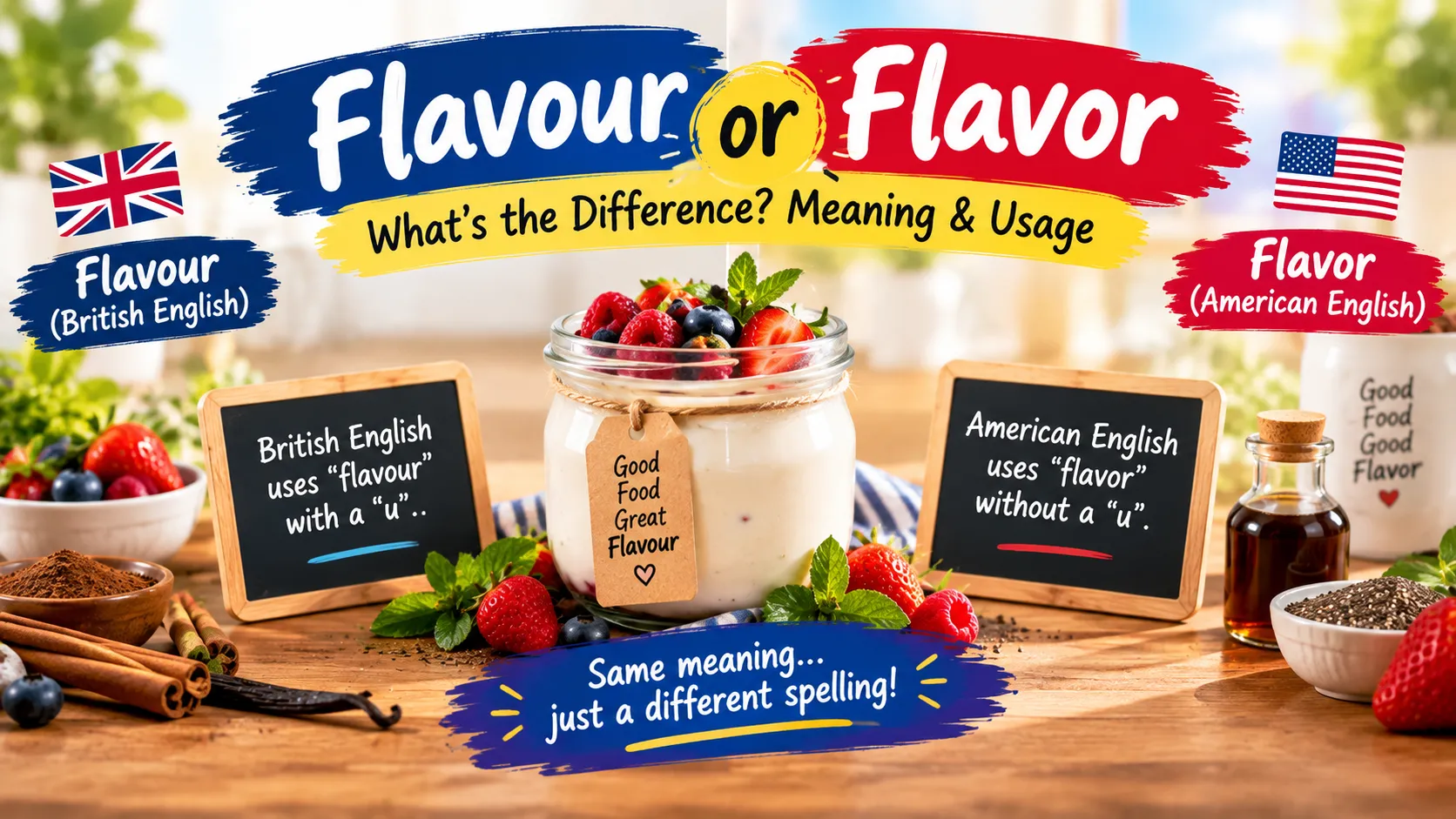
If you have seen both flavour and flavor, you may wonder whether they have different meanings or whether one is simply a spelling mistake. The good news is that both are correct.
The difference is mainly based on the variety of English being used. Flavour is the standard spelling in British English, while Flavor is the standard spelling in American English. Both words have the same meaning and are pronounced essentially the same way.
Flavour or Flavor: Quick Answer
- Flavour is the British English spelling.
- Flavor is the American English spelling.
- Both words have the same basic meaning.
- Both can be used as a noun or a verb.
- The pronunciation is essentially the same.
- Neither spelling is a mistake when it is used according to the appropriate English variety.
For example:
- British English: This ice cream has a delicious chocolate flavour.
- American English: This ice cream has a delicious chocolate flavor.
The main difference is the spelling: British English keeps -our, while American English uses -or.
What Does Flavour Mean?
Flavour is the British English spelling of the word. As a noun, it commonly refers to the taste or characteristic quality of food and drink.
It can also describe the distinctive character, atmosphere, or quality of something.
Flavour as a Noun
When flavour is used as a noun, it can refer to:
- The particular taste of food or drink.
- A distinctive quality or character.
- A particular type or variety of something.
For example:
- The soup has a rich flavour.
- I love the flavour of fresh strawberries.
- The restaurant offers several different flavours of ice cream.
- The festival has a unique cultural flavour.
In these examples, flavour does not always refer strictly to taste. It can also describe the distinctive character of an experience, place, or idea.
Examples of Flavour in a Sentence
Here are some natural examples using the British spelling:
- This sauce has a strong garlic flavour.
- The herbs give the dish a wonderful flavour.
- I prefer the chocolate flavour to the vanilla one.
- The tea has a delicate flavour.
- The book captures the flavour of life in a small village.
Flavour as a Verb
Flavour can also be used as a verb. It means to give food or drink a particular taste.
For example:
- Fresh herbs flavour the soup.
- The chef flavoured the sauce with garlic.
- You can flavour the rice with spices.
- Lemon is used to flavour the drink.
The British spelling remains flavour when the word is used as a verb.
What Does Flavor Mean?
Flavor is the American English spelling of the same word.
It has the same meanings as flavour. It can refer to the taste of something, its distinctive quality, or the act of giving something a particular taste.
Flavor as a Noun
As a noun, flavor commonly refers to the taste or characteristic quality of something.
Examples include:
- This soup has a delicious flavor.
- I like the flavor of fresh coffee.
- The store sells many ice cream flavors.
- The spices add extra flavor to the dish.
The meaning does not change simply because the spelling changes from flavour to flavor.
Examples of Flavor in a Sentence
Here are examples using the American spelling:
- This sauce has a strong garlic flavor.
- The herbs give the dish a wonderful flavor.
- I prefer the chocolate flavor.
- The tea has a delicate flavor.
- The restaurant offers several different flavors of ice cream.
Flavor as a Verb
Flavor can also work as a verb. It means to give something a particular taste.
For example:
- Fresh herbs flavor the soup.
- The chef flavored the sauce with garlic.
- You can flavor the rice with spices.
- Lemon is used to flavor the drink.
The American spelling uses -or throughout these forms.
Flavour vs Flavor: What Is the Difference?
The simplest difference between Flavour And Flavor is regional spelling.
| Feature | Flavour | Flavor |
| English variety | British English | American English |
| Meaning | Same | Same |
| Pronunciation | Essentially the same | Essentially the same |
| Main spelling | -our | -or |
| Example | chocolate flavour | chocolate flavor |
So, if you are writing for a British English audience, flavour is generally the appropriate choice. If you are following American English, use flavor.
Are Flavour and Flavor Pronounced Differently?
No. Flavour and flavor are essentially pronounced the same way.
The difference is in spelling rather than pronunciation.
A simple pronunciation guide is approximately:
flavour / flavor: “FLAY-vuh” in many British pronunciations and “FLAY-ver” in common American pronunciation.
The exact pronunciation can vary slightly by accent, but changing the spelling does not create a different word or meaning.
Flavour and Flavor Word Forms
The spelling difference continues in several related forms of the word.
Singular and Plural Forms
British English:
- flavour → flavours
American English:
- flavor → flavors
Examples:
- The shop sells several ice cream flavours.
- The shop sells several ice cream flavors.
Past Tense and Past Participle
British English:
- flavour → flavoured
American English:
- flavor → flavored
Examples:
- The chef flavoured the sauce with herbs.
- The chef flavored the sauce with herbs.
Present Participle
British English:
- flavouring
American English:
- flavoring
Examples:
- Natural flavouring is used in the product.
- Natural flavoring is used in the product.
Adjective Forms
Another related form is:
- British English: flavourful
- American English: flavorful
Both mean having a strong, pleasant, or distinctive taste.
For example:
- The curry is very flavourful.
- The curry is very flavorful.
The important point is to keep the spelling system consistent.
Flavour vs Flavor in British and American English
Which Spelling Is British English?
Flavour is the standard British English spelling.
You are likely to see it in UK Publications, British educational materials, and writing that follows British spelling conventions.
Examples:
- natural flavour
- chocolate flavour
- rich flavour
- flavoured water
Which Spelling Is American English?
Flavor is the standard American English spelling.
It is commonly used in American publications, educational materials, websites, product descriptions, and other writing that follows US spelling conventions.
Examples:
- natural flavor
- chocolate flavor
- rich flavor
- flavored water
Why Does British English Have “-our” and American English Have “-or”?
The difference between flavour and flavor is part of a wider pattern in British and American spelling.
You can see similar differences in words such as:
| British English | American English |
| colour | color |
| honour | honor |
| favour | favor |
| behaviour | behavior |
| flavour | flavor |
This pattern is useful for recognizing differences between the two spelling systems.
However, it should not be treated as a universal rule that can be applied automatically to every English word. English spelling has many individual conventions and exceptions.
When Should You Use Flavour or Flavor?
The best spelling depends on the variety of English you are using and your intended audience.
Use Flavour When Writing in British English
Choose flavour when your writing follows British English conventions.
This can include:
- UK-focused websites
- British English schoolwork
- British publications
- Educational materials using British spelling
- Content written primarily for a British audience
For example:
The restaurant is famous for the rich flavour of its traditional dishes.
Use Flavor When Writing in American English
Choose flavor when your writing follows American English conventions.
This can include:
- US-focused websites
- American publications
- American English schoolwork
- Content written primarily for an American audience
- Materials that follow US spelling conventions
For example:
The restaurant is famous for the rich flavor of its traditional dishes.
Can You Use Flavour and Flavor in the Same Article?
Technically, readers will understand both forms, but it is usually better to choose one spelling system and use it consistently.
If your article follows British English, use:
- flavour
- flavours
- flavoured
- flavouring
- flavourful
If your article follows American English, use:
- flavor
- flavors
- flavored
- flavoring
- flavorful
There can be legitimate exceptions. For example, you may need to preserve the original spelling in a direct quotation, official title, brand name, or product name.
The goal is not to avoid the other spelling completely. The goal is to maintain consistency in your own writing.
Common Mistakes with Flavour and Flavor
Mistake 1: Thinking One Spelling Is Wrong
A common mistake is assuming that flavour is incorrect because American English uses flavor, or assuming that flavor is incorrect because British English uses flavour.
Neither assumption is correct.
Both are standard spellings. The appropriate choice depends on the English variety.
Mistake 2: Mixing British and American Spellings
Using flavour in one paragraph and flavor in another may make your writing look inconsistent.
For professional or academic writing, choose the spelling system that matches your audience and follow it throughout the article.
Mistake 3: Using the Wrong Word Form
The spelling difference applies to related forms too.
British English:
- flavours
- flavoured
- flavouring
- flavourful
American English:
- flavors
- flavored
- flavoring
- flavorful
Pay attention to these forms when editing your writing.
Mistake 4: Assuming the Meaning Is Different
Flavour and flavor do not normally have different meanings.
The difference is primarily regional spelling.
Mistake 5: Treating “-our” and “-or” as a Universal Rule
Although words such as colour/color, favour/favor, and flavour/flavor show a familiar pattern, you should not change every -our word to -or or vice versa without checking the standard spelling.
English spelling contains many word-specific conventions.
- Related To Another Article: https://grammixo.com/labour-or-labor/
Flavour or Flavor: Example Sentences
Seeing both forms in context makes the difference easier to understand.
1. Examples with Flavour
- The soup has a rich flavour.
- Fresh herbs improve the flavour of the dish.
- I enjoy the natural flavour of ripe fruit.
- This tea has a mild flavour.
- The restaurant is known for its unique flavour combinations.
2. Examples with Flavor
- The soup has a rich flavor.
- Fresh herbs improve the flavor of the dish.
- I enjoy the natural flavor of ripe fruit.
- This tea has a mild flavor.
- The restaurant is known for its unique flavor combinations.
3. Examples Showing the Figurative Meaning
The word can also describe a distinctive quality or character rather than literal taste.
For example:
- The event had a distinctly traditional flavour.
- The story gives readers a flavour of village life.
- The event had a distinctly traditional flavor.
- The story gives readers a flavor of village life.
In these examples, the word refers to a particular quality, character, or impression.
Flavour or Flavor in Common Expressions
Both spellings appear in many common combinations. The spelling simply changes according to the English variety.
Examples include:
- a rich flavour/flavor
- natural flavour/flavor
- chocolate flavour/flavor
- add flavour/flavor
- full of flavour/flavor
- a flavour/flavor of something
For example:
British English:
The herbs add extra flavour to the meal.
American English:
The herbs add extra flavor to the meal.
Flavour vs Flavor: Quick Comparison
| Spelling | English Variety | Part of Speech | Meaning | Example |
| flavour | British English | Noun/Verb | Taste, quality, or give taste | The soup has a rich flavour. |
| flavor | American English | Noun/Verb | Taste, quality, or give taste | The soup has a rich flavor. |
The core meaning remains the same. The spelling is what changes.
How to Remember Flavour vs Flavor
A simple memory trick can help:
British English → Flavour → “U” stays
American English → Flavor → “U” disappears
You can connect this with other familiar spelling pairs:
- colour → color
- favour → favor
- honour → honor
- flavour → flavor
This makes it easier to remember that flavour belongs to the British spelling pattern, while flavor is the American form.
People Also Ask
Flavour is the standard British English spelling.
Flavor is the standard American English spelling.
Yes. They are different spellings of the same word and generally have the same meaning.
No. Flavour is the standard British English spelling.
No. Flavor is the standard American English spelling.
Conclusion
Flavour and flavor are both Correct Spellings of the same word.
The main difference is regional:
- Flavour = British English
- Flavor = American English
Both can function as nouns and verbs, and their related forms follow the same spelling distinction: flavours/flavors, flavoured/flavored, flavouring/flavoring, and flavourful/flavorful.
So, the important thing is not to decide that one spelling is right and the other is wrong. Instead, choose the form that matches your intended variety of English and keep your spelling consistent throughout your writing.
