
Introduction
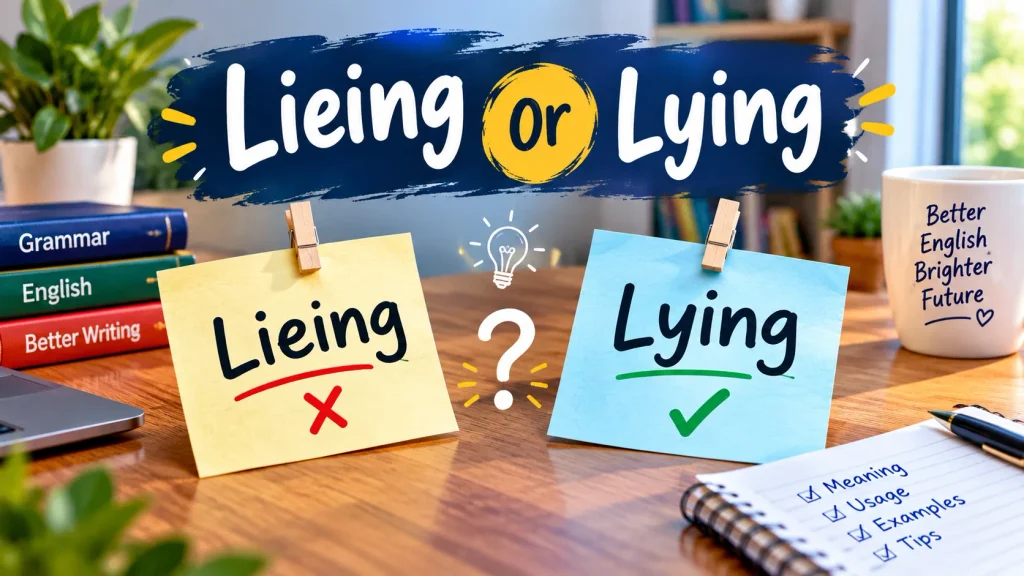
Have you ever wondered whether the correct spelling is Lieing Or Lying? These two spellings may look similar, but only one is correct in standard modern English. Whether you are writing about resting in bed or telling someone something untrue, knowing the correct spelling helps you communicate clearly.
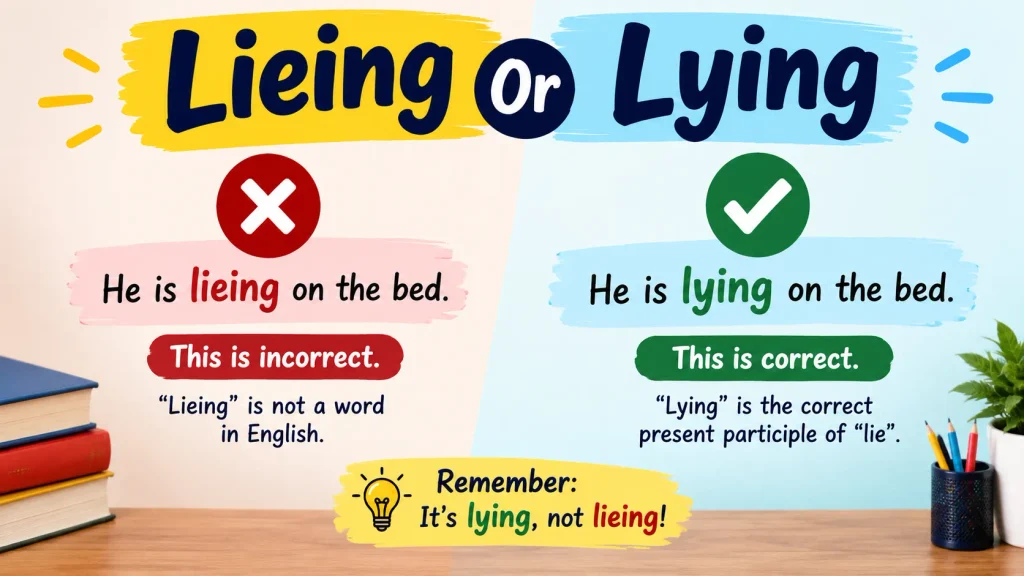
The correct spelling is lying. The word lieing is a common spelling mistake because people often add -ing to a verb without changing its spelling first. However, the verb lie follows a specific spelling rule: when a verb ends in -ie, the ie changes to y before adding -ing.
In this guide, you will learn why lying is correct, what it means, how to use it in sentences, and how it differs from laying. You will also find practical examples and a short quiz to help you remember the rule.
Lieing or Lying: Quick Answer
Lying is the correct spelling, while lieing is incorrect in standard modern English.
Use lying when referring to resting in a horizontal position or deliberately saying something that is not true.
Examples:
- She is lying on the sofa and reading a book.
- He was lying about where he had been.
- The cat is lying under the table.
The spelling rule is simple: change the ie at the end of lie to y before adding -ing.
Correct: lie → lying
Incorrect: lie → lieing
Remember this rule whenever you use the word lying in your writing.
Why Is Lying the Correct Spelling?
The spelling lying follows a standard English spelling pattern. When certain verbs end in -ie, the final two letters change to y before the suffix -ing is added.
The original verb is lie. If you added -ing without changing anything, you might expect to get lieing. English spelling rules, however, require a change in the final letters.
The correct process is:
- Start with the verb lie.
- Remove the final ie.
- Replace it with y.
- Add -ing to form lying.
This gives you the correct spelling: lying.
The IE-to-Y Spelling Rule
The general rule is that verbs ending in -ie change that ending to y before taking -ing.
Here are three common examples:
| Base verb | Correct -ing form |
| Lie | Lying |
| Die | Dying |
| Tie | Tying |
For example:
- The child is lying on the bed.
- The flowers are dying without enough water.
- She is tying her shoelaces.
Notice that the final ie changes to y in each word. This spelling pattern helps prevent awkward letter combinations and produces the accepted forms.
Examples of Words That Change IE to Y
Learning similar words makes the rule easier to remember.
Lie → Lying
- The dog is lying beside its owner.
Die → Dying
- The plant is dying because it has not received enough water.
Tie → Tying
- He is tying a ribbon around the gift.
These verbs follow the same pattern when -ing is added. If you remember dying and tying, you can use the same rule to spell lying correctly.
What Does Lying Mean?
The word lying has two common meanings. It can describe someone or something resting in a horizontal position, or it can describe the act of saying something untrue.
The intended meaning depends on the context of the sentence.
Lying as in Resting or Being in a Flat Position
In this sense, lying is the -ing form of the verb lie, meaning to recline or rest in a horizontal position.
It describes a person, animal, or object that is positioned horizontally or remains in a particular place.
Examples:
- My brother is lying on the couch.
- The baby was lying peacefully in the crib.
- Several books are lying on the desk.
- We spent the afternoon lying on the beach.
In these sentences, lying does not mean telling a falsehood. It describes position or location.
Lying as in Telling an Untruth
Lying can also mean deliberately making a false statement or trying to mislead someone.
This meaning is associated with honesty, trust, and communication.
Examples:
- He is lying about his test results.
- She admitted to lying to her parents.
- I think the witness is lying about what happened.
- They were lying when they said the shop was closed.
In these examples, lying refers to dishonesty rather than physical position.
The spelling is the same for both meanings. You must use the surrounding words to understand which meaning is intended.
Lieing vs. Lying: Key Differences
The difference between lieing and lying is spelling. Only lying is the standard spelling.
| Feature | Lieing | Lying |
| Standard spelling | Incorrect | Correct |
| Accepted modern form | No | Yes |
| Refers to resting | Incorrect form | Correct form |
| Refers to telling an untruth | Incorrect form | Correct form |
| Follows the standard spelling rule | No | Yes |
Examples:
Incorrect: The children are lieing on the grass.
Correct: The children are lying on the grass.
Incorrect: He is lieing about his age.
Correct: He is lying about his age.
The best way to avoid this mistake is to remember that lie becomes lying, not lieing, when you add -ing.
Lying vs. Laying: What Is the Difference?
Although lying and laying look and sound similar, they are not Interchangeable in every sentence. The main difference is that lie generally means to recline, while lay means to put something down.
Understanding the difference will help you choose the correct verb.
When to Use Lying
Use lying when a person, animal, or object is reclining or resting in a horizontal position. It can also mean telling an untruth.
Examples:
- She is lying on the floor.
- The cat is lying near the window.
- He is lying about the reason for his absence.
In the first two sentences, lying describes position. In the third, it describes dishonesty.
When to Use Laying
Use laying when someone is putting, placing, or setting something down. In this use, the verb lay normally takes a direct object.
Examples:
- She is laying the baby in the crib.
- He is laying the books on the shelf.
- They are laying new tiles in the kitchen.
- The hen is laying an egg.
Each example involves placing something or producing an egg. The verb lay takes an object, such as the baby, the books, or an egg.
How to Tell Lie and Lay Apart
A useful way to distinguish the two verbs is to ask whether someone is resting or putting something somewhere.
Use lie when the subject rests or reclines:
- I lie on the sofa after work.
- Yesterday, I lay on the sofa.
- I have lain on this bed before.
Use lay when the subject places something:
- I lay the blanket on the bed.
- Yesterday, I laid the blanket on the bed.
- I have laid the blanket there before.
The past tense can be confusing because lay is also the past tense of lie when lie means to recline.
For clarity, remember these two patterns:
- Lie → lay → lain: to recline.
- Lay → laid → laid: to put something down.
There is also a separate pattern for lie meaning to tell an untruth:
- Lie → lied → lied: to make a false statement.
Lie, Lay, Lain, Lied, and Laying: Verb Forms Explained
The verb lie has different forms depending on its meaning and grammatical tense. Learning these forms helps you avoid common mistakes.
| Verb | Past tense | Past participle | -ing form |
| Lie (recline) | Lay | Lain | Lying |
| Lie (tell an untruth) | Lied | Lied | Lying |
| Lay (put something down) | Laid | Laid | Laying |
Examples of Lie Meaning Recline
Present tense: I lie down when I feel tired.
Past tense: I lay down for an hour yesterday.
Present perfect: I have lain here for a while.
Present continuous: I am lying on the sofa.
Examples of Lie Meaning Tell an Untruth
Present tense: He lies about his achievements.
Past tense: He lied about his achievements yesterday.
Present perfect: He has lied about this before.
Present continuous: He is lying about what happened.
Examples of Lay Meaning Put Something Down
Present tense: She lays the keys on the table.
Past tense: She laid the keys on the table.
Present perfect: She has laid the keys on the table.
Present continuous: She is laying the keys on the table.
These forms may seem confusing at first, but the key is to identify the intended meaning before choosing the tense.
How to Use Lying in a Sentence
You can use lying in several types of sentences. It may describe a current action, an ongoing situation, or the act of making a false statement.
Examples of Lying Down
When lying refers to resting or position, it usually appears with a location or position phrase.
Examples:
- The tired student is lying on the bed.
- Our dog was lying near the fireplace.
- I enjoy lying on the grass and watching the clouds.
- The old jacket is lying on the chair.
- She found her phone lying under the desk.
- He has been lying down since lunch.
These examples show how lying can describe a temporary action or a position.
Examples of Lying About Something
When lying means telling an untruth, it often appears with about, to, or another phrase that explains the situation.
Examples:
- He is lying about his whereabouts.
- She was lying to her friends.
- The student admitted to lying about the missing homework.
- I knew he was lying when his story changed.
- They accused the man of lying about the agreement.
- Telling the truth is better than lying to someone you trust.
In these sentences, lying refers to dishonesty rather than resting.
Lying in Different Tenses
The form lying can appear in different grammatical constructions.
Present continuous
Use am, is, or are with lying for an action happening now.
- I am lying on the bed.
- She is lying about the incident.
- They are lying in the garden.
Past continuous
Use was or were with lying for an action that was ongoing in the past.
- He was lying on the sofa when I arrived.
- They were lying about their reasons for leaving.
Present perfect continuous
Use has been or have been with lying for an action or situation that began earlier and continues into the present or has recently been ongoing.
- She has been lying down for an hour.
- He has been lying to his family for months.
The surrounding words tell you whether lying describes a physical position or dishonesty.
How to Pronounce Lying
The word lying is Pronounced with two syllables. Its pronunciation is the same whether it refers to resting or telling an untruth.
In everyday speech, it sounds like the word flying without the initial f.
For example:
- She is lying on the bed.
- He is lying about the results.
The two meanings share the same spelling and pronunciation. Context makes the intended meaning clear.
When practising pronunciation, say the word naturally and avoid adding an extra syllable because of the incorrect spelling lieing.
Common Mistakes to Avoid When Using Lying
Several mistakes commonly occur when people write lying. Knowing them will make your grammar more accurate.
1. Writing “lieing” instead of “lying”
Incorrect: The dog is lieing near the door.
Correct: The dog is lying near the door.
Remember to change ie to y before adding -ing.
2. Confusing lying with laying
Incorrect: I am laying on the bed.
Correct: I am lying on the bed.
When you are describing your own position, use lying. Use laying when you are putting something down, as in “I am laying the book on the desk.”
3. Using the wrong past tense of lie
Incorrect: Yesterday, I lied on the sofa. (When describing resting.)
Correct: Yesterday, I lay on the sofa.
However, lied is correct when the intended meaning is telling an untruth.
Example: Yesterday, he lied about his homework.
4. Confusing lain and laid
Incorrect: I have laid on this bed before. (When describing resting.)
Correct: I have lain on this bed before.
Use lain as the past participle of lie meaning to recline. Use laid as the past tense and past participle of lay meaning to put something down.
5. Assuming the two meanings of lying have different spellings
The spelling remains lying whether you are describing a person resting or someone making a false statement.
Correct: The child is lying on the sofa.
Correct: The child is lying about the broken vase.
Both sentences use the same word correctly.
Is Lying Spelled the Same in British and American English?
Yes. Lying is the correct spelling in both British English and American English.
Unlike some words that have different regional spellings, such as colour and color, lying does not change according to the English variety you use.
Examples in British English:
- The dog is lying on the garden path.
- He is lying about the results.
Examples in American English:
- The dog is lying on the lawn.
- He is lying about the results.
The spelling rule is the same in both varieties. You should not use lieing as an alternative British or American spelling.
- Related To Another Article: https://grammixo.com/hight-or-height/
Practice: Lieing or Lying?
Test your understanding by completing the sentences below. Choose the correct spelling or verb form for each sentence.
Fill in the Blanks
1. The baby is _____ in the crib.
a) lieing
b) lying
2. He was _____ about his test results.
a) lieing
b) lying
3. Yesterday, I _____ on the sofa for an hour.
a) lay
b) laid
4. She is _____ the books on the shelf.
a) laying
b) lying
5. I have _____ on this beach before.
a) laid
b) lain
6. The hen is _____ an egg.
a) laying
b) lying
7. He _____ to his teacher yesterday.
a) lay
b) lied
8. The cat was _____ under the table.
a) lieing
b) lying
Answers and Explanations
1. b) lying
Lying describes the baby’s position. The spelling lieing is incorrect.
2. b) lying
Here, lying means making a false statement.
3. a) lay
Lay is the past tense of lie when the meaning is to rest or recline.
4. a) laying
Laying is correct because the books are being placed on the shelf.
5. b) lain
Lain is the past participle of lie when it means to recline.
6. a) laying
The hen is producing an egg, so laying is the correct verb.
7. b) lied
Lied is the past tense of lie when it means to tell an untruth.
8. b) lying
The cat’s position is being described, so lying is correct.
If you answered all eight questions correctly, you understand the main spelling rule and the difference between lying and laying.
People Also Ask
No. Lieing is not the standard spelling of the modern English word. The correct form is lying, whether the word refers to resting in a horizontal position or telling an untruth.
English spelling rules require the final ie in certain verbs to change to y before adding -ing. Therefore, lie becomes lying. The same pattern appears in die → dying and tie → tying.
The correct expression is lying down.
Example: I am lying down because I feel tired.
The spelling lieing down is incorrect because lie changes to lying before the suffix is added.
The past tense depends on the meaning.
When lie means to rest or recline, its past tense is lay.
Example: I lay on the sofa yesterday.
When lie means to tell an untruth, its past tense is lied.
Example: He lied about what happened.
Lying is the -ing form of lie, which can mean to recline or tell an untruth. Laying is the -ing form of lay, which usually means to put something down.
Examples:
I am lying on the bed.
I am laying the blanket on the bed.
The first sentence describes a position; the second describes placing something.
Final Verdict: Lieing or Lying?
The correct spelling is lying, not lieing. The same spelling is used in both British and American English, whether you mean resting in a Horizontal position or telling an untruth.
Remember the simple rule: when a verb ends in -ie, change ie to y before adding -ing. This is why lie becomes lying, just as die becomes dying and tie becomes tying.
Also, keep the difference between lying and laying in mind. Use lying to describe resting or dishonesty, and use laying when someone is putting something down.
With these rules and examples, you can confidently choose the correct spelling whenever you write about lying.
