Introduction
If you are confused about sense or since, you are not alone. These two words look and sound similar, but they have Completely different meanings and grammatical uses.
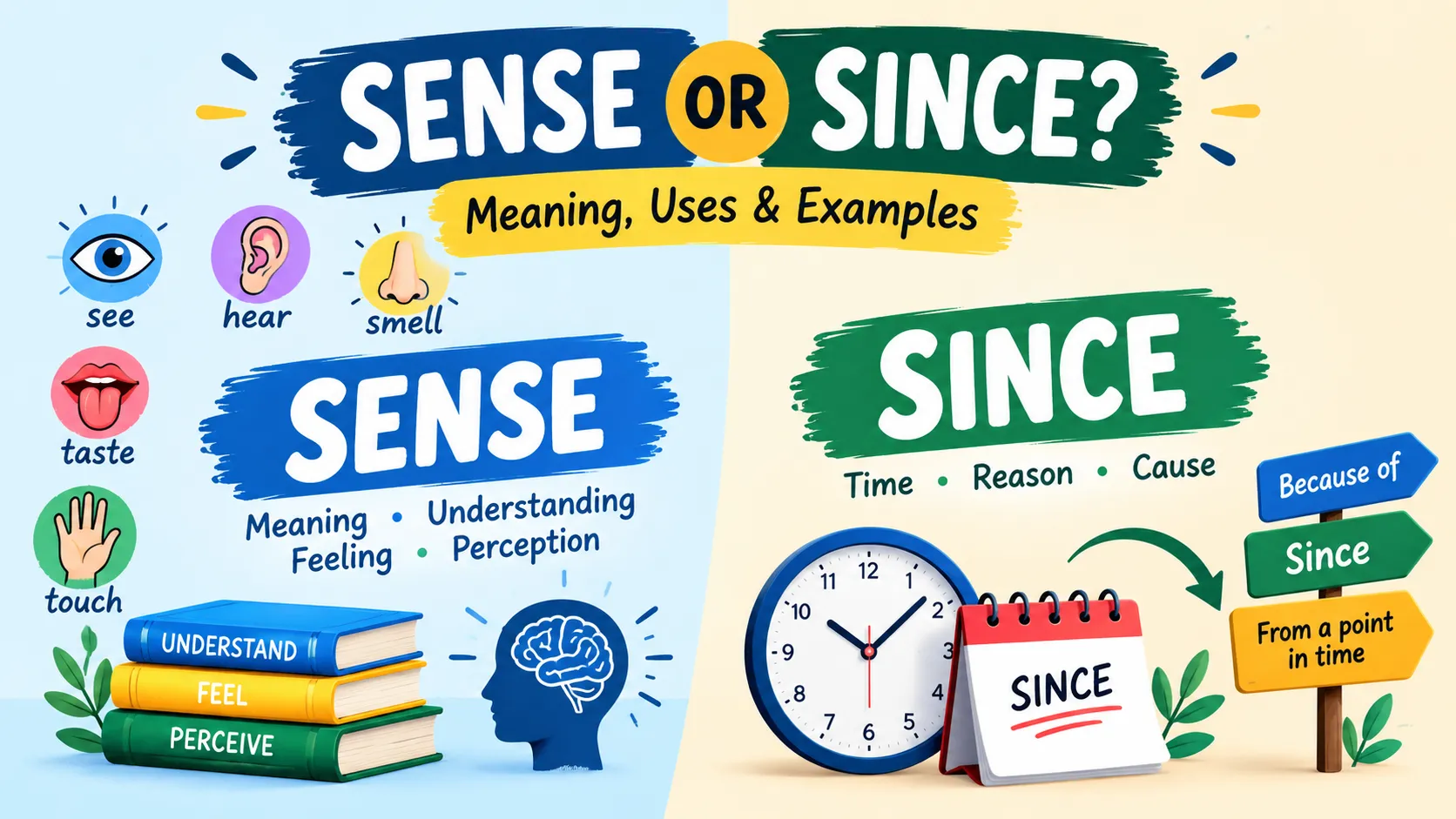
Sense usually relates to meaning, understanding, perception, or judgment. Since commonly refers to a starting point in time or gives a reason for something.
For example:
- Your explanation makes sense.
- I have lived here since 2020.
- Since it was raining, we stayed home.
The easiest way to remember the difference is:
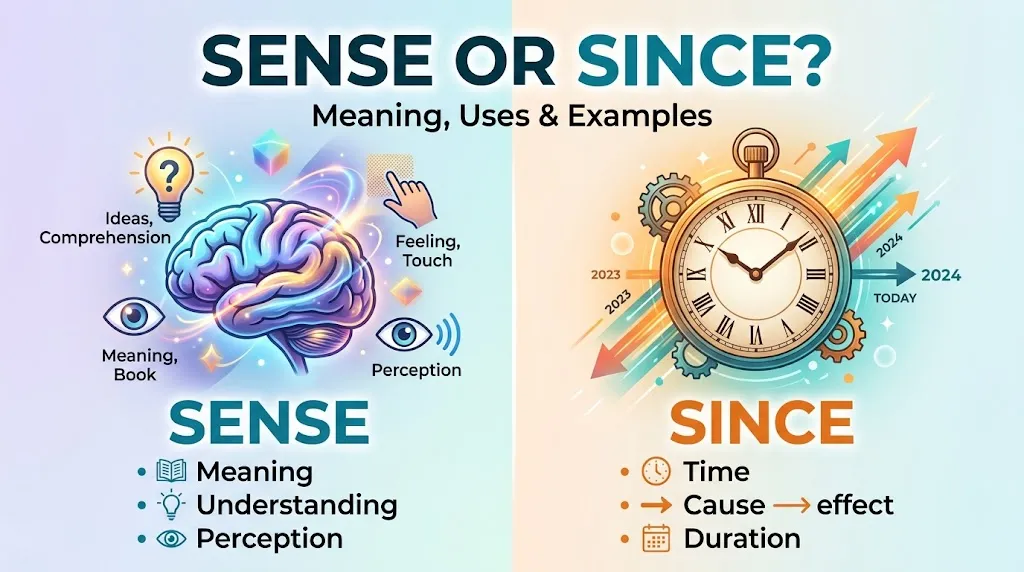
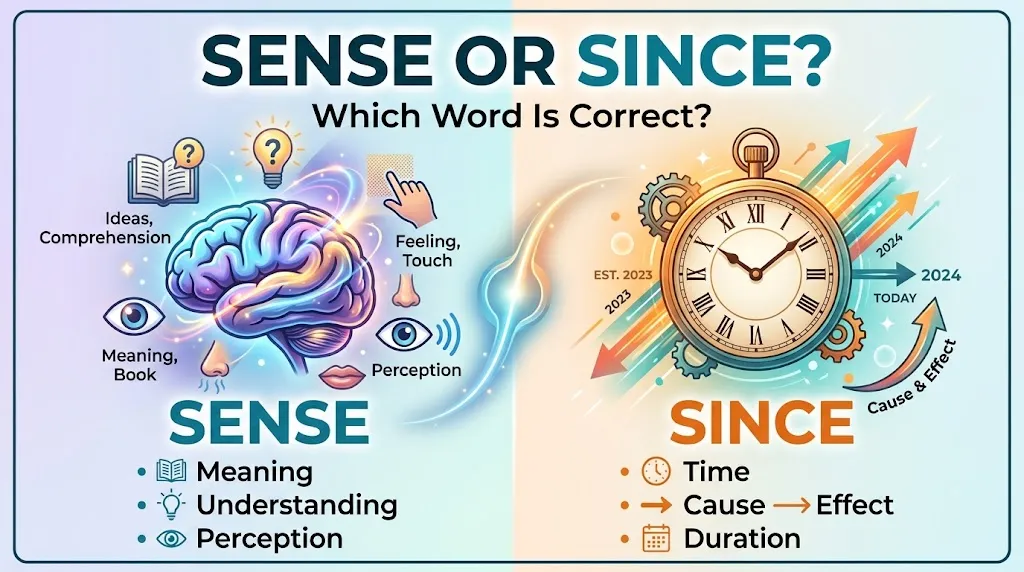
Sense = meaning, understanding, or perception
Since = time or reason
Let’s look at each word in detail.
Sense or Since: Quick Answer
Sense is generally used as a noun or verb. It can refer to meaning, understanding, good judgment, physical perception, or awareness.
Since can work as a preposition, conjunction, or adverb. It is mainly used to describe a point in time or a reason.
| Word | Main Meaning | Common Grammar Role | Example |
| Sense | Meaning, understanding, perception | Noun, verb | That makes sense. |
| Since | From a past time or because | Preposition, conjunction, adverb | I have known her since 2020. |
So, if you mean understanding or meaning, choose sense. If you mean from a particular time or because, choose since.
What Does “Sense” Mean?
Sense has several related meanings. It can describe the meaning of something, a person’s ability to understand something, physical perception, or good judgment.
Sense as a Noun
As a noun, sense can refer to meaning or understanding.
For example:
- That sentence does not make sense.
- I don’t understand the sense of this argument.
- Your explanation makes perfect sense.
Here, sense refers to something being logical, understandable, or meaningful.
Sense can also describe one of the physical abilities through which we experience the world.
The five commonly recognized senses are:
- sight
- hearing
- smell
- taste
- touch
For example:
Dogs have a strong sense of smell.
The word can also refer to good judgment or practical understanding.
For example:
She has good common sense.
Common Expressions With “Sense”
Sense appears in many common expressions, including:
- common sense
- sense of humor
- sense of direction
- sense of responsibility
- sense of purpose
- sense of danger
- sense of achievement
Examples:
He has an excellent sense of humor.
I have no sense of direction.
She has a strong sense of responsibility.
In each example, sense relates to an ability, feeling, understanding, or quality.
Sense as a Verb
Sense can also be used as a verb. As a verb, it means to notice, perceive, or become aware of something.
For example:
I could sense that something was wrong.
She sensed his concern immediately.
He sensed danger nearby.
Here, sense means to become aware of something, sometimes without directly seeing or hearing it.
What Does “Since” Mean?
Since is different from sense. It is commonly used for time or reason.
Since for Time
We use since to identify the point when something began in the past.
It can be followed by:
- a year
- a date
- a day
- a time
- an event
- a clause
Examples:
I have lived here since 2020.
She has worked there since Monday.
We have known each other since childhood.
He has been happier since he changed jobs.
The important idea is that since identifies a starting point.
For example:
Since 2020 = starting in 2020
Since Monday = starting on Monday
Since childhood = starting during childhood
Since for Reason or Cause
Since can also mean because or as when it introduces a reason.
For example:
Since it was raining, we stayed inside.
This means:
Because it was raining, we stayed inside.
Another example:
Since you are already here, let’s begin.
Here, since introduces the reason for beginning.
However, since does not always mean “because.” You need to understand the context to determine whether it refers to time or reason.
Since as an Adverb
Since can also be used as an adverb when it means from a particular time until now or from that time onward.
For example:
I met him years ago and haven’t seen him since.
She left the company in June and hasn’t returned since.
In these sentences, since refers back to an earlier time already mentioned.
Sense vs. Since: The Main Difference
The main difference is simple:
Sense relates to meaning, understanding, perception, or judgment.
Since relates to a starting point in time or a reason.
Compare these sentences:
That explanation makes sense.
Here, sense means the explanation is understandable.
I have lived here since 2020.
Here, since identifies when the action began.
Another example:
I could sense that she was worried.
Here, sense means perceive or notice.
Since she was worried, we decided to stay with her.
Here, since introduces a reason.
The words may look similar, but their meanings are not interchangeable.
Sense vs. Since Examples
The following examples show the difference clearly:
| Sense | Since |
| That makes sense. | I have lived here since 2020. |
| She has common sense. | I haven’t seen him since Monday. |
| I could sense danger. | Since it was late, we went home. |
| His explanation makes sense. | She has worked here since June. |
| He has a good sense of humor. | We have known each other since childhood. |
| I sensed that something was wrong. | I haven’t heard from her since yesterday. |
A useful approach is to ask what you mean before choosing the word.
If the sentence is about meaning, understanding, or perception, use sense.
If it is about time or reason, use since.
“Makes Sense” or “Makes Since”?
The correct phrase is “makes sense.”
“Makes since” is incorrect when you mean that something is understandable or logical.
Correct:
Your Explanation makes sense.
Incorrect:
Your explanation makes since.
Why?
The expression make sense means to be understandable, logical, or reasonable.
Examples:
That doesn’t make sense.
Does this make sense?
Your idea makes perfect sense.
Now everything makes sense.
Whenever you are talking about whether something is logical or understandable, use sense.
“Does That Make Sense” or “Does That Make Since”?
The correct expression is:
Does that make sense?
It is a common question used to ask whether someone understands an explanation or idea.
For example:
The first step is to save the document. Does that make sense?
I’ve explained the process as clearly as I can. Does that make sense?
The incorrect version is:
Does that make since? ❌
Remember that sense refers to meaning or understanding in this expression.
Since vs. For: What’s the Difference?
Since and for are often confused because both can be used when talking about time.
The difference is straightforward:
Since = starting point
For = duration
Compare:
I have lived here since 2020.
2020 is the point when the situation started.
I have lived here for six years.
Six years describes the duration.
Use “Since” for a Starting Point
Use since with a specific point in time.
Examples:
- since Monday
- since January
- since 2020
- since breakfast
- since childhood
- since last summer
Example:
She has worked here since January.
Use “For” for a Duration
Use for with a period of time.
Examples:
- for two hours
- for three days
- for six years
- for several months
- for a long time
Example:
She has worked here for six years.
An easy test is:
When did it start? → Since
How long? → For
Sense vs. Since: Common Mistakes
Because the words look and sound similar, learners sometimes use one in place of the other.
Mistake 1: “It Makes Since”
Incorrect:
It makes since. ❌
Correct:
It makes sense. ✅
The phrase refers to understanding, so sense is required.
Mistake 2: “I Haven’t Seen Her Sense Monday”
Incorrect:
I haven’t seen her sense Monday. ❌
Correct:
I haven’t seen her since Monday. ✅
Here, Monday is a starting point in time, so since is correct.
Mistake 3: “Sense It Was Raining”
Incorrect:
Sense it was raining, we stayed home. ❌
Correct:
Since it was raining, we stayed home. ✅
Here, since means because.
Mistake 4: Confusing “Since” With “For”
Incorrect:
I have lived here since six years. ❌
Correct:
I have lived here for six years. ✅
“Six years” is a duration, so for is needed.
Can “Sense” and “Since” Be Used in the Same Sentence?
Yes. Both words can appear naturally in the same sentence because they perform different functions.
For example:
Since you explained it, the situation makes more sense.
Here:
- Since introduces a reason.
- sense refers to understanding or meaning.
Another example:
She has had a strong sense of responsibility since childhood.
Here:
- sense refers to a quality or awareness.
- since identifies the starting point in time.
This is a useful way to see why the two words cannot simply replace each other.
Sense vs. Since Pronunciation
Another reason people confuse sense and since is that their pronunciation can be quite similar in many varieties of English.
They are not necessarily pronounced Identically in every accent, so it is better not to rely only on sound.
Instead, pay attention to the meaning and grammatical role of the word.
If you hear a sentence such as:
It doesn’t make ___.
The intended word is sense, because the expression is make sense.
If you hear:
I have lived here ___ 2020.
The word is since, because 2020 represents a starting point.
Context is therefore more reliable than pronunciation alone.
Sense vs. Since in Everyday and Formal Writing
Both words are common in everyday English and formal writing, but their use depends on what you want to communicate.
Everyday Conversation
That makes sense.
I’ve known him since school.
Text Messages
Makes sense!
Haven’t seen you since Friday.
Academic Writing
The results make sense when viewed in the context of the previous study.
The population has increased significantly since 2010.
Professional Writing
Your proposed solution makes sense.
We have used this process since the beginning of the project.
The meanings remain the same; only the surrounding language changes according to the situation.
- Related To Another Article: https://grammixo.com/fair-or-fare/
How to Remember Sense vs. Since
A simple memory trick can help you choose the correct word quickly.
Sense = Meaning
Think:
Sense → Meaning
If something is understandable, logical, or related to perception, sense is likely the right choice.
Examples:
That makes sense.
I could sense something was wrong.
Since = Time or Reason
Think:
Since → Time or Reason
Use since when you identify a starting point:
I have worked here since 2021.
Or when it introduces a reason:
Since it was late, we went home.
You can also use two quick replacement tests:
Can you replace the word with “meaning” or “understanding”?
→ Consider sense.
Can you replace it with “because”?
→ Since may be correct when it is being used to introduce a reason.
The “because” test does not apply when since is being used for time.
Sense or Since: Quick Decision Guide
When you are unsure, follow these three questions:
Are you talking about meaning, understanding, judgment, or perception?
Use sense.
That doesn’t make sense.
Are you talking about when something started?
Use since.
I have known her since 2018.
Are you introducing a reason?
Use since when it means because.
Since you are ready, we can start.
This simple decision process will solve most sense vs. since questions.
Sense or Since Practice Exercise
Choose sense or since to complete each sentence.
- Your explanation makes ______.
- I have known him ______ childhood.
- ______ it was getting late, we went home.
- She has a strong ______ of responsibility.
- I haven’t spoken to her ______ Monday.
- He could ______ that something was wrong.
- Does this ______ to you?
- We have lived here ______ 2020.
- She has a good ______ of direction.
- ______ you are already here, let’s begin.
- I haven’t seen him ______ last summer.
- His argument doesn’t make ______.
- I ______ that she was uncomfortable.
- He has had this job ______ January.
- The instructions finally make ______.
Sense or Since Exercise Answers
- sense — The sentence refers to understanding.
- since — Childhood is the starting point.
- Since — It introduces a reason.
- sense — It refers to a quality or awareness.
- since — Monday is a starting point in time.
- sense — Here, sense is a verb meaning perceive or notice.
- make sense — The expression means to be understandable.
- since — 2020 is the starting point.
- sense — “Sense of direction” is a common expression.
- Since — It means because.
- since — Last summer identifies a point in time.
- sense — “Make sense” refers to being logical or understandable.
- sensed — Here, sense is being used as a verb in the past tense.
- since — January is the starting point.
- sense — The expression means the instructions are understandable.
People Also Ask
Sense refers to meaning, understanding, perception, or judgment. Since generally refers to a starting point in time or introduces a reason.
The correct phrase is “makes sense.” It means that something is logical or understandable.
No. Since can also introduce a reason and can mean because in that context.
For example:
Since it was raining, we stayed home.
Yes. Sense can be a verb meaning to perceive, notice, or become aware of something.
She sensed that something was wrong.
Yes.
Since you explained the problem, it makes more sense.
They have different meanings and grammatical functions in the sentence.
Final Takeaway: Sense vs. Since
The difference between sense and since becomes much easier once you focus on their meanings.
- Sense = meaning, Understanding, judgment, or perception.
- Since = a starting point in time or a reason.
- Use since with a starting point such as 2020, Monday, or childhood.
- Use for with a duration such as two years or three hours.
- Use sense in the expression make sense.
- “Makes sense” is correct; “makes since” is incorrect when you mean understanding.
- Since can mean because when it introduces a reason.
The simplest memory rule is:
Sense = meaning. Since = time or reason.
Once you connect each word with its function, choosing between sense or since becomes much easier.

1 thought on “Sense or Since: What’s the Difference? Meaning & Examples”