
Since vs Sense: Quick Answer
Since and sense are commonly confused because their spellings are similar and their pronunciation can be difficult to distinguish in fast speech. However, they have completely different meanings and grammatical functions.
The easiest rule is:
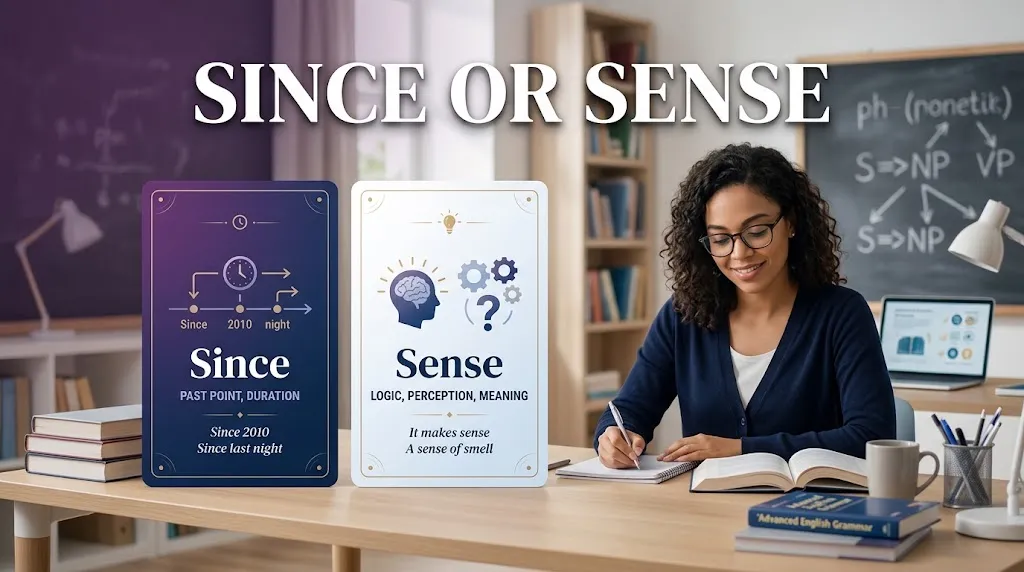
Since = time or reason
And other = meaning, understanding, perception, or judgment
For example:
- I have lived here since 2020.
- Since it was raining, we stayed home.
- Your explanation makes sense.
- I could sense that something was wrong.
The key is to look at the meaning of the sentence rather than choosing the word by sound.
Difference at a Glance
| Word | Main Meaning | Common Grammar Role | Example |
| Since | From a particular time; because | Preposition, conjunction, adverb | I have lived here since 2020. |
| Sense | Meaning, perception, awareness, judgment | Noun, verb | Your explanation makes sense. |
Use since when you are talking about a starting point in time or giving a reason.
Use sense when you are talking about meaning, understanding, perception, awareness, or judgment.
Cambridge describes since as a preposition, conjunction, and adverb, with time and reason uses. Sense can be a noun or verb and covers meanings including perception, awareness, judgment, and meaning.
A simple test
Ask:
When or why? → Since
Meaning, perception, or judgment? → Sense
What Does Since Mean?
Since has two major uses: time and reason.
Since for Time
When since refers to time, it identifies the point when something started.
Examples:
- I have lived here since 2020.
- She has worked there since Monday.
- We have known each other since childhood.
- He has studied English since January.
- They have been friends since school.
In each sentence, since introduces a starting point.
Cambridge explains that since can refer to a particular point in the past and can be followed by a date, time, noun phrase, or clause.
Since for Reason
Since can also mean because or as.
Examples:
- Since it was raining, we stayed home.
- Since you are already here, let’s begin.
- We left early since everyone was tired.
- Since the store was closed, we went somewhere else.
Here, since does not refer to time. It introduces a reason.
A useful test is to replace since with because.
Since it was late, we went home.
→
Because it was late, we went home.
The basic meaning remains the same, so since is expressing a reason. Cambridge also identifies this use of since as a conjunction introducing a reason.
What Does Sense Mean?
Sense has several meanings. It can refer to perception, understanding, awareness, judgment, feeling, or the meaning of something.
Examples:
- She has a good sense of humor.
- This explanation makes sense.
- I lost my sense of direction.
- He has a strong sense of responsibility.
- I could sense that something was wrong.
As a noun, sense can describe a physical ability, awareness, judgment, feeling, or meaning. As a verb, it can mean to feel, detect, or become aware of something.
Since vs. Sense: Grammar Difference
Understanding their parts of speech makes the distinction much easier.
Since
Since can function as:
- A preposition
- A conjunction
- An adverb
Preposition
I have lived here since 2020.
Here, since comes before a time expression.
Conjunction for Time
I have felt better since I started exercising.
Here, since connects two clauses and refers to time.
Conjunction for Reason
Since you are ready, we can begin.
Here, since means approximately because.
Adverb
He left two years ago and has not returned since.
The time reference is understood from the context.
Sense
Sense can function as:
- A noun
- A verb
Noun
That idea makes sense.
Here, sense refers to meaning or logic.
Verb
I could sense that she was worried.
Here, sense means to perceive or become aware of something.
How to Use Since for Time
One of the most important uses of since is to identify a starting point.
Common structures include:
| Structure | Example |
| since + year | since 2020 |
| since + month | since January |
| since + day | since Monday |
| since + event | since graduation |
| since + noun phrase | since childhood |
| since + clause | since we met |
Examples
- I have studied English since 2020.
- She has worked here since January.
- I have not seen him since Monday.
- We have been friends since college.
- He has played football since he was six.
Notice the difference between a starting point and a duration:
I have lived here since 2020.
I have lived here for six years.
Since tells you when the period began.
For tells you how long the period lasted or has lasted.
Since with the Present Perfect and Other Tenses
A very common pattern is:
Present perfect + since + starting point
Examples:
- I have lived here since 2018.
- She has worked there since June.
- They have known each other since school.
- We have been waiting since morning.
The present perfect is especially common when an action or state began in the past and has a connection with the present.
Since in “It Has Been … Since”
Another useful structure is:
It has been + period + since + past event
Examples:
- It has been five years since I visited my hometown.
- It has been a long time since we last talked.
- It has been three months since she moved away.
The tense after since depends on the construction and the intended meaning. Cambridge documents several standard tense patterns involving since.
Since vs For: What Is the Difference?
This is another common grammar problem.
Use Since for a Starting Point
- since 2020
- since Monday
- since breakfast
- since childhood
- since last summer
Use For for a Duration
- for two years
- for three hours
- for several days
- for six months
- for a long time
Compare:
I have worked here since 2020.
I have worked here for six years.
Another example:
She has been waiting since 9 a.m.
She has been waiting for three hours.
Easy Question Test
When did it start? → Since
How long? → For
Cambridge specifically distinguishes since, which refers to a point in past time, from for, which is used with a period of time.
How to Use Sense as a Noun
As a noun, sense has several Important Meanings.
Sense Meaning Understanding
- Your explanation makes sense.
- That argument does not make sense.
- I cannot make sense of this message.
Here, sense means something like meaning, logic, or understandability.
Sense Meaning Physical Ability
- Humans have five basic senses.
- My sense of smell is weak.
- The accident affected his sense of hearing.
The physical senses include abilities such as sight, hearing, smell, taste, and touch.
Sense Meaning Judgment
- She has good sense.
- Use your common sense.
- He had the sense to ask for help.
Here, sense refers to the ability to make reasonable judgments.
Sense Meaning: Feeling or Awareness
- I had a strange sense that something was wrong.
- There was a sense of excitement in the room.
- He has a strong sense of responsibility.
These uses relate to awareness, feeling, or understanding.
How to Use Sense as a Verb
Sense can also be a verb meaning to perceive, detect, feel, or become aware of something.
Examples:
- I could sense something was wrong.
- She sensed that he was nervous.
- He sensed danger nearby.
- They sensed a change in the atmosphere.
- I could sense her disappointment.
The verb can describe awareness that is not necessarily based on a clearly identified process.
Verb Forms
| Form | Word |
| Base form | sense |
| Third-person singular | senses |
| Past tense | sensed |
| Past participle | sensed |
| -ing form | sensing |
Examples:
I sense a problem.
She senses tension in the room.
He sensed danger.
They were sensing a change.
Cambridge defines the verb sense as feeling or becoming aware of something.
Make Sense or Make Sense?
The correct expression is:
Make sense
Not:
Make since
This is one of the most common mistakes involving these two words.
Correct Examples
- Does this make sense?
- Your explanation makes sense.
- That doesn’t make sense.
- The instructions finally made sense.
- I am trying to make sense of this information.
Incorrect Examples
- ❌ Does that make sense?
- ❌ Your explanation makes since.
- ❌ It doesn’t make since.
Why Is “Make Sense” Correct?
In this expression, sense is a noun referring to meaning, logic, or intelligibility.
Your explanation makes sense.
This means that your explanation is understandable or logical.
Cambridge lists make sense as an established expression meaning that something has a meaning or reason that can be understood.
Ever Since or Ever Sense?
The correct expression is:
Ever since
Not:
Ever sense
Ever since means continuously from a particular time onward.
Examples:
- I have loved football ever since I was a child.
- She has been happier ever since she changed jobs.
- We have stayed friends ever since college.
- He has not returned ever since that day.
Here, since refers to time.
Memory Tip
Ever since = from that time onward
Cambridge describes ever since as a stronger form of since or since then.
Sense Of or Since Of?
The correct expression in phrases such as these is:
sense of
Examples:
- a sense of humor
- a sense of responsibility
- a sense of direction
- a sense of security
- a sense of confidence
- a sense of danger
For example:
She has a great sense of humor.
Here, sense is a noun.
Since is not used as a replacement for sense of in these expressions.
Since vs Sense Pronunciation
The words are often confused in speech and writing, but their standard dictionary pronunciations have different vowel sounds:
- Since — /sɪns/
- Sense — /sens/
Cambridge gives since as /sɪns/ and sense as /sens/.
A useful practice technique is to say them slowly:
since → /sɪns/
sense → /sens/
The spelling becomes easier to remember when you connect each word’s sound with its meaning.
Common Mistakes With Since and Sense
| Incorrect | Correct | Why |
| It makes sense. | It makes sense. | Sense means meaning or logic. |
| I have lived here since 2020. | I have lived here since 2020. | Since introduces a starting point. |
| Ever since Monday | Ever since Monday | Since is used for time. |
| I can sense danger. | I can sense danger. | Sense can be a verb meaning perceive. |
| She has a sense of humor. | She has a sense of humor. | Sense is the noun required here. |
| Since you are tired, rest. | Since you are tired, rest. | Since can introduce a reason. |
| I have waited since three hours. | I have waited for three hours. | For is used with a duration. |
| Every since then | Ever since then | Ever since is the standard expression. |
The safest strategy is not to choose the spelling from sound alone. First identify the meaning and grammatical function.
Since or Sense: Sentence Examples
Examples With Since
- I have lived here since 2020.
- She has worked there since Monday.
- We have been friends since Childhood.
- I have not seen him since last week.
- Since it was raining, we stayed inside.
- He has played football since he was young.
- They have known each other since college.
- She has felt better since the treatment ended.
- I haven’t spoken to him since yesterday.
- Since everyone is ready, let’s begin.
Examples With Sense
- That explanation makes sense.
- Your answer makes perfect sense.
- I could sense something was wrong.
- She has a good sense of humor.
- He has a strong sense of responsibility.
- I lost my sense of direction.
- Humans have five basic senses.
- The plan does not make sense.
- She sensed danger immediately.
- I could not make sense of the message.
Since or Sense in Everyday English
These words appear frequently in ordinary conversation and writing.
Conversation
A: Why are you tired?
B: I’ve been working since early morning.
A: Do you understand the instructions?
B: Yes, they make sense now.
A: Why did you leave early?
B: Since everyone was tired, we decided to go home.
A: Did you notice anything strange?
B: Yes. I could sense that something was wrong.
Business English
- We have worked with this company since 2022.
- Since the deadline has changed, we need to update the schedule.
- Your proposal makes sense.
- I sense some uncertainty among the customers.
Academic English
- Researchers have studied this issue since 2010.
- Since the evidence is limited, further research is necessary.
- The conclusion makes sense in this context.
- Students need a good sense of structure when writing essays.
Common Confusion: Since, Sense, and Sence
A third spelling sometimes appears in searches:
Sence
In standard English, sence is not the spelling you should use for the meanings discussed in this article.
The standard forms are:
- since → time or reason
- sense → meaning, perception, awareness, judgment
Examples:
I have lived here since 2020.
That explanation makes sense.
Avoid choosing the spelling simply because it looks or sounds familiar.
Since or Sense: Easy Memory Trick
Use this two-question test.
Question 1: Am I Talking About Time or Reason?
If yes, choose since.
I have been here since Monday.
Time → since
Since you are tired, go home.
Reason → since
Question 2: Am I Talking About Meaning, Perception, or Judgment?
If yes, choose sense.
That explanation makes sense.
Meaning → sense
I could sense something was wrong.
Perception → sense
The One-Line Rule
Since tells you when or why. Sense tells you what something means or what you perceive.
Since vs Sense: Quick Comparison Table
| Feature | Since | Sense |
| Core idea | Time or reason | Meaning, perception, awareness, judgment |
| Main grammar roles | Preposition, conjunction, adverb | Noun, verb |
| Time use | Yes | No |
| Reason use | Yes | No |
| Meaning/understanding | No | Yes |
| Physical perception | No | Yes |
| Common expression | ever since | make sense |
| Common structure | since + starting point | sense of + noun |
| Verb forms | — | sense, sensed, sensing |
| Example | I have lived here since 2020. | That makes sense. |
Practice Exercise: Choose Since or Sense
Fill in each blank with since or sense.
- I have lived here ______ 2021.
- Does this explanation make ______?
- ______ it was late, we went home.
- I could ______ that she was worried.
- She has had that job ______ March.
- He has a good ______ of direction.
- We have been friends ______ childhood.
- That doesn’t make any ______.
- ______ you are here, let’s begin.
- I haven’t seen him ______ Monday.
- She has a strong ______ of responsibility.
- He ______ danger immediately.
- I have known her ever ______ school.
- Your answer makes perfect ______.
- ______ everyone agreed, we continued.
Answers
- since
- sense
- Since
- sense
- since
- sense
- since
- sense
- Since
- since
- sense
- sensed
- since
- sense
- Since

Related To Another Article: https://grammixo.com/fazed-or-phased/
Multiple-Choice Questions
1. Which sentence is correct?
A. I have lived here sense 2020.
B. I have lived here since 2020.
C. I have lived here sence 2020.
D. I have lived here for three years.
Answer: B
Why: 2020 is a starting point in time, so since is correct.
2. Which sentence uses “sense” correctly?
A. I have worked since Monday.
B. It doesn’t make sense.
C. Your explanation makes sense.
D. Ever since 2020.
Answer: C
Why: Sense refers to meaning or understanding in the expression make sense.
3. Which word means “because” in this sentence?
Since everyone was tired, we went home.
A. Sense
B. Since
C. Sence
D. For
Answer: B
Why: Here, since introduces a reason and means approximately because.
4. Choose the correct sentence.
A. I can since something is wrong.
B. I can sense something is wrong.
C. I can sence something is wrong.
D. I can since of something wrong.
Answer: B
Why: Sense is a verb meaning to perceive or become aware of something.
5. Choose the correct phrase.
A. ever sense
B. every since
C. ever since
D. ever sence
Answer: C
Why: Ever since refers to a continuing period from a particular time.
Sentence Correction Practice
Correct these sentences.
1. It doesn’t make sense.
Correct: It doesn’t make sense.
2. I have known him since 2019.
Correct: I have known him since 2019.
3. Ever since we met, we have been friends.
Correct: Ever since we met, we have been friends.
4. I can sense something is wrong.
Correct: I can sense something is wrong.
5. I have waited since three hours.
Correct: I have waited for three hours.
The last example is important because since and for do different jobs: since identifies a starting point, while for identifies a duration.
Advanced Usage: Since + Clause
Since can introduce a clause referring to a past event or state.
Examples:
- I have felt happier since I changed jobs.
- We have known each other since we were children.
- She has improved since she started practicing.
- They have not spoken since they argued.
The clause after since can contain its own subject and verb.
Compare
I have lived here since 2020.
Here, since is followed by a noun phrase.
I have lived here since I moved here.
Here, since introduces a clause.
Cambridge notes that since can introduce a subordinate clause and can occur with several tense patterns depending on the construction.
Advanced Usage: Since + -ing
When the subject is the same in the main clause and the time clause, since + -ing can be used.
Examples:
Since leaving school, he has had several temporary jobs.
This is similar to:
Since he left school, he has had several temporary jobs.
Another example:
Since moving here, I have learned a lot about the area.
This means:
Since I moved here, I have learned a lot about the area.
This is a useful structure for more advanced writing.
Special Case: Since at the End of a Sentence
Sometimes since appears at the end of a sentence when its time reference is already understood.
For example:
He left two years ago and hasn’t returned since.
The listener understands that since means since he left two years ago.
You may also see:
They bought the house in 2006 and have made many improvements since then.
Cambridge identifies since and since then as adverbial time expressions when the reference point is understood from context.
Special Case: “In a Sense”
The noun sense appears in several useful expressions.
One is:
in a sense
This means in a particular way or from a particular point of view.
Example:
In a sense, both answers are correct.
Here, sense has nothing to do with the time word since.
Other useful expressions include:
- in some sense
- in every sense
- in the usual sense
- in the broadest sense
These uses relate to a particular meaning or interpretation of something.
Common Expressions With Since
Here are some useful expressions to remember:
Ever Since
I have known her ever since childhood.
Since Then
He moved abroad in 2020 and has lived there since then.
Long Since
She had long since forgotten the incident.
Since When?
Since when have you been interested in photography?
These expressions all use since because they involve time or a temporal relationship.
Common Expressions With Sense
Make Sense
Your explanation makes sense.
Make Sense of
I cannot make sense of this message.
Common Sense
Use your common sense.
Sense of Humor
He has a great sense of humor.
Sense of Direction
I have a terrible sense of direction.
Sense of Responsibility
Students should develop a strong sense of responsibility.
Sense of Smell
My sense of smell is weak today.
These expressions all use sense because they relate to meaning, judgment, awareness, feeling, or perception.
Since or Sense: How to Choose in Five Seconds
When proofreading, follow these steps:
Step 1: Look at the meaning
Do you mean time?
→ Use since.
I have been here since Monday.
Step 2: Look for a reason
Can you replace the word with because?
→ Use since.
Since it was raining, we stayed inside.
Step 3: Look for meaning or logic
Does the sentence discuss whether something is understandable?
→ Use sense.
Your explanation makes sense.
Step 4: Look for perception
Does the word mean detect, feel, or become aware?
→ Use sense.
I could sense danger.
Step 5: Check familiar expressions
- ever since → correct
- make sense → correct
- sense of humor → correct
- common sense → correct
This method is more reliable than trying to remember the spelling by sound.
Since or Sense: Final Answer
The correct word depends on the meaning of the sentence.
Use Since When You Mean:
- a starting point in time
- a period beginning in the past
- from then until another time
- because
- as a reason
Examples:
I have lived here since 2020.
Since it was late, we went home.
Use Sense When You Mean:
- meaning
- understanding
- logic
- perception
- awareness
- judgment
- physical ability
Examples:
That explanation makes sense.
I could sense that something was wrong.
The easiest rule to remember is:
Since = when or why
Sense = meaning or perception
Once you identify what the sentence means, choosing between since and sense becomes much easier.
People Also Ask
Both words are correct, but they have different meanings. Use since for time or reason, and sense for meaning, perception, awareness, feeling, or judgment.
The correct expression is make sense.
Does that make sense?
Here, sense refers to meaning, logic, or understanding.
No, when you mean “from a particular time onward,” the standard expression is ever since.
I have known her ever since childhood.
Yes. Since can function as a conjunction meaning because or as.
Since it was raining, we stayed home.
This can be expressed as:
Because it was raining, we stayed home.
Sense can be both.
As a noun:
This makes sense.
As a verb:
I could sense danger.
Conclusion
Since and sense may sound similar, but they have Completely different meanings and uses. Since is mainly used to talk about a starting point in time or to show a reason, while sense is a noun or verb related to meaning, understanding, awareness, or the ability to perceive something.
A simple way to remember the difference is: since = time or reason, while sense = meaning, feeling, or understanding. Once you understand these basic roles, choosing the correct word becomes much easier.
Whenever you are unsure, look at the context of the sentence. If you are talking about when something started or explaining why something happened, use since. If you are talking about meaning, perception, or understanding, use sense. With regular practice, you can easily avoid confusing these two common words

1 thought on “Since vs Sense: Difference, Meaning, Rules & Examples”