Introduction
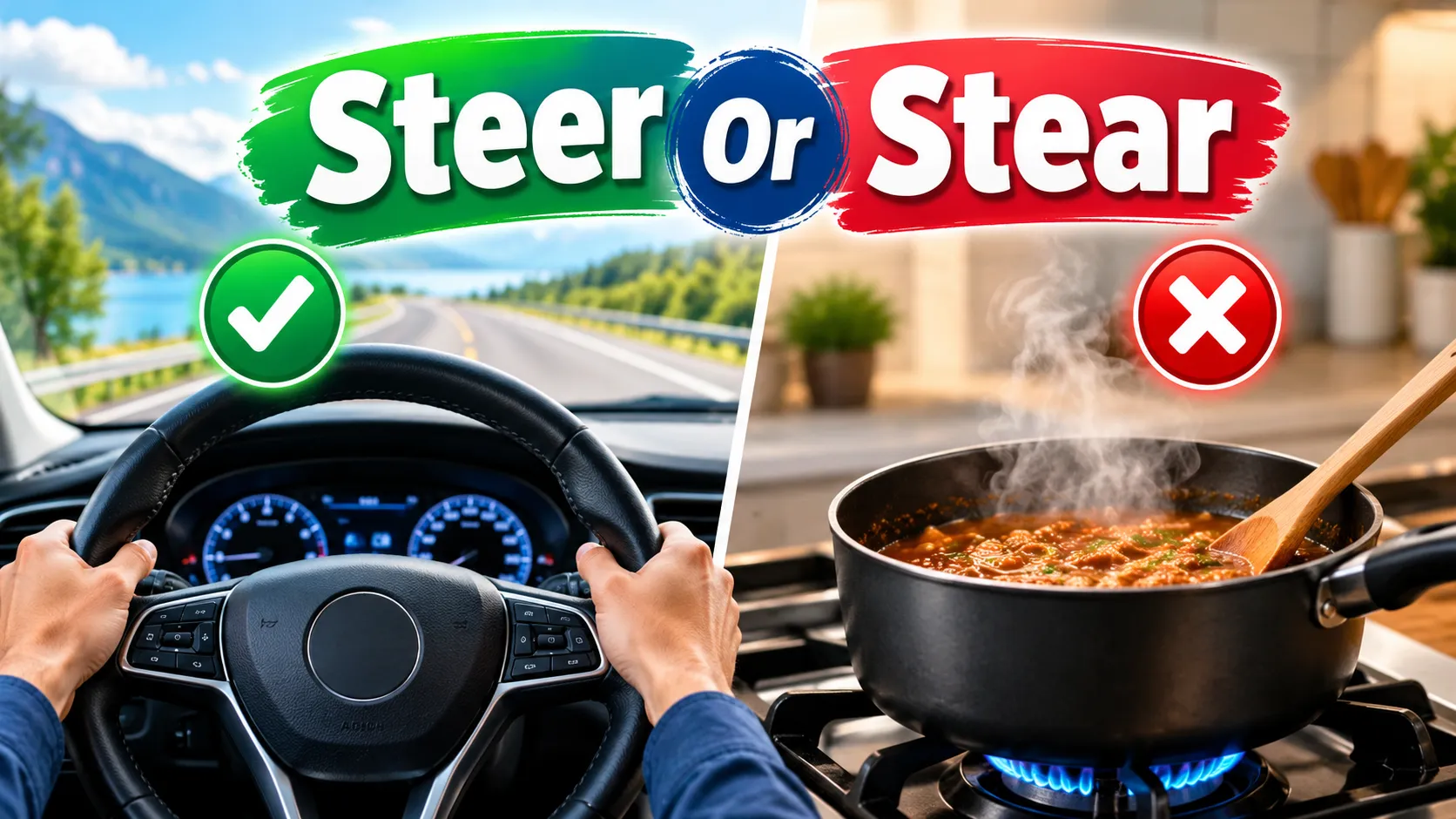
Have you ever wondered whether the correct spelling is Steer Or Stear? Although these words look similar, they are not interchangeable in standard modern English. The correct spelling for guiding a vehicle, directing movement, or influencing the course of an action is steer. The spelling stear is not the standard form of this verb.
Understanding the difference helps you avoid spelling mistakes in everyday writing, professional communication, and academic work. In this guide, you will learn the meaning of steer, its grammatical forms, pronunciation, common expressions, and practical examples that make the correct spelling easy to remember.
Steer or Stear: Quick Answer
Steer is the correct spelling when you mean to guide, direct, or control the movement of something. It can also describe influencing the direction of a conversation, decision, or situation.
Stear is not the standard spelling of this verb in modern English. However, similar letter sequences may appear in specialized terms, historical material, or proper names. These uses do not make stear an alternative spelling of steer.
| Word | Meaning or use | Correct in standard modern English? |
| Steer | To guide, direct, or control | Yes |
| Stear | Nonstandard spelling of the verb steer | No |
Examples:
- Correct: Please steer the car carefully around the corner.
- Incorrect: Please stear the car carefully around the corner.
- Correct: The manager tried to steer the discussion toward a solution.
- Incorrect: The manager tried to stear the discussion toward a solution.
Remember that when you want to express the idea of guiding or directing something, steer is the spelling to use.
What Does Steer Mean?
The word steer has several related meanings. It is most commonly used as a verb, but it can also function as a noun in particular contexts.
Steer as a Verb
As a verb, steer means to guide, direct, or control the course or movement of something. It is frequently used when discussing vehicles, boats, conversations, decisions, and plans.
Examples:
- She learned to steer a car before driving on busy roads.
- The captain steered the boat toward the harbor.
- Our teacher helped steer the discussion toward the main topic.
- The counselor encouraged him to steer his career in a new direction.
- Good planning can help steer a project toward success.
In each example, steer describes guiding something along a particular course, either physically or figuratively.
Steer as a Noun
As a noun, steer can refer to a male bovine, typically one that has been castrated and raised for beef. This meaning is common in agricultural contexts, particularly in North America.
Examples:
- The farmer raised a steer for the local livestock show.
- The steer was moved into a separate enclosure.
- The ranch specializes in raising cattle and steers.
This noun meaning is different from the verb meaning, but the spelling remains the same.
Steer in Everyday English
People use steer in ordinary conversation to describe directing movement or influencing an outcome.
For example:
- “Can you steer me toward the nearest bus station?”
- “She managed to steer the meeting back to the main issue.”
- “We need to steer away from unnecessary expenses.”
- “He helped steer the team through a difficult project.”
These sentences show that steering does not always involve physically controlling a vehicle. It can also mean guiding people, conversations, and decisions.
What Does Stear Mean?
In standard modern English, stear is not the accepted spelling of the verb meaning to guide or direct. If you are writing about controlling a car, directing a discussion, or influencing a decision, use steer.
Is Stear a Standard English Word?
For ordinary English writing, stear should not be used as a replacement for steer. It is generally treated as a misspelling when someone intends to describe guiding or directing something.
For example:
- Incorrect: He tried to stear the boat away from the rocks.
- Correct: He tried to steer the boat away from the rocks.
The same rule applies to related forms:
- Incorrect: She is stearing the vehicle.
- Correct: She is steering the vehicle.
When checking a dictionary, consider the context carefully. A letter sequence may appear in a specialized expression, a historical source, or a proper name without being a standard alternative spelling in everyday English.
Stear in Historical or Specialized Contexts
English spelling has changed over time, and specialized vocabulary does not always follow ordinary spelling patterns. In addition, words and names from other languages may contain letter combinations that resemble stear.
For this reason, it is too broad to claim that the sequence stear can never occur anywhere. However, such occurrences do not establish stear as a correct alternative to the verb steer.
For example, stearic acid is the name of a chemical substance. Its spelling is part of a specialized scientific term, not an alternative spelling of the verb steer.
If you encounter stear in an old document or a technical source, check the specific context before deciding what it means.
What Is the Difference Between Steer and Stear?
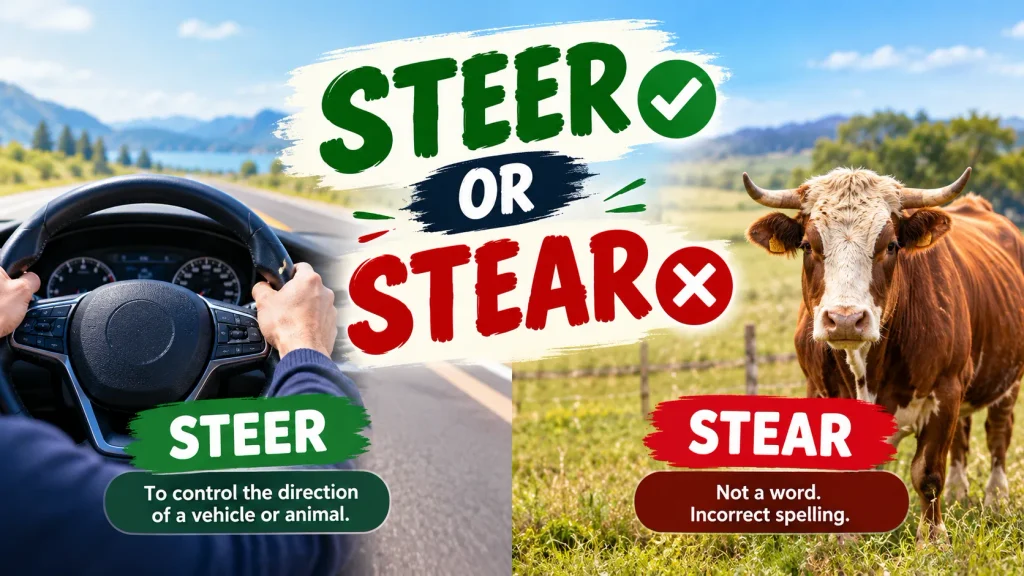
The main difference is that steer is the standard spelling used for the verb meaning to guide or direct, whereas stear is not the standard spelling of that verb.
Spelling Difference: “ee” vs. “ea”
The words differ in their internal vowel letters:
- Steer: S-T-E-E-R
- Stear: S-T-E-A-R
The two spellings may look similar, but the presence of a different vowel combination does not make them interchangeable.
When writing about driving, navigation, or directing an activity, remember the double e in steer.
Difference in Meaning and Usage
In standard English, steer has established meanings as both a verb and a noun. The incorrect spelling stear does not carry those same meanings simply because it resembles the correct word.
Compare these examples:
| Sentence | Explanation |
| She can steer the car safely. | Correct: steer means to guide the car. |
| He steered the conversation toward a solution. | Correct: steered is the past tense. |
| They are steering the project in a new direction. | Correct: steering is the -ing form. |
| She will stear the boat toward the shore. | Incorrect: Use steer. |
The most reliable way to choose the correct spelling is to identify the intended meaning before writing the word.
Correct and Incorrect Sentence Examples
Here are additional examples to help you recognize the difference.
Incorrect: The driver must stear carefully on the icy road.
Correct: The driver must steer carefully on the icy road.
Incorrect: The director wants to stear the conversation toward the budget.
Correct: The director wants to steer the conversation toward the budget.
Incorrect: They are stearing the project in the right direction.
Correct: They are steering the project in the right direction.
Incorrect: He steared the boat toward the island.
Correct: He steered the boat toward the island.
In each correction, the intended meaning requires steer or one of its grammatical forms.
Why Do People Confuse Steer and Stear?
There are several reasons writers may confuse these spellings. Most commonly, the error occurs when someone relies on how a word looks or sounds instead of remembering its established spelling.
Similar-Looking Vowel Patterns
English contains many words with similar vowel combinations. For example, see, sea, meet, and meat contain different spelling patterns that can represent similar sounds in certain accents.
Because steer and stear look alike, a writer may mistakenly substitute ea for ee.
The best solution is to learn the conventional spelling of the complete word rather than trying to guess it from individual letters.
Why Spelling by Sound Can Be Misleading
Pronunciation does not always tell you how to spell an English word. Several different spellings can represent similar sounds, and pronunciation can vary between accents.
For example, steer may sound slightly different depending on the speaker’s accent. Nevertheless, the standard spelling remains steer.
When in doubt, check a reliable dictionary instead of relying entirely on pronunciation.
Common Typing and Autocorrect Mistakes
Typing quickly can lead to accidental spelling substitutions. A writer may type stear without noticing that the vowel letters are incorrect.
Autocorrect can help identify some errors, but it does not catch every mistake. It may also fail when a misspelling resembles a name or a specialized term.
To avoid this problem:
- Proofread important sentences before publishing them.
- Use a spell-checking tool as an additional check.
- Read the entire sentence to confirm that the word fits the meaning.
- Check unfamiliar words in a dictionary.
These simple habits can improve spelling accuracy in emails, assignments, articles, and other forms of writing.
How to Use Steer in a Sentence
The word Steer Is Flexible. It can describe controlling a vehicle, guiding a discussion, influencing a decision, or avoiding a particular situation.
Steer a Car, Bike, or Boat
The most familiar use of steer involves directing a vehicle or other means of transport.
Examples:
- She learned to steer a car in an empty parking area.
- The driver steered around the fallen branch.
- The captain steered the boat toward the dock.
- He steered the bicycle along the narrow path.
- The pilot adjusted the controls to guide the aircraft.
In these examples, steer describes directing the movement or course of something.
Steer a Conversation or Discussion
The verb can also describe influencing the direction of a conversation.
Examples:
- The host steered the conversation toward travel.
- Our teacher steered the discussion back to the lesson.
- The chairperson tried to steer the meeting away from unrelated issues.
- She steered the interview toward the candidate’s experience.
This use is figurative because the speaker is guiding the topic rather than physically moving an object.
Steer Someone Toward a Decision
When you steer someone toward an option, you influence or guide that person in a particular direction.
Examples:
- The adviser steered the student toward a suitable course.
- Her experience helped steer her toward a new career.
- The evidence steered the investigators toward a possible explanation.
- The discussion steered the group toward a practical solution.
This expression does not necessarily mean forcing someone to make a decision. It can simply mean helping or influencing them to consider a particular choice.
Steer Clear of Something
The expression steer clear of means to avoid someone or something, or to keep away from a potentially difficult or unwanted situation.
Examples:
- You should steer clear of unreliable information.
- He decided to steer clear of unnecessary arguments.
- The hikers steered clear of the restricted area.
- She tries to steer clear of distractions while studying.
Although the expression comes from the idea of directing a course away from something, it is widely used figuratively in modern English.
Steer Verb Forms and Grammar Rules
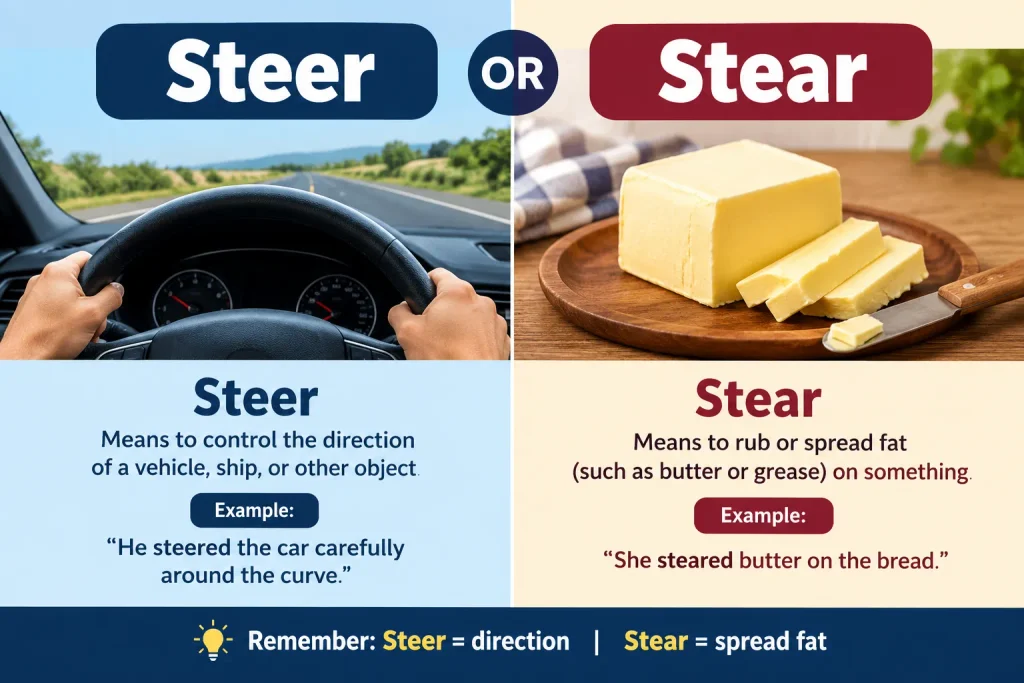
Understanding the grammatical forms of steer helps you use the word correctly in different tenses.
Steer, Steers, Steered, and Steering
The verb steer follows the regular pattern for many English verbs.
| Verb form | Grammatical use | Example |
| Steer | Base form | I steer the boat carefully. |
| Steers | Third-person singular present | She steers the car. |
| Steered | Simple past | He steered the boat yesterday. |
| Steered | Past participle | They have steered the project well. |
| Steering | Present participle or gerund | She is steering the vehicle. |
Notice that the past tense and past participle are both spelled steered. The word adds -ed to the base form, while steering adds -ing.
When to Use Steer vs. Steers
Use steer with subjects such as I, you, we, and they in the simple present tense. It is also used after modal verbs such as can, should, and will.
Examples:
- I steer the boat on weekends.
- They steer the conversation toward useful topics.
- You should steer carefully.
- We can steer the project in a different direction.
Use steers with a third-person singular subject such as he, she, or it in the simple present tense.
Examples:
- He steers the vehicle carefully.
- She steers the meeting toward its main objective.
- The guide steers visitors toward the correct entrance.
The difference is grammatical, not a change in the basic meaning.
When to Use Steered
Use steered for an action that happened in the past. It can also function as a past participle with auxiliary verbs such as has, have, and had.
Examples:
- She steered the car around the obstacle.
- They steered the boat toward the harbor.
- He has steered the company through several changes.
- The teacher had steered the conversation toward the main question.
Do not write steared or steared as an alternative form. The correct past-tense spelling is steered.
How to Use Steering in a Sentence
The form steering can be used with a form of be to describe an ongoing action. It can also function as a noun or as part of a compound expression.
Examples:
- She is steering the car through traffic.
- They were steering the boat toward the shore.
- Careful steering is important on a winding road.
- The steering wheel needs attention.
Remember the spelling pattern: steer → steering. The final e is dropped before adding -ing, leaving the double e in the word.
Steer or Stear in American and British English
A common question is whether steer is American English and stear is British English.
Is the Spelling Different in the US and UK?
No. Steer is the standard spelling in both American and British English when referring to guiding or directing something.
Unlike some words that have Recognized Regional spelling variations, such as color and colour, steer does not have a standard American-British spelling difference.
Examples in both varieties include:
- She learned to steer a car.
- The captain steered the boat toward the harbor.
- We should steer clear of unnecessary complications.
The same spelling rules apply in both varieties of English.
Pronunciation Differences in American and British English
Pronunciation can vary between English accents, including American and British varieties. In some accents, the vowel in steer may sound different, and the pronunciation of the final r may also vary.
However, these pronunciation differences do not change the spelling. Whether you speak American English or British English, use steer when you mean to guide or direct something.
How to Pronounce Steer
The word steer is generally pronounced with one syllable. Its exact vowel quality varies by accent.
A simple pronunciation guide is steer, rhyming approximately with words such as near and clear in many English accents.
Steer Pronunciation in Simple English
Say the word as one unit rather than separating the letters into individual sounds. The initial st forms the beginning of the word, and the vowel sound is followed by an r sound in accents that pronounce it.
A dictionary with audio pronunciation can help you hear the differences between American and British pronunciations.
Most importantly, do not use pronunciation alone to decide whether steer should be spelled with ee or ea. The standard written form is steer.
Words That Rhyme With Steer
Depending on the accent, these words commonly rhyme with steer:
- Near
- Clear
- Dear
- Fear
- Gear
- Year
Rhyming words can help you remember how steer sounds. However, they do not all share the same spelling pattern, which is another reason to learn each word’s spelling individually.
Common Mistakes to Avoid With Steer
Even familiar words can be misspelled when people write quickly or confuse similar-looking letter combinations.
Writing Stear Instead of Steer
This is the main spelling mistake associated with the keyword.
Incorrect: The driver tried to stear around the parked truck.
Correct: The driver tried to steer around the parked truck.
The intended meaning is to guide the vehicle, so steer is required.
Using the Wrong Verb Form
Another mistake is choosing a form that does not agree with the tense or subject.
Incorrect: She steer the car every morning.
Correct: She steers the car every morning.
Incorrect: He steared the boat yesterday.
Correct: He steered the boat yesterday.
Incorrect: They are stear the vehicle.
Correct: They are steering the vehicle.
Choosing the correct spelling is only one part of good grammar. The verb form must also match the sentence structure.
Confusing Steer With Similar-Sounding Words
Some words sound similar to steer but have different meanings and spellings.
- Steer: To guide or direct something.
- Stare: To look at someone or something for a period of time.
- Stern: Strict or serious; also the rear part of a boat.
- Steer clear: To avoid someone or something.
Examples:
- Please steer the car toward the entrance.
- Do not stare at people.
- The teacher gave the class a stern warning.
- We decided to steer clear of the argument.
Learning the meaning of each word helps you choose the correct one in context.

Easy Tricks to Remember the Correct Spelling
If you frequently confuse steer and stear, a few simple memory techniques can help.
Remember Steer With a Steering Wheel
Think of a steering wheel whenever you need to remember the verb steer. Both words contain the same spelling pattern at the beginning.
For example:
- Steer the car.
- Steering wheel.
- Steered the vehicle.
Associating the word with a familiar object can make the spelling easier to recall.
Remember the Word Family: Steer, Steered, Steering
Practice the related forms together:
Steer → Steers → Steered → Steering
Seeing the words as a family helps you remember how the spelling changes when the verb is used in different grammatical forms.
For example:
- I steer the boat.
- She steers the boat.
- He steered the boat.
- They are steering the boat.
All four forms begin with the same spelling, steer.
Use the Meaning to Check the Spelling
Before choosing between steer and stear, ask yourself what you want to say.
If you mean to guide a vehicle, direct a discussion, or influence a decision, choose steer.
For example:
- We need to steer the conversation toward a solution.
- The driver steered around the obstacle.
- She is steering her career in a new direction.
This meaning-based check is especially helpful when proofreading articles, essays, and professional documents.
- Related To Another Article: https://grammixo.com/skied-or-skiied/
Practice Quiz: Steer or Stear?
Test your Understanding of the correct spelling and grammatical forms. Choose the most suitable answer for each sentence before checking the answer key.
Choose the Correct Spelling
1. Please _____ the car toward the parking space.
a) Stear
b) Steer
2. The captain _____ the boat away from the rocks yesterday.
a) Steared
b) Steered
3. She is _____ the discussion toward the main issue.
a) Stearing
b) Steering
4. He _____ the team toward a practical solution.
a) Steers
b) Stears
5. We should _____ clear of unnecessary arguments.
a) Steer
b) Stear
Correct the Spelling Mistakes
Rewrite each sentence using the correct spelling.
6. The driver tried to stear around the obstacle.
7. She is stearing the conversation toward a new topic.
8. They steared the boat toward the harbor.
Quiz Answers With Explanations
1. b) Steer — The sentence describes guiding a car, so steer is correct.
2. b) Steered — Steered is the regular past-tense form of steer.
3. b) Steering — Use steering after is to describe an action in progress.
4. a) Steers — The third-person singular subject he takes steers in the simple present tense.
5. a) Steer — The established expression is steer clear of, meaning to avoid something.
6. Corrected: The driver tried to steer around the obstacle.
7. Corrected: She is steering the conversation toward a new topic.
8. Corrected: They steered the boat toward the harbor.
If you answered all eight questions correctly, you understand the main spelling and grammar rules. If not, review the verb-forms table and the memory tips above.
People Also Ask
A: Steer is the correct standard spelling when you mean to guide, direct, or control the movement of something. Stear is not the standard spelling of this verb.
A: The sequence stear may appear in historical material, specialized vocabulary, or proper names. However, it is not an accepted alternative spelling of the ordinary English verb steer. Always consider the context in which it appears.
A: As a verb, steer means to guide or direct something, such as a vehicle, conversation, or decision. As a noun, it can refer to a male bovine, typically one raised for beef.
A: The past tense of steer is steered. For example: “She steered the boat toward the shore.”
A: Yes. Steering is the correct -ing form of steer. It can describe an ongoing action, as in “He is steering the car,” or refer to the act or mechanism of directing movement.
Conclusion
The correct Spelling Is Steer when you mean to guide, direct, or control something. It can describe steering a vehicle, guiding a conversation, or influencing a decision. Its standard grammatical forms are steer, steers, steered, and steering. Although stear may occur in certain specialized or historical contexts, it is not an alternative spelling of the ordinary verb. Remember the double e in steer, and use it consistently in your writing.

1 thought on “Steer or Stear: Which Spelling Is Correct?”