
Introductio
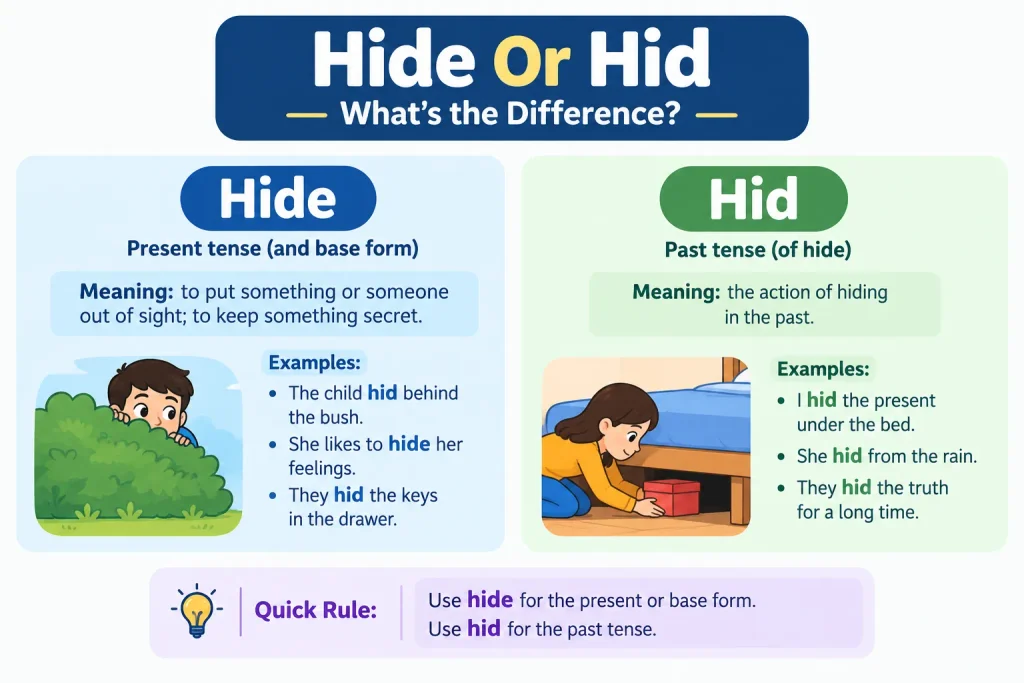
If you are confused about hide or hid, both words are correct—but they are used in different grammatical situations.
Hide is the base form of the Irregular verb, while hid is its simple past form. The third principal form is hidden, which is the past participle. The complete pattern is:
Hide → Hid → Hidden
For example:
- I hide my keys in this drawer.
- I hid my keys there yesterday.
- I have hidden my keys somewhere safe.
Oxford lists the verb forms as hide, hid, hidden, hiding, while Cambridge also identifies hid as the past tense and hidden as the past participle.
Hide vs. Hid: Quick Answer
The easiest way to understand the difference is to look at the grammatical form you need.
| Word | Grammatical form | Main use | Example |
| hide | Base form | Present, infinitive, commands, modals | I hide my keys. |
| hid | Simple past | Completed past action | I hid my keys yesterday. |
| hidden | Past participle | Perfect and passive constructions | I have hidden my keys. |
| hiding | -ing form | Continuous constructions | I am hiding my keys. |
So:
- Hide = base form
- Hid = simple past
- Hidden = past participle
- Hiding = present participle/-ing form
The key point is that hide and hid are not interchangeable. Your sentence structure and tense determine which form you need.
What Does Hide Mean?
Hide means to put a person or thing somewhere it cannot easily be seen or found. It can also mean to keep information, emotions, or something else from being noticed or known. Cambridge and Oxford both give these meanings for the verb hide.
Examples:
- I hide my spare keys in a drawer.
- Please hide the birthday present.
- She tries to hide her feelings.
- The children hide behind the sofa.
- Don’t hide the truth from me.
The word can describe physical concealment as well as figurative concealment.
Compare:
She hid the letter in a drawer.
Here, hide means physically putting something somewhere it cannot be found easily.
He tried to hide his disappointment.
Here, hide means not showing an emotion.
What Is the Difference Between Hide and Hid?
The main difference is tense and grammatical form.
Hide is the base form and is used in several structures, including present-tense sentences with I, you, we, and they.
Hid is the simple past form and describes an action that happened in the past.
Compare:
- I hide my wallet here.
- I hid my wallet yesterday.
The first sentence describes a present or habitual action. The second describes a completed past action.
Oxford’s verb table confirms that the simple past of hide is hid, while its past participle is hidden.
When Should You Use Hide?
Use hide when the sentence requires the base form of the verb.
1. Present simple
With I, you, we, and they, use hide:
- I hide my documents here.
- You hide your emotions well.
- We hide the presents before the party.
- They hide behind the wall.
With he, she, or it, use hides:
- He hides his diary.
- She hides the key.
- The cat hides under the bed.
2. After “to”
Use the base form after the infinitive marker to:
- I want to hide.
- She decided to hide the letter.
- They tried to hide the evidence.
Incorrect:
- ❌ I want to hid.
- ❌ She decided to hid the letter.
3. After modal verbs
Modal verbs are followed by the base form:
- I can hide the box.
- She could hide behind the door.
- You should hide your password.
- They will hide the presents.
- He might hide the letter.
Incorrect:
- ❌ She could hid.
- ❌ They will hid the presents.
4. In commands
Commands normally use the base form:
- Hide behind the wall.
- Hide the gift somewhere safe.
- Hide your personal information.
Oxford gives examples such as “Quick, hide!” to illustrate this use.
When Should You Use Hid?
Use hid when you are Describing a completed action in the simple past.
Examples:
- I hid the key under the mat.
- She hid behind the curtain.
- He hid his disappointment.
- We hid the presents in the closet.
- They hid from the rain.
- The child hid under the table.
Past-time expressions can make the choice particularly clear:
- I hid the letter yesterday.
- She hid the money last night.
- They hid the documents two days ago.
- He hid the gift earlier.
Oxford provides examples such as “He hid the letter in a drawer” and “I hid under the bed,” confirming hid as the simple past form.
A useful rule is:
Completed past action → hid
Hide, Hid, Hidden, and Hiding Compared
Learners often know hide and hid but become confused when hidden and hiding appear.
Here is the complete pattern:
| Form | Function | Example |
| hide | Base form | I want to hide. |
| hides | Third-person singular present | She hides the key. |
| hid | Simple past | She hid the key yesterday. |
| hidden | Past participle | She has hidden the key. |
| hiding | -ing form | She is hiding the key. |
Cambridge lists hid as the past tense and hidden as the past participle, while Oxford lists the same principal forms.
Compare these sentences:
- She hides her diary.
- She hid her diary yesterday.
- She has hidden her diary.
- She is hiding her diary.
Each form has a different grammatical function.
Is “I Have Hid” Correct?
In standard modern English, the normal form is:
I have hidden.
Not:
❌ I have hid.
Examples:
- ✅ I have hidden the documents.
- ❌ I have hid the documents.
- ✅ She has hidden the key.
- ❌ She has hid the key.
- ✅ They had hidden the presents.
- ❌ They had hid the presents.
The reason is simple: have, has, and had are used here with the past participle hidden.
Compare:
Simple past:
She hid the letter.
Present perfect:
She has hidden the letter.
Past perfect:
She had hidden the letter.
This is one of the most important distinctions among hide, hid, and hidden.
Should You Say “Did Hide” or “Did Hid”?
The correct form is:
Did + hide
Not:
❌ Did + hid
For example:
- Did you hide the keys?
- Did she hide the letter?
- Did they hide behind the wall?
- Why did he hide the gift?
The same rule applies to negative sentences:
- I did not hide the truth.
- She did not hide the evidence.
- They did not hide the presents.
Why? Because did already carries the past-tense marking, so the main verb returns to its base form.
Compare:
She hid the key.
but:
Did she hide the key?
This distinction applies broadly to English verbs, not just hide.
Is “Was Hid” Correct?
For a standard passive construction, use hidden, not hid.
Correct:
The letter was hidden under the bed.
Incorrect:
❌ The letter was hid under the bed.
More examples:
- The money was hidden in a box.
- The key was hidden behind the picture.
- The documents were hidden from the public.
- The treasure was hidden underground.
The difference becomes clearer when you compare active and passive sentences:
Active:
She hid the letter.
Passive:
The letter was hidden by her.
Oxford gives passive examples such as “The house was hidden by trees.”
Hide in Different Tenses
The verb hide appears in different forms depending on the tense and structure.
| Tense | Example |
| Present simple | I hide the key. |
| Present continuous | I am hiding the key. |
| Present perfect | I have hidden the key. |
| Present perfect continuous | I have been hiding the key. |
| Past simple | I hid the key. |
| Past continuous | I was hiding the key. |
| Past perfect | I had hidden the key. |
| Past perfect continuous | I had been hiding the key. |
| Future simple | I will hide the key. |
| Future continuous | I will be hiding the key. |
| Future perfect | I will have hidden the key. |
This shows why the rule is more than simply “hide = present and hid = past.” The correct form depends on the complete grammatical construction.
Common Mistakes With Hide, Hid, and Hidden
These errors are Especially common among English learners.
Mistake 1: Using “hide” for a completed past action
❌ Yesterday, I hide the keys.
✅ Yesterday, I hid the keys.
Mistake 2: Using “hid” after “did”
❌ Did you hid the letter?
✅ Did you hide the letter?
Mistake 3: Using “hid” after “have”
❌ I have hid the money.
✅ I have hidden the money.
Mistake 4: Using “hid” after “had”
❌ She had hid the gift.
✅ She had hidden the gift.
Mistake 5: Using “hided” for the ordinary meaning of hide
❌ He hided the book.
✅ He hid the book.
For the ordinary verb meaning “conceal,” the standard simple past is hid, not hided. Both Cambridge and Oxford list hid as the past form.
Mistake 6: Using “hidden” as the simple past
❌ She hidden the letter yesterday.
✅ She hid the letter yesterday.
Mistake 7: Using “hid” after a modal
❌ They will hid the presents.
✅ They will hide the presents.
The easiest way to avoid these mistakes is to identify the auxiliary verb and tense before choosing the verb form.
Hide vs. Hid: Example Sentences
Examples make the distinction easier to remember.
Examples with “Hide”
- I hide my spare keys in a safe place.
- They hide during the game.
- Please hide the birthday present.
- I want to hide from the crowd.
- She can hide the documents.
- We will hide the gifts until tomorrow.
- You should hide your password.
- Cats often hide in quiet places.
- He tries to hide his emotions.
- Don’t hide the truth from me.
“Hid” with Examples
- I hid the key under the mat.
- She hid behind the door.
- He hid his disappointment.
- We hid the presents in the closet.
- They hid from the rain.
- The child hid under the table.
- She hid the letter in a drawer.
- He hid his phone in his bag.
- The dog hid behind the sofa.
- I hid the gift before the party.
Examples with “Hidden”
- I have hidden the documents.
- She has hidden the key.
- They had hidden the treasure.
- The letter was hidden under the bed.
- The money is hidden somewhere safe.
- He has hidden his feelings.
- The evidence had been hidden carefully.
- The answer is hidden in the paragraph.
- We have hidden the presents.
- The house was hidden by trees.
These examples reflect the standard verb forms documented by Oxford and Cambridge.
Hide vs. Hid in Questions, Negatives, and Modals
A quick structural table can make the rule easier to revise.
| Structur | Correct form | Example |
| Present simple | hide | I hide my keys. |
| Third-person present | hides | She hides her keys. |
| Simple past statement | hid | I hid my keys. |
| Past question with did | hide | Did you hide your keys? |
| Past negative with did | hide | I did not hide them. |
| Infinitive | hide | I want to hide them. |
| Modal | hide | I can hide them. |
| Present perfect | hidden | I have hidden them. |
| Past perfect | hidden | I had hidden them. |
| Passive | hidden | They were hidden carefully. |
| Continuous | hiding | I am hiding them. |
Three formulas are particularly useful:
Did + hide
Modal + hide
Have/has/had + hidden
If you remember these patterns, most common errors disappear.
Hide or Hid Pronunciation and British vs. American English
Hide and hid are pronounced differently.
- hide = /haɪd/
- hid = /hɪd/
- hidden = /ˈhɪdən/
The vowel in hide is the long /aɪ/ sound, similar to the vowel in ride. The vowel in hid is the short /ɪ/ sound, similar to the vowel in did.
Oxford gives hide as /haɪd/ and hid as /hɪd/.
There is also no major British-American spelling difference in these verb forms. Both varieties use:
hide → hid → hidden
So the choice depends on grammar, not on whether you are using British or American English. Oxford’s American English entry also lists hid as the past simple and hidden as the past participle.

Related To Another Article: https://grammixo.com/niece-or-neice/
Practice Exercise: Hide or Hid?
Test your understanding by choosing the correct form.
Fill in the blanks
- Yesterday, I ___ the book under my bed.
- I usually ___ my wallet in this drawer.
- Did you ___ the letter?
- She has ___ the keys.
- They ___ behind the tree yesterday.
- We will ___ the presents before the guests arrive.
- He did not ___ anything.
- She had ___ the money before I arrived.
- The children ___ during the game.
- I want to ___ the gift.
Answers
- hid
- hide
- hide
- hidden
- hid
- hide
- hide
- hidden
- hid
- hide
Why?
- Yesterday → simple past → hid
- Usually → present/habitual action → hide
- Did → base form → hide
- Has → past participle → hidden
- Will → base form → hide
- Had → past participle → hidden
- Want to → infinitive → hide
Multiple-Choice Questions
1. Which sentence is correct?
A. I have hid the keys.
B. I have hidden the keys.
C. I have hide the keys.
D. I have hided the keys.
Answer: B. Have requires the past participle hidden.
2. Which sentence is correct?
A. Did you hid the letter?
B. Did you hidden the letter?
C. Did you hide the letter?
D. Did you hided the letter?
Answer: C. After did, use the base form hide.
3. What is the simple past of “hide”?
A. Hided
B. Hidden
C. Hiding
D. Hid
Answer: D. Hid.
4. Which sentence uses the correct passive form?
A. The money was hid under the bed.
B. The money was hidden under the bed.
C. The money was hide under the bed.
D. The money was hiding under the bed.
Answer: B. Hidden is the correct past participle in this passive construction.
People Also Ask
Yes. Hid is the simple past form of hide.
She hid the letter yesterday.
Both Oxford and Cambridge list hid as the past tense of hide.
The past participle is hidden.
The three principal forms are:
hide – hid – hidden
In standard modern English, the usual form is “I have hidden.”
I have hidden the keys.
Yes. I hid is correct when you are using the simple past.
I hid the gift yesterday.
Use:
Did you hide?
After did, use the base form hide.
Final Answer: Hide or Hid?
Both hide and hid are correct, but they perform different Grammatical Jobs.
Hide is the base form:
I hide my keys here.
Hid is the simple past:
I hid my keys yesterday.
Hidden is the past participle:
I have hidden my keys.
The complete pattern is:
Hide → Hid → Hidden
Use hide after did, modal verbs, and to:
- Did you hide it?
- I can hide it.
- I want to hide it.
Use hid for a simple past statement:
- I hid it yesterday.
Didden of use after have, has, or had, and in standard passive constructions:
- I have hidden it.
- She had hidden it.
- The letter was hidden under the bed.
Once you remember hide → hid → hidden, the most common mistakes—such as “I have hid,” “Did you hid,” “She hided,” and “She hidden it”—become much easier to avoid.
Quick revision:
Hide = base form
Hid = simple past
Hidden = past participle
Hiding = -ing form

1 thought on “Hide or Hid: Correct Usage, Meaning & Examples”