
Introduction
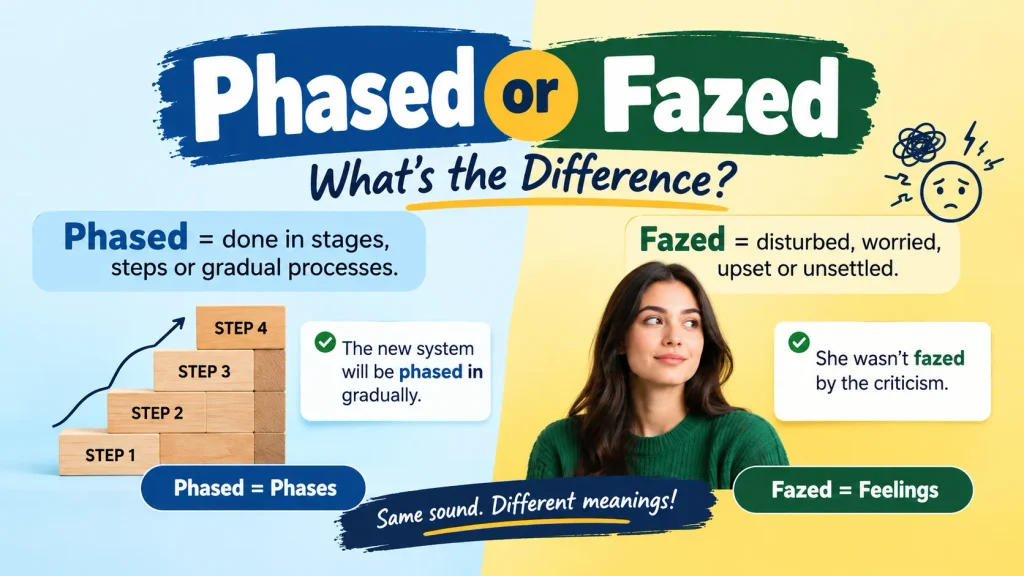
Phased is related to stages, gradual changes, or Introducing something step by step. Fazed means bothered, worried, upset, or unsettled by something.
Compare these two sentences:
The company phased in the new system gradually.
She wasn’t fazed by the difficult questions.
The first sentence is about a process happening in stages. The second describes a person’s reaction.
Phased or Fazed: Quick Answer
The easiest rule is:
Phased = stages or gradual processes
Fazed = bothered, worried, or unsettled
Word | Meaning | Example |
| Phased | Done, introduced, or changed in stages | The new policy was phased in gradually. |
| Fazed | Bothered, worried, upset, or unsettled | She wasn’t fazed by the criticism. |
Quick substitution test
You can replace the word with staged or introduced gradually; use phased.
Example:
The changes were staged over several months.
And:
The criticism didn’t bother her.
The criticism didn’t faze her.
What Does “Fazed” Mean?
Fazed is the past tense and past participle of the verb faze.
To faze someone means to disturb, worry, upset, confuse, or unsettle them.
Examples of fazed
- She wasn’t fazed by the difficult interview.
- The criticism didn’t faze him.
- Nothing seems to faze her.
- He wasn’t fazed by the sudden change of plans.
- The long delay didn’t faze the travelers.
- The unexpected question didn’t faze the speaker.
- The pressure didn’t faze the experienced player.
- She wasn’t fazed by the negative comments.
- The large audience didn’t faze him.
- They remained calm and weren’t fazed by the problem.
In each example, fazed concerns a person’s reaction.
Common sentence pattern
A very common structure is:
Subject + be + fazed + by + situation
Examples:
He was fazed by the criticism.
She wasn’t fazed by the pressure.
They were not fazed by the unexpected changes.
Nothing can faze her.
The criticism didn’t faze him.
Difficult situations don’t faze them.
What Does “Phased” Mean?
As a verb, phase can mean to introduce, implement, change, or remove something gradually and in stages.
This is why phased commonly appears with in and out.
Examples of phased
- The company phased in the new software.
- The school phased in the new curriculum.
- The company began a phased transition.
- The service was gradually phased out.
- The new rules were phased in across the organization.
- The project followed a phased implementation plan.
- The older technology is being phased out.
Here, phased is connected with stages, timing, implementation, transition, or gradual change.
Phased vs Fazed: Side-by-Side Comparison
| Feature | Phased | Fazed |
| Base verb | Phase | Faze |
| Main meaning | Introduced or arranged in stages | Disturbed or unsettled |
| Common idea | Process | Reaction |
| Common context | Policies, systems, projects, programs | People and emotions |
| Common phrase | Phased in | Fazed by |
| Another common phrase | Phased out | Didn’t faze |
| Example | The system was phased in. | She wasn’t fazed by it. |
| Opposite-related form | — | Unfazed |
The easiest distinction is:
Phased → process
Fazed → reaction
Phase vs Faze: What Is the Difference?
The difference between phase and faze explains the difference between phased and fazed.
Phase
Phase can be a noun or a verb.
As a noun, it means a stage or period in a process or development.
The project has entered its final phase.
As a verb, it can mean to introduce or remove something gradually.
The company will phase in the new system.
They plan to phase out the old equipment.
Faze
Faze is a verb related to someone’s emotional response.
The difficult situation didn’t faze her.
Nothing seems to faze him.
The simple distinction
Phase = stage
Faze = disturb
Once you understand the two base verbs, choosing between phased and fazed becomes much easier.
“Phased by” or “Fazed by”?
fazed by
- She wasn’t fazed by the criticism.
- He was fazed by the unexpected question.
- The students weren’t fazed by the difficult exam.
- The player wasn’t fazed by the pressure.
- She remained calm and wasn’t fazed by the situation.
The basic pattern is:
person + be + fazed + by + situation
Example
Here, fazed describes the candidate’s reaction.
“Phased In” or “Fazed In”?
The correct expression is:
phased in
Not:
❌ fazed in
Phase in means to introduce or implement something gradually.
Examples
The company phased in the new software.
The school phased in the revised curriculum.
The new regulations were phased in over two years.
The organization is phasing in a new training system.
Easy rule
Phase in = introduce gradually
“Phased Out” or “Fazed Out”?
The correct expression is:
phased out
Phase out means to gradually stop using, producing, providing, or supporting something.
Examples
The company phased out the older software.
The school phased out the outdated textbook.
The manufacturer is phasing out the old model.
The service was gradually phased out.
Incorrect
❌ The company fazed out the old product.
Remember
Phase in = gradually introduce
Phase out = gradually remove
Unfazed or Unphased?
unfazed
Examples:
She remained unfazed by the criticism.
He looked completely unfazed by the pressure.
The player was unfazed by the hostile crowd.
Nothing seemed to make her nervous; she remained unfazed.
faze → unfazed
Common Mistakes With Phased and Fazed
These words create several predictable spelling mistakes.
Mistake 1: Nothing can phase me
Nothing can faze me.
Not:
❌ Nothing can phase me.
Mistake 2: I wasn’t phased by the criticism
Use:
I wasn’t fazed by the criticism.
Mistake 3: The company fazed in the new system
Use:
The company phased in the new system.
Mistake 4: The old product was fazed out
Use:
The old product was phased out.
Mistake 5: We entered a new faze
Use:
We entered a new phase.
Mistake 6: She was completely unphased
She was completely unfazed.
Mistake 7: The policy didn’t phase him
The policy didn’t faze him.
Is “Phased” Ever Used With People?
Yes.
The important point is that phased describes how something happens, not necessarily what kind of noun appears in the sentence.
Compare these sentences:
The employees were phased into the new schedule.
Here, the employees were gradually introduced to the new schedule.
Now compare:
The employees weren’t fazed by the new schedule.
Here, fazed describes their emotional reaction.
—
The workers were phased into the new system over six months.
Meaning: The transition happened gradually.
The workers weren’t fazed by the new system.
Meaning: The workers weren’t bothered or unsettled by it.
Phased or Fazed in Different Contexts
Understanding context is one of the fastest ways to choose the correct word.
| Context | Correct word | Example |
| New policy introduced gradually | Phased | The policy was phased in. |
| Old product removed gradually | Phased | The product was phased out. |
| Difficult question doesn’t bother someone | Fazed | The question didn’t faze her. |
| Pressure doesn’t upset someone | Fazed | He wasn’t fazed by the pressure. |
| A stage of development | Phase | This is the final phase. |
| Someone remains calm | Unfazed | She remained unfazed. |
| Gradual transition | Phased | The company used a phased transition. |
| Emotional reaction | Fazed | He wasn’t fazed by the criticism. |

Phased or Fazed: Real-Life Examples
Workplace English
The company phased in its new employee-management system.
This means the system was introduced gradually.
Education
The school phased in the new curriculum over two years.
The curriculum was implemented in stages.
Technology
The manufacturer phased out support for the older device.
Support was gradually discontinued.
Interviews
She wasn’t fazed by the difficult interview questions.
Sports
The goalkeeper wasn’t fazed by the pressure.
The pressure did not disturb him.
Business
The organization adopted a phased approach to expansion.
The expansion was planned in stages.
Everyday conversation
Don’t worry about him; nothing seems to faze him.
He rarely becomes upset or unsettled.
Phased or Fazed: Sentence Patterns
Learning common structures can help you use these words naturally.
Common patterns with “phased”
phase in + object
The company phased in the new policy.
phase out + object
The company phased out the old policy.
be + phased in
The new system was phased in gradually.
be + phased out
The old system was phased out.
phased approach
We used a phased approach to the project.
phased implementation
The team chose phased implementation.
Common patterns with “fazed”
be + fazed + by
She wasn’t fazed by the criticism.
didn’t + faze + object
The criticism didn’t faze her.
nothing + can + faze + object
Nothing can faze him.
be + unfazed + by
He remained unfazed by the pressure.
Can “Phased” and “Fazed” Be Interchanged?
No.
Consider:
The company phased out the old system.
Replacing phased with fazed changes the sentence into an incorrect expression.
Now consider:
The criticism didn’t faze her.
Replacing faze with phase changes the intended meaning and creates a spelling error.
How to Remember Phased vs Fazed
Use this two-word memory trick:
PHASE = STAGE
Think:
phase → stage → process → phased
Examples:
The project entered a new phase.
The system was phased in.
The old service was phased out.
FAZE = BOTHER
Think:
faze → bother → reaction → fazed
Examples:
The criticism didn’t faze her.
She wasn’t fazed by the pressure.
He remained unfazed.
One-line memory rule
PHASED = STAGES
FAZED = BOTHERED
This is usually enough to remember the difference.
Related To Another Article: https://grammixo.com/hide-or-hid-2/
A Simple Substitution Test
Test for “phased”
Ask:
Can I replace it with “introduced gradually,” “staged,” or “done in stages”?
The new rules were ___ in gradually.
Try:
The new rules were introduced gradually.
—
The new rules were phased in gradually.
Test for “fazed”
Ask:
Can I replace it with “bothered,” “worried,” or “unsettled”?
Example:
The criticism didn’t ___ her.
Try:
The criticism didn’t bother her.
—
The criticism didn’t faze her.
—
Phased or Fazed: Practice Quiz
Choose phased, fazed, phase, or faze.
1. The company gradually ___ out the old software.
2. She wasn’t ___ by the difficult question.
3. Nothing could ___ him.
4. The project entered its final ___.
5. The new rules were ___ in over several months.
6. The criticism didn’t ___ her.
7. The company plans to ___ out the older model.
8. He remained completely ___ by the pressure.
9. The organization used a ___ approach to implementation.
10. We are entering the next ___ of the project.
Answers and Explanations
1. Phased
The company gradually phased out the old software.
Why: Phase out means gradually removing something.
2. Fazed
She wasn’t fazed by the difficult question.
Why: The sentence describes her emotional reaction.
3. Faze
Nothing could faze him.
Why: Faze means to bother or unsettle.
4. Phase
The project entered its final phase.
Why: A phase is a stage in a process.
5. Phased
The new rules were phased in over several months.
Why: The rules were introduced gradually.
6. Faze
The criticism didn’t faze her.
Why: The criticism did not bother or upset her.
7. Phase
The company plans to phase out the older model.
Why: After to, use the base form of the verb ” phase.
8. Unfazed
He remained completely unfazed by the pressure.
Why: Unfazed means not bothered or unsettled.
9. Phased
The organization used a phased approach to implementation.
Why: The approach happens in stages.
10. Phase
We are entering the next phase of the project.
Why: A phase is a stage or period in development.
Sentence Correction Practice
1. Nothing can faze her.
2. I wasn’t fazed by the criticism.
3. The company phased in the new software.
4. The old system was phased out.
5. She was completely unfazed by the pressure.
Correct Answers
- Nothing can faze her.
- I wasn’t fazed by the criticism.
- The company phased in the new software.
- The old system was phased out.
- She was completely unfazed by the pressure.
Exam Tip: Phased or Fazed?
In grammar and vocabulary tests, look at the words surrounding the blank.
- in
- out
- gradually
- stages
- implementation
- transition
- system
- policy
- program
The answer is often related to phase/phased.
- by
- pressure
- criticism
- question
- fear
- surprise
- difficulty
- nothing can
The answer is often related to faze/fazed.
Quick Revision Table
| Remember This | Meaning |
| Phase | Stage or period |
| Phased | Introduced or arranged in stages |
| Phase in | Introduce gradually |
| Phase out | Remove gradually |
| Faze | Bother or unsettle |
| Fazed | Bothered or unsettled |
| Unfazed | Not bothered or unsettled |
| Phase vs faze | Stage vs emotional disturbance |
| Phased vs fazed | Process vs reaction |
The fastest rule
If it is about stages, use PHASE.
If it is about being bothered, use FAZED.
People Also Ask
It depends on the meaning. Phased relates to stages or gradual processes, while fazed means bothered, worried, upset, or unsettled.
Yes. I wasn’t fazed is correct when you mean that you were not bothered, worried, or unsettled by something.
I wasn’t fazed by the difficult questions.
It can be correct when phased has its process-related meaning, but if you mean “I wasn’t bothered,” use fazed.
Phase means a stage or period and can also mean to introduce or remove something gradually. Faze means to bother, worry, upset, or unsettle someone.
If you mean “nothing can bother me,” the standard spelling is:
Nothing can faze me.
Conclusion
Choosing between Phased Or Fazed becomes much easier when you focus on meaning rather than pronunciation.
Use phased for stages, gradual changes, implementation, transitions, and processes:
The new system was phased in gradually.
Use fazed for being bothered, worried, upset, or unsettled:
She wasn’t fazed by the criticism.
And remember the two simplest associations:
Phase = stage
Faze = bother

1 thought on “Phased or Fazed: What’s the Difference? Correct Usage”